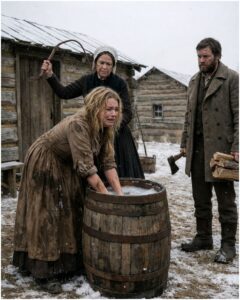
She cried later, privately, behind the shed, into the sleeve of her own coat.
After that, she stopped crying altogether.
Grief didn’t turn Ruth into a monster all at once. It carved her down slowly, like water cutting through stone, until whatever tenderness had lived in her was gone and something sharper took its place. Bills piled. Wood ran low. Winter pressed the valley flat beneath its white, and every failure felt like proof that Ruth had been left behind by God, by luck, by love.
And because she couldn’t hit fate, she hit Eliza.
“You breathe wrong,” Ruth would hiss, and Eliza never knew how breathing could be wrong until she learned it could be blamed.
Some nights it was a belt. Some nights it was the broom handle. Some nights it was just hands, fast and furious and intimate in the worst way, like violence with a mother’s fingerprints.
Eliza stopped crying after the first year.
Tears made Ruth angrier, as if sadness were a luxury Ruth could no longer afford to witness in her own house.
By the time Eliza was sixteen, the town had decided, silently, that it was all too complicated. Ruth was grieving. Ruth was struggling. Ruth was “doing her best.”
Eliza was just… enduring.
Then, the first week of October, the mountain man came down.
He arrived like weather, the way things arrived in Timber Hollow. Unannounced. Unavoidable. The kind of presence that made people turn their heads before they knew why.
He was tall, broad-shouldered, beard streaked with early gray, and his eyes were the color of storm clouds caught on granite. He wore a coat that had lived through too many winters to be called a coat anymore. It was practically a second hide. A rifle sat easy across his back, not waved around for attention but carried like a tool you respected.
His name was Jeremiah Boone, and even his name sounded like it belonged to the mountain.
Folks in Timber Hollow whispered about him the way they whispered about wolves: with fear braided with admiration.
He lived alone past Black Ridge, in a cabin he’d built by hand. He hunted elk, trapped furs, and came down to town twice a year for salt, coffee, and ammunition. He didn’t drink. He didn’t talk much. He didn’t smile at all.
There were other whispers too.
They said he’d buried a wife once.
They said something in him broke after that.
Eliza saw him first at the general store, and she saw him in the way you see someone when you’re always watching for danger: with your whole body.
She had been sent to buy flour and kerosene with coins that still smelled like her mother’s angry palm. The porch boards were warped from years of weather, and when she stepped wrong, her ankle twisted. The sack tipped. Flour burst out in a soft white cloud, blooming like smoke.
Eliza’s stomach dropped. Her pulse began to race ahead of her thoughts.
She braced for yelling.
Instead, a deep voice rumbled close by.
“Easy.”
A massive hand steadied her elbow, not yanking, not hurting, simply there like a bracket holding up a wall.
Eliza looked up.
Jeremiah Boone was close enough that she could smell pine resin and woodsmoke on him. His gaze moved over her face, then to her wrists where her sleeve had slid back a fraction, revealing purple marks half-hidden beneath cloth.
His jaw tightened so sharply she could see the muscle jump.
“You hurt?” he asked.
Eliza shook her head automatically. The answer arrived in her mouth the way a prayer arrived: practiced.
“No, sir. I’m fine.”
Jeremiah didn’t believe her. That was clear too, because instead of nodding and moving on like everyone else, he held her gaze a heartbeat longer, as if waiting for the truth to crawl out.
It didn’t. Not then.
Truth was dangerous in Timber Hollow. Truth made waves, and waves knocked people off their feet, and everyone in town had decided they preferred still water.
Jeremiah crouched and picked up the spilled sack, tying it off with a quick twist of cord. He handed it back with a gentleness that didn’t match his size.
Eliza took it, careful not to touch his fingers too long. Touch could be misread. Touch could become a debt.
“Watch that porch,” he said, nodding at the warped board.
“Yes, sir,” she whispered, and hurried inside the store as if she could outrun the embarrassment on her cheeks.
But even as she moved, she felt something strange follow her.
Not fear.
Something closer to being seen.
That evening, the wind carried the sound again.
A crack. A muffled cry. A sharp voice like a knife: “Useless. Useless!”
Jeremiah Boone had been outside the store loading salt into his mule cart when he heard it. He went still. The mule flicked its ear, sensing the shift in the air.
Another strike.
Another small sound, swallowed quickly as if the girl didn’t want to be punished for making noise.
Jeremiah turned toward the Carter cabin.
No one stopped him.
That fact, too, was a kind of confession.
In Timber Hollow, people would stop a man for a fight in the street. They would stop a boy for stealing apples. They would stop a woman for standing too close to someone else’s husband at church.
But when it came to a girl being beaten behind thin walls, the town turned into fog.
Jeremiah walked through that fog like he’d been born for it.
He didn’t knock.
The door swung inward beneath one heavy push.
Inside, Ruth Carter froze mid-swing, broom handle raised like a weapon she’d used too many times to count. Her face was sharp with rage, eyes bright and wild, as if anger was the only thing keeping her upright.
Eliza was curled near the hearth, arms over her head, shoulders hunched. Ash smeared her cheek where she’d fallen too close to the fire. Her breath came quick, soundless, like a rabbit caught in a trap.
For a moment, the room held its breath.
Jeremiah stepped inside slowly.
Not rushed. Not showy. Controlled, dangerous, certain. Like a bear entering a hunter’s camp, aware of every movement, deciding whether it needed to kill.
“That’s enough,” he said.
His voice wasn’t loud, but it landed like an ax head biting into a stump.
Ruth straightened, her mouth twisting.
“This is my house,” she snapped, gripping the broom tighter. “Who the hell do you think you are?”
Jeremiah’s eyes moved to Eliza. She flinched when he shifted, not from him, but from the expectation of what came after movement: pain.
He saw that flinch like a man sees a footprint in fresh snow. Evidence. Direction.
Something ancient stirred in his chest, something that tasted like regret and iron.
“She’s coming with me,” he said.
The words fell like a verdict.
Ruth barked a laugh, harsh and incredulous.
“She’s my daughter.”
Jeremiah took one step closer. The floor creaked under his boots.
“You’re killing her,” he said, simple as a fact.
The silence that followed was heavier than winter snow. Even Ruth faltered, just slightly, like her rage had stumbled over the blunt truth of it.
Jeremiah didn’t raise his voice. He didn’t threaten. He simply held out his hand toward Eliza.
For a second, Eliza didn’t understand what she was seeing.
No one had ever reached for her like that.
Hands reached for her to strike, to shove, to yank her upright, to force her into chores. Hands grabbed her wrist like a leash.
This hand was open. Waiting.
Offering.
Eliza’s fingers trembled as they touched his.
Ruth exploded.
“You think you can steal her?” she shrieked. “You think anyone will believe you? I’ll call the sheriff! I’ll tell them you kidnapped her, you bastard!”
Jeremiah’s gaze didn’t leave Ruth’s face.
“Go on,” he said.
Two words, calm as cold water.
Then, like a man reading a law out loud, he added, “And you can explain to him why half this town heard her scream for years.”
Ruth’s face drained of color.
It wasn’t Jeremiah’s strength she feared, not fully. It was his reputation. His history. The stories people told like caution signs nailed to trees.
He’d once dragged a poacher fifteen miles through snow to face charges. Not because he enjoyed cruelty, but because he believed justice shouldn’t be optional just because the trail was hard.
Jeremiah Boone wasn’t bluffing. And Ruth Carter knew it.
Eliza stood slowly. Her legs barely held her. Her whole body waited for a last strike, a last yank, a last command to “get back here.”
It didn’t come.
Jeremiah shrugged off his heavy coat and wrapped it around her shoulders. It swallowed her in wool and warmth, smelling of pine and smoke and something else she didn’t recognize at first.
Safety.
As they stepped outside, Timber Hollow watched from behind curtains. A face here, a shadow there. People pretending they were just passing by, just looking out for the weather, just checking if the mule cart was still parked.
Eliza felt their eyes like pins.
For the first time in her life, she wasn’t walking back inside that door.
She didn’t know where Black Ridge was exactly. She didn’t know what waited in the mountains. She didn’t know if Jeremiah Boone was a hero or another kind of danger with quieter hands.
But when he lifted her onto the mule cart and covered her with blankets, she felt something fragile bloom inside her ribs.
Hope, thin as a spring shoot pushing through snow.
The climb took hours.
The valley fell away behind them like a bad dream. The air grew colder, cleaner. The sky widened. Pines stood like dark sentries, and the trail narrowed into a ribbon carved through rock and trees.
Eliza swayed from exhaustion. Every bump on the path sent pain through her bruises like a reminder that her body had been living in a storm.
At one point, Jeremiah glanced back and saw her shivering violently.
“Almost there,” he said quietly.
Not rushed. Not irritated. Just steady.
The steadiness was its own shock. Eliza’s whole life had been built around someone else’s moods, around storms that appeared without warning. Jeremiah moved like someone who had made peace with silence, who didn’t need to fill it with cruelty.
They reached the cabin at dusk.
It wasn’t fancy. Rough-hewn logs, a stone chimney, lantern light glowing warm through a small window. Smoke curled into the violet sky like a signal.
Inside, it was clean, orderly, spare. A table, two chairs, shelves lined with jars, a stack of split wood near the hearth. And in the corner, a second bed, untouched for years, its blanket folded so neatly it looked like it had been waiting.
Jeremiah shut the door behind them and slid the bar into place.
Not a prison bar.
A protection.
He knelt in front of Eliza and, with a gentleness that made her throat ache, rolled up her sleeve.
Bruises old and new bloomed across her skin like dark flowers. Cuts, half-healed. A wrist that had been twisted too often.
Jeremiah’s jaw flexed.
“No one’s touching you again,” he said.
Eliza didn’t answer. She didn’t know how to believe that yet. Belief was a luxury. Belief got you hurt when it proved false.
That night, she ate until she felt full.
The stew was simple, but the warmth of it felt like a miracle. Her stomach cramped halfway through, unused to kindness in portions larger than scraps. Jeremiah watched without comment, refilled her bowl anyway.
When she finished, she sat by the fire while Jeremiah heated water in a pot. He handed her a cloth.
“For the cuts,” he said.
His hands were enormous but careful, as if he understood that gentleness was not the absence of strength but its most disciplined form.
Eliza dabbed at the wounds, hissing softly.
Jeremiah turned away to give her privacy, but his voice came, low and measured.
“You can sleep in the corner bed. Door stays barred.”
Eliza nodded, then hesitated, the question pressing against her teeth like it had been waiting years for a chance.
“Why?” she whispered.
Jeremiah went still. The fire crackled, throwing shadows against the walls.
For a heartbeat, Eliza saw something in his face, something old and bruised behind the beard and the granite eyes. A memory. A loss. The shape of a failure that still weighed on him.
He could have told her the whole truth then. That he remembered another small hand slipping away from his once. That silence had cost him too much. That he had promised a grave he wouldn’t fail again.
But he only said, “Because someone should have.”
It was the simplest answer, and it was the most devastating, because Eliza realized how true it was. Someone should have. Someone, years ago, could have pushed open that door and said enough.
No one had.
Until now.
Eliza lay down that night expecting shouting, footsteps, a sudden crash of anger against wood.
Instead, she heard wind in the pines and the steady sound of a man moving quietly, keeping watch, not because he had to, but because he chose to.
For the first time in years, she slept without fear.
But down in Timber Hollow, Ruth Carter was not finished.
And the mountain had its own tests waiting.
The first week in the mountains was the quietest week of Eliza’s life and, strangely, the loudest.
There were no screams, no snapping belts, no sharp voice waiting to explode behind her. But silence itself felt unfamiliar, almost dangerous, like a field that looked empty until you realized it was full of hidden traps.
Eliza woke before dawn the first morning, heart racing, certain she’d overslept and punishment was coming.
There was only wind against pine and the crackle of firewood.
Jeremiah was already awake, sitting at the rough table, sharpening a blade with slow, rhythmic strokes. The sound should have frightened her. Sharp things had always meant harm.
But Jeremiah’s movements were patient, almost meditative, like he was carving order into the day.
When he saw Eliza standing frozen in the doorway, he didn’t bark.
“There’s oats,” he said. “And honey.”
That was it. No insult. No command. Just food.
Eliza approached the table cautiously. Even sitting felt like she was breaking a rule.
Jeremiah noticed the way she flinched when he shifted in his chair. He stood and moved slower, giving her space without making a speech about it, as if he understood trauma had its own language and he was learning hers without demanding translation.
Over the next days, he showed her simple things.
How to split kindling without bruising her palms. How to check rabbit snares. How to tell when weather was turning by the smell of the air, by the pressure in your ears, by the way birds disappeared.
He didn’t order her. He demonstrated once, then let her try.
When she failed, he didn’t shout.
He corrected.
The first time Eliza dropped a bundle of wood, instinct snapped her arms up over her head, bracing for the hit that always followed mistakes.
Jeremiah went still.
He crouched until his eyes were level with hers, his storm-cloud gaze steady.
“No one’s going to hit you here,” he said.
His voice wasn’t soft. It was firm like law, like something written into the bones of the cabin itself.
Something inside Eliza cracked then, not from pain, but from disbelief.
She had spent years learning the rules of violence. Now she was being asked to learn something much harder: the rules of safety.
Safety meant you could breathe without calculating consequences.
Safety meant mistakes were allowed to exist without punishment.
Safety meant you could exist.
Down in Timber Hollow, Ruth Carter was unraveling.
When the sheriff finally arrived at her door with questions, it wasn’t because he’d suddenly grown a conscience. It was because gossip had started to change shape. People weren’t whispering with the usual relish anymore. They were whispering with a new, dangerous ingredient.
Guilt.
Neighbors had admitted what they’d heard for years. Not proudly. Not bravely. But they admitted it, and once words leave mouths, they become hard to shove back inside.
Ruth raged. She accused Jeremiah Boone of kidnapping, of brainwashing, of theft.
“She’s my daughter!” Ruth screamed at the sheriff, eyes flashing like flint. “That man is a savage. He lives like an animal. He’s stolen her!”
The sheriff, Cal Mercer, had been in office long enough to know the smell of a lie. And bruises, even fading ones, told their own story.
Ten days later, Cal Mercer made the climb to Black Ridge.
Eliza saw him first, a small figure winding up the trail on a horse. Her stomach twisted into knots. Old fear woke up like a dog that had never stopped listening for its master’s whistle.
Jeremiah stepped outside before the sheriff dismounted.
“You’ve got nerve,” Mercer muttered, eyes narrowing.
Jeremiah folded his arms.
“You’ve got eyes,” he said. “Use ’em.”
Eliza stood in the doorway.
Sleeves rolled up deliberately for the first time in her life.
The sheriff’s gaze dropped to her arms. To the bruises. To the healing cuts. To the way she stood straighter now, even if her hands trembled slightly.
Mercer’s jaw tightened.
He looked at Eliza, not unkindly, but with the weight of the question that could decide the rest of her life.
“You want to go back?” he asked.
The question felt like standing at the edge of a cliff.
Sixteen years of fear tugged at her heels, whispering that the familiar pain was safer than the unknown.
But then she looked at Jeremiah.
He wasn’t pleading. He wasn’t forcing. He simply nodded once, as if to say: Whatever you choose, it will be yours.
Eliza swallowed.
Her voice came out steadier than she felt.
“No, sir,” she said. “I don’t.”
The sheriff studied Jeremiah one long moment, measuring him against all the town’s stories, against his own duty, against the risk of angering Ruth Carter and the comfort of doing nothing.
Then Mercer tipped his hat.
“She stays,” he said.
When he rode away, something invisible snapped loose from Eliza’s spine.
For the first time in her life, someone in authority had asked what she wanted.
And someone had listened.
Winter came early that year.
Snow fell thick across Black Ridge, swallowing trails and silencing the world. The cabin became an island of warmth in a sea of white.
Food had to be rationed carefully. Jeremiah hunted less, conserving ammunition. They worked like a unit now, hauling water before the stream froze, reinforcing shutters, stacking wood shoulder high.
Eliza grew stronger.
Her cheeks filled out. The hollow look in her eyes softened. Her hands got calluses that came from work, not from being grabbed. She learned to lift, to split, to tie knots that didn’t slip. Each small skill became a brick in a new foundation.
But healing wasn’t a straight trail up a mountain. It was a switchback. It doubled back. It surprised you with steep drops.
One evening, a storm rolled in faster than Jeremiah predicted.
He had gone out to check trap lines before dusk, because the mountains demanded respect and traps didn’t care about your timing.
The sky turned violent. Wind howled like something alive.
He didn’t return by dark.
Fear rose in Eliza like a tide.
The old voice, Ruth’s voice, whispered in her head: You’re alone. You’re always alone. And it’s your fault.
Eliza stood by the door, hands shaking, staring at the blizzard as if it were a mouth waiting to swallow the last good thing she’d ever been given.
But another voice, new and fragile, answered.
Not this time.
She lit the lantern, wrapped herself in Jeremiah’s spare coat, and stepped into the storm.
Snow bit her face. Wind shoved her sideways. The world was white chaos, soundless except for the roar of air and the creak of trees bending under ice.
Her instincts screamed to go back, to hide, to wait for someone else to solve the problem.
But Jeremiah had taught her more than chores. He had taught her that leaving someone behind was a choice.
And Eliza was done making that choice.
She followed tree lines. Kept her back to the gusts. Listened between the wind.
Then she heard it.
A low whistle, faint but deliberate.
Jeremiah’s.
Eliza stumbled toward the sound and found him fifty yards off the main path, leg pinned under a fallen branch heavy with ice. Blood darkened the snow near his boot. His face was tight with pain, but his eyes were open.
When he saw her, anger flickered there, quick and sharp.
“You shouldn’t be out here,” he growled through clenched teeth.
Eliza’s voice came out like flint striking steel.
“You taught me not to leave people behind,” she shot back.
Jeremiah blinked, as if the words hit him harder than the storm.
Together, painfully, they worked.
Eliza wedged a broken limb under the branch as a lever. Her muscles shook, screaming, but she kept pushing. The branch shifted, then lifted just enough for Jeremiah to pull his leg free with a low hiss.
He tried to stand.
Collapsed.
Eliza moved without thinking, sliding under his arm, taking his weight. He was heavy, solid, and for a terrifying moment she thought he might crush her.
But she had been carrying things her whole life.
Pain. Fear. Responsibility that wasn’t hers.
She could carry him too.
Step by step, half-dragging, half-carrying, she got him back to the cabin.
It took nearly an hour. The storm fought them like a living thing. Tears froze on her cheeks. Her arms burned. Her lungs felt like they were filled with needles.
She didn’t stop.
Not once.
When they finally stumbled through the cabin door, Jeremiah’s weight nearly took her down, but she managed to get him onto the bed. His leg wasn’t broken, but it was badly torn, the kind of wound that could turn deadly if left to the cold.
Eliza heated water. Cleaned the wound. Wrapped it as best she could remember from watching him treat his own cuts. Her hands trembled only from effort, not fear.
At some point, as Jeremiah drifted in and out of pain-clouded sleep, he looked at her differently.
Not as someone he’d rescued.
As someone who stood beside him.
“You’re stronger than you think,” he murmured, voice rough.
Eliza swallowed hard.
For the first time in her life, she believed it.
By spring, word had spread beyond Timber Hollow.
Some called Jeremiah Boone reckless. Some called him a hero. Some, quietly, called him something more dangerous.
A man who made the town look at itself.
When Eliza walked into town beside him months later, head high, eyes clearer than they’d ever been, shoulders squared beneath a simple coat Jeremiah had sewn tighter to fit her, people stared.
Not at a beaten girl anymore.
At someone remade.
At the general store, the same warped porch board still waited like a memory. Eliza stepped over it without stumbling.
Across the street, Ruth Carter stood outside the post office, face hard, hands clenched, as if she’d been holding fury so long it had become her only posture.
Their eyes met.
Eliza felt the old fear flicker, quick as a match trying to catch.
Then she let it go out.
She didn’t flinch. She didn’t shrink. She didn’t offer Ruth even the smallest piece of her new spine.
She simply turned away and kept walking.
That was the victory Ruth could not understand.
Because Ruth had always believed possession was love, and control was motherhood, and pain was the price of surviving.
Eliza’s walk away was a language Ruth didn’t speak.
That summer, Jeremiah built an addition onto the cabin.
Not because Eliza needed saving anymore.
Because she chose to stay.
One evening, sitting on the porch as the sun melted gold across Black Ridge, Eliza asked the question that had been growing in her like a root.
“Why did you really take me?” she said quietly.
Jeremiah stared out at the ridgeline for a long time, as if he could read answers in the shape of the mountains.
Finally he said, “Because the world doesn’t get to break good things just because it can.”
Eliza’s throat tightened.
No one had ever called her a “good thing.”
Not her mother. Not the town. Not even herself.
The wind moved through the trees, not harsh now, but steady, like breath.
And for the first time in her life, Eliza felt chosen.
Not claimed. Not owned. Not controlled.
Chosen.
The mountain hadn’t just taken her in.
It had given her back to herself.