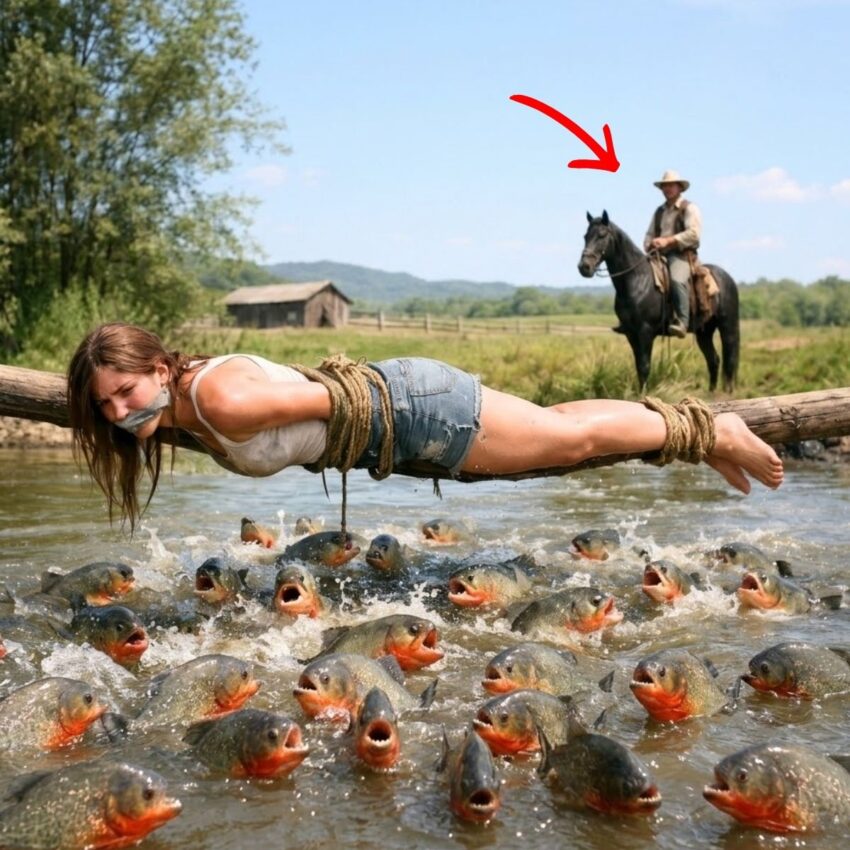
Dust clung to my skin like a second layer, and the late-afternoon sun still pressed down with the same cruel weight it had carried all day. My black horse moved at an easy pace along the dirt road, knowing the way home better than I did. I let the reins hang loose. He had become my companion in the years since my wife died—the last gift she ever gave me, bought with money she had quietly saved while her illness was already stealing the color from her face.
“Take care of him,” she had said, running her hand along his neck with that stubborn tenderness only she had. “And let him take care of you when I can’t.”
At the time, I told her not to talk like that. But she had known. She always knew.
Three years had passed since I buried her, and yet some days it still felt as if I had only stepped outside for a moment and might find her on the porch when I returned. But life had not paused for my grief. Fences still needed mending. Cattle still wandered. Water troughs still cracked in the heat. So I kept working, because work was easier than feeling.
That evening I was riding back from the north pasture, every muscle aching in that familiar way that at least reminded me I was still alive. The river ahead usually brought me peace. Its low murmur was one of the few sounds in the world that didn’t feel like a demand. But just as we neared the steep bank, my horse stopped so abruptly that my body jolted forward.
His ears snapped forward. His whole body went tense.
Animals know before we do.
I looked ahead, expecting maybe a snake or a wild boar down near the water, but at first I saw nothing except the same crooked trees, the same dusty road, the same muddy river reflecting the orange sky. Then I noticed something strange below—a shape in the water that did not belong there.
At first I thought it was debris carried by rain. Broken branches, maybe part of a collapsed fence. But as I narrowed my eyes and stepped closer, the shape sharpened into something far worse.
There was a wooden frame built in the river, crude but sturdy, four heavy stakes driven into the riverbed and tied together with crossbeams. Suspended above the water, bound to that frame with thick ropes, was a young woman.
For one long, frozen second, my mind refused to accept what my eyes were seeing.
She hung a few feet above the surface, wrists and ankles tied, head drooping forward, body trembling with shallow breaths. Beneath her, the water boiled—not with current, but with movement. Dark bodies churned and collided under her in a tight frenzy.
Piranhas.
Dozens of them.
Then I smelled it—the metallic stink of blood.
A thin stream ran from a cut on her left leg, dripping slowly into the river. Each drop triggered a savage explosion below as the fish leapt and snapped at the scent.
This was no accident.
Someone had done this carefully. Deliberately. Someone had cut her just deep enough to keep the blood coming and the piranhas waiting. Someone wanted her terrified before she died.
My stomach twisted so hard I nearly turned away.
For three years I had lived by one simple rule: keep your head down, mind your own business, survive the day. Grief had turned me into a man who avoided trouble because trouble required energy, and energy required hope. I had little of either left.
But then she lifted her face.
Even from a distance I could see the terror in her eyes. Not just fear of death—fear of being abandoned to it.
Her cracked lips moved.
“Please.”
Only one word. Barely sound at all. But it hit me like a blow to the chest.
I ran.
I slid down the bank, half-falling in the loose dirt, boots skidding over stones. When I reached the water’s edge, I saw the setup more clearly. Fresh tire tracks. Several sets of footprints in the drying mud. Whoever had brought her here had left not long ago.
And maybe they weren’t far.
The thought crawled up my spine. I scanned the trees, the shadows between the trunks. I felt watched. My heart hammered, but the choice had already been made. I stepped into the river.
The water was colder than I expected, sucking into my boots and climbing my legs as I waded forward. The bottom was slick with mud and hidden holes. Every step fought me. The piranhas swarmed tighter, circling in a silver-black cloud around my knees.
I remembered something my father once taught me—that piranhas often hesitate with large moving animals. I prayed that was true, because prayer was all I had. I raised my arms, made myself bigger, and kept going.
“Hold on,” I called to the girl. “I’m getting you out.”
She did not answer, but her eyes locked onto mine with a desperate, disbelieving intensity.
When I reached the structure, rage nearly blinded me. The ropes were industrial nylon, knotted by someone who knew exactly what they were doing. The cut on her leg was precise, just above the ankle, meant to torture rather than kill quickly. Whoever had arranged this had done it with patience.
My hands went to my belt. The knife my grandfather left me was still there.
“Listen to me,” I said, looking up at her. “When I cut these, you’re going to drop. Don’t panic. Don’t fight me. I’ll catch you.”
She gave the smallest nod.
I started with her right wrist. The blade sawed through the wet nylon in harsh, scraping strokes. Sweat ran into my eyes. The piranhas thrashed harder below, sensing change. At last the rope snapped, and her arm fell limp with a cry of pain she somehow swallowed back.
The second wrist followed.
Now she hung upside down by her ankles, blood rushing to her head, arms dangling uselessly. I moved faster, water up to my waist now, boots slipping over algae-slick stones.
That was when I heard it.
An engine.
Far off, but getting closer.
My blood turned to ice.
They were coming back.
I attacked the rope at her left ankle, cutting without care now, fibers spraying loose under the blade. Another sound followed the engine—voices. Men. More than one.
The rope gave way.
Only one ankle remained.
The vehicle stopped up on the road. Doors slammed. Men spoke low and sharp. Then footsteps headed down toward the river.
“Hurry,” I muttered, though whether to myself or to her I don’t know.
The last rope was almost through when I heard one of the men say, “Check if the water’s high enough yet.”
The final fibers snapped.
She dropped, and I caught her against my chest just before she hit the river. The impact nearly took me down. My feet slid, the current shoved against us, and for a horrible second I thought we would both fall straight into the feeding frenzy below. But I found balance on a submerged rock and turned my body between her and the fish.
Then I fought my way back to shore.
Every step felt impossibly slow. My clothes dragged at me, her body was limp in my arms, and the piranhas exploded around us in furious confusion. One jumped high enough to tear my pants at the thigh. I kept moving.
By the time I stumbled onto the bank, she was unconscious.
Voices came from above.
“Where is she?”
“The ropes are cut!”
“Someone took her!”
Then another sound joined them—dogs.
Not just men with guns, but men with dogs.
There was no going back to the road. I turned south and plunged into the dense brush along the riverbank, carrying her with both arms while branches clawed at my face and thorns tore through my shirt. Behind me came shouts, barking, and the terrifying certainty that I had stepped into something far larger than I understood.
Night fell quickly in the cerrado. I could hardly see where I was going, but I kept the sound of the river to my left and pushed forward until my lungs burned. At last I veered back toward the water. If the dogs were following our scent, maybe the river could buy us time.
It was a desperate gamble. Her leg was still bleeding, and piranhas still ruled those waters. But desperation had already become our only companion.
I waded in again, holding her as high as I could and letting the current carry us downstream for a while. It worked. Behind us, the barking turned confused, the shouts broke into argument, and for a few precious minutes the hunt lost our trail.
When I finally dragged us out on the opposite bank, she was shaking violently with cold. I found a narrow shelter among large rocks—a shallow cave I had used years earlier during storms—and laid her down on dry sand. My horse, faithful creature that he was, found us not long after, appearing in the darkness like an answered prayer. In his saddlebag I found a half-full canteen, a scrap of waxed canvas, and a little rapadura.
I gave the girl water, a little at a time. I wrapped her in the canvas. Then I tore strips from my clothes and tied off the bleeding as best I could.
Only when she had finally caught her breath did I ask, “Who are you?”
She looked at me for a long moment, as if deciding whether I was worth trusting. Then she whispered one word.
“Witness.”
That explained everything.
Her name was Mariana. She had worked at a veterinary clinic in Porangatu. For months, men had been bringing in animals with strange, repeated injuries—not random wounds, but controlled ones, as if the animals were being used to test substances. Drugs. Poison. Something illegal and profitable. Her boss kept quiet. Mariana didn’t. She took photos, recorded license plates, wrote down dates.
Then she made the mistake of believing the law could protect her.
She took the evidence to a police officer in Goiânia, hoping distance would keep her safe. Three days later, men came to her house in the night, dragged her away, and took her to the river.
By dawn, after a storm had washed away the tracks, I knew one thing clearly: if I gave her back to fear now, then everything my wife had tried to teach me about staying human in a cruel world would die with her memory.
So I took Mariana to the only people I trusted enough to risk it—Sebastião Ferreira and his daughter Dalva, poor farmers living deep off the main road. Years earlier, I had saved Sebastião after an accident and paid for his treatment. When he saw the state we were in, he did not hesitate.
“A Ferreira doesn’t go back on his word,” he said.
Dalva cleaned Mariana’s wound, stitched it with boiled needle and thread, and fed us while Sebastião stood watch. For a few hours, inside that humble house with its wood stove and cracked walls, I remembered what it felt like not just to survive, but to be held together by other people’s decency.
Then the men came.
Three vehicles. Fake or corrupted federal agents. Guns. Lies. They called Mariana a terrorist and drug trafficker. They tore through the house, overturning furniture, smashing dishes, searching every room. Sebastião hid us in an old underground cellar beneath the kitchen floor. In that darkness, Mariana’s hand in mine, I heard boots stop directly above us.
“There’s a trapdoor here,” one man said.
My heart stopped.
But at that exact moment another voice shouted from outside that they had found fresh tracks leading toward the pasture—my horse’s tracks. The men rushed out after the wrong trail, and we were spared by nothing more than chance and a brave old man’s nerve.
When we climbed out, Dalva was crying over her wrecked kitchen. Mariana looked around at the damage and whispered, “I brought this on you.”
“No,” Dalva said, wiping her face. “The evil was theirs long before you arrived.”
Those words changed something in all of us.
Fear was still there. Danger was still real. But silence suddenly felt worse.
Mariana remembered that the evidence she gathered had been backed up online. If we could reach a priest in town—Padre Anselmo, a stubborn man with a computer and a dislike for corrupt officials—we might still have a chance to send everything to journalists, churches, activists, anyone who would listen before these men could bury the truth.
That night, as Sebastião drove us through forgotten back roads under the thin light of the moon, I looked out across the dark cerrado and thought of my wife. For three years I had lived like a man already half-buried, doing just enough to keep breathing. But somewhere between the river full of piranhas and the shattered kitchen of a poor farmer’s house, something inside me had begun to wake again.
Maybe grief had not ended my life. Maybe it had only paused it.
Maybe purpose can return in the shape of another person’s cry for help.
Maybe courage is not the absence of fear, but the moment you decide someone else’s life matters more than your safety.
I don’t know what would have happened if I had kept riding that day. I only know that if I had, I would have lost whatever was left of my soul.
Sometimes the road home is interrupted by something impossible. Sometimes stopping changes everything. Sometimes saving a stranger is the very thing that saves you too.
And as that old truck rattled through the night, carrying us toward danger, truth, and the faintest possibility of justice, I felt something I had not felt since the woman I loved took her last breath.
Hope.