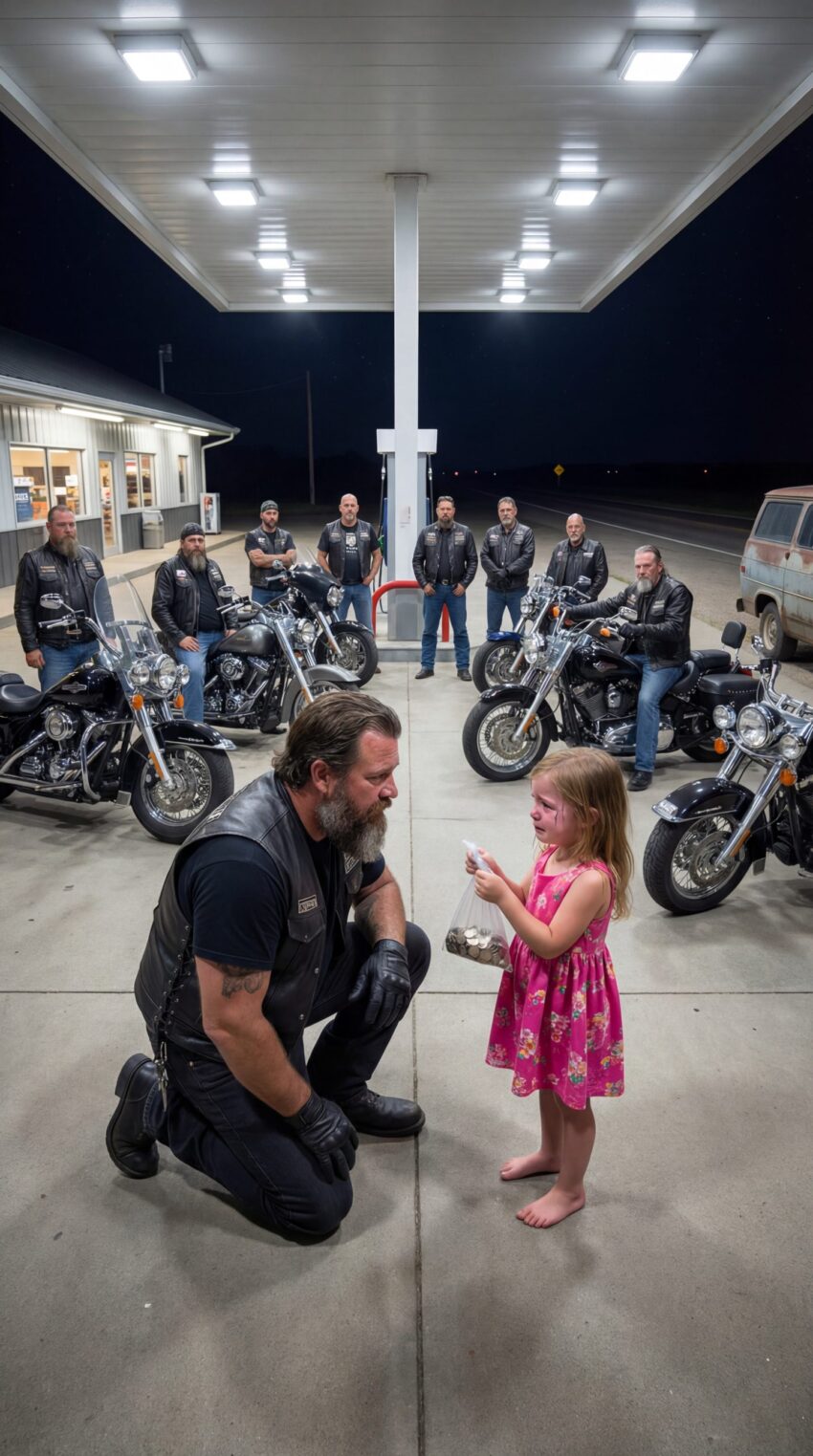
The Night Harper Walked Out of the Dark
There are stretches of road in America that feel cut off from everything familiar, especially after midnight, when the headlights seem to carve out the only real place left in the world. Beyond that narrow beam of light, the land turns into shadow, silence, and distance. On nights like that, time feels strange. A mile can feel like ten. A simple stop can turn into something you never forget.
It was one of those nights in the open plains outside Dodge City, Kansas. The air was sharp with cold, and the wind moved across the empty highway like it had nothing to slow it down. Miles of darkness lay in every direction, broken only by a small gas station sitting under a row of tired fluorescent lights. The station looked old in the way many highway places do, like it had survived on routine more than care. Its windows glowed weakly. The pumps hummed. Every few minutes a truck thundered past and disappeared again, leaving the silence even deeper than before.
That was where Weston Hale pulled in.
He rode a weathered cruiser that sounded steady rather than loud, the kind of motorcycle that had clearly traveled thousands of miles without needing to prove anything. When he shut off the engine, the quiet came down around him all at once. He stayed seated for a second, hands still resting on the grips, shoulders heavy from the long ride.
Weston was forty-seven, broad through the chest and built like a man who had spent years lifting, working, fixing, carrying. His beard had gone salt-and-pepper around the chin, and the lines in his face came from more than age. He wore an old leather vest over a thermal shirt, faded jeans, and boots marked by road dust. From a distance, he looked like the kind of man strangers often judged too quickly. Most people noticed the motorcycle first, then the vest, then the size of him. By the time they looked at his face, they had usually already decided what kind of person he must be.
They were often wrong.
Weston climbed off the bike slowly, stretched his back, and rubbed the cold out of one hand before reaching for the pump. He had been riding for hours, letting the road do what it always did for him—keep his mind moving before it could settle too long on memories he still didn’t enjoy meeting head-on.
He had just started fueling up when he noticed movement at the edge of the light.
At first, it looked like nothing more than a shadow shifting where there shouldn’t have been one. His body reacted before his thoughts did. He turned carefully, not fast, not sharp. Years had taught him that sudden movements only made fear worse, especially if the person approaching was already scared.
Then he saw her.
She was little. No older than six, maybe seven. She stood just beyond the brightest part of the station lights, barefoot on the cold pavement. Her nightgown was thin and wrinkled, the hem damp and dark from the ground. Her hair was tangled like she had run her hands through it over and over. Tear tracks had dried and started again on her cheeks. In one hand, she carried a small clear plastic bag filled with coins.
She did not stop at a safe distance. She came straight toward him with the kind of quiet determination children have when they are too worried to be shy.
Weston slowly put the pump back and lowered himself into a crouch so he would not tower over her.
“Hey there,” he said gently. “You alright?”
The girl lifted the bag a little, and the coins made a faint clinking sound.
“Can you help me buy milk for my baby brother?”
The words were soft. Plain. Not dramatic at all.
That was what made them hit so hard.
Weston felt something tighten in his chest. Children were not supposed to sound that calm while asking for help in the middle of the night.
“What’s your name?” he asked.
“Harper.”
“That’s a pretty name,” he said. “And your brother’s name?”
“Noah. He’s little.”
Weston nodded once. “Okay, Harper. Where’s your mom? Or your dad?”
The girl looked over her shoulder toward the darkness beyond the side of the station.
“They’re in the van.”
She swallowed hard and looked back at him.
“They won’t wake up.”
The Kind of Silence That Means Something Is Wrong
There are certain sentences that do not need to be explained. Weston knew that the second he heard her say it.
Children do not always have the language for emergencies. They don’t describe danger the way adults do. They tell you exactly what they see, and sometimes that makes the truth even heavier.
Weston kept his expression steady. He did not want her to feel more frightened than she already was.
“Okay,” he said softly. “You did the right thing by coming here.”
Harper stared at him, searching his face as if she needed to know whether he really meant that.
He did.
“Stay here for just a minute,” he said. “I’m going to get what your brother needs, and then you can show me where the van is.”
She nodded right away.
She was too obedient, Weston thought. Too careful. Too used to handling things alone.
Inside the station, the heat barely worked, and the air smelled like coffee, dust, and old fryer oil. Behind the counter stood a thin young cashier wearing a gray hoodie and the tired expression of someone working a shift he hated.
He glanced up. “Need anything else?”
Weston stepped straight to the counter. “There’s a little girl outside with no shoes on.”
The cashier blinked. “Oh. Yeah. She comes around sometimes.”
Weston stared at him. “Sometimes?”
The young man shifted uncomfortably. “She tries to buy stuff with coins. We’re not supposed to sell to kids without an adult.”
Weston’s jaw tightened. He kept his voice low.
“She says her parents won’t wake up. There’s a baby in that van.”
The cashier’s face changed then. Not into cruelty. Into guilt.
“I didn’t know,” he muttered.
Weston looked at him for a beat and said, “That’s the problem.”
He moved quickly through the aisles, grabbing formula, bottled water, crackers, bananas, baby wipes, and a thick fleece blanket from a rack near the back. At the register, he placed everything down, pulled out cash, and did not wait for the total before handing over more than enough.
The cashier bagged it fast this time.
“Should I call someone?” he asked.
“Yes,” Weston said. “But I’m calling too.”
When he stepped back outside, Harper had not moved. She stood beside his motorcycle with both hands wrapped around the little bag of coins, as though it were still her job to fix the whole night herself.
Weston set the supplies down in front of her.
“This is for Noah.”
She looked at the bags, then at the coins in her own hand.
“But I have money.”
He gently closed her fingers around the plastic sack again.
“You keep that, sweetheart.”
Her lips trembled.
“I tried to wake them,” she whispered. “I shook them. I said their names. I kept trying.”
Weston had heard grown men say less after worse.
“You did everything right,” he told her. “Now show me where they are.”
The Van Beyond the Lights
Harper led him around the side of the building, past the reach of the brightest bulbs, toward a patch of gravel where the shadows thickened. The highway noise seemed farther away there. A faded blue van sat off to the side, angled crookedly, one tire soft and the windows fogged from the inside.
Weston’s instincts sharpened immediately.
He set the bags down, moved in front of Harper, and said, “Stay right behind me.”
She obeyed without a word.
When he opened the side door, a stale, heavy smell drifted out. Not violent. Not sharp. Just wrong. The kind of air that said no one inside had been fully okay for a while.
Two adults sat slumped in the front seats. A man behind the wheel. A woman turned partly toward the passenger window. Both were breathing, but barely moving. In the back lay a baby boy wrapped in a thin blanket, fussing with weak, tired sounds that seemed too small for the cold around him.
Weston moved fast then.
He pulled out his phone and dialed emergency services first, giving the location clearly, calmly, and twice to make sure they had it right. Then, without wasting a second, he made one more call.
Darren Pike answered on the second ring.
“West?”
“I’m at a station off Route 50 outside Dodge. I need help here. Two kids. Medical emergency. Bring whoever’s close.”
Darren did not ask unnecessary questions.
“We’re coming.”
Weston slid the side door mostly shut again to block the wind and picked up the formula. He looked at Harper.
“Can Noah drink from a bottle?”
She nodded.
“He cries and cries when he’s hungry.”
Weston’s face softened. “Alright. Let’s take care of him.”
He brought the baby formula inside the station and asked the cashier for warm water. The young man moved faster now, with shaking hands and a silence that suggested shame had finally reached him. Weston mixed the bottle carefully, tested it, then carried it back to the van.
Harper climbed partway inside and helped hold the bottle with both tiny hands while Weston supported the baby’s head. Noah drank like he had been waiting too long to trust that food was really coming.
Harper watched him with wide, exhausted eyes.
“He’s okay now?”
“He’s doing better,” Weston said. “You helped him.”
Her chin quivered again, but she kept herself together.
That, more than anything, broke his heart.
The Sound of Engines in the Dark
The first siren was still a few minutes out when another sound rolled in from the highway—the low, familiar rhythm of motorcycles.
One headlight became three. Three became six. Then more.
The riders pulled into the station lot in a loose line, not loud for the sake of being loud, but steady, watchful, and purposeful. Men and women in riding jackets and vests shut off their engines and dismounted with the quick calm of people who knew how to arrive without making a bad moment worse.
Darren Pike came first, tall and broad, with a shaved head and a face that always looked stern until children were involved.
“What do we have?” he asked quietly.
Weston pointed toward the van. “Two adults unresponsive but breathing. Little girl found me at the pump. Baby was hungry and weak.”
Darren glanced at Harper, then down at the bottle in her hands. Something shifted in his expression immediately.
“Alright,” he said. “We keep this calm.”
Another rider, Teresa Vance, slipped off her leather gloves and crouched near Harper’s eye level.
“Hi, honey,” she said. “My name’s Teresa.”
Harper pressed closer to Weston at first, then peeked at Teresa with wary curiosity.
“Are you all his friends?”
Teresa smiled softly. “We are.”
Harper looked at Weston again as if asking whether that meant these people were safe too.
He nodded. “They’re good people.”
That seemed enough for her.
The paramedics arrived moments later, red and blue light sweeping across the station, the van, the pumps, the bikes, the gravel, all of it suddenly too bright after so much darkness. They moved quickly to the adults, checking pulse, breathing, responsiveness, and loading equipment with the kind of trained urgency that speaks louder than panic ever could.
One of the EMTs stepped back after the first assessment and quietly said to Weston, “You called at the right time.”
He did not ask how much later would have been too late.
He already knew he did not want that answer.
A Little Girl Who Refused to Let Go
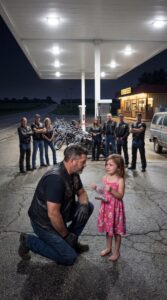
Once the adults were being treated, the questions began.
A sheriff’s deputy arrived, notebook in hand, voice kept low. He spoke gently to Harper, but every new adult, every new question, seemed to remind her that she still did not know what would happen next.
She stood beside Weston the entire time, one small hand wrapped around two of his fingers.
At one point the paramedics carried Noah out, now warmer in the fleece blanket, his small face finally relaxed from hunger and cold. Harper leaned toward him at once.
“He’s alright?”
A paramedic gave her a kind smile. “He’s doing much better.”
Only then did Harper breathe all the way out.
The deputy spoke with Weston off to the side after that.
“We’ll likely need temporary placement,” he said. “At least until relatives can be found and everything is sorted.”
Weston glanced toward Harper. She had heard enough to know the subject was her.
Her face changed at once.
“No,” she said, her voice quiet but firm. “I stay with Noah.”
The deputy crouched slightly. “We’re going to make sure both of you are safe.”
Her grip on Weston tightened.
“I stay with him,” she repeated. “He cries if I’m gone.”
Nobody spoke for a second.
Darren came over. Teresa stood behind Harper like a quiet shield. The deputy looked from one face to another, measuring the scene.
Weston did not make promises he could not keep. He had learned a long time ago that children remembered broken promises in ways adults often did not.
So he said the most honest thing first.
“We’re not letting her be alone tonight.”
That changed the tone of everything.
Calls were made. A local emergency family advocate was contacted. A temporary arrangement was discussed. Because Harper and Noah were siblings, because the situation was urgent, because several responsible adults were standing there willing to cooperate fully, the path became clearer.
Not easy.
But clearer.
Harper never let go of Weston’s hand.
The Ride He Never Planned to Take
By the time the station quieted down again, the sky had begun to pale at the far edge of morning. It was not sunrise yet, but night had started to loosen its grip.
The adults had been taken for medical care. Noah had been checked and stabilized. The emergency advocate, a woman named Colleen Mercer, had arrived with a cardigan over her scrubs and kindness in her eyes. She had a calm voice that made frightened people feel less cornered.
After speaking with law enforcement and reviewing the immediate situation, she looked at Weston.
“Would you be willing to drive with us to the hospital and stay until we know what comes next?” she asked.
Before he could answer, Harper looked up at him.
Not pleading. Not crying.
Just hoping.
Weston had spent years riding away from places. Riding through towns without stopping longer than necessary. Riding because motion was easier than staying anywhere that might ask something tender from him.
But some choices do not feel like detours.
They feel like appointments your life had with you all along.
“Yes,” he said.
Harper’s shoulders dropped in relief.
Teresa helped buckle her into the back seat of Colleen’s SUV while Noah was secured carefully beside her. Weston climbed into the front, still smelling like gasoline, cold air, and the long road. As they pulled away from the station, Harper leaned forward slightly and asked the question she had probably been holding in all night.
“Why did you help me?”
Weston turned enough to look at her.
There were many answers he could have given. Because no child should have to ask strangers for milk. Because someone should have noticed sooner. Because he had once known what it felt like for the world to pass by when help was needed.
Instead, he gave her the truest and simplest answer.
“Because you came to me.”
Harper sat with that for a moment, then nodded as if that made perfect sense.
Maybe to children, it does.
Morning Light and the Beginning of Something New
Hospitals in the early morning have their own kind of quiet, different from highway silence, but still heavy with waiting. Colleen handled paperwork. Nurses checked Noah again. Harper was given warm socks, juice, and a little stuffed bear from a donation bin. Teresa and Darren stayed until everything was settled enough that leaving no longer felt like abandonment.
Weston stayed too.
He sat beside Harper in a row of plastic chairs while she leaned against his arm, fighting sleep and finally losing to it. The stuffed bear slipped from her hand into his lap. He picked it up and set it gently against her.
At some point, Colleen returned with the update that the children would remain together under temporary protective care while relatives were contacted and the adults received treatment. Nothing was final yet. Nothing was certain. But for the first time since Harper stepped into the station lights, the path ahead no longer looked like a cliff.
Weston looked down at the little girl sleeping against him and the baby resting safely a short distance away.
He had stopped for gas.
That was all.
He had meant to fuel up, warm his hands, maybe buy coffee, and keep moving west before sunrise.
Instead, a child had walked out of the dark carrying coins, and the whole night had turned into a reminder that some of the most important moments in life arrive without warning, without preparation, and without giving you the luxury of deciding whether you feel ready.
When Harper finally woke, the first thing she did was look for Noah. The second thing she did was look for Weston.
He was still there.
Her eyes softened with relief.
“You stayed.”
Weston gave her a small smile. “I said I would.”
And though he had not actually used those words before, somehow both of them knew it was true.
Outside the hospital, the morning sun rose slowly over western Kansas, touching the parking lot, the windows, the chrome of waiting motorcycles, and the road stretching out beyond them.
For the first time in a long while, Weston did not feel any hurry to get back on it.
Sometimes a life changes because of a grand plan.
And sometimes it changes because a little girl in bare feet decides that one more stranger might still listen.
Real kindness is not measured by appearance, reputation, or first impressions, because some of the safest hearts in the world are carried inside people others hesitate to trust.
Children should never have to carry responsibilities that belong to adults, and when they do, the most important thing we can offer first is not judgment, but protection, steadiness, and the reassurance that they are no longer alone.
Many painful situations continue not because nobody could see them, but because too many people learn to look away, and this story reminds us that attention itself can be an act of mercy.
The person who steps forward in a hard moment may not be the one society expects, which is why character should always matter more than image.
Sometimes help does not begin with a perfect plan or heroic speech, but with one simple decision to stop, notice, listen carefully, and take another person’s fear seriously.
A child’s quiet words can hold more truth than a room full of adult explanations, and wise people learn to hear the urgency hidden inside small voices.
We should never underestimate how much healing can begin the moment someone reliable says, through words or actions, “I’m here, and I’m not leaving you to face this by yourself.”
Compassion becomes most powerful when it moves beyond feeling and turns into practical care—warmth, food, safety, patience, advocacy, and the willingness to stay until the danger has truly passed.
It is often in the darkest, loneliest corners of ordinary life that human goodness reveals its brightest form, proving that even one attentive person can change the direction of someone else’s story.
Before we decide who looks trustworthy and who does not, we should ask a deeper question: when a frightened child reaches out in the cold and asks for help, who will actually kneel down, listen, and answer with love?