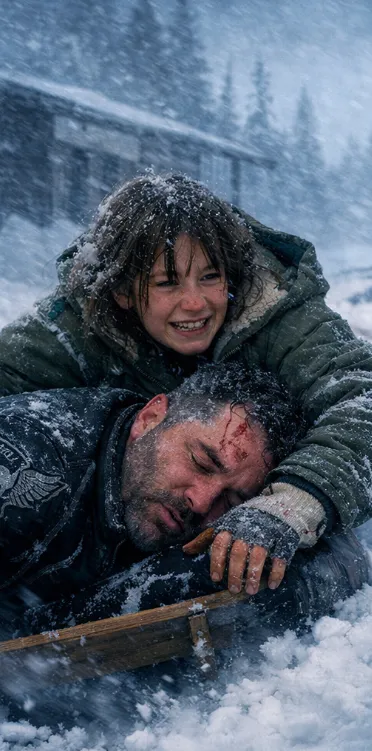
The storm had already erased the road when Lena realized the man was still breathing. Snow lashed her face like shards of glass, and the world beyond a few feet dissolved into white chaos. For a second, she froze—not from the cold, but from the terrible understanding that stopping here might change everything.
She had been walking for hours, dragging her battered wooden sled along the buried stretch of Highway 27, heading toward the abandoned depot she knew by heart. The wind screamed in her ears, a constant threat that seemed almost alive, as if daring her to lie down and disappear. Her oversized parka flapped awkwardly around her thin frame, sleeves rolled and tied, the fabric swallowing her like something borrowed from another life.
Her hands were wrapped in old socks, knotted at the wrists with frayed string, stiff with frost and soaked through. Every movement sent sharp waves of pain shooting up her arms, alternating between burning and numbness so intense she could barely feel her fingers. But she kept moving. She always kept moving. Because stillness meant hunger, and hunger always meant something worse.
That lesson hadn’t come from the storm.
It had come long before—from the places that were supposed to protect her.
Two nights earlier, Lena had stood barefoot in the dim hallway of Cedar Pines Transitional Home, listening through a cracked door. Ms. Harrington’s voice carried easily, smooth and controlled, as she spoke to the state auditor. Warm rooms. Enough food. Plenty of beds. Lena knew every word was a lie. She had counted the children herself—seventeen squeezed into a house built for twelve. She had seen the two youngest shivering on the enclosed porch, wrapped in plastic sheets that rattled in the wind.
The radiators only worked when inspections were coming.
And then, the night before the storm hit, Ms. Harrington packed her SUV and left. She drove south, chasing safety, leaving behind a half-empty fridge and a house full of children no one intended to save.
That was when Lena understood.
No one was coming.
She left before the others realized how little food remained. Before the older kids turned desperate. Before survival turned them against each other. She slipped out into the cold with her sled and headed for the only place she trusted—a forgotten depot that didn’t ask questions and didn’t expect answers.
That was when she saw the shape beneath the snow.
At first, she thought it was debris. Something twisted and half-buried, maybe part of an old sign or broken equipment. But as she moved closer, dragging the sled behind her, she noticed the curve of metal too deliberate to be random.
It was a motorcycle.
And beside it, a man.
He lay face-down, one arm stretched forward, as if he had been crawling before the storm swallowed him whole. His leather jacket was frozen stiff, dusted with ice, and his body looked too still, too heavy, like something the storm had claimed.
Lena’s first instinct was to run.
Dead adults meant police. Police meant records. Records meant going back.
And going back always ended worse.
Then his fingers twitched.
The movement was small, barely visible beneath the snow, but it was enough to stop her breath. The wind howled louder, as if angered by the interruption. Lena hesitated, her heart pounding so hard it made her dizzy.
She dropped the sled.
Her boots crunched through the snow as she rushed to him, brushing ice from his face with shaking hands. Blood had frozen along his temple, dark and crusted, and his lips were cracked and pale.
A thin breath escaped him.
“No,” she whispered, her voice trembling as much as her hands. “Don’t.”
She shook his shoulder, first gently, then harder, panic rising in her chest like a tide she couldn’t hold back. His eyelids fluttered, and a sound slipped from his throat—broken, incomplete, but alive.
That was enough.
Lena was small. Too small for this. Too weak.
But desperation didn’t care.
She hooked her arms under his shoulders, planting her feet in the snow, and pulled with everything she had. At first, he didn’t move at all. He was too heavy, too solid, like dragging a piece of the earth itself. But then the ice beneath him shifted, and his body slid an inch.
Then another.
The effort tore a sob from her throat, swallowed instantly by the wind. Her muscles screamed, her arms burned, but she didn’t stop. She couldn’t.
Because she knew what it felt like to be left behind.
It took her nearly an hour to drag him to the depot.
Inside, the air was still bitterly cold, but the wind was gone, replaced by a suffocating silence. The smell of old grease and rust filled the space, familiar and strangely comforting. Lena dragged the sled into the corner where she had hidden scraps of cloth and a heavy canvas tarp.
She couldn’t remove his jacket—it was frozen solid—but she packed the rags around him, pressing them into every gap she could find. Then she pulled the tarp over him.
And then, after a moment of hesitation, she crawled underneath it too.
Her back pressed against his chest, her small body curled against his larger frame. She was the only warmth he had.
“You have to stay,” she whispered into the darkness, her teeth chattering. “You can’t leave me here alone.”
For two days, the storm raged without mercy.
Lena melted snow in a dented tin can, dripping water into his mouth a few drops at a time. He drifted in and out of fever, muttering names she didn’t recognize—Gunner, Stig, Elias—like ghosts calling him back. Sometimes he thrashed, his strength terrifying, his hand clamping around her wrist so tightly it made her gasp.
But each time, he released her the moment he realized how small she was.
He wore a patch on his jacket—a skull with iron wings. Lena didn’t know what it meant, but she knew enough to understand it wasn’t something good.
Still, she stayed.
Because to her, he wasn’t dangerous.
He was alone.
On the third morning, the storm stopped.
The silence was so sudden it felt wrong, like the world had forgotten how to breathe. Then, faint at first, came a low rumble.
Engines.
Many of them.
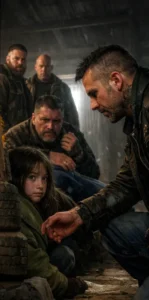
Lena scrambled out from under the tarp, panic flooding her chest. She ran to the back of the depot and squeezed behind a stack of rusted tires, pulling herself as small as possible.
The bay door burst open with a screech, and light flooded in.
Four men stormed inside, their boots heavy, their voices sharp with urgency.
“Bike’s outside! He’s gotta be here!”
They found the sled.
Then the tarp.
One of them dropped to his knees, his voice breaking as he pulled it back. “Silas! Boss!”
The man Lena had saved groaned, shifting under the canvas.
The others moved instantly, checking him, shouting orders, relief and fury tangled together in their voices.
Lena held her breath.
Invisible.
“Wait,” Silas rasped.
Everything stopped.
“We got you, boss. Medical’s on the way.”
“The girl,” he said, forcing the words out. His eyes searched the room, unfocused but determined. “Where is the girl?”
The men exchanged confused glances.
“There’s nobody here.”
Silas grabbed one of them by the collar, his strength sudden and absolute. “She dragged me out of the snow. She kept me alive. Find her.”
The order hit the room like a command no one would dare ignore.
They found her in seconds.
A man with tattoos along his neck moved the tires aside and looked down at her. Lena flinched, bracing herself, expecting the grab, the anger, the punishment.
But it didn’t come.
The man stepped back, his expression shifting as he took in her oversized coat, her shaking hands, her hollow face.
“She’s here, boss,” he said quietly.
Silas pushed himself upright, ignoring the pain that twisted his face. He crossed the room slowly, leaning on his men, until he reached her.
And then, instead of towering over her—
He knelt.
His gloved hand paused before touching her, giving her time to pull away if she wanted. When she didn’t, he rested it gently on her shoulder.
“You pulled me out?” he asked.
Lena nodded.
“Why?”
“You were alone,” she whispered. “Nobody came.”
Silas stared at her, something shifting behind his eyes, something breaking open. He saw the truth written in every detail—the makeshift gloves, the fear, the stubborn strength.
A child who had learned to survive without anyone.
He removed the heavy chain from his neck and placed it over hers. It hung low, too big, too heavy.
“Somebody came,” he said softly. “You did.”
He looked up at his men.
“Pack it up. She comes with us.”
“Boss,” one hesitated. “She’s a kid—”
Silas’s voice cut through the room like thunder. “She comes with us. And I want to know who left her out there.”
They found out.
And when they did, the world shifted.
They didn’t burn Cedar Pines down. That would have been mercy.
Instead, thirty motorcycles lined the property in silence, engines rumbling like distant thunder. When the police arrived, they found Ms. Harrington already confessing, her voice shaking as she admitted everything—fraud, neglect, theft—anything to make the silent figures watching her disappear.
The system changed after that.
Not because it wanted to.
Because it was afraid not to.
And Lena never went back.
Years later, she stood on a stage in a pressed gown, the weight of a silver chain resting against her chest. In the front row, a man with gray in his beard and a cane at his side watched her without smiling.
When her name was called, she walked forward, steady and unafraid.
Silas didn’t clap.
He simply nodded.
A quiet acknowledgment.
A king saluting the small, stubborn girl who had refused to let him die—and in doing so, had changed everything.
Lena touched the ring at her neck and smiled.
She had saved a stranger in the storm. And in return, she had been given a life where she would never be invisible again.