A Girl Stood on a Police Cruiser Because No One Else Could See What Was Happening
The morning had begun like any other at the small gas station off State Road 52 in Mason Creek, Indiana. Trucks pulled in for coffee. Locals came for cigarettes, fountain drinks, and the kind of quick breakfast people ate standing beside their cars. The station was old, with two weathered pumps, a faded ice machine near the entrance, and a buzzing sign that promised hot coffee twenty-four hours a day even when the coffee was never quite hot enough.
No one there expected the day to split open in front of them.
I had only stopped because I was running low on gas and needed caffeine before another hour on the road. That was all. I remember the smell of fuel in the cold air, the sound of tires crunching over gravel, and a police cruiser already parked near the side of the lot. At first, it looked like the kind of roadside stop people barely noticed anymore. A deputy stood near a broad-shouldered biker sitting on the curb. Another officer was talking into his radio. A few people glanced over, then went back to their business.
From a distance, the man looked exactly like the kind of stranger a nervous crowd would judge in a second. He was tall even while seated, heavy through the chest and shoulders, with a worn leather vest, faded patches, and a beard that had seen more winters than most of the young men in town. His wrists were secured behind his back. His head hung low.
It seemed simple.
Routine.
Nothing to see.
And then a little girl came running from behind the station.
She was barefoot, her hair flying loose behind her, a small stuffed dog hanging from one wrist by a frayed ribbon. She looked too young to be there alone and too frightened to be ignored, but fear does not always make adults pay attention. Sometimes it makes them more impatient.
She did not slow down when she reached the cruiser.
She climbed right onto the hood.
The Child No One Understood
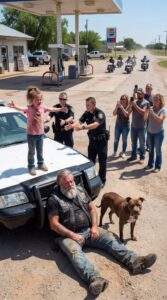
For a second, the whole lot froze as if everyone had stopped breathing at once.
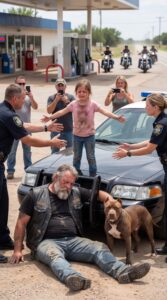
The girl spread her arms wide across the hood of the police car as though her tiny body could become a wall. Her face was pale, but her eyes were locked on the biker, not on the officers, not on the people staring at her, not on the phones that had already begun to rise.
One deputy stepped forward sharply. “Sweetheart, get down right now.”
She shook her head so hard her hair whipped across her face. “No! Please look at him!”
The officer’s voice hardened. “You need to step off the vehicle.”
But she did not move.
She looked seven, maybe eight years old, all elbows and trembling knees, standing barefoot on cold metal in a place full of adults who assumed she was making trouble. A man near me muttered that somebody needed to get her mother. A woman by the pump said children had no discipline anymore. Another person started recording.
It all happened quickly after that, but memory has a strange way of stretching important moments. I remember the girl’s small chest rising fast with panic. I remember the biker lifting his head only slightly, as if even that cost him something. I remember his shoulders moving in a strange rhythm that did not look quite right.
At first, I thought he was trying to catch his breath.
Then I noticed his hands.
Even with his wrists secured, his fingers were twitching in an odd pattern behind his back.
The girl saw it too. Maybe she had seen it before any of us.
Her voice broke when she shouted again. “He’s not fighting you. He’s not okay.”
The deputy reached toward her, careful at first, probably hoping to lift her down without making the scene worse. She stepped back another inch on the hood, wobbling but keeping her balance.
“Don’t touch me,” she cried. “You’re making it worse.”
Nothing about that made sense to the crowd. To us, it looked like a child interfering with law enforcement for reasons no one could understand. To the officers, it was a growing safety problem. To the girl, it was something else entirely.
It was urgent.
It was personal.
The Man on the Curb
 \
\
Later, I learned the biker’s name was Deke Rowan. At that moment, he was just a stranger to everyone except the child on the cruiser.
Deputy Nolan Pierce had stopped him over a registration issue and what he described as unusual movement when Deke pulled into the lot. Nothing about the stop had started out dramatic. The man had not argued. He had not shouted. He had not threatened anyone. He had simply become harder to read by the minute.
That made things worse.
Silence often does.
People are more comfortable with the kind of trouble they recognize. Anger makes sense. Defiance makes sense. Loud men, hard faces, rough voices, those all fit a story people know how to tell themselves.
But Deke Rowan was not loud.
He was fading.
His head dipped forward again. One shoulder jerked sharply. Deputy Pierce tightened his grip on the man’s upper arm and said, “Sit still, sir.”
The girl made a sound I still remember because it was not the sound of a child throwing a tantrum. It was the sound of someone watching a disaster she had already seen once before.
“No,” she screamed. “Please don’t do that.”
Another officer moved toward the cruiser. “Come here, honey. We’ll help him. You need to come down.”
She stared at him with tears standing in her eyes.
“Then look at him,” she said. “Really look at him.”
By then the lot had gone quieter. Even the people recording had lowered their phones a little, because doubt had entered the space. It spread like a cold draft. The biker’s breathing had become uneven. His jaw tightened. His shoulders jerked again, harder this time, and suddenly nothing about him looked dangerous. He looked like a man losing a battle inside his own body.
Deputy Pierce misread it for one more second. Maybe two.
Then Deke pitched forward.
When the Truth Became Impossible to Ignore
He hit the pavement hard.
The sound turned the whole crowd silent.
His body did not move like someone bracing for impact or trying to push himself up. It shook. At first the motion was small, a tremor running through his shoulders. Then it spread, pulling through him in violent waves. His restrained arms made it worse. His wrists twisted behind him, trapped in a position that no one should be forced to endure in a medical emergency.
The deputy dropped to his knees immediately, all command gone from his face.
“Get the key,” he shouted. “Now.”
The girl jumped down from the hood before anyone could stop her. She ran straight to Deke and dropped beside him with a steadiness that seemed impossible in someone her age. She did not throw herself over him. She did not panic. She stayed close to his shoulder and kept her voice low and calm.
“It’s okay,” she whispered. “I’m here. Just breathe. I’m right here.”
Someone near the pumps gasped. Another person backed away. A woman covered her mouth with both hands.
The cuffs came off at last, but the damage of those long extra seconds sat heavy in the air. Deputy Pierce and the second officer turned Deke carefully onto his side. One of them called for the ambulance again, his voice sharper now, stripped of pride.
I looked at the little girl and understood in one awful moment that she had not guessed. She had known.
Deputy Pierce glanced at her while keeping one hand near Deke’s shoulder. “How did you know?”
She swallowed hard and answered without taking her eyes off the biker.
“My dad used to do this.”
The words landed harder than anything else that morning.
A child that small should not have recognized a seizure faster than trained adults. But loss teaches lessons that childhood never should.
Deke’s breathing slowed in a way that frightened everyone. Deputy Pierce checked for a pulse, and something changed in his face. The officer who had tried to pull the girl from the cruiser looked like he wanted to say something, maybe an apology, maybe a prayer, but nothing came out.
Then the sound of motorcycles rolled in from the highway.
The Riders Who Came for Him
It was not the wild roar people imagine when they think of a large group of bikers. It was more controlled than that, more measured, like a tide of engines moving with purpose.
One after another, motorcycles turned into the station lot.
There were dozens of them.
Men and women climbed off their bikes in weathered leather and denim, their faces serious, their steps quick but not chaotic. Nobody shouted. Nobody rushed the officers. Still, the air changed the moment they arrived. The crowd pulled back. The deputies straightened on instinct.
An older rider with silver in his beard stepped forward first. He had the kind of face that looked carved rather than aged, with deep lines around his eyes and a calm that carried its own authority.
He looked down at Deke on the pavement, and the grief in his expression was quiet but unmistakable.
“Deke,” he said softly, kneeling beside him.
The little girl looked up. “You know him?”
The older rider nodded once. “Better than most.”
He slid off his folded bandana and tucked it gently beneath Deke’s head so it would not rest against the hard ground. The gesture was careful, almost tender.
Deputy Pierce, to his credit, did not interfere. His voice had changed too. “Sir, the ambulance is on the way.”
The older rider finally looked up at him. “Good.” Then he glanced back at Deke and added, “He never asks for help. That’s always been his worst habit.”
Another biker standing behind him, a woman in a brown riding jacket, said quietly, “He pulled my brother out of a ditch in January and stayed with him until the medics came.”
A younger rider near the edge of the group spoke up next. “He paid for a stranger’s motel room during that ice storm last winter. Never told anybody.”
The stories kept coming, not loud, not dramatic, just factual. Small acts. Quiet acts. The sort of things people rarely hear about because decent men often do them without witnesses.
The older rider placed one hand over Deke’s shoulder and said to the girl, “I’m Marlowe Grady.”
She nodded. “I’m Tansy.”
It fit her somehow, the name and the face and the fierce stillness in her.
Marlowe looked at her with a kind of wonder. “You were the one on the car.”
Tansy’s voice turned small for the first time. “Nobody was seeing him.”
Marlowe let out a slow breath. “You did.”
A Child Carrying More Than She Should
The ambulance still had not arrived, and every second felt stretched thin enough to break.
Deputy Pierce remained kneeling beside Deke, no longer treating him as a suspect but as a man in danger. “Stay with us,” he said, his tone low and steady. “Come on, Mr. Rowan.”
Tansy leaned a little closer. “He can hear us,” she whispered. “Keep talking.”
The deputy looked at her, surprised, and followed her lead. “All right. Deke, help is coming. You stay right here with us.”
Marlowe’s eyes narrowed as if he had just understood something larger than the emergency itself. He studied Tansy for a moment, then asked gently, “Your dad had seizures?”
She nodded without looking up. “After he got hurt at work. Sometimes he would stare first. Sometimes his fingers would twitch. Then he’d fall. People always thought he was just acting strange before it happened.”
There was no self-pity in her voice, which somehow made it sadder. It sounded rehearsed by life.
“Is he okay now?” the deputy asked quietly.
Tansy was silent for a moment.
Then she said, “He passed away last year.”
No one answered. No one knew how. The station lot, which had started the morning with coffee, engines, and ordinary impatience, now held a kind of grief that belonged to strangers and yet somehow connected them.
Marlowe lowered his head briefly. “I’m sorry, little one.”
Tansy touched the stuffed dog at her wrist with her free hand. “I just didn’t want it to happen again while everybody stood there.”
That sentence stayed with me more than anything else.
Not because it was dramatic.
Because it was true.
The Morning After Judgment
When the ambulance finally arrived, the paramedics moved with the speed of people who knew they were late and hated it. They assessed Deke, started treatment, and lifted him onto the stretcher with practiced care. One medic asked quick questions. Deputy Pierce answered some. Tansy answered others with surprising clarity.
As they rolled Deke toward the ambulance, his eyes opened for the briefest moment. He looked disoriented, exhausted, caught between pain and awareness. Tansy stepped close, and his fingers brushed hers for a heartbeat.
“You’re okay,” she told him, though no one could promise that yet. “They know now.”
His lips moved. The sound that came out was rough and thin. “Kid…”
Then the medics loaded him in and closed the doors.
The siren started.
The ambulance pulled away.
For a long moment, nobody moved.
Deputy Pierce stood in the middle of that silence with his hat in one hand. He looked toward Tansy first, then toward Marlowe and the riders gathered around him.
“I got it wrong,” he said.
It was not a dramatic speech. It was not polished. But it mattered because he meant it.
Marlowe nodded. “You corrected it.”
The deputy glanced toward the highway where the ambulance had vanished. “Not fast enough.”
Marlowe looked at him for another moment and said, “Then remember it fast enough next time.”
That was all.
No crowd applause. No shouting. No grand moral announcement. Just the truth placed where everyone could see it.
One by one, the riders returned to their motorcycles. Their engines started again, softer this time, like a vigil ending. Marlowe remained just long enough to crouch beside Tansy.
“Does your mother know where you are?”
She lowered her eyes. “Probably by now.”
Marlowe almost smiled. “I bet she’s scared to death.”
Tansy looked back toward the road. “I was scared too.”
Marlowe nodded. “That’s not the same thing as being helpless.”
Three Months Later
I did not expect to see either of them again, but some places gather stories and hold onto them.
Three months later, I stopped at the same gas station on another gray morning. The flickering sign still buzzed. The coffee still needed help. But something in me slowed as soon as I pulled in, because outside the entrance stood a motorcycle I recognized before I understood why.
Deke Rowan leaned beside it, thinner than before, moving with more caution than strength. He still wore leather, though his vest hung looser on him now. He looked like a man who had walked a long road back from somewhere dark and had not yet decided what to say about it.
A few feet away stood Tansy in clean sneakers and a yellow coat two sizes too big, clutching the same stuffed dog.
She saw him before I did.
Then she ran.
Deke lowered himself carefully to one knee just before she reached him, and Tansy wrapped both arms around his neck as though this reunion had belonged to them from the beginning. He hugged her back with the kind of gentleness that only strong men understand.
“I told them,” she said into his shoulder.
Deke let out a breath that sounded halfway between a laugh and tears. “Yeah, you did.”
She pulled back just enough to look at him. “You scared everybody.”
He smiled faintly. “I hear that happened.”
Marlowe stepped out from the station doorway carrying two coffees and paused when he saw them. He did not interrupt. He simply stood there and watched with quiet satisfaction.
Deke looked at Tansy for a long moment before speaking again. “You saved my life, kid.”
She shook her head immediately. “No. I just made people stop and see.”
He looked down, then back at her, and there was something humbled in his expression that had not been there before. “Sometimes that’s the same thing.”
Marlowe handed him one of the coffees and said, “Doctor still says one cup, not six.”
Deke took it with a tired smile. “You have become unbearable.”
Tansy laughed, and the sound felt like something repaired.
I stood by my car for a moment longer than I needed to, watching them. It struck me then that the most important person in that story had not been the officer, the crowd, or even the riders who came in for their friend.
It had been a child who recognized suffering because life had forced her to learn its shape too early.
She had not been stronger than everyone else.
She had simply refused to look away.
Sometimes the person who understands a crisis first is not the loudest voice, the most powerful title, or the oldest person in the room, but the one whose heart has already been broken by something similar and who recognizes the warning signs before anyone else is willing to admit them.
We should all remember that appearances can tell a shallow story, because a man who looks intimidating may be carrying deep pain, and a child who looks disruptive may actually be the only one brave enough to protect a stranger when the rest of the world is too confident in its first judgment.
Compassion is not always soft and quiet in the way people imagine, because sometimes compassion looks like standing in the wrong place, speaking at the wrong moment, or refusing to obey when obedience would allow harm to continue.
One of the hardest lessons in life is that being certain can feel responsible while still being dangerously wrong, and that is why humility matters so much in moments of tension, especially when another human being’s safety depends on our willingness to notice what does not fit the story we already believe.
Children often see with extraordinary clarity because they have not yet learned to hide behind pride, status, procedure, or assumptions, and when a child speaks with urgent honesty, the adults in the room should listen more carefully than they usually do.
Real strength is not found only in power, size, uniforms, or authority, but also in gentleness, restraint, accountability, and the courage to say, “I got it wrong,” when the truth becomes impossible to deny.
Many of the kindest people in the world are misunderstood at first glance, because goodness does not always arrive dressed in neat clothes and easy smiles, and some of the people who have suffered the most are the ones most ready to protect others from being left alone in their worst moment.
A single act of attention can change the entire course of a day, because there are moments when the difference between tragedy and mercy is simply one person who notices, one person who asks again, or one person who refuses to let the crowd move on too quickly.
Healing often begins not with grand speeches or dramatic promises, but with the simple human decision to stay near someone in pain, to speak calmly, to keep watch, and to offer steady presence when fear would make everyone else step back.
The world becomes safer and kinder when we learn to slow down our judgment, widen our empathy, and treat every stranger as someone whose full story we do not yet know, because sometimes the life that gets saved depends entirely on whether we choose assumption or compassion in a critical moment