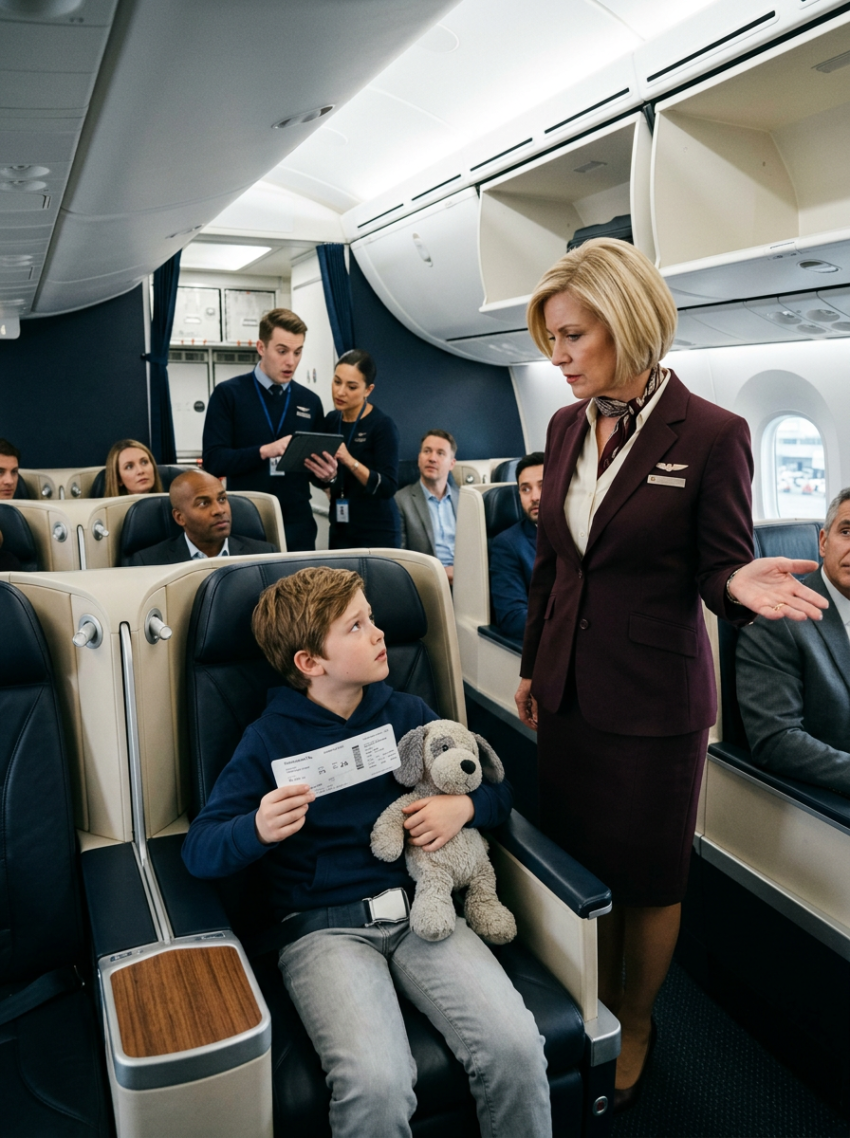
The Boy in Seat 2A
For almost eight years, I worked as a flight attendant for a major American airline, and during that time, I learned something important about people.
Airports reveal character.
Some travelers become impatient over small delays. Others remain kind even after missing connections, losing luggage, or sitting beside a crying child for four hours. I had watched wealthy executives argue over overhead bins, nervous teenagers fly alone for the first time, and exhausted parents whisper apologies to strangers because their children could not settle down.
After so many flights, I thought very little could surprise me anymore.
Then came Flight 417 from Seattle to Atlanta.
It was a late-afternoon departure on a clear fall day. Sunlight streamed through the terminal windows while passengers boarded one by one, dragging roller bags behind them and checking seat numbers on their phones.
My name is Mason Reed, and I was working the forward cabin that day.
While helping an older couple place their luggage overhead, I noticed a young boy sitting quietly in seat 2A.
His name was Caleb Monroe.
He was nine years old.
Caleb wore a simple dark-blue sweatshirt, gray jeans, and white sneakers. Nothing about his clothes suggested luxury. Beside him sat a small backpack, and in his lap rested a worn stuffed dog with one floppy ear.
He looked nervous but prepared.
Before boarding, Caleb had been escorted to the aircraft by a ground-service employee because he was traveling under the airline’s unaccompanied-minor program. His paperwork had been checked, his identification confirmed, and his assigned seat was clearly listed as 2A in first class.
There was nothing unusual about it.
At least, there should not have been.
Caleb’s mother had accompanied him through the airport as far as regulations allowed. His father was scheduled to meet him when the plane reached Atlanta.
Before leaving him with airline staff, she had apparently repeated the same instruction several times.
“Stay in your assigned seat, keep your backpack with you, and if you need anything, ask a flight attendant.”
Caleb had taken those words seriously.
Unfortunately, not every adult around him took the time to understand why he was there.
An Assumption Made Too Quickly
About ten minutes before boarding finished, senior flight attendant Vanessa Crawford entered the first-class cabin.
Vanessa had worked for the airline for more than twenty years.
She was highly experienced, extremely confident, and known for running a cabin with strict discipline. Newer employees respected her knowledge, but many also found her difficult because she rarely questioned her first impression of a situation.
She stopped when she noticed Caleb.
For several seconds, she simply stared at him.
Then she looked toward the rear of the aircraft and back again.
Finally, she walked over.
“Sweetheart, where are your parents?” she asked.
Caleb looked up.
“My mom is at the airport. My dad is meeting me in Atlanta.”
Vanessa frowned.
“And what seat are you supposed to be in?”
Caleb glanced at the number above him.
“Two A.”
Vanessa gave a small sigh.
“No, I mean your actual seat.”
Caleb became confused.
“This is my actual seat.”
A businessman across the aisle looked up from his laptop.
Vanessa extended her hand.
“Let me see your boarding pass.”
Caleb opened his backpack carefully and handed her the printed ticket his mother had placed inside.
Vanessa looked at it.
For some reason, instead of accepting what was clearly printed there, she seemed convinced there had been some kind of mistake.
“This is first class,” she said.
Caleb nodded.
“I know.”
“Are you traveling with someone seated nearby?”
“No. I’m traveling by myself.”
Vanessa’s expression became firmer.
“Then something was entered incorrectly. Children traveling alone are normally placed where the crew can monitor them more easily. Pick up your things. I’m going to find you another seat.”
Caleb shook his head.
Not dramatically.
Not disrespectfully.
He simply stayed where he was.
“My mom told me not to change seats unless someone checks everything first.”
That answer should have slowed the situation down.
Instead, it seemed to irritate Vanessa.
“I am the one checking everything.”
Caleb held the stuffed dog closer.
“But my ticket says this seat.”
The Cabin Became Quiet
By then, several passengers were paying attention.
Vanessa lowered her voice, but her tone became sharper.
“Young man, I need you to cooperate with me.”
Caleb looked toward the front door of the aircraft, almost as if he expected his mother to come back.
“Can you call the lady who brought me onto the plane?”
It was a perfectly reasonable request.
The ground employee who had escorted him aboard could have resolved everything within seconds.
But Vanessa did not call anyone.
Instead, she reached for Caleb’s backpack.
Caleb immediately grabbed the strap.
“Please don’t take my bag.”
I was several rows away when I heard him.
I turned toward the sound.
Vanessa was standing over him while Caleb looked increasingly frightened.
I walked forward.
“Everything okay here?” I asked.
Vanessa barely looked at me.
“There’s been a seating mistake. I’m fixing it.”
Caleb spoke before I could answer.
“There wasn’t a mistake.”
His voice was quiet, but it carried through the cabin.
I looked at the boarding pass still in Vanessa’s hand.
Seat 2A.
First class.
Then I looked at the child’s special-service identification tag.
That caught my attention immediately.
“He’s one of our unaccompanied minors,” I said.
Vanessa replied quickly.
“I can see that.”
Something felt wrong.
“Then his seat assignment should already be confirmed.”
Vanessa crossed her arms.
“Mason, I’ve handled hundreds of these situations. Children traveling alone are sometimes moved for operational reasons.”
“Was he moved today?”
She did not answer.
So I stepped toward the crew tablet near the forward galley and opened the passenger manifest.
I searched Caleb’s name.
The information appeared instantly.
Caleb Monroe.
Age nine.
Unaccompanied minor.
Seat 2A.
Special handling confirmed.
Authorized pickup contact in Atlanta.
Everything was exactly as Caleb had said.
I looked back at Vanessa.
“His seat is correct.”
Her expression changed only slightly.
“Then someone in reservations made an unusual choice.”
“Maybe. But it’s still his assigned seat.”
Caleb watched both of us silently.
I walked over and crouched beside him.
“Caleb, you’re in the right place.”
His shoulders relaxed a little.
“I told her.”
“You did.”
What Made the Situation Worse
At that point, the issue should have ended.
But Vanessa seemed embarrassed that passengers had heard the conversation.
And embarrassment sometimes makes people defend a mistake instead of correcting it.
She leaned toward me.
“He was refusing crew instructions.”
I kept my voice calm.
“Because the instruction was based on incorrect information.”
“That doesn’t matter. Passengers need to follow directions.”
I looked toward Caleb.
He was nine years old, flying across the country without either parent beside him, trying to follow the instructions his mother had given him.
He was not creating a disturbance.
He was not shouting.
He was not behaving badly.
He had simply insisted that his assigned seat was, in fact, his assigned seat.
Then our lead cabin supervisor, Lauren Bishop, entered the area.
She immediately sensed the tension.
“What happened?”
Vanessa answered first.
“The child refused to move after I told him there was a seat problem.”
Lauren turned to me.
I handed her the tablet.
“There is no seat problem.”
Lauren read the record carefully.
Then she looked at Caleb.
Then at Vanessa.
“Why were we trying to move him?”
Vanessa hesitated.
“Because the situation didn’t look right.”
Lauren’s expression became serious.
“What exactly didn’t look right?”
No one spoke.
That question changed the atmosphere.
Because everyone suddenly understood that the issue was no longer about a seat number.
It was about why Vanessa had doubted the child in the first place.
Caleb did not look like the passengers Vanessa expected to see in first class.
That assumption had come before verification.
And that assumption had created everything that followed.
A Name That Changed the Room
Lauren reviewed the full passenger notes.
Then she froze.
There was additional information visible to supervisors that I had not opened.
She read it twice.
“Mason,” she said quietly.
I stepped closer.
Lauren lowered her voice.
“Do you know who his emergency contact is?”
I shook my head.
She turned the screen.
The name listed there was Grant Monroe.
I knew the name immediately.
Almost everyone at the airline did.
Grant Monroe was not simply a frequent flyer or wealthy customer.
He was one of the company’s principal owners and the chairman of the airline’s board.
Caleb was his son.
I looked at Lauren.
Vanessa heard the name.
Her face changed completely.
“Grant Monroe?”
Lauren nodded.
Vanessa stared at Caleb as if she were suddenly seeing a different child.
And that was perhaps the most troubling part.
Because Caleb had not changed.
His clothes had not changed.
His ticket had not changed.
His behavior had not changed.
Only Vanessa’s knowledge of his family had changed.
Caleb looked at us.
“Is my dad in trouble?”
Lauren immediately softened.
“No, honey. Your dad is fine.”
He nodded slowly.
“Okay.”
I could tell he did not understand why the adults had suddenly become uncomfortable.
Maybe that was for the best.
The Flight Did Not Leave as Planned
Lauren contacted the captain before the aircraft door closed.
The captain then contacted operations.
Because the incident involved an unaccompanied child and questions about whether proper procedures had been followed, departure was temporarily paused.
Passengers began checking their watches.
Some whispered to one another.
A few had clearly recorded portions of the interaction.
Vanessa moved into the galley and stopped speaking.
Meanwhile, I brought Caleb a cup of apple juice.
“You doing okay?”
He nodded.
“Am I still going to Atlanta?”
“Yes.”
“Will my dad still be there?”
“Absolutely.”
He looked down at his stuffed dog.
“His name is Scout.”
I smiled.
“Scout looks like he’s flown before.”
For the first time since the situation began, Caleb smiled.
“Three times.”
Twenty minutes later, we received new instructions.
Grant Monroe happened to be in Seattle for company meetings.
He had already been notified.
He was coming directly to the aircraft.
The Father Who Boarded the Plane
When Grant Monroe stepped onto Flight 417, he did not look like a powerful corporate chairman.
He looked like a worried father.
He was wearing a dark business suit without a tie, and he walked directly past the crew without stopping.
The moment Caleb saw him, he stood.
“Dad!”
Grant knelt and opened his arms.
Caleb ran into them.
For several seconds, Grant said nothing.
He simply held his son.
Then he pulled back.
“You okay?”
Caleb nodded.
“I think so.”
Grant looked at the stuffed dog.
“Scout okay too?”
Caleb gave a tiny smile.
“Yeah.”
Only then did Grant stand.
Lauren explained what had happened.
She did not exaggerate.
She did not minimize it.
She simply described the sequence of events.
When she finished, Grant looked toward Vanessa.
His voice remained calm.
“Did my son have the correct boarding pass?”
Vanessa nodded.
“Yes.”
“Was his unaccompanied-minor status properly documented?”
“Yes.”
“Did he explain that his mother told him to remain in his assigned seat?”
Vanessa hesitated.
“Yes.”
Grant paused.
“Then why did you decide he did not belong there?”
The cabin became silent again.
Vanessa tried to answer.
“Sir, I thought there had been an operational error.”
Grant nodded once.
“Thinking there might be an error is not the problem.”
He glanced toward Caleb.
“Refusing to verify before treating a frightened child as though he had done something wrong is the problem.”
Vanessa looked down.
Grant continued.
“And the fact that everyone’s attitude changed the moment my name appeared on the screen tells me we have a larger issue than one seat assignment.”
No one argued with him.
What Happened Next
Flight 417 eventually departed after another crew member replaced Vanessa.
The company placed her on administrative leave while the incident was reviewed.
Contrary to what passengers expected, Grant did not demand an immediate public dismissal.
Instead, he requested a formal investigation.
He wanted to know exactly which procedures had failed, why a properly registered unaccompanied minor could be questioned without anyone first checking the passenger record, and whether employees were receiving enough training on unconscious assumptions and respectful conflict resolution.
Weeks later, Vanessa left the airline following the internal review.
But Grant did not stop there.
He announced a new training initiative focused on passenger dignity, child safety, and decision-making under pressure.
To my surprise, Lauren and I were invited to help design the program.
During our first training session, I stood before almost sixty flight attendants.
Some had decades more experience than I did.
I told them Caleb’s story without mentioning his father’s position until the very end.
Then I asked a simple question.
“Would the child deserve less patience if his father were a mechanic, a teacher, a restaurant worker, or unemployed?”
No one answered.
Because no answer was necessary.
The Lesson Behind Seat 2A
Months later, I saw another situation unfold on a completely different flight.
A teenage girl boarded wearing an oversized sweatshirt and carrying an old backpack. She had a business-class seat.
A passenger beside her looked at the seat number, then at her, and called a flight attendant.
“I think she may be in the wrong section.”
The young attendant checked the boarding pass immediately.
Then she smiled at the girl.
“You’re exactly where you’re supposed to be.”
That sentence stayed with me.
Not because it was dramatic.
Because it was simple.
You’re exactly where you’re supposed to be.
Sometimes respect is nothing more complicated than checking the facts before making assumptions.
Sometimes dignity means speaking to a child as carefully as you would speak to a powerful executive.
And sometimes the biggest lesson on an airplane has nothing to do with flying.
Caleb Monroe was only nine years old when he sat in seat 2A with his old stuffed dog and a boarding pass that clearly showed where he belonged.
He should never have needed his father’s name to prove it.
None of us should.
Never decide where someone belongs based on their clothes, age, appearance, or the way they carry themselves, because the truth of a person’s life is almost always larger than what can be understood in a few seconds.
Respect means very little when it is offered only after we discover that someone is wealthy, powerful, influential, or connected to an important name; real respect is given before we know any of those things.
Experience can make us wiser, but it can also make us too confident in our own assumptions, which is why even the most experienced person should still pause long enough to verify the facts.
Children often remember the way adults made them feel long after they forget the exact words that were spoken, so kindness toward a frightened child is never a small act.
Authority should never become an excuse to stop listening, because leadership is strongest when rules are combined with patience, judgment, fairness, and the willingness to admit a mistake.
A person should not have to reveal an important family connection before others decide to treat them with basic dignity, because human worth does not come from titles, money, status, or influence.
One of the most powerful things we can say when someone is being unfairly questioned is simply, “You are exactly where you’re supposed to be,” because sometimes reassurance restores what another person’s assumptions have shaken.
Correcting a mistake may feel uncomfortable, especially in front of other people, but protecting our pride after learning the truth can turn a small misunderstanding into something far more damaging.
The best policies are not created merely to protect companies from consequences; they are created to remind people that every stranger who enters our care carries a story, a family, and a dignity that deserves protection.
Before deciding that someone looks out of place, remember Caleb sitting quietly in seat 2A, because sometimes the person who seems least likely to belong is the one who was exactly where they were meant to be all along.