Uncategorized
A wounded Marine steps off a Greyhound into the thin air of Colorado, expecting a homecoming and finds weeds in the yard, curtains drawn, and a silence so loud it feels like a verdict. The house is still standing, but the life he left behind is already halfway gone. Then, from behind a half-closed door, a tiny voice says the one word he thought he’d never hear again Daddy.
February 28, 2026 – by admin – Leave a Comment
Daddy, are you coming home? I kept your spot warm.
A little girl named Sophie sat on the porch of a creaking mountain cabin, legs swinging beneath her faded pink dress, eyes fixed on the road that wound through the snow-covered pines. She hadn’t seen her father in four years. Her mother had just driven away with a stranger. All she had left was an old photograph… and a dog who never left her side. They said the man who returned was too broken to raise a child. But when David Miller, a wounded Marine, stepped off the bus that winter afternoon, what happened next would prove the world wrong—one quiet act of love at a time.
Snow was falling. Buddy, the German Shepherd who once served beside David in war, waited by the door. And inside that house, a little girl whispered, “He’s home.”
Before we begin, tell me—where in the world are you watching from? And if you believe love can rebuild what war tried to destroy, hit that subscribe button. Now… let’s begin.
The late October wind slid down the slopes of the Rocky Mountains, whispering through the tall pines that lined the road to Estes Park, Colorado. The sky was a flat gray, not yet storming but on the edge of something. A few dry leaves blew across the cracked asphalt as the Greyhound bus hissed to a stop at a nearly empty roadside station, its windows fogged and streaked from long hours on the road.
Only one man stepped off.
David Miller stood for a moment beneath the bus stop awning, clutching the worn strap of his military-issued backpack slung over one shoulder. He was thirty-five, broad-shouldered but slightly hunched, the stance of a man used to carrying weight—both seen and unseen. His uniform jacket, though neatly pressed, was clearly faded at the elbows, and his boots had lost their shine somewhere between Afghanistan and Denver.
His face was weathered: a sharp jawline under the beginning of a beard, eyes a steely blue that now looked gray in the overcast light. There were crow’s feet at the corners of those eyes—not from laughter, but from squinting against sun, sand, and pain.
He reached into his coat and pulled out a small object: a worn-out paratrooper teddy bear with one ear half-torn. He held it gently in his calloused hands, brushing a speck of dirt from its stitched chest. This was his homecoming.
David had left Estes Park four years earlier, newly enlisted, married, full of hope. Rachel, his wife back then, had held Sophie, their baby girl, waving from the porch of their modest wooden house as he boarded the recruiter’s van. That memory had played in his mind thousands of times—on hot nights in the desert, on cold flights in military transports, in field tents where silence was louder than gunfire.
Now he walked slowly along the dirt path that led from the station to Pinebrook Lane. The neighborhood was still, its modest homes half-hidden behind hedges and weather-worn fences. His own house came into view just beyond a bend—a two-bedroom wooden cabin with peeling gray paint, crooked gutters, and a mailbox that leaned like it had given up standing straight.
Something was off.
The yard, once overgrown but vibrant with sunflowers Rachel had planted, was now full of tall, dry weeds. The welcome mat was gone. The curtains were drawn. David’s heart quickened, though his pace did not.
He stepped onto the porch. It groaned under his boots, the same sound it had made the day he left—only lonelier. He raised a hand and knocked twice.
The door opened.
Rachel Evans stood there, pale and composed. She had always been slender, almost fragile-looking, with long brown hair and a sharply defined nose that gave her a kind of elegant severity. Her posture had always been proud, but now it was distant—closed off. She wore a white blouse tucked neatly into dark jeans, and makeup so subtle it made her seem ghostly in the cold daylight.
She didn’t look surprised.
Rachel had once been warm, even funny—she used to laugh at David’s terrible jokes and bake late at night because “cookies don’t care about bedtime.” But something had shifted in the years he was away. The loneliness, the bills, the waiting—perhaps it hardened her. Or maybe it just made her tired.
“I’m home,” David said softly, barely louder than the wind.
Rachel said nothing. Instead, she bent down and picked up a stack of papers from a side table just inside the door. She handed them to him, eyes still unreadable. On top was a divorce decree, already signed. Behind her, David saw a small suitcase neatly zipped and propped by the wall.
“What is this?” he asked, voice cracking like the porch wood beneath him.
Rachel’s voice was low, rehearsed. “Mark is waiting.”
A car engine revved outside the gate. David turned and saw a sleek black Lexus idling on the curb. Inside sat Mark Delaney, a real estate investor in his early forties, with salt-and-pepper hair and a jawline like a magazine ad. He wore a white shirt, sunglasses, and a gold watch that reflected a flash of dull sun. He looked out the window at David like one might glance at a stray dog—neither cruel nor interested.
Rachel straightened her shoulders. “He gives me everything I need. No waiting, no pain. You… you can raise Sophie if you want. I… I can’t anymore.”
David didn’t speak.
The papers slipped from his hand and fluttered to the porch. A gust of wind caught the top page and sent it skittering into the yard.
Then it happened.
A small voice called out from behind the half-open door: “Daddy?”
Sophie ran out. She was five now, but still tiny for her age, dressed in an oversized pink sweater with a frayed sleeve and jeans that needed hemming. Her blonde curls were tied in a loose ponytail, and she clutched a thin blanket decorated with faded cartoon owls.
“Daddy!” she screamed, running full speed toward David.
He dropped to his knees just in time to catch her. She crashed into his arms, and he scooped her up, burying his face in her hair, which smelled of crayons and cold sheets.
“I missed you,” she said into his neck.
David tried to speak but his throat refused. He just held her.
From the doorway, Rachel looked away. There was a flicker—regret, guilt, maybe even love—but it was gone before it landed. She turned and walked down the steps. Mark opened the door for her without getting out. She placed the suitcase in the back, slid into the passenger seat, and shut the door without another glance.
The car pulled away, its tires spitting gravel, and disappeared down the road.
David remained on the porch steps, holding Sophie tightly. The house loomed behind them, gray and silent.
Then a bark echoed through the yard.
From around the back of the house came a blur of black and tan. Buddy, David’s old German Shepherd, now clearly older and leaner, skidded to a stop at the sight of him. The dog barked again, tail wagging in wide, furious arcs.
“Buddy?” David whispered.
The dog bounded up, placing both paws on David’s shoulders and letting out a long, mournful whine before licking his face.
Sophie giggled through her tears. David let out a broken laugh. “You’re still here.”
The wind picked up. The old welcome chime still hung above the door, and it let out a soft, trembling song—like it hadn’t had a reason to ring until now.
David, Sophie, and Buddy sat there for a while, the past scattered like leaves at their feet, the future quiet and unpromised. But they were together. And for now, that was enough.
The air in Estes Park grew colder with each passing day, the autumn slowly giving way to the edge of a long, bitter Colorado winter. Mornings were silvered with frost, and the old wooden house creaked under the weight of chilly wind slipping between the cracks in its siding.
Inside, David Miller moved with quiet determination, beginning a new kind of battle—one that required no gun, but asked just as much from his body and more from his soul.
He woke at dawn to the sound of Sophie’s cough echoing through the small hallway. It was a dry, rhythmic sound—familiar now. David kept her medicine on the nightstand, though lately he had to shake the bottle harder and longer to get anything out. The label warned it was near expiration. The prescription had run out, and a new refill wasn’t cheap.
He scooped Sophie up from her little bed and sat beside her, gently rubbing her back until the coughs subsided. The room was still dark, lit only by the yellow glow of a small plug-in nightlight shaped like a crescent moon. Buddy, the aging German Shepherd, lay under Sophie’s bed with his snout poking out.
The moment David sat, Buddy pressed a paw softly against Sophie’s hand, as if to say, “I’m here.”
David kissed the top of her head. “Shh… you’re okay, kiddo,” he whispered.
She nodded sleepily and curled closer, her thin arms clutching her Captain Bear tight to her chest.
After laying her back down, David shuffled into the kitchen. The floorboards groaned under his steps. He poured water into a kettle and placed it on the rusted stovetop burner, then moved to the battered wooden table, where his left hand struggled to grip a pen.
His right hand—the dominant one—had lost most of its dexterity due to a nerve injury from a shrapnel wound in Kandahar. Learning to write with his left had become a daily ritual. Today, he was practicing signing his name the way Sophie would see it on her school forms and homework folders.
David Miller. Again. D. Miller. Again.
Sometimes the letters danced off the page like they were laughing at him. But he pushed on.
After breakfast—oatmeal and toast for Sophie, black coffee for himself—David dressed quickly and got Sophie bundled in layers for her walk to the neighbor’s. Her small backpack dragged a bit on her shoulders. She looked up at him with sleepy eyes and a runny nose.
“Do you work all day again today?” she asked, tugging at his sleeve.
“Yeah, sweetheart,” he replied, kneeling to zip her jacket. “But I’ll be home before you close your eyes tonight.”
They crossed the yard to the house three doors down—a pale yellow home with green shutters and a wind chime made from silver spoons. A woman stood on the porch, waving.
This was Martha Grayson, a widow in her early sixties with short silver hair always tucked behind one ear, and a warm but no-nonsense presence. Her face was lined, not from age alone, but from grief she wore like an invisible shawl. Her husband had died in Vietnam; her son, Danny, was killed in a car crash ten years ago. Since then, she’d spent her days baking and quietly watching out for those who didn’t ask for help but needed it.
Martha bent down and took Sophie’s hand. “Come here, sunshine,” she said softly. “I made apple pie last night, and I saved a slice just for you.” Sophie beamed. “Can Buddy come next time?”
David chuckled. “Only if he promises not to steal your pie.”
He nodded gratefully at Martha. “Thank you, again.”
Martha nodded. “She’s good company. And you’re a good father. Don’t forget that.”
By 8:30 a.m., David was at Tommy’s Auto Shop, a small, grease-streaked garage on the edge of town. Tommy Gutierrez, the owner, was a broad-shouldered man in his fifties with a limp from an old factory injury and a beard that looked like it hadn’t seen a razor since the Reagan administration.
Tommy had a bark of a voice, but his heart was softer than he liked to admit. He’d offered David a job the day after the town saw the viral clip of the ex-soldier cycling through the storm with his daughter. Tommy didn’t say much—just handed him a pair of overalls and pointed to a broken-down Ford.
That morning, David worked on oil changes, replaced brake pads, and rotated tires. Grease stained his hands, and sweat soaked through his undershirt despite the cold.
At lunch, he sat on a crate outside the garage, chewing slowly through a sandwich made of day-old bread and a single slice of ham. His thermos of lukewarm coffee steamed beside him. He stared at the horizon, where the mountains towered beyond the valley. For a moment, he let himself breathe—not think, not plan, just breathe.
After the garage, he biked to the local warehouse, where he worked the evening shift stacking crates and checking inventory. His fingers were raw by then, his muscles aching, but every hour earned was closer to a warm jacket for Sophie, a refill of her medicine, a bag of dog food for Buddy.
He returned home after 11 p.m. The house was cold. The heater clicked erratically, and the window in the kitchen leaked wind through its broken seal. He didn’t bother to eat. He just poured some warm water into a metal bowl for Buddy, who greeted him with a quiet wag of the tail, then padded toward Sophie’s room.
David checked in to find her fast asleep, still holding Captain Bear. Her blanket had slipped to the floor. He tucked her in and sat beside her bed, tracing the edge of the old teddy bear’s uniform. From the floor, Buddy let out a soft whine, resting his head on his front paws, his eyes always watching.
David smiled faintly. “You’re the only soldier I know who never got tired of guarding the innocent,” he murmured.
After that, he lit a single lamp in the living room and took out his notebook. The day’s entry was short: “Today Sophie didn’t cough until 3 a.m. That’s improvement. Her smile lasted longer than usual when she saw the pie. Buddy still limps on the left leg. I remembered how to write my last name without shaking.”
He paused, then added: “I’m not sure I’m doing this right. But she hasn’t cried herself to sleep in three nights. That must count.”
He closed the notebook, blew out the lamp, and lay down on the old couch wrapped in a blanket that smelled faintly of motor oil and cinnamon.
The wind that night howled like a wounded animal, curling around the corners of the wooden house in Estes Park with icy fingers. It was the first full snowstorm of the season—unexpected, brutal, and fast-moving. The power had already flickered twice by 8 p.m., and the forecast on the old radio in the kitchen warned of worsening conditions.
The temperature had dropped below 20°F, and outside, snow was piling up in thick, wet sheets that clung to everything.
Inside the house, David Miller stood over Sophie’s bed, his palm pressed to her forehead. She was burning up. Her cheeks were flushed bright red, her breathing shallow. Sweat soaked through her long-sleeved pajamas, and her hands twitched occasionally, like she was trying to grasp something invisible. Her eyes fluttered beneath closed lids.
“Sophie,” he said softly. “Hey, sweetheart. Wake up.”
She murmured something unintelligible and turned her head, whimpering.
David’s stomach turned.
The bottle of fever medicine on the nightstand had been empty since last Tuesday, and the only other medicine they had had expired months ago. He had meant to get a refill on Friday, but between late shifts, broken pay cycles, and the snow rolling in, it never happened.
He picked up his phone and tried calling the town clinic. No signal. The snowstorm had taken out the tower—again. He stared at the screen, his thumb hovering, searching for any other contact. No neighbors had working vehicles that he knew of, and the ambulance would never make it up this road in time, not tonight.
He looked over at Buddy, who was pacing in small tight circles at the edge of the bed. The dog’s ears were back, his nose occasionally pressing against Sophie’s limp fingers.
David made a decision.
In the backyard shed, half-buried under old tarps and forgotten tools, was his rusted mountain bike—the one he had used to get to work before Tommy lent him the pickup for short trips. It was battered, the chain a little loose, the brakes questionable. But it rolled.
He hauled it out, wiped the snow from its frame, and checked the tires. Still aired—barely. He didn’t have time to be picky.
Back in the bedroom, he pulled his military jacket from the closet. It was thick, olive green, and still smelled faintly of sand and gun oil. He wrapped Sophie in layers of blankets and then zipped her into the jacket, tying it tight at her chest with a length of cloth. Her arms were nestled against her sides, her face flushed and resting against his shoulder.
Buddy stood near the door, tail rigid, as if waiting for command.
David glanced at him. “You coming?”
The dog barked once, sharp and clear.
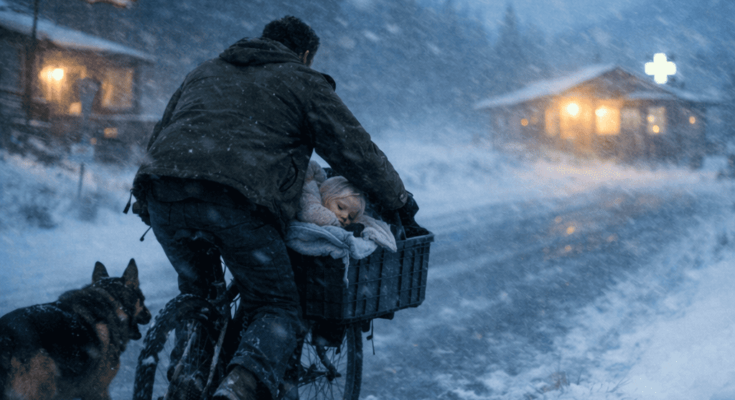
Outside, the snow had risen nearly a foot. David secured Sophie into a deep crate attached to the front of the bike, padding it with towels and wrapping a clear sheet of plastic loosely over the top to shield her from the snow. Her head lolled slightly, and he gently tilted it back into position.
David mounted the bike. His legs screamed with the first pedal.
Buddy bounded beside them.
The ride to the clinic was eight miles of winding roads, frozen potholes, and near-zero visibility. The snow whipped sideways, slapping David’s face with every rotation of the wheels. His breath came out in heavy bursts, each cloud immediately caught by the wind and shattered. His gloved hands gripped the handlebars so tightly they went numb within minutes.
Halfway through the ride, as they turned onto Route 36, a patch of open road stretched between the trees. That’s when the headlights hit them.
A silver SUV was parked on the shoulder, engine running, its windshield wipers flapping helplessly against the snow. Inside sat Ethan Jacobs, a 17-year-old high school senior with a mop of curly brown hair and a TikTok habit that rivaled his GPA. He had been livestreaming the snowstorm to his small online following, bored, restless, hoping for some “epic winter chaos.”
What he saw instead was David.
A man in a soaked military jacket pedaling like his life depended on it, snow pouring down in waves, a child barely visible in the basket in front, and a German Shepherd running beside them like a guardian wolf from another age.
Ethan went silent.
His followers began commenting furiously: “Who is that??” “Dude record that—omg that’s INSANE” “Please tell me that kid’s okay!”
He turned the phone to follow the blur of motion until it disappeared into the white wall of snow.
The clip ended there.
David’s muscles had long since given out. Now he ran on willpower alone. His knees buckled with every turn. Tears leaked from his eyes, both from the cold and from something deeper—fear, exhaustion, memory.
Buddy barked periodically, especially when they passed parked vehicles or crosswalks. It sounded almost like he was warning the storm itself to back off.
Sophie moaned once in her sleep. David bent down as much as he could. “Almost there, baby. Just stay with me.”
The last stretch to the clinic was a steep uphill. The wheels slipped in the slush. David got off and pushed, teeth clenched, back bent forward like a soldier carrying the wounded. Buddy growled at the wind.
At last, the faint green glow of the clinic’s emergency sign blinked through the snow. The light buzzed weakly, half-covered in icicles.
David burst through the last hundred feet and collapsed at the door, banging it with his elbow until it creaked open.
A nurse—young, tall, wearing scrubs beneath a heavy parka—rushed out. Her name was Elena Price, twenty-nine, thin, with freckles across her nose and eyes too tired for someone her age. She had been working a double shift, running low on caffeine and patience, but the sight on her doorstep stunned her.
David held Sophie out with trembling arms. “Fever… all night… please.”
Elena shouted for a doctor. Another nurse emerged, and they gently took Sophie from his arms and disappeared into the warmth of the hallway.
David sank to his knees in the snow, breathing heavily, vision swimming.
Buddy lay down beside him, pressing against his side, as if reminding him he wasn’t alone.
Inside, monitors beeped, warm air circulated, and someone wrapped Sophie in heated blankets. Elena glanced back through the glass door and whispered, more to herself than anyone else, “That man just biked through a blizzard for his child. He’s not just a father—he’s a damn hero.”
The snowstorm passed, but its imprint lingered long after the roads were cleared.
In the days that followed, the image of a man pedaling through a blizzard with a child swaddled in an army coat and a German Shepherd racing beside him spread across the internet like wildfire. The video—shaky, grainy, and no longer than forty-five seconds—was enough to stir something across state lines and screens.
It was Ethan Jacobs’ livestream that did it.
A teenager’s spontaneous video became a symbol: the embodiment of resilience, sacrifice, and unspoken love. Someone dubbed it “Blizzard Ride.” Others simply called it “The Father.”
By the end of the week, national news stations had picked up the clip. Articles surfaced with headlines like: “Ex-Marine Bikes Through Storm to Save Daughter” “The Quiet Hero from Estes Park” “Who Is David Miller?”
In the small clinic room, David sat quietly beside Sophie’s hospital bed, unaware of the storm outside the hospital walls—this time, a digital one. Sophie’s fever had broken. She was sleeping soundly, cheeks returning to a healthy shade of pink. Her hand, small and warm, rested gently atop Buddy’s head, the dog snoring lightly on the hospital floor.
Elena Price, the nurse who had first received them, entered the room holding a tray. She was wearing a new pair of scrubs, this time blue with small stethoscopes patterned along the sleeves. Her freckles stood out more under the fluorescent lighting, and her tired eyes now carried a softness.
“You didn’t eat your breakfast,” she said, setting the tray near David’s chair.
David shook his head. “She’s okay now. That’s enough.”
Elena pulled over a chair. “You’ve got a stack of letters and two gift baskets waiting at the front desk. Someone sent you a thermal sleeping bag… another one sent socks. Like, really good socks.”
David blinked. “Why?”
Elena laughed quietly. “You really don’t know what’s happening, do you?”
He shook his head again, slower this time.
She picked up her phone, scrolled a moment, then turned it toward him. The video. The view count. The hashtags. And the graffiti.
He stared at it, mouth slightly open, but no words came.
Meanwhile, across the country, in a high-rise apartment in downtown Chicago, Rachel Evans sat at a marble countertop with a cup of black coffee untouched beside her. Her silk robe—cream-colored with gold embroidery—hung loosely around her thin frame. She had lost weight. Her cheekbones were sharper now, her eyes darker, less from eyeliner and more from lack of sleep.
The apartment had everything she thought she wanted: stainless steel appliances, floor-to-ceiling windows, a view of Lake Michigan. But none of it felt grounded. The whole place was so quiet it made her ears ring.
She scrolled through her iPad, reading the headline that had now circled to her news feed multiple times.
She hadn’t watched the video until that morning. Now she watched it on a loop.
There he was—David—his silhouette hunched over the handlebars, pushing through the snow with desperation. Buddy keeping pace. And there, in the makeshift basket, wrapped in that old army jacket, was Sophie.
Even blurry, even distant, Rachel recognized her daughter’s eyes.
She put the iPad down and pressed both hands over her face. The sob started deep in her chest and rose like an old memory too long buried.
That look. The way Sophie rested against David, trusting without question.
Rachel used to be that person. Used to be the one Sophie leaned into at night. But she had left. Not just physically, but in the way that mattered.
In Estes Park, the town responded in its own way. The local school where Sophie would eventually attend had a mural painted on the brick wall facing the playground. It showed a father pushing a bicycle against a snowy background, a child wrapped in blankets in front, and a loyal dog bounding beside them.
Above it, in bold white letters, someone had written: “Family is where people don’t leave.”
David saw it one afternoon when he rode into town to pick up groceries and new gloves for Sophie. He stood across the street, staring at it for a long time. Buddy sat beside him, tail thumping in slow, steady beats.
Several passersby stopped and nodded at him—some smiled, others didn’t speak but offered warmth in their eyes.
Tommy Gutierrez, the garage owner, caught up with him outside the store. Tommy wore his usual denim jacket and oil-stained cap. He handed David a brown envelope.
“Mail came to the shop. Figured you’d want it.”
David nodded, took it silently.
“You okay with all this?” Tommy asked, motioning toward the mural.
David didn’t answer right away. “I didn’t ask for it.”
“No, you didn’t,” Tommy agreed. “But maybe it found you anyway.”
At home, the impact of the storm became tangible. Donations poured in, not in cash but in what mattered more. A team from a veterans’ outreach program showed up to fix the roof. Another crew replaced the broken window and repaired the old water heater.
Boxes of clothes and warm bedding arrived on the porch with no return addresses.
Sophie now had a proper winter coat—a deep purple one with a faux-fur hood. She insisted on putting it on inside the house, spinning in circles and laughing while Buddy barked and chased her in loops.
One afternoon, a local journalist knocked on the door. She introduced herself as Claire Bentley, early thirties, petite, with short curly red hair and thick-rimmed glasses. She had a kind, slightly nervous energy, and carried a worn leather notebook instead of a camera.
“I’m not here to do a story unless you want one,” she said. “People just want to know how you’re doing.”
David stood in the doorway, arms crossed, Buddy beside him like a quiet bouncer.
“We’re fine,” he said, then added, “We’d like to be left alone now.”
Claire nodded without offense. “If you ever change your mind, here’s my card.”
She handed it over, then backed away.
David didn’t look at the card until later that night. It sat on the kitchen table beside the notebook he used for letters to Sophie. He didn’t throw it away.
The first frost of December clung to the windowpanes of the small wooden house like lace spun by winter’s hand. The town of Estes Park had grown quiet, tucked beneath the hush of low-hanging clouds and chimney smoke curling into pale skies.
David had started repairing the front porch, replacing old boards with donated planks, his breath puffing white into the air with each steady hammer swing. Sophie sat nearby, bundled in her purple coat, coloring on the steps with sidewalk chalk that barely worked in the cold. Buddy lay at her feet, tail flicking as he watched a squirrel dart across the snow-dusted yard.
They didn’t see the car at first.
It was a sleek silver sedan—clearly out of place on the cracked gravel road—its paint polished to a mirror shine, tires humming too quietly for the wind to catch. It came to a slow stop across the street.
For a moment, it just sat there, its windows dark.
Then the door opened.
Rachel Evans stepped out slowly, clutching a small pink gift bag in her left hand. Her long chestnut hair had been pulled into a neat low bun. Her makeup was soft, minimal, and expertly done—but up close, one would see the fine lines etched around her mouth, the way her shoulders hunched slightly beneath the expensive wool coat, like she was bracing for something.
She wore tall suede boots, impractical for snow but elegant, and a silk scarf that fluttered in the breeze.
She had hesitated for days before coming. But after the video, after the mural, after the silence that filled every inch of her apartment like fog, she had realized she couldn’t keep watching from afar.
She had to face what she had left behind.
David spotted her first. His grip on the hammer tightened, but he said nothing.
Sophie looked up next, following his gaze. Her expression was neutral at first—confused more than anything.
Buddy stood, growled low, then went silent and sat back down, gaze fixed.
Rachel stepped closer. “Hi,” she said softly.
David lowered the hammer, straightened up. “You’re back.”
“I just… I wanted to see her.”
There was no venom in his voice. Just a plain, hollow acknowledgment, like the taste of cold water.
Sophie rose slowly. She squinted at the woman, tilting her head slightly, as if searching for a memory that refused to click into place.
Rachel stepped forward, crouched down, and held out the pink bag. “I brought you something, sweetheart. A doll. She’s got brown hair and a purple dress, just like you used to like.”
Sophie looked at it, then looked up at David, then over to Buddy.
After a pause, she stepped back and turned, walking quietly to the dog and wrapping her arms around his neck. Buddy nuzzled into her shoulder without a sound.
Rachel didn’t move.
The silence was broken by the creak of a gate.
From the side of the yard came Martha Grayson, wearing a quilted housecoat and rubber boots, her gray hair tucked under a knit hat. Her eyes, always sharp behind her oval glasses, narrowed as she took in the scene.
Martha had always been protective of the Millers—perhaps too much so—but grief gave her a fierce sense of loyalty. She approached slowly, not with aggression, but with a firm voice sharpened by age and truth.
“I don’t know what you’re here to do,” she said to Rachel. “But if it’s just to poke around and leave again, don’t.”
Rachel turned, startled. “I didn’t come to cause problems.”
Martha nodded. “Good. Then maybe you’ll understand when I say that little girl’s learned to live without you. Don’t teach her to unlearn that unless you’re ready to stay through the hard parts.”
Rachel lowered her gaze. “I just want to talk to her.”
“She’s not ready to talk,” David said suddenly. His voice was low, steady. “And honestly… neither am I.”
He didn’t say it with malice, just resignation—like someone who’d been holding a fragile vase together with one hand and didn’t want another reaching in and shaking it loose.
Rachel’s hand trembled. She placed the doll on the porch railing and reached into her coat pocket, pulling out a small folded letter. She hesitated, then stepped to the mailbox and slipped it in.
“I wrote something… for her. If she ever wants to read it.”
David didn’t reply.
Rachel turned back toward her car, then paused. Her breath steamed in the air.
“I used to tell her fairy tales,” she whispered, almost to herself. “About how no matter what happened, her family would always be there. I don’t think she believes in them anymore.”
David looked at her. “That’s the thing about fairy tales. They’re easy to tell and hard to live.”
Rachel nodded slowly, eyes glossy. “I’m sorry.”
Then she walked away.
Sophie didn’t look back. She sat with Buddy, stroking his fur, her chalk forgotten and melting into the wet wood.
David watched Rachel drive away, the taillights disappearing down the road. He waited until the quiet returned, then opened the mailbox and took the letter. He didn’t read it. Just placed it gently in the drawer beside the stove, next to unpaid bills and Sophie’s crayon drawings.
That night, as they had every night for the past month, David tucked Sophie in. She didn’t ask about the woman. He didn’t offer anything.
Instead, he sat beside her bed while Buddy lay across the doorway like a living barrier to the world. When the girl finally fell asleep, David reached into his pocket and pulled out a screwdriver—the last board on the porch still needed tightening.
He worked quietly, methodically, and with each turn of the wrist, tried to imagine what healing sounded like.
It wasn’t a grand speech. It wasn’t forgiveness offered or demanded. Sometimes it was just a silence left undisturbed.
The wind was quieter than usual that morning. A heavy blanket of clouds stretched across the Colorado sky, but there was no snow—only the pale, dry cold that made the earth feel still. The wooden fence creaked faintly in the breeze, and somewhere deep in the pine trees behind the house, a lone crow called out before going silent again.
David woke early, as he always did, long before Sophie stirred. He brewed a pot of black coffee, the smell curling through the kitchen and wrapping around the soft ticking of the wall clock. Buddy followed him as he moved through the house, the old dog’s nails clicking against the floor.
His steps had grown slower, more deliberate—he was getting older now, gray creeping along the edges of his ears and muzzle.
David opened the front door and leaned down to collect the small stack of mail wedged into the rusty mailbox. Bills. A catalog he didn’t remember subscribing to. A plain, cream-colored envelope with no return address, folded perfectly in thirds.
It had no postage stamp. Someone had placed it there by hand.
He didn’t have to guess who it was from.
Buddy sniffed at the envelope, then gave a soft, uncertain whine and gently took it in his mouth. He padded into the house and dropped it neatly at David’s feet, as if delivering a message that didn’t want to be opened.
David stared at it for a long moment.
The envelope was sealed with a single piece of scotch tape. Nothing fancy. The handwriting was familiar—Rachel’s. Small, neat, and slightly slanted, just the way she used to write grocery lists and birthday cards.
On the front, it read only: “For Sophie.”
He sat down at the kitchen table, sunlight barely pushing through the frosted windows behind him. His hands hovered over the envelope before slowly peeling the tape open. He unfolded the letter inside.
It wasn’t long.
“Sophie, I don’t know if you remember how I used to braid your hair before bed. I don’t know if you still sleep with Captain Bear. I don’t know how you laugh now, or if you still like stories about princesses and trains. I’m sorry. I left when I should have stayed. I thought I was choosing peace, but I chose silence. And now I know silence isn’t peace—it’s just a place where love doesn’t speak loud enough. I won’t ask you to forgive me yet. But I hope, one day, you’ll read this and know I never stopped thinking of you. I’m not where I should be. Not yet. But I’m trying to find the way back. Love, Mommy.”
David read it once. Then again.
He folded it carefully, slowly, and rose from the table. In the corner of the living room sat an old wooden box—once a military footlocker, now holding things he never quite found the courage to throw away. Medals he didn’t display. Letters from buddies he hadn’t called in years. Photographs he couldn’t bear to hang.
He opened it and placed Rachel’s letter inside, next to a bronze campaign star and a photograph of himself and Buddy during deployment—sand in their eyes, grins half-buried in exhaustion. He closed the lid gently.
Later that afternoon, David picked Sophie up from Martha’s house. The older woman greeted him in her usual tart tone, her arms crossed over her patchwork sweater.
“She ate two helpings of stew and only spilled her apple juice once,” she reported. “You’re raising a tornado with a halo.”
David chuckled, thanked her, and took Sophie’s small gloved hand in his own.
As they walked home, Sophie looked up at him suddenly and asked, “Daddy, is Mommy still alive?”
The question hung in the cold air between them.
David didn’t respond immediately. His boots crunched softly in the snow before he finally answered. “Yes,” he said. “She’s alive. Just… still learning how to find her way back.”
Sophie didn’t ask more.
But that night, while David did the dishes and Buddy snoozed near the fireplace, Sophie sat at the kitchen table with a box of crayons. Her tongue poked out slightly in concentration as she drew on a piece of thick paper.
When she was done, she held it up to the light and studied it.
In the drawing, a small white house stood beneath a sky filled with swirling blue. In front of the house were three figures—one tall, one small, and one with four legs and pointed ears. The tall figure had short brown hair and held the small one’s hand. Beside them, the dog sat proudly.
To the right of the drawing, a space was left blank. No figure. Only a faint outline in gray.
At the bottom, in red crayon, Sophie had written: “If Mommy stands long enough at the door, I will open it.”
She placed the drawing on the fridge with a magnet shaped like a bear.
David saw it an hour later and stood there for a long time, not speaking, just looking. He didn’t say anything to Sophie about it. Just kissed her forehead that night a little longer than usual, and watched her as she fell asleep with Captain Bear tucked beneath her chin.
Buddy, ever faithful, curled up at the foot of her bed, one ear twitching as if he, too, was waiting for someone who hadn’t yet knocked.
The snow in Denver had come early that year, soft and wet like the kind that blanketed sidewalks but melted before noon. The city, larger and louder than Estes Park, buzzed with movement and warm breath in cold air. Holiday lights clung to lampposts, and coffee shops smelled like cinnamon and burnt espresso.
But in the quiet warmth of the Willow Creek Community Hall, the world was slower. Calmer.
David Miller sat on a folding chair backstage, his palms slightly damp, his heart tapping a steady rhythm behind his ribs. He wasn’t a man afraid of combat or pain. But this was different. This was baring something no one could see.
He clutched a small weathered notebook in his hand — not to read from, but to hold onto like a life vest.
The letter had come three weeks earlier, embossed with the seal of the National Veterans Council. The invitation was formal, elegant, and filled with praise he didn’t know how to receive.
“We invite you to speak at our upcoming symposium ‘War and What Remains.’”
He’d folded it and shoved it in a drawer, content to ignore it. Until Sophie asked the question.
“Daddy,” she said one night, tugging on the sleeve of his flannel shirt, “you tell me stories from the war before bedtime. Why won’t you tell them to grownups, too?”
David didn’t have an answer. Just stared at her as she hugged Captain Bear tight against her chest, her brown eyes wide and sincere.
So now he was here. Not to be celebrated. Not to be thanked. But to tell the truth.
The emcee — a woman in her fifties with sharp eyes and graying dreadlocks pulled into a high bun — introduced him with reverence. Her name was Dr. Lydia Grant, a psychologist and Vietnam veteran’s daughter who now ran reintegration programs for returning soldiers.
“Today’s speaker is someone many of you know from a story that captured the country’s heart,” she said. “But what you don’t know is what he carries behind that image — the truths that live beneath the quiet.”
David stood, tall and lean in his pressed gray shirt and navy blazer. His once military-short hair had grown out, now peppered with silver around the temples. There was a new calm to his posture — not peace exactly, but steadiness. Sophie had helped build that in him.
She sat in the front row now, legs swinging in her seat, wearing the sky-blue dress he had ironed the night before with all the concentration of a soldier prepping for inspection. She held Captain Bear on her lap, the little bear now dressed in a custom-made miniature uniform with his own set of faux medals. Buddy lay at her feet, his large frame curled into a tidy watchful shape, his ears twitching every time someone shifted in their seat.
David didn’t speak right away.
When he did, his voice was low and measured, the cadence of a man who’d learned to pick his words with care. “I’m not here to talk about strategy, politics, or medals,” he began. “I’m here to talk about what doesn’t go away.”
He spoke about Bobby — his first friend in boot camp — and how they used to trade letters from home. Bobby died in an ambush during a supply run. David still remembered the way his hands shook as he zipped the body bag.
He spoke about the sixteen-year-old boy with trembling hands and wide eyes who raised a rifle in panic — a moment where instinct and regret became lifelong companions. “I don’t know that boy’s name,” he said. “But he visits me more than most people do.”
The audience was silent. No coughing. No rustling papers. Only stillness.
David’s eyes shifted to Sophie, and then back to the room.
“My hardest battle wasn’t over there. It’s here. It’s learning how to be a dad who can teach his daughter how to sleep in the sound of wind, not the sound of gunfire.”
The room didn’t erupt when he finished. It breathed — in, out, in, out — as if every person in those rows needed a moment to return from wherever his words had taken them.
Then someone stood.
A tall man in his sixties, stooped slightly with the help of a worn oak cane. His name was Richard Haynes — a Gulf War vet whose right eye was cloudy with an old injury. He cleared his throat.
“Thank you,” he said. “For reminding me that some wars don’t end with silence. They keep echoing. And the bravest thing we can do is speak over them.”
Then others stood. One by one. No cheering. Just quiet, heartfelt applause that built like a slow tide.
Not for a hero. But for a man who dared to be honest.
Afterward, while Sophie played with Buddy outside the doors, chasing him through flurries of snow beneath a bare-limbed tree, David was approached by a group of younger veterans. They were from a transitional housing unit in Aurora — men in their twenties and early thirties, each carrying something different but equally heavy.
One introduced himself as Luis Ortega, short and wiry with tired eyes and tattooed knuckles. He said, “You didn’t sound like a hero up there. You sounded like my brother. Like me.”
Another, James Thorne, lanky and quiet with a nervous stammer, asked if David would be willing to visit the unit sometimes. “Not as a counselor. Just… someone who gets it.”
David didn’t answer right away. Then he nodded once. “Yeah. I can do that.”
He didn’t want to become a symbol. But maybe he could become a bridge.
That night, back in Estes Park, Sophie laid Captain Bear gently on her pillow.
“Did I do okay?” David asked, brushing her hair back.
Sophie smiled. “You did better than bedtime stories.”
Snow had fallen through the night in Estes Park, the kind that piled softly on windowsills and muffled the world into silence. By morning, every rooftop was capped in white, and the streetlamps wore halos of frost.
Inside the small wooden house at the edge of the pines, the warmth of cinnamon and pine needles curled through the air like a memory gently stirred.
It was Christmas morning.
For the first time in years, there stood a small tree in the corner of David’s living room. It was modest, a six-foot pine he and Sophie had cut down together from the edge of a neighbor’s property with permission. The trunk was slightly crooked, and the branches too sparse in places, but to Sophie, it was perfect.
David had strung up a simple line of warm yellow lights and a few ornaments they’d found at a thrift store. There was a handmade paper star at the top—Sophie had cut and colored it herself, glitter clinging stubbornly to her fingers for days afterward.
Beneath the tree sat three wrapped presents: a secondhand sweater, a wooden puzzle in the shape of Colorado, and a new leash for Buddy.
And then there was the card.
Sophie had hung it herself: a white Christmas card with silver lettering that read, “May love find you this season.” Inside was Rachel’s handwriting, soft and looping, the ink slightly smudged as if tears had landed before it dried.
She hadn’t returned, but the card had arrived without warning two weeks before. No return address. Just “To Sophie” on the front.
David had asked her once if she wanted to write back. Sophie had shaken her head and simply said, “She knows where the door is.”
He respected that.
The card now hung near the center of the tree.
Next to it, on the fireplace mantel, rested a small wooden box. Inside, neatly arranged, were the letter Rachel had left long ago, David’s campaign medals, and now, a red-and-gold badge shaped like a paw print.
It was Buddy’s.
The town council had given it to him the week before, during the annual Winter Honor Ceremony at the town square. They had called it “The Medal of Loyalty,” engraved with the words: For service beyond the call of instinct.
Buddy hadn’t cared much for the ceremony—too many people, too many cameras. He had sat stoically by David’s side, tail gently thumping only when Sophie hugged him tight.
The mayor, a short, round man named Gerald Winslow with wispy gray hair and a booming voice, had declared, “Buddy reminded us all of what silent courage looks like.”
The townspeople applauded. Buddy sneezed and looked unimpressed.
Now, lying beneath the tree, his greying head resting on his front paws, Buddy dozed while Sophie spun circles in her socks across the hardwood floor.
“Want to hear my poem again, Daddy?” she asked, stopping in front of David, who was sipping coffee by the window.
He smiled and nodded.
Sophie cleared her throat dramatically, then pulled a crumpled paper from her sweater pocket and began. “My daddy’s not Santa, but he can fix things just as well— Like broken toys, and scary nights, and hearts where shadows dwell.”
David blinked hard and smiled, his eyes shining with something warmer than the fire behind him.
Sophie beamed. “Mrs. Callahan said I could read it at the winter concert.”
Mrs. Callahan was Sophie’s teacher — a tall, willowy woman in her late thirties with a kind, tired smile and a voice like a lullaby. She had been one of the first people in town to welcome David and Sophie quietly, leaving school flyers in their mailbox and extra mittens on the porch when the cold came early.
Her own husband had served in Iraq and never come back. She understood more than she said.
As the morning sunlight stretched across the snow outside, David glanced at the far wall of the living room where Sophie’s drawings were proudly taped. There, at the center, was one in particular — a simple scene drawn in crayon.
Two figures stood side by side: one tall, one small. Both smiling. Beside them sat a big brown dog with pointed ears and a pink tongue.
Above them, a sun peeked from the corner, and beneath, in crooked letters, were the words: “This is what home looks like.”
David felt something settle in his chest — not closure exactly, but acceptance. Peace, not because the story had ended perfectly, but because it had continued.
That night, when Sophie had long gone to sleep and Buddy had curled up on the rug near the fire, David stepped outside. The sky was clear now, a thousand stars scattered like shattered glass across a velvet backdrop. His breath fogged in the air as he looked up.
He didn’t feel alone anymore.
There was no Rachel in the doorway, no promise of return or fairytale reunion. But there was a girl who believed he could fix things, a dog who had never once left his side, and a town that had come to see him not as the man broken by war, but the father rebuilt by love.
And that… was enough.
In the quiet stillness of winter, when it seemed only sorrow and separation remained, a miracle unfolded—not in flashes of lightning or divine thunder, but in the small, steady acts of love: a handwritten apology, a loyal dog who never left, a little girl who believed her father could fix anything, and a soldier who found healing not through forgetting, but through telling the truth.
God doesn’t always show up in storms or shining lights. Sometimes, He comes in the form of a single father drying his daughter’s tears, in the silent footsteps of a dog standing guard, or in a child’s hand drawing a picture of home.
Whether you’re walking through darkness or dancing in light, remember: miracles don’t always change our circumstances—sometimes, they change our hearts just enough to carry on.
Comment “Amen” if you believe God still works miracles in the lives of those who endure. Share this story with someone who needs a reminder that love and loyalty can rebuild even the most broken places. Subscribe to this channel for more soul-healing stories about faith, family, and second chances.
And may God bless you and your loved ones, in every quiet battle and every unexpected joy. Because sometimes, the miracle… is the one who stayed.