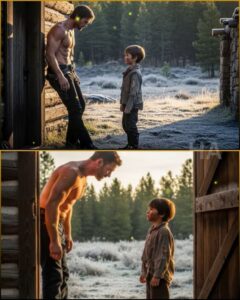
Clayton set the cup down slowly and reached for the shotgun that leaned beside the doorframe. He didn’t shoulder it. He didn’t point it. He just held it the way a man held an umbrella in a storm, out of habit and hard-earned caution.
He crossed the cabin in two strides and cracked the door.
Wind knifed in. Snow swirled at his boots.
And there, on the porch, was a boy.
Maybe eight years old. Maybe younger. The kind of thin that wasn’t just a lack of food, but a lack of safety. His cheeks were raw and red from the cold, his eyelashes rimed with ice. He wore a jacket that was too small and gloves that looked like they’d once belonged to a grown man.
His eyes, though, were huge. Not with wonder.
With panic.
He stared up at Clayton like he’d walked straight into a legend and had no time to be impressed.
“Sir,” the boy said, and his voice cracked right down the middle. “They beaten my mama.”
Clayton’s grip tightened on the door edge. “Who’s ‘they’?”
The boy swallowed hard, as if the words were sharp. “Men. From… from the ranch. The one down the valley.”
Clayton felt something in his chest shift. A small, ugly memory stirring.
“What’s your name?” Clayton asked, forcing his voice to stay level.
“Eli,” the boy whispered. “Eli Carter.”
“And your mama?”
The boy turned his head, as if he was afraid to look back because looking back would make it real. “She… she’s in our cabin. She’s sick. And she’s bleeding. She said don’t go. But she got real quiet, and I—” His breath hitched. “I didn’t know where else to go.”
Clayton’s eyes flicked over the boy’s sleeves. Bruises. Old, yellowing, and newer, purple. On his neck, there was a thin scratch like a fingernail.
Clayton’s jaw locked.
He opened the door wider.
“Come inside,” he said.
Eli didn’t move. Not at first. His gaze darted behind him, into the woods, like he expected something to come charging out of the dark.
Clayton saw it then, too.
The way the boy’s whole body was braced for punishment.
Clayton lowered the shotgun gently and leaned down, keeping his movements slow. “Kid,” he said, softer now, “you’re safe on my porch. You hear me?”
Eli’s eyes filled, but he blinked hard, stubborn. “Yes, sir.”
Clayton stepped back, giving the boy room to choose. “You can warm up first,” he offered. “Then you can tell me where your cabin is.”
Eli finally moved, stumbling across the threshold like his legs were borrowed. The warmth inside hit him so fast he swayed.
Clayton caught him by the elbow. Eli flinched.
Clayton froze. Released him immediately. “Sorry,” he muttered. “I won’t grab you.”
Eli stared, confused, like he didn’t understand a grown man apologizing.
Clayton shut the door against the storm and set a log on the coals. Flames licked up, bright and sudden, painting Eli’s face in gold and shadow.
The boy’s lips trembled. “Can you… can you help her?”
Clayton didn’t answer right away, because the answer was already in motion inside him. He crossed to the stove, filled the kettle, set it on to boil, then grabbed a lantern and a thick wool blanket from a hook.
“You eat,” Clayton said, pulling a chunk of bread and a jar of peanut butter from a shelf. “Right now.”
Eli looked at the food like it might vanish if he blinked.
Clayton shoved a spoon into his hand. “Eat. And tell me where.”
Eli’s mouth worked, but no sound came. Then he blurted, “It’s past the creek, by the dead cottonwood. Our roof leaks in the corner. Mama put a pot under it, but it froze.”
Clayton nodded. “Good. You stay here by the fire.”
Eli’s eyes widened. “You’re going?”
Clayton grabbed his coat. “I’m going.”
“But… but you don’t even know us.”
Clayton paused at the door, the lantern in one hand, his coat half on. He glanced back at the boy, at the bruises, at the desperation that didn’t belong on a child.
“I know enough,” he said.
And then he stepped into the storm.
The mountains tried to stop him.
Snow came down in thick, blinding sheets. The wind shoved at him like it had hands. Clayton moved anyway, boots crunching over drifts, lantern swinging, a dark silhouette against the white.
As he walked, his mind filled in the spaces Eli’s words couldn’t.
Men from the ranch.
There were a few ranches in these parts, but only one that inspired fear the way thunder inspired prayer: Black Hollow Ranch, run by a man named Wade Kincaid.
Kincaid didn’t own the valley on paper. He owned it in the way wolves owned territory. People learned where not to step.
Clayton had kept his distance from Black Hollow for years. He’d made his own fences, his own deals, his own quiet life. He told himself that staying out of other people’s trouble was the only way to keep what little peace he had left.
But a boy knocking in a storm didn’t feel like “other people.”
It felt like the world putting its weight on Clayton’s door and asking what kind of man he still was.
He found the creek by sound first, a faint rush beneath ice. Then he spotted the dead cottonwood, its branches twisted like fingers.
The cabin beyond it was barely a cabin at all. One room. Crooked chimney. A door that looked like it had been kicked more than once.
Clayton’s throat tightened.
He pushed it open.
Inside, the air was colder than it should have been. The fire had gone out. A thin blanket lay on the floor near the stove, and on that blanket was a woman.
She was curled on her side as if trying to fold herself small enough to disappear. Her hair was dark, loose, damp with sweat. Her face was swollen on one side. There was dried blood at her lip.
Her eyes were half open, unfocused.
Clayton crouched beside her. “Ma’am,” he said. “Can you hear me?”
Her gaze flickered toward him. A weak attempt at alarm.
“No,” she whispered, and the word sounded like a plea and a warning at the same time. “Don’t… don’t bring trouble.”
Clayton’s jaw clenched. “Eli brought it already.”
Her lashes fluttered. “Eli… where—”
“He’s safe,” Clayton said. “At my place. Warm.”
Her face crumpled with relief so sharp it looked like pain. “Thank you,” she breathed, and then she coughed, a wet, shaky sound that made Clayton’s stomach turn.
He carefully slid an arm under her shoulders. She flinched but didn’t fight him.
“What’s your name?” he asked.
“Marian,” she whispered. “Marian Carter.”
Clayton lifted her, surprised by how light she was. A grown woman should not weigh this little.
She tried to speak again, but her head lolled, exhaustion dragging her under.
Clayton wrapped her in his thick wool blanket, scooped her up, and carried her into the storm.
The mountains watched, silent and cold.
But for the first time in a long time, Clayton didn’t feel alone out there.
He felt… responsible.
Back in Clayton’s cabin, Eli shot up from the floor the moment the door opened.
“Mama!” he cried, scrambling forward, his hands reaching and hovering, afraid to touch.
Clayton laid Marian on his bed, the cleanest place in the cabin, and fed the fire until it roared.
Marian’s eyes opened again, clearer now as warmth touched her skin. She looked around, frightened, her gaze landing on Eli.
“Baby,” she whispered, voice cracking. “You shouldn’t have—”
Eli climbed onto the bed and pressed his forehead against her shoulder, careful. “You was dying,” he choked out. “I couldn’t just watch.”
Marian’s hand trembled as she cupped his cheek. “I’m here,” she said, though the words sounded like a promise she wasn’t sure she could keep.
Clayton set a pot on the stove and began heating water. He moved with quiet purpose, the kind of efficiency born from years of doing hard things without help.
Marian watched him. “You didn’t have to.”
Clayton didn’t look at her. “Drink this when it’s ready.”
“What is it?” Eli asked.
“Willow bark,” Clayton said. “And some dried mint. It’ll help the fever and the pain.”
Marian’s eyes narrowed slightly. “You know remedies.”
Clayton’s hands stilled just a fraction. “Had to. Once.”
The silence that followed was thick, but not hostile. More like a door neither of them was ready to open.
Clayton brought Marian the bitter tea, lifting the cup to her lips. She drank in small, obedient sips, grimacing at the taste. Eli watched every swallow like it was a miracle.
After the tea, Clayton took a clean cloth and gently wiped Marian’s face, washing away dried blood. When he touched the bruise swelling along her cheekbone, Marian hissed softly.
“Sorry,” Clayton muttered.
Marian studied him, her breathing shallow but steadier. “You live out here alone?”
Clayton shrugged. “Mostly.”
Eli’s voice was small. “You got a family?”
Clayton’s gaze shifted to the fire. For a long moment, he didn’t answer.
Then he said, “I used to.”
The words dropped into the room like stones into deep water.
Eli swallowed. “What happened?”
Clayton’s jaw tightened. “Winter happened.”
Marian’s eyes softened in a way that told Clayton she understood without needing details. Loss recognized loss like wolves recognized pack scent.
She turned her face toward the wall, fighting tears.
Clayton moved away, pretending he hadn’t seen.
Two days passed with the storm.
In that time, Marian’s fever rose and fell like a tide, but each time it came back, it came back weaker. Clayton kept her warm, kept her drinking tea, kept her breathing steady. Eli stayed close, sleeping on the floor beside the bed, one hand always on the blanket like he could hold her to this world by sheer stubbornness.
Clayton watched them without meaning to.
He told himself it was practical. He needed to make sure Marian didn’t worsen. He needed to know if Eli was sick, too. He told himself it was just a temporary storm shelter, nothing more.
But some nights, when the fire snapped and the wind scratched at the windows, Clayton felt something strange and uncomfortable in his chest.
Not pain.
Not exactly.
More like… the fragile beginning of warmth.
On the third morning, the storm finally loosened its grip. The sky turned a washed-out blue, and sunlight fell across the snow in blinding sheets.
Marian managed to sit up.
Eli nearly cried from happiness. “See?” he said, voice bright, too loud. “I told you you wasn’t gonna die.”
Marian smiled faintly and brushed his hair back. “You’re bossy,” she murmured.
“I learned from you,” Eli said, and the way he said it made Marian’s smile falter.
Clayton pretended to be busy slicing jerky. “You can stand?” he asked Marian.
She tried, wobbling. Clayton was there before she could fall, but he stopped himself from grabbing her too hard, remembering Eli’s flinch.
He offered his arm instead, like a gentleman from another century.
Marian took it, surprised.
“Thank you,” she said quietly.
Clayton nodded once. “You need to eat more than tea.”
Marian lowered herself into a chair by the fire. The color in her face was still thin, like watercolor, but she looked alive.
Eli asked the question that had been boiling in him for days. “Why did they beat you, Mama?”
Marian went still.
Clayton’s knife paused mid-slice.
Outside, a raven called from a pine tree, harsh and judgmental.
Marian’s voice came out brittle. “Because I said no.”
Eli’s brow furrowed. “No to what?”
Marian stared into the fire like it might explain for her. “To leaving,” she said. “To giving up our cabin. To… to being quiet.”
Clayton’s eyes narrowed. “Kincaid?”
Marian flinched at the name. “Wade Kincaid doesn’t come himself,” she whispered. “He sends men. He sends threats in other people’s mouths.”
Clayton felt heat climb his spine, slow and dangerous. “What does he want with your land?”
Marian’s laugh was humorless. “He wants all land.”
Eli’s fists clenched. “He ain’t allowed.”
Marian pulled him close. “Baby, that’s not how the world works.”
Clayton surprised himself by saying, “It can be.”
Marian looked at him sharply.
Clayton kept his gaze on the fire. “What happened before you got hit?”
Marian’s throat bobbed. “They came again,” she said. “Two of them. Said the cabin was on Black Hollow’s grazing line now. Said I needed to sign some paper. I told them my husband built that cabin with his own hands. He’s buried in the little cemetery by town. I told them I wouldn’t sign anything.”
Her hands trembled in her lap, remembering.
“They smiled,” she whispered. “Like I was a joke they’d already heard. One of them grabbed Eli. He screamed. I… I swung a skillet. I didn’t even think.”
Eli leaned into her, ashamed and furious all at once.
Marian swallowed. “They got mad. They said… they said a woman alone doesn’t get to make demands.”
Clayton’s fingers tightened around the knife handle until his knuckles went pale.
Marian continued, voice shaking. “They hit me. Once, then again. Eli tried to fight them. They shoved him into the wall. They told me next time, they’d burn the cabin down with us inside.”
Eli’s eyes filled. “I told ‘em I’d bite.”
Marian kissed his forehead. “You did bite,” she murmured, and there was pride in her voice even through fear.
Clayton set the knife down with controlled care. “And if you go back,” he said, “they’ll come again.”
Marian’s shoulders sagged like she’d been carrying that truth alone for too long. “I know.”
Eli looked between them, desperate. “So we don’t go back,” he blurted. “We stay here.”
Marian’s eyes widened. “Eli—”
Clayton stared at the fire, at the dancing orange that made shadows look alive. He heard his own voice, rougher than usual.
“You can stay,” he said. “For now. Until we figure it out.”
Marian’s breath caught.
“Clayton,” she whispered, as if saying his name might break something fragile.
Clayton rubbed a hand over his jaw. “It’s a big cabin,” he muttered, like that explained why his chest felt tight. “And it’s winter. I’m not sending you back into a threat.”
Eli let out a sound that was half laugh, half sob. “You’re good,” he announced, as if he’d made a scientific discovery.
Clayton huffed. “Don’t start.”
But Marian’s eyes shone, and not just with gratitude. With the cautious, trembling disbelief of someone who had gotten used to doors staying closed.
The next week taught Clayton things he hadn’t expected to learn again.
He taught Eli how to split kindling without chopping off his own toes. Eli tried hard, tongue sticking out in concentration, and when he finally managed a clean split, he looked at Clayton like he’d just been handed a medal.
Marian, still weak, insisted on helping. She swept the floor, cooked what she could, mended a torn shirt with careful stitches. She did it with that stubborn dignity of a person who refused to be a burden.
One afternoon, Clayton came in from checking traps and found Marian at the table, staring at the window like she was listening to something beyond the glass.
“You hearing things?” Clayton asked.
Marian didn’t look away. “I’m remembering things,” she said quietly.
Clayton hung his coat. “Same difference.”
Marian’s mouth quirked. “You always this cheerful?”
Clayton grunted. “Only on holidays.”
She laughed, and the sound was small but real. It startled both of them.
Then Marian’s expression sobered. “They’ll come,” she said.
Clayton nodded once. “I know.”
“You don’t have to fight my battles,” Marian added. Her voice held a plea disguised as pride. “You’ve already done too much.”
Clayton leaned against the wall, arms crossed. “I’m not good at watching,” he said.
Marian’s brows lifted. “Watching what?”
Clayton looked at Eli across the room, bent over a piece of wood, carefully carving a lopsided horse the way Clayton had shown him. Eli’s face was fierce with concentration, like he was carving hope itself.
Clayton’s voice softened without permission. “Watching a kid learn to be afraid of breathing.”
Marian’s throat tightened. She looked down at her hands.
“You’re not safe either,” she whispered. “Kincaid doesn’t like men who say no.”
Clayton’s eyes were flint now. “Then he picked a bad man to push.”
Marian studied Clayton’s face, as if trying to read the scars behind his calm. “What did winter take from you?” she asked, gently, like she was touching a bruise.
Clayton’s gaze went to the rafters. For a long moment, he said nothing.
Finally, he spoke, voice low. “My wife, Nora. And my little girl, June.”
Marian swallowed, eyes shining. “I’m so sorry.”
Clayton nodded once, jaw tight. “Blizzard hit early. Road blocked. Fever. I rode for help anyway. Came back too late.”
Silence filled the cabin, heavy and sacred.
Eli looked up from his carving, sensing the change. “You miss them,” he said quietly.
Clayton’s throat worked. “Every day.”
Eli stood, walked over, and without asking, slid his small hand into Clayton’s big one. It was clumsy. Brave.
Clayton froze, then slowly closed his fingers around Eli’s hand like he was holding something precious and breakable.
Marian watched, tears slipping down her cheeks without sound.
And in that moment, the cabin didn’t feel like a hiding place.
It felt like the beginning of a home.
The problem with beginnings is that the world doesn’t always respect them.
On the twelfth day, Clayton saw the riders.
He was outside at dawn, breath fogging, checking the fence line where snow had drifted high. The sun was a pale coin behind clouds. He turned his head and spotted dark shapes moving between trees, too purposeful to be deer.
Two horses. Two men.
Clayton’s spine went rigid.
He walked back to the cabin quickly, not running, but the urgency in his stride could’ve lit a match.
Inside, Marian was stirring a pot of beans, Eli sitting at the table, drawing a picture with charcoal.
Clayton shut the door and latched it. “We’ve got company,” he said.
Marian’s face drained. “How many?”
“Two,” Clayton answered. “Maybe more behind.”
Eli’s hand froze mid-drawing. “Is it them?”
Marian didn’t answer, but her eyes did.
Clayton crossed to the mantle and pulled down his rifle.
Marian stepped forward. “Clayton… please don’t—”
Clayton met her gaze. “You and the boy go into the back room,” he said.
“We don’t have a back room,” Eli whispered.
Clayton’s jaw tightened. “Then you go behind the stove. Stay low.”
Marian swallowed hard. “Clayton, if they see you protecting us, they’ll come with more. They’ll—”
Clayton leaned closer, voice rough but steady. “They already came,” he said. “They already hurt you. I’m done with ‘what if.’”
There was a knock.
This one wasn’t pleading.
It was the kind of knock that expected obedience.
Clayton lifted his chin slightly, telling Marian and Eli with his eyes to move. Marian grabbed Eli’s shoulders and guided him behind the stove, pressing him close.
The knock came again, harder.
Clayton opened the door.
Cold rushed in, sharp as a slap.
Two men sat on horseback, bundled in coats that looked expensive even covered in snow. The first had a thin mustache and a smile like a knife. The second had a heavy jaw and eyes that didn’t bother pretending to be polite.
The mustached one tipped his hat. “Morning,” he called, voice cheerful in a way that made Clayton want to break something. “We’re looking for a woman and a boy.”
Clayton’s expression stayed blank. “Plenty of those in Montana.”
The man chuckled. “This one’s specific. Widow. Dark hair. A mouth that don’t know when to close.”
Clayton didn’t react, but inside him, something hot and old rose up.
The second man leaned forward in the saddle, peering past Clayton’s shoulder like the cabin belonged to him. “You got no visitors out here,” he said. “So don’t get cute. We know she ran this way.”
Clayton’s voice was calm. “If she did, maybe she had a reason.”
Mustache smiled wider. “She had a reason, alright. She owes Mr. Kincaid a signature.”
Clayton stepped out onto the porch, closing the door behind him, body blocking their view. “Tell Mr. Kincaid to get his own signatures.”
The second man’s eyes narrowed. “You Clayton Rusk?”
Clayton didn’t answer.
Mustache nodded like he’d just solved a puzzle. “Thought so. Heard you were hiding out like a wounded bear. Didn’t think you’d stick your neck out for someone else’s mess.”
Clayton’s gaze stayed steady. “You’re on my land.”
The second man’s voice dropped. “This ain’t about your land. This is about Mr. Kincaid’s patience. He ain’t got much left.”
Clayton’s breath fogged slow. “Then he should learn to breathe.”
Mustache laughed, but his eyes were cold. “Look, Rusk. We don’t want trouble. We just want the woman. She signs, we go.”
Clayton took one step forward, towering. “No.”
The second man shifted, hand moving toward his coat.
Clayton saw it.
Time slowed the way it did right before a horse bucked.
“Don’t,” Clayton warned, voice low.
The second man hesitated, then smirked like he wanted to prove something. His hand dipped again.
Clayton moved faster.
He yanked the man’s arm up by the wrist, twisting it just enough to make the man hiss and curse, not enough to break it. Clayton’s grip was iron.
Mustache’s smile vanished. “You just put hands on him.”
Clayton’s eyes were flint. “You came to my door with threats. You don’t get to stay comfortable.”
The second man tried to jerk free. Clayton didn’t let him. He leaned in close, voice so quiet it was almost kind.
“Here’s what’s going to happen,” Clayton said. “You’re going to ride back down that mountain. You’re going to tell Wade Kincaid that Marian Carter is under my roof. And if he sends anyone else up here, I’ll treat them like they’re trespassing wolves.”
Mustache’s face went tight. “You think you’re a hero?”
Clayton released the second man’s wrist, and the man recoiled, rubbing it. Clayton didn’t smile.
“I’m not a hero,” he said. “I’m a widower who’s tired of burying people.”
For a heartbeat, the only sound was wind and the horses snorting, uneasy.
Mustache’s eyes flicked to the rifle on Clayton’s shoulder. “Mr. Kincaid won’t like this.”
Clayton shrugged. “He can dislike it from far away.”
Mustache spat into the snow. “This ain’t over.”
Clayton nodded once. “No. It’s starting.”
The men wheeled their horses around, retreating into the trees.
Clayton stood on the porch until the last hoofbeat vanished.
Then he went back inside.
Marian came out from behind the stove like she’d been holding her breath for a year. Eli followed, eyes huge.
“They gone?” Eli whispered.
Clayton nodded, setting his rifle down.
Marian stared at him, trembling. “You shouldn’t have told them my name.”
Clayton met her gaze. “They already knew it.”
Marian’s voice cracked. “They’ll come with more.”
Clayton’s expression didn’t soften, but something gentle slipped into his tone. “Then we’ll be ready.”
Eli stepped forward, fists clenched. “I can help,” he insisted. “I can throw rocks.”
Clayton crouched to Eli’s level. “No,” he said firmly. “Your job is to stay alive.”
Eli swallowed, eyes wet. “My mama’s always trying to stay alive.”
Clayton’s throat tightened. He looked up at Marian.
Marian’s eyes shone with fear, but also something else.
Trust, fragile as new ice.
“What do we do?” she whispered.
Clayton exhaled slowly. “We stop pretending this is only your fight,” he said. “We take it to town.”
Marian blinked. “Town?”
Clayton nodded. “Hamilton’s got a sheriff. And a judge. And folks who’ve been afraid of Kincaid so long they forgot they’re allowed to get angry.”
Marian’s laugh was bitter. “Sheriff drinks at Kincaid’s bar.”
Clayton’s jaw tightened. “Then we don’t start with the sheriff.”
He walked to a small desk in the corner and pulled open a drawer. Inside were papers, neatly stacked, like he’d kept them waiting for a day he didn’t want to face.
Marian watched him. “What’s that?”
Clayton’s voice was rough. “Deeds. Old surveys. Land lines. Kincaid’s been pushing fences for years. I’ve kept records.”
Marian stared. “Why?”
Clayton’s eyes flicked to Eli, then back. “Because my wife used to say, ‘If you don’t write the truth down, a liar will write something else.’”
Marian swallowed hard.
Clayton lifted the stack of papers. “We go to a lawyer in town,” he said. “Not one Kincaid owns. There’s an older woman, Marla Baines. She hates Kincaid on principle and caffeine alone.”
Eli blinked. “Caffeine?”
Clayton huffed. “Coffee. Come on.”
The smallest smile tugged at Marian’s mouth despite everything.
And that, right there, was why Clayton was doing this.
Because fear had been living in Marian’s bones too long.
Because a child shouldn’t know what it felt like to beg a stranger for help.
Because sometimes, the only way to honor the people you lost was to protect the people still breathing.
They left at dawn the next day.
Clayton hitched his strongest horse to the sled and wrapped Marian and Eli in blankets. The cold bit hard, but the sky was clear, and the mountains looked almost peaceful, as if they hadn’t tried to kill anyone a week earlier.
Eli leaned into Marian, whispering questions about town like he was trying to imagine a world where men didn’t show up with papers and fists.
Marian kept her gaze on the horizon, jaw tight, like she expected a shadow to move wrong.
Clayton drove the sled with steady hands.
When they reached Hamilton, the town looked normal. That was the cruelest part. Smoke from chimneys. A dog barking. Men laughing outside the general store like winter and violence were things that happened to other people.
Clayton pulled the sled to a stop outside a small office with a worn sign: BAINES LAW.
Inside, the air smelled of paper and lemon polish. An older woman with sharp eyes looked up from her desk and blinked at Clayton.
“Well,” Marla Baines said, dry as dust. “If it isn’t the mountain ghost.”
Clayton nodded. “Morning.”
Marla’s eyes shifted to Marian and Eli. Her expression changed, the sharpness turning into something like steel.
“What did Wade do?” she asked, not bothering with politeness.
Marian’s voice trembled. “He sent men,” she said. “They tried to force me to sign.”
Marla’s jaw tightened. “Sit,” she ordered, gesturing to chairs. “All of you.”
Clayton set the papers on her desk.
Marla flipped through them with quick, practiced fingers. Her eyebrows rose. “You’ve been collecting,” she murmured.
Clayton’s voice was quiet. “I’ve been watching.”
Marla looked up. “Good. Because watching is how you learn where to aim.”
Eli stared at her. “You gonna stop him?”
Marla leaned forward slightly, eyes softening just for the boy. “Honey,” she said, “I’ve been waiting for somebody brave enough to bring me a reason.”
Marian’s breath shook. “What can we do?”
Marla tapped the papers. “We can do paperwork,” she said, and then her eyes narrowed. “And we can do witnesses. And we can do something Kincaid hates most.”
Clayton’s gaze sharpened. “What’s that?”
Marla smiled without humor. “We can drag him into daylight.”
By afternoon, word spread the way word always spread in a small town: faster than honesty, slower than fear.
Kincaid’s men heard. Kincaid heard.
Clayton knew because when they stepped out of Marla’s office, a black wagon sat across the street, and Wade Kincaid himself stood beside it.
He was a handsome man in the way a wolf could be called handsome if you ignored the teeth. Dark coat, expensive boots, gloves that had never shoveled anything. His smile was polite, practiced, and empty.
“Clayton Rusk,” Kincaid called, voice warm. “Didn’t think you still came down from your mountain.”
Clayton stopped, Marian and Eli beside him.
Marian’s hand trembled, but Eli clutched it tight.
Clayton’s voice was flat. “Didn’t think you still sent cowards to do your talking.”
Kincaid’s smile didn’t slip, but his eyes hardened. “I hear you’ve been entertaining,” he said. “A widow and her boy.”
Marian’s breathing went shallow.
Kincaid looked at her like she was livestock. “Marian Carter,” he said, almost kindly. “This can be simple. You sign, you go. You refuse, the valley gets… uncomfortable.”
Clayton stepped forward, just enough to block Kincaid’s view. “You touch her again, and the valley’s going to get loud.”
Kincaid’s smile widened. “Threats?” he murmured. “From you?”
Clayton leaned in, voice low. “Not a threat,” he said. “A forecast.”
Kincaid’s eyes flicked to Eli. “And the boy? He bites, I hear.”
Eli’s face went red with rage. “Don’t talk about me like I’m a dog.”
Kincaid laughed softly. “You’re right. Dogs are loyal.”
Clayton’s hand twitched, but Marian squeezed his arm, as if reminding him: Daylight. Witnesses. Not blood.
Marla Baines stepped out of her office then, papers in hand, eyes like knives.
“Wade,” she called. “You’re looking pale. Afraid somebody finally found your fence-moving hobbies?”
Kincaid’s smile faltered. “Marla.”
Marla lifted the papers. “We filed,” she said. “And we requested an emergency hearing. You know what that means?”
Kincaid’s jaw tightened. “Means you’re trying to make a show.”
Marla’s grin was sharp. “No, sweetheart. You already made the show. I’m just selling tickets.”
People on the street slowed. Turned. Watched.
Kincaid’s eyes scanned the gathering faces. He didn’t like eyes. He liked silence.
He looked back at Clayton, voice low. “You think you’re saving them.”
Clayton’s gaze didn’t move. “I’m saving me, too.”
Kincaid blinked.
Clayton’s voice was quiet but heavy. “Because if I let you do this again,” he said, “then I’m the kind of man my daughter would’ve been afraid of.”
For the first time, something in Kincaid’s expression shifted.
Not guilt.
Surprise.
Like he hadn’t expected Clayton to have a reason deeper than pride.
Kincaid’s smile returned, thinner. “We’ll see what the judge says.”
Marla’s eyes glinted. “Oh, we will.”
Kincaid turned, climbed into his wagon, and rolled away.
But the street didn’t go back to normal.
Because people had seen something rare.
Someone had said no to Wade Kincaid and stayed standing.
The hearing happened two days later, in a small courtroom that smelled like old wood and cold coffee.
Kincaid arrived with two lawyers and a smug look that told the room he expected to win before anyone spoke.
Marian sat with Eli beside Clayton, her hands clenched so tight her knuckles were white.
Marla stood at the front, calm as a blade.
She laid out the records. The shifting fences. The intimidation. The assault.
Then she did the thing that changed the air in the room.
She called witnesses.
A man from the general store who’d seen Kincaid’s men dragging a widow’s things outside in the snow.
A woman who’d heard threats shouted through Marian’s cabin door.
A teenage boy who admitted, shaking, that he’d been paid once to “deliver a message” that was really just a warning.
Each witness stepped up, voice trembling, eyes darting toward Kincaid.
And each time, they spoke anyway.
Kincaid’s smile vanished one inch at a time.
When it was Marian’s turn, she stood slowly, legs shaking. She looked at Eli, then at Clayton, and drew in a breath that tasted like fear and stubbornness.
“My husband built our cabin,” she said. “He died working the logging roads. We stayed because it’s all we had. And when Mr. Kincaid wanted it, he didn’t offer to buy it. He sent men to break me.”
Her voice cracked. She swallowed. Then she lifted her chin.
“They hit me in front of my son.”
A murmur moved through the courtroom like wind through dry grass.
The judge’s expression tightened.
Kincaid’s lawyer stood. “No proof of assault,” he snapped. “No medical records. No—”
Marla cut in smoothly. “We have photographs,” she said, lifting them. “Taken by the town doctor. Who, by the way, is tired of stitching up people who can’t afford to fight back.”
The judge held out a hand. Took the photos. Looked.
His face hardened.
Kincaid shifted in his seat.
Then Clayton stood.
He hadn’t planned to. But he did.
When the judge looked at him, Clayton’s voice came out low and steady.
“I lived quiet for years,” Clayton said. “Because grief makes a man small. And I thought being small kept me safe.”
He glanced at Marian and Eli.
“But a kid knocked on my door in a blizzard,” he continued, “and he wasn’t asking for charity. He was asking for his mother to live.”
Clayton turned his gaze to Kincaid. “And it made me remember something,” he said. “Bullies don’t stop because you’re quiet. They stop because you stand.”
The courtroom went silent.
The judge exhaled slowly, as if he’d been waiting to breathe for years.
His gavel came down.
The ruling wasn’t perfect. Justice rarely was.
But it was real.
A restraining order. A property boundary injunction. A criminal investigation into the assault. And, most importantly, a public record that Wade Kincaid couldn’t erase with money.
Kincaid’s face went stiff with rage held behind manners.
He stood to leave, eyes cold, but the room no longer looked away.
Outside the courthouse, Marian stepped into the winter sun and inhaled like she’d forgotten air could belong to her.
Eli tugged Clayton’s sleeve. “We won?” he whispered.
Clayton looked down at him, then over at Marian, who stood with her face lifted, tears shining but unashamed.
“We started winning,” Clayton said.
That night, back in Clayton’s cabin, the fire burned bright.
Marian sat at the table, turning a mug in her hands, as if she didn’t trust peace to stay. Eli sprawled on the floor with his wooden horse, talking to it like it was a friend.
Clayton watched them and felt the unfamiliar ache of something like hope.
Marian looked up. “You didn’t have to do all of this,” she said softly.
Clayton leaned against the counter. “Maybe I did,” he replied.
Marian’s eyes searched his face. “Why?”
Clayton stared at the fire, at the way it ate wood and turned it into warmth, into light.
“Because I thought my story ended when Nora and June died,” he said, voice rough. “I thought the mountain was where I went to disappear.”
He looked at Eli, at the boy’s small hands shaping a future out of scraps.
“But you showed up,” he continued. “And you didn’t ask me to be perfect. You just… asked me to open a door.”
Marian’s tears slipped free. “Clayton…”
Eli looked up, sensing the heaviness. “Is Mama gonna be okay now?” he asked.
Marian opened her mouth, but Clayton answered first.
“She’s going to be okay,” Clayton said firmly. “And so are you.”
Eli nodded like he accepted that as law. Then he stood, walked over to Clayton, and held out the wooden horse he’d carved.
“I made it better,” he said seriously. “It’s still crooked, but it’s stronger.”
Clayton took it, throat tight. The horse was clumsy, uneven, but unmistakably made with care.
Clayton swallowed. “It’s good,” he said.
Eli beamed, then climbed back onto Marian’s lap like he belonged there.
Marian looked at Clayton through her tears. “We can’t stay forever,” she whispered, even as her voice sounded like she wanted to.
Clayton didn’t answer right away.
Then he said, “You don’t have to decide tonight.”
Marian nodded slowly.
Outside, the wind moved through the pines, softer now, like it had lost its hunger.
The mountains still held secrets. They always would.
But inside that cabin, one secret was changing shape.
It wasn’t the secret of pain.
It was the secret of survival turning into something else.
Something warmer.
Something that didn’t disappear when winter arrived.
Because sometimes, the most shocking thing a giant rancher could do wasn’t to fight.
It was to let people in.
And to build a home where fear used to live.
THE END