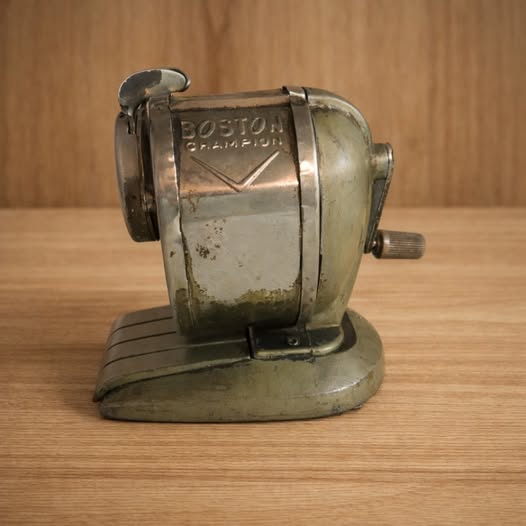
Boston Champion Pencil Sharpener
A vintage, hand-crank, desk-style pencil sharpener made from heavy metal, designed for frequent daily use in schools, offices, and homes.
What You’re Looking At (Based on the Photos)
Embossed branding: “BOSTON CHAMPION” stamped into the metal body
Hand crank: side-mounted crank with a knurled metal grip for turning
Front pencil opening: where the pencil is inserted to be sharpened
Solid base: a weighted base meant to sit firmly on a desk (many models were also designed to be secured to a surface)
When It Appeared (Time Period)
While pencil sharpeners existed earlier, hand-crank, desk-mounted sharpeners like this became especially common in the early-to-mid 20th century.
Most surviving “Boston Champion” style sharpeners are typically associated with the early 1900s through the mid-1900s, when durable, repairable office tools were standard.
Who Made It (Creator / Manufacturer)
The “Boston” name is historically tied to American pencil sharpener manufacturing, commonly associated with the Hunt Manufacturing Company and related “Boston” branded product lines.
Rather than being the invention of a single person, the Boston Champion is best understood as a manufactured product line that evolved through practical engineering and mass production.
Primary Purpose (What It Was Used For)
Sharpening standard wooden pencils quickly, consistently, and cleanly
Built for environments where many pencils needed sharpening daily, such as:
Classrooms
Clerical offices
Drafting or bookkeeping desks
Home study areas
How It Works (Simple Step-by-Step)
Insert the pencil into the front opening.
Turn the side crank smoothly.
Internal cutters shave the wood and graphite to form a point.
Stop turning when the pencil feels fully sharpened or resistance changes.
Remove the pencil; collected shavings are typically held inside the unit or in an internal compartment (depending on the exact variant).
Why Vintage Users Preferred This Design
Speed and control: hand power with a steady crank motion
Consistency: produces a more uniform point than many small handheld sharpeners
Durability: heavy metal construction designed to survive years of use
Desk-friendly: stable base reduces slipping during sharpening
Common Collectible Appeal Today
Industrial vintage look: aged metal, patina, and classic stamped branding
Mechanical satisfaction: smooth crank action and precision cutting
Practical nostalgia: strongly associated with traditional school and office life
Built-to-repair era: many can still function with cleaning and basic maintenance
Basic Care and Use Tips
Do not force the crank if it jams; remove the pencil and check for broken graphite.
Clean out shavings regularly to prevent clogging.
For preservation, avoid harsh chemicals on the exterior—gentle cleaning helps keep the original finish and patina.
If using it as a collectible, keep it dry and dust-free to reduce corrosion.