The Voice at Pump Number Four
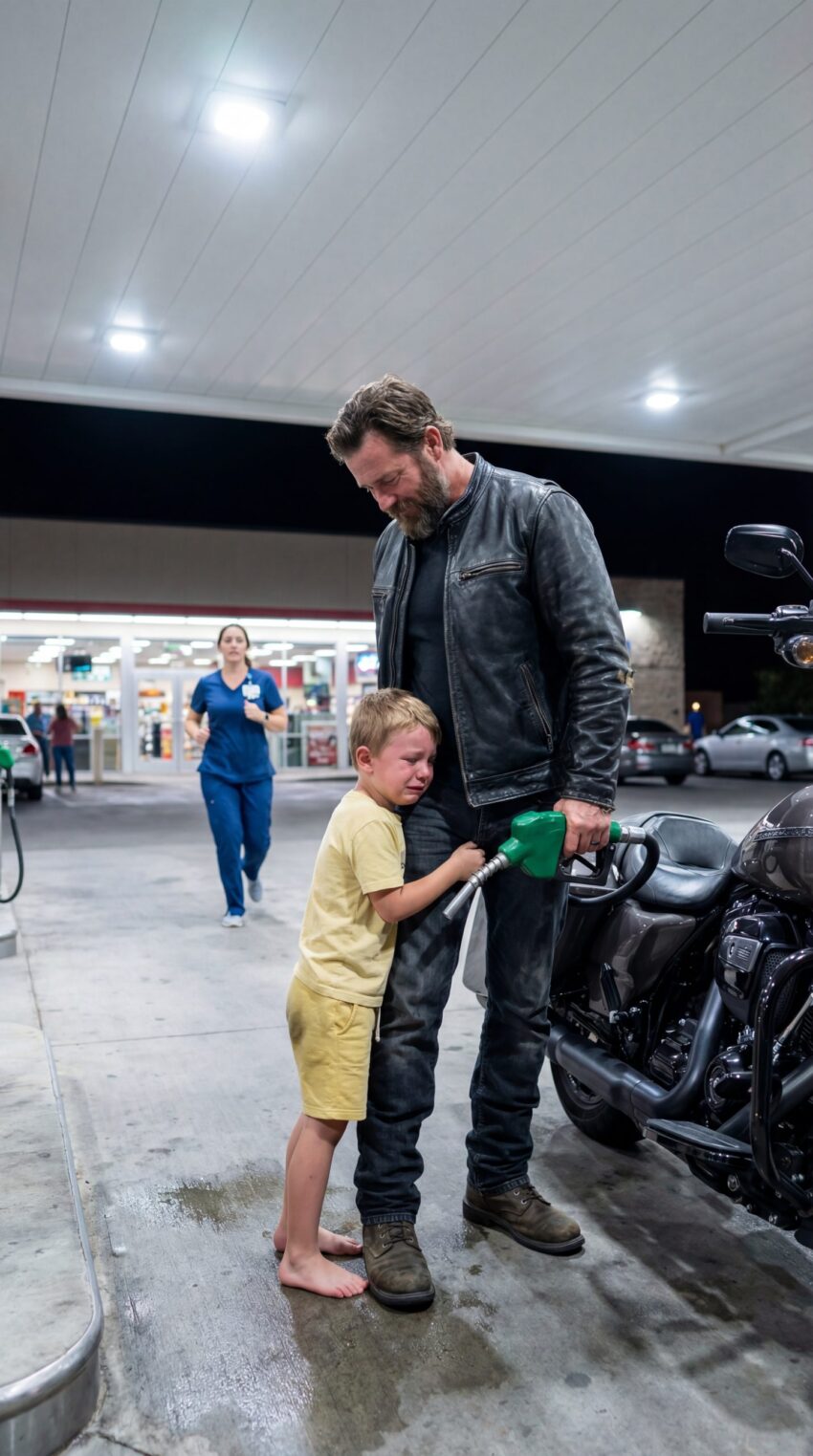
At 2:07 in the morning, the gas station off Interstate 81 looked like the kind of place people only stopped at because they had no better option. The white lights above the pumps buzzed softly in the cold Virginia air. A faded ice machine leaned against the side wall. A delivery truck idled near the edge of the lot. Somewhere behind the building, a loose metal sign knocked back and forth in the wind.
Garrett Vance stood beside his motorcycle with one hand wrapped around the gas nozzle and the other braced against his lower back. He had been riding for hours, long enough for the cold to work its way through his jacket and settle into his bones. His shoulders ached. His eyes burned. His beard smelled faintly of coffee, road dust, and the wind that had followed him across two states.
He was tired in the way that went beyond sleep. The kind of tired that lived in a man for years and made every mile feel like both an escape and a punishment. He had not planned to stop there for long. He only wanted enough gas to keep moving before his thoughts caught up with him again.
Then he heard a child’s voice cut through the empty night.
“Daddy! Daddy, I found you!”
Before Garrett could even turn, a small body hit his right leg with enough force to make him stumble half a step. Tiny arms wrapped around him and held on with desperate strength. A little boy, barefoot on the freezing concrete, pressed his face into Garrett’s leather jacket as if letting go would end the world.
The child was wearing blue dinosaur pajamas and crying so hard his whole body shook.
“Please don’t leave again,” the boy sobbed. “Please come home this time. I’ll be good. I won’t make noise anymore. Mom cries every night. Please don’t go.”
Garrett went completely still.
The pump kept clicking as the tank filled, but all he could hear was that voice.
The boy was not his son. Garrett knew that in an instant. He had never seen him before in his life.
He looked down slowly, his heart pounding so hard it hurt.
“Hey, buddy,” he said, careful and quiet, as if one wrong word might break something already cracked. “I think maybe you’ve got the wrong man.”
The little boy only clung tighter.
“No, I don’t,” he cried. “You have the same jacket. The eagle on the back. You smell like coffee and the road and the bike. I know it’s you.”
For one impossible second, Garrett forgot how to breathe.
The Woman Who Knew at Once
The door of the convenience store flew open so hard it hit the metal stopper with a bang. A woman in navy scrubs ran toward them across the pavement, panic written all over her face. She looked to be in her early thirties, with tired eyes, loose hair falling out of a quick ponytail, and the kind of exhaustion that no amount of sleep could fix.
When she saw the boy attached to Garrett’s leg, she stopped so suddenly it was as if the air had left her body.
“Owen, sweetheart, he isn’t—”
Her voice broke before she could finish. Then she looked fully at Garrett.
Something in her expression shattered.
She raised one trembling hand to her mouth.
“Oh my God,” she whispered. “You look so much like him.”
Garrett swallowed. “Like who?”
The woman fumbled for her phone and unlocked it with shaking fingers. She held the screen up for him to see. The photo on the lock screen showed a man sitting on a motorcycle with a little boy on his lap. The boy was laughing into the camera. The man had a strong build, a dark beard, broad shoulders, and a leather jacket with a large eagle stitched across the back.
He looked enough like Garrett to make the hair rise on the back of his neck.
“My husband,” the woman said softly. “His name was Nolan Mercer. He was killed fourteen months ago while deployed overseas. We’re driving north to my mother’s place in West Virginia. Owen saw your bike, your jacket, your face from a distance, and…”
She could not finish that sentence either.
The little boy lifted his head and stared up at Garrett. For the first time, confusion entered his eyes. He studied Garrett’s face with heartbreaking seriousness, as though trying to force the world to become what he needed it to be.
“You look different,” he said in a small voice. “Your eyes don’t look the same.”
Garrett knelt slowly so he was eye level with him.
“I’m sorry, buddy,” he said. “I’m not your dad.”
What happened next hit Garrett harder than any blow ever had.
The little boy did not scream. He did not argue. He did not throw a fit.
He simply let go.
He sank down right there on the stained concrete beside the pump, folded in on himself, wrapped his arms around his knees, and made the kind of sound that came from somewhere deeper than tears. It was raw and helpless and far too heavy for a child that small.
Garrett had heard a sound like that only once before, when his own mother had been told that her younger son was never coming home.
The woman crouched beside the boy, helpless tears running down her face.
“I’m sorry,” she said over and over, though it was not clear whether she was speaking to her son, to Garrett, or to the whole night around them. “He doesn’t understand. He still believes his father is going to come back. The therapist says he’s stuck in that place where his heart won’t let go.”
Garrett stared at the child on the ground.
Then he made a decision before he had time to think it through.
The Promise He Did Not Mean to Make
Garrett lowered himself until he was sitting on one knee beside the boy.
“Owen,” he said gently. “Your dad can’t come back, and I know that hurts more than words can say. But maybe… maybe I was meant to be here tonight so you wouldn’t feel alone.”
The boy looked up with tear-filled eyes.
“Did he send you?”
The woman drew in a sharp breath as if she wanted to stop this before it went too far. Garrett lifted a hand slightly, asking for one moment more.
“What’s your name?” the boy asked.
“Garrett Vance. Most folks call me G.”
“Why?”
A faint smile touched Garrett’s face despite everything.
“Because saying Garrett takes longer, and most of my friends are lazy.”
For the first time, a tiny flicker of something passed across the child’s face. Not happiness exactly. Just a brief easing of pain.
“My dad used to whistle all the time,” Owen said. “He was teaching me a song before he left. ‘Amazing Grace.’ He said when I learned it right, we’d sing it on a long drive.”
That hit Garrett in a place still tender.
His closest friend in the motorcycle club, a man everyone called Brick, had used to whistle that same hymn whenever chemo left him too weak to speak much. He said the melody made the fear feel smaller. Brick had been gone six weeks.
Garrett cleared his throat.
“You want to hear it?”
Owen nodded.
So there, in the middle of the night at a roadside gas station, under cold fluorescent lights and a sky that gave nothing back, Garrett whistled “Amazing Grace” for a child whose father was never coming home.
The woman covered her mouth and cried openly.
When the last note faded, Owen stood up.
He looked at Garrett with a seriousness that did not belong on a six-year-old face.
“My dad didn’t send you,” he said. “But maybe you’re sad too.”
Garrett let out a breath that sounded almost like a laugh and almost like a wound reopening.
“Yeah,” he said. “I am.”
“Why?”
Garrett looked at the child, then at the woman, then at the dark highway stretching beyond the station like a road into nowhere.
“Because I lost my brother,” he said quietly. “And before that, a long time ago, I lost my little boy.”
Owen stepped closer and reached for Garrett’s hand.
His fingers were tiny and warm and trusting.
“Mom says sadness gets smaller when somebody helps you carry it,” he whispered.
Garrett looked up at the woman. Her eyes were full of surprise now, not just grief.
“He hasn’t talked this much to anyone in weeks,” she said.
The Road None of Them Expected
Her name was Elise Mercer. She worked night shifts as a nurse. She had been driving for hours, trying to make it to her mother’s house outside Beckley, West Virginia, before dawn. Owen had finally fallen asleep in the back seat, but when she stopped for gas and went inside to pay, he woke up, saw Garrett through the window, and ran.
That was the simple version.
The real version was written in the trembling of her hands, in the dark circles under her eyes, and in the way her son seemed to be standing on the edge of something fragile inside himself.
“We’re headed to my mother’s place,” Elise said after a long silence. “Just for a while. I need help. Owen needs space. I don’t even know what comes after that.”
Owen tugged Garrett’s sleeve.
“You can come too. Grandma makes blueberry pancakes.”
Elise gave a tired, embarrassed shake of her head.
“Honey, Mr. Vance probably has somewhere to be.”
Garrett looked at the highway.
Then he looked at the boy.
Then he gave the only honest answer he had left.
“No,” he said softly. “I really don’t.”
What he did not tell them there, beneath the gas station lights, was that he had been running for seventeen years.
He had once had a wife named Laurel and a seven-year-old son named Caleb. One spring afternoon, a man who never should have been behind the wheel crossed a line he should not have crossed, and Garrett’s world never recovered. After that, he learned to live in motion. He joined a motorcycle club called the Iron Lanterns because men like that understood silence. They understood what it meant to carry ghosts and say very little about them. Ride far enough, and sometimes the memories blurred around the edges.
That had always been the idea.
But Owen’s hand was still in his, and the child was looking at him as if broken people might still be worth following.
So when Elise got back into her old Subaru and started the engine, Garrett climbed onto his bike and rode behind them into the night.
Pancakes, Silence, and a Question About Heaven
They stopped for breakfast after sunrise at a diner that had probably been serving truckers since the 1970s. The booths were cracked. The coffee was strong. A tired waitress called everyone honey whether she knew them or not.
Owen insisted on sitting beside Garrett instead of across from him. He ordered pancakes and then stared at them without touching his fork.
“The last time Dad had pancakes,” he said quietly, “was the morning before he left.”
Elise reached toward him. “Sweetheart, you need to eat something.”
Owen shook his head. “I’m not hungry.”
Then he pointed at Garrett’s untouched plate.
“He’s not eating either.”
It was true. Garrett had ordered out of habit, not hunger. Grief sat in his stomach like a stone.
He picked up his fork and looked at the boy.
“How about this,” he said. “You take a bite, and I take a bite. Same time.”
Owen considered that very carefully.
“Do you promise you won’t leave after breakfast?”
Elise closed her eyes briefly, as if the question hurt.
Garrett answered anyway.
“I promise.”
So they took a bite together.
Then another.
Then a third.
Owen kept watching him between bites, as though he believed Garrett might disappear if he looked away for too long.
A few minutes later, the boy asked the question Garrett should have known was coming.
“Did you really have a son?”
Garrett nodded slowly.
“Yes.”
“What was his name?”
“Caleb.”
“Where is he now?”
Garrett stared out the diner window for a moment before answering.
“I believe he’s somewhere safe,” he said. “Maybe somewhere your dad is too.”
Owen’s eyes widened.
“Do you think they know each other?”
Garrett nearly broke right there in the booth.
“Maybe,” he said, his voice rough. “Maybe they do.”
The little boy thought about that with full sincerity.
“Then maybe Caleb is showing my dad around,” he said. “So he won’t feel alone.”
Garrett had to excuse himself.
He went into the restroom, locked the door, braced both hands against the sink, and cried harder than he had cried in years.
When he came back, Owen and Elise were speaking in whispers. Elise’s cheeks were wet.
“He wants to know,” she said softly, “if you can teach him how to whistle that song.”
Garrett sat down.
“Yeah,” he said. “I can try.”
What Elise Finally Told Him
The road into West Virginia curved through hills washed in pale morning light. Owen eventually fell asleep in the back seat again, one hand still resting near the window as if he wanted to make sure Garrett’s motorcycle stayed in sight.
Elise called Garrett through the car’s hands-free speaker so they could talk while driving.
She told him Nolan had survived deployment after deployment, had made it home enough times for Owen to know the smell of his jacket and the sound of his boots, and had promised that when service finally ended for good, he would learn to ride with his son beside the ocean.
Then one roadside blast overseas ended all of those plans at once.
“Owen saw the officers come to our door,” Elise said. “He saw me fall apart. But he barely cried. Not really. The counselor says he’s trying to be strong for me, like he thinks that’s his job now.”
Garrett kept his eyes on the road.
“Last night was the first time he let go,” he said.
“Yes,” she answered. “And it broke me to see it. But it also scared me less than the silence did.”
There was a pause.
Then Elise said the thing Garrett had already sensed but did not want to hear out loud.
“I’m not asking you to replace anybody. I know you can’t. I know how wrong that would be. But Owen sees something familiar in you, and maybe what he really recognizes is grief. Maybe children know it when they stand close enough.”
Garrett did not answer for a long moment.
When he finally spoke, his voice was quiet.
“I don’t know how to help anybody.”
“You already are,” Elise said.
The House with Flowers in Front
Elise’s mother lived in a small white house outside Beckley with a bright blue porch swing and flower beds that looked loved even in the off-season. By the time they pulled into the driveway, the sky was turning gold at the edges.
Owen woke the second the car stopped and looked frantically through the back window.
When he saw Garrett pulling in behind them, his face lit with relief.
“You’re still here.”
Garrett parked the bike and took off his gloves.
“I told you I would be.”
An older woman stepped out onto the porch before Elise even made it up the walk. Her silver hair was clipped back neatly. Her eyes were kind, but they carried the weight of someone who had known loss long enough to recognize it quickly.
This was Marjorie Hale, and one look at Garrett was enough for her to understand far more than anyone had said.
“You’re staying for dinner,” she told him.
It was not a question.
Inside, the house smelled like roast chicken, soap, and the kind of safety Garrett had not felt in years. Owen sat between Garrett and his mother at the table and talked more in one evening than he probably had in months. He talked about motorcycles, about how his dad had promised to teach him to ride a bike without training wheels, about how maybe when he got older Garrett could show him how an engine worked.
Elise kept glancing at Garrett with apology and gratitude mixed together.
Marjorie watched all of it quietly until she finally asked, “And what about your people, Garrett?”
He set his fork down.
“My motorcycle club is most of what I’ve got now. The Iron Lanterns.”
“And before them?”
Garrett met her eyes.
“Before them, I had a wife and a son. I lost both. Then I lost my brother too.”
Marjorie nodded once, slow and certain.
“That is too much for one man to carry by himself.”
Garrett looked down at his hands.
“You carry it because the world doesn’t stop asking you to.”
“No,” she said gently but firmly. “You survive it because you have no choice. Carrying it alone is a different thing entirely.”
The room went quiet.
Owen listened to every word.
The Night the Fear Finally Spoke
After dinner, Owen asked to see Garrett’s motorcycle up close. Elise hesitated, then nodded. Outside, the evening air was cool and clean. Crickets had started up in the grass. The hills beyond the house were fading into shadow.
Owen ran his small hands over the bike with reverence.
“Dad said when I got bigger, we’d go see the ocean together.”
“That sounds like a good promise,” Garrett said.
“He wanted to see every ocean.”
Garrett smiled sadly. “That’s a lot of ocean.”
He lifted Owen carefully and sat him on the motorcycle seat. The child looked so small there that it hurt.
But the joy on his face was real. Bright. Unforced. The kind of joy grief had not fully managed to steal.
Then, just as quickly, that brightness faded into something more fragile.
“Mr. Garrett?”
“Yeah, buddy?”
“Will you stay tonight?”
Garrett looked over at Elise, who had come to stand a few feet away. Her eyes told him she would understand either answer.
“I don’t know if that’s a good idea,” he said carefully.
Owen’s lower lip trembled.
“Not forever,” he said in a rush. “Just tonight. I don’t sleep good anymore. I try, but every time the house gets quiet, I think if I fall asleep, people might go away again.”
That sentence landed in the center of Garrett’s chest.
It was not dramatic. It was not loud.
It was simply true.
Garrett looked at Elise. She had tears in her eyes but let her son speak for himself.
“I can sleep on the couch,” Garrett said.
Owen exhaled as if he had been holding his breath for months.
“Okay,” he whispered. “Okay.”
The Beginning of Something Softer
That night, Garrett did sleep on the couch. Or at least he lay there in the dark while the old house settled around him and thought about all the roads he had taken to avoid exactly this kind of closeness.
Around midnight, he heard small footsteps.
Owen stood in the doorway of the living room, clutching a blanket.
“I had a bad dream,” he whispered.
Garrett sat up immediately.
“Come here.”
The boy climbed onto the couch beside him, all skinny arms and trembling breath.
“Was it about your dad?” Garrett asked.
Owen nodded.
“In the dream, I could see him, but every time I ran to him, he got farther away.”
Garrett put an arm carefully around his shoulders.
“That’s what missing somebody feels like sometimes,” he said. “Like reaching and reaching and still not being able to touch them.”
“Does it ever stop?”
Garrett thought about Caleb. About Laurel. About his brother. About Brick. About every mile he had ridden trying to outrun an ache that had learned how to live in him.
Then he answered honestly.
“It changes,” he said. “And one day it doesn’t hurt in exactly the same way it used to. But the love stays. That part stays.”
Owen leaned against him.
“I don’t want to forget him.”
“You won’t,” Garrett said. “Not if you keep talking about him. Not if you keep loving him.”
The boy was quiet for a moment.
Then he asked, “Can people who are hurting help each other?”
Garrett looked toward the dark hallway, where he knew Elise was probably awake and listening, just as unsure of all this as he was.
He looked down at the child resting against his side.
And for the first time in many years, the answer came without a fight.
“Yeah,” he said softly. “I think that’s exactly how some people survive.”
By morning, the mountains outside the window were washed in pale light, and the house smelled like coffee and blueberry pancakes.
Garrett stood in the kitchen doorway while Owen laughed at something his grandmother said, and Elise looked less like a woman drowning than she had the night before.
Nothing was fixed. No miracle had erased the empty chair in their lives. Nolan was still gone. Caleb was still gone. Garrett’s brother was still gone. The losses were real, and they always would be.
But there was a table. There was warmth. There were pancakes, and a child learning how to whistle, and a man who had spent years running finally standing still long enough to feel something other than pain.
It was not a perfect ending.
It was something better.
It was a beginning.
Those who have lost someone they love do not need pressure to move on quickly; they need gentle company, honest patience, and the freedom to grieve without feeling like they are doing it wrong.
Sometimes healing begins in the most ordinary places, because pain does not always wait for sacred spaces, and comfort does not always arrive in the form we thought we needed.
A hurting child does not always need grand speeches or perfect answers; often, what reaches them first is the quiet presence of someone willing to stay.
The people who carry deep sorrow often recognize it in each other long before they speak of it, and that silent recognition can become the first bridge back to life.
Love does not end just because a person is gone, and remembering someone with tenderness is not a sign of weakness but a sign that the bond still matters.
There are moments when strangers step into our lives for only a short time, yet leave behind a kindness so meaningful that it changes the direction of everything that follows.
Running from grief can keep a person moving, but being seen in grief can finally help that person begin to rest.
Children often understand emotional truth more clearly than adults do, because they reach for comfort without pretending that pain is small or easy.
Real strength is not found in never breaking down; it is found in allowing ourselves to be honest, to receive help, and to keep loving after loss has tried to harden us.
Even after the darkest seasons, life can still offer small beginnings, and sometimes all a wounded heart needs is one safe place, one shared meal, and one promise that someone will stay.