The Night the Highway Chose Her
Rain did not simply fall over western Colorado that night. It pressed down on the land with a weight that seemed almost personal, turning the blacktop into a sheet of glass and the gravel shoulder into a ribbon of mud. The headlights passing on U.S. Highway 50 came and went too fast, brief white flashes that never slowed long enough to ask questions.
Nine-year-old Emery Quinn stood alone beside the road with her paperback copy of Charlotte’s Web tucked under one arm and a small silver emergency blanket wrapped badly around her shoulders. She had put her shoes on the wrong feet in such a rush that her ankles already ached, but she did not sit down to fix them. She was too afraid that if she crouched, if she made herself smaller, the whole world would forget she was there.
Eleven minutes earlier, her stepmother had pulled the car over with that same icy self-control she used when she wanted to seem reasonable. She had not shouted. She had not made a scene. She had only turned toward Emery with a face as calm as still water and said two words that split the child’s world in half.
“Get out.”
Emery had stared at her, certain she had heard wrong.
“I said get out, Emery. Maybe standing here for a while will help you think about consequences.”
The girl still did not fully understand what she had done wrong. Maybe it was the cereal bowl she had forgotten on the windowsill. Maybe it was the school paper she had hidden in her backpack because she did not want another lecture. Maybe it was nothing at all. Living with Valerie Cross had taught her that the reason never mattered as much as the mood.
So Emery had stepped out.
And the car had driven away.
Now she stood with rain in her eyelashes and counted under her breath because numbers felt steady in a world where adults did not. She counted to one hundred, then to five hundred, then to one thousand, until the vibration began under her feet and rolled through the dark like distant thunder.
She looked west and saw them.
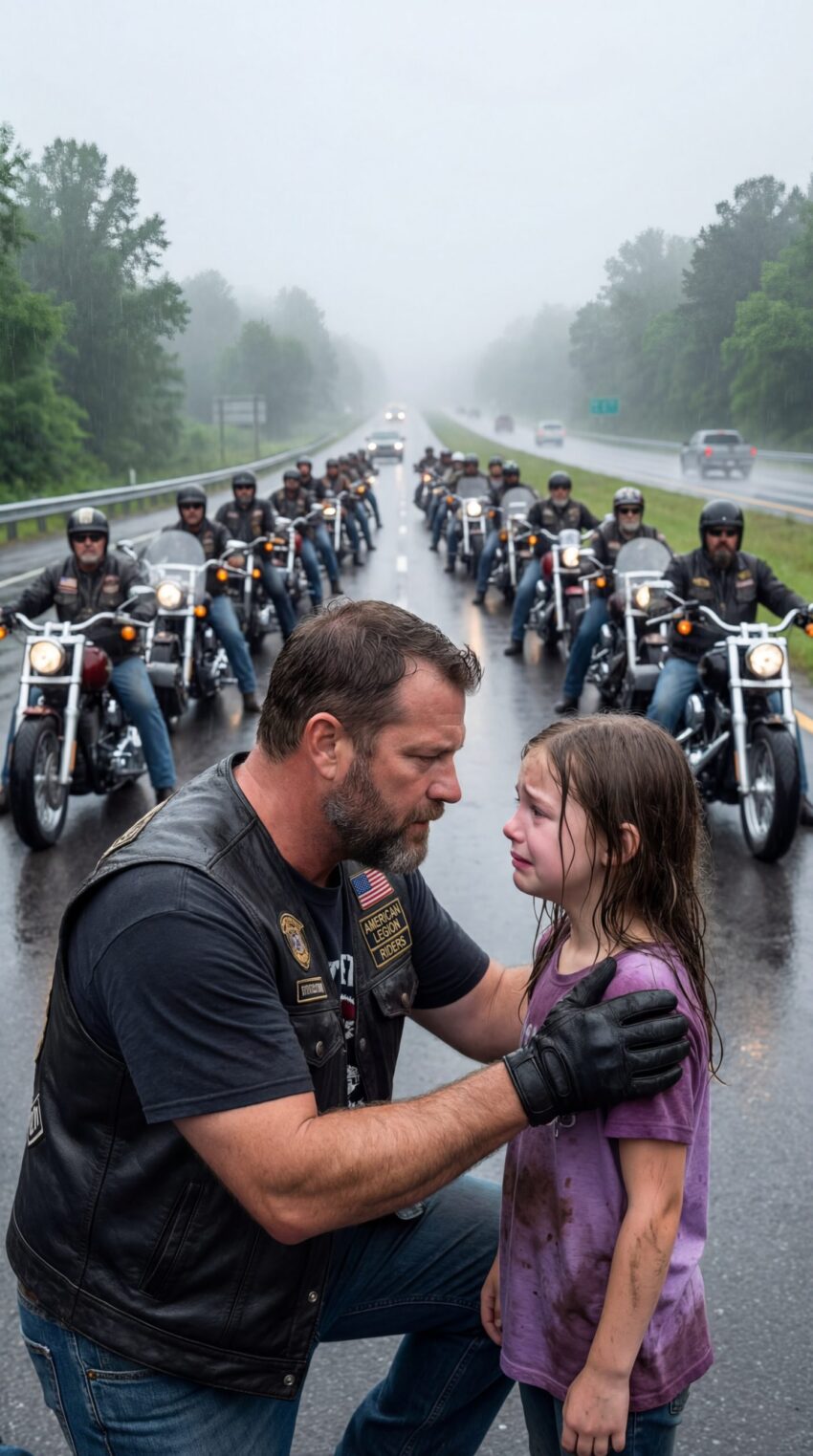
Not one or two motorcycles, but a whole line of them stretching through the rain, chrome and black paint catching the highway lights in broken flashes. Engines growled low and heavy as the riders slowed together. There must have been more than a hundred of them, moving like one long creature made of steel and headlamps.
The lead rider cut his engine first.
Silence fell so suddenly that Emery could hear rain tapping against her book cover.
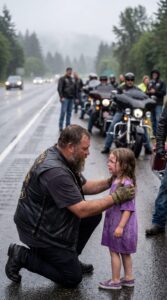
The man who stepped off the front bike was huge, broad-shouldered and weathered, with a dark leather vest over a faded thermal shirt and the kind of face that looked carved from old wood. He lowered himself to one knee so he would not tower over her. Water ran from the ends of his beard, but his eyes were steady and careful.
“Hey there, sweetheart,” he said, his voice low and warm. “You shouldn’t be standing out here by yourself in weather like this.”
Emery’s fingers tightened around the book.
“I’m okay,” she whispered, though even she could hear the shake in her voice.
He glanced once at her blanket, her backward shoes, and the empty road behind her.
“No, you’re not,” he said gently. “And that’s not your fault. What’s your name?”
“Emery.”
“I’m Rhett,” he said. “Can you tell me who left you here?”
Something in the question broke the last fragile wall she had been holding up. Tears spilled hot against her cold cheeks.
“My stepmom,” she said. “She said I needed to learn.”
The men behind Rhett went very still.
No one shouted. No one cursed. The quiet was somehow more powerful than anger.
Rhett took off his own riding jacket and wrapped it around Emery over the silver blanket, swallowing her small frame in heavy leather and warmth.
“Listen to me carefully,” he said. “You are not staying out here another second. No child stands alone on a highway while good people pass by.”
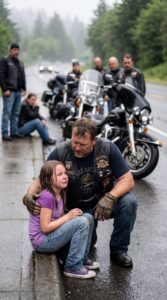
He lifted her as if she weighed nothing and carried her toward a support truck traveling with the riders. One of the women from the group, a medic named Tessa, dried Emery’s hair with a towel and handed her warm cocoa from a thermos. Someone brought clean socks. Someone else found a charger for the girl’s dying phone. Nobody asked anything cruel, and nobody told her to stop crying.
For the first time since the car disappeared, Emery felt her breathing begin to slow.
A Father Called Back by Fear
Nearly three hours later, red and blue lights appeared through the rain.
Deputy Mason Hale stepped out of his cruiser, boots sinking into the wet gravel. Behind him came a mud-splashed pickup driven far too fast for a man trying to stay calm. The driver barely shut the door before running toward the truck where Emery sat wrapped in leather and blankets.
Her father, Travis Quinn, looked like a man who had left half his life behind to get there. His flannel shirt was damp, his beard rough with road dust, and his eyes were wild with fear.
“Emery!” he shouted.
The girl jumped down before anyone could stop her and ran straight into him. Travis dropped to his knees in the mud and held her so tightly it looked as if he were trying to make up for every mile that had ever separated them. He had been hauling freight through Utah when the school called to say Emery had never arrived home. By the time Deputy Hale reached him, Travis had already turned his rig around.
“I’m sorry, baby,” he kept saying into her hair. “I am so sorry. I didn’t know. I swear to you, I didn’t know.”
Emery clung to him without speaking. She believed him. That was the part that hurt most. She believed her father loved her, but love had not been enough to see what was happening under his own roof.
Rhett stood a few feet away with his arms crossed, giving them space. Deputy Hale asked careful questions and wrote down every detail. When he mentioned Valerie’s name, Travis’s face tightened in a way that suggested this night had not appeared from nowhere. It had simply revealed what had been building for too long.
Then Emery’s phone buzzed where it sat charging on the seat.
Tessa looked at the screen. Her expression shifted.
“This message is from Valerie,” she said quietly.
Travis took the phone and read the words aloud, though his voice nearly vanished by the end.
“Tell them I was coming back. Tell them this was discipline. If you say anything else, your father may finally learn what really happened to your mother.”
The rain seemed colder after that.
Rhett looked at Travis. “What does she mean by that?”
Travis stared at the phone as if it had turned into something alive in his hand. His grief changed shape right there in front of them. Emery saw confusion first, then dread, then a look so haunted it made her stomach twist.
Her mother, June Quinn, had passed away four years earlier after a fast, terrible illness. That was the story Emery had grown up hearing. It was the story printed on sympathy cards and whispered in church hallways and folded into every memory she had of casseroles left on the porch.
But Travis no longer looked like a man standing inside a settled truth.
He looked like a man whose past had just opened under his feet.
The Folder in the Black Sedan
The black sedan came out of the rain so suddenly that Deputy Hale reached for his sidearm before the car had fully stopped. The man who stepped out did not move like a threat. He moved like someone who had been carrying bad news for a long time.
He was lean, older, and rough around the edges, with a pale scar curving under his jaw and a raincoat too thin for the weather. In one hand he carried a weathered file folder thick with papers. In the other, an old digital recorder sealed inside a plastic evidence bag.
He looked at Travis first.
“You don’t remember me, do you?” the stranger asked.
Travis rose slowly. “Should I?”
“My name is Silas Vane. Your wife hired me once before she got too sick to keep asking questions.”
No one spoke.
Silas placed the folder on the hood of the cruiser. Inside were photographs, copies of insurance records, hospice notes, property paperwork, and pages of handwritten dates. Valerie’s face appeared again and again, not just as the woman who later married Travis, but as a hospice nurse who had been around June during the last weeks of her life.
There were also records showing unusual policy changes, signatures Travis did not recognize, and a secondary insurance document that had been prepared only months before Emery was left on the roadside.
“Valerie didn’t drift into your life by accident,” Silas said. “She positioned herself there. Your first wife got uneasy near the end. She thought someone was handling her medication in ways that didn’t match what the doctor told her. She asked me to look into it. By the time I found enough to matter, June was gone, and Valerie had already started building herself a new image in your house.”
Travis gripped the edge of the cruiser so hard his knuckles whitened.
“You’re saying June knew?”
Silas nodded once.
“She knew something was wrong. She just ran out of time before she could prove it.”
Deputy Hale turned another page and found photographs of Valerie meeting a sharply dressed man outside a restaurant in Montrose. Another set showed the same man entering a private airstrip office after dark. Hale recognized him immediately: Harold Pike, the county district attorney.
Silas pointed to the image.
“That’s the connection keeping Valerie comfortable. She’s been planning to leave town with money that doesn’t belong to her. Tonight wasn’t punishment. It was a disappearing act. She needed Emery out of the picture before morning.”
Emery sat frozen on the truck seat, her small fingers wrapped around the edges of Rhett’s jacket. She understood enough to know that nothing was as she had believed. Adults had always seemed powerful because they knew things children didn’t. Yet one by one, the adults in her life were being unmasked as frightened, greedy, careless, or late.
And still, the people who had stopped for her remained.
The Ride to the Airstrip
Silas had one more piece of information.
Valerie was not at the motel where her credit card had last appeared. That purchase, he believed, had been made by someone else as a decoy. Her real destination was a private landing strip north of town, where a small plane was scheduled to leave before dawn.
Rhett looked toward the line of motorcycles glistening under the rain.
Then he looked at Travis.
“The front office may be tangled up,” he said, nodding once toward the photograph of Pike, “but the road still belongs to people willing to stand up on it. If you want the truth, we ride now.”
What followed felt less like a plan and more like a force of nature reorganizing itself.
Engines came alive in waves. Headlights cut through the storm. Deputy Hale radioed quietly for state backup from outside the county chain of command. Travis got behind the wheel of the pickup with Emery beside him, Tessa in the back, and Silas riding ahead with Rhett at the front of the column.
More than a hundred motorcycles moved through the rain in a protective formation around the truck. Emery had never seen anything like it. From inside the cab, it looked as if the highway itself had chosen to defend her.
When they reached the airstrip, the small twin-engine plane was already rolling toward the far end of the runway.
Valerie stood near the cabin steps with a bag in one hand and a coat pulled tight around her body. Harold Pike was beside her, turning at the sound of the approaching engines. The plane slowed as the flood of headlights spread across the tarmac.
Rhett did not rush. He rode straight down the center until he stopped well ahead of the plane’s path, forcing the pilot to cut power. All around him, bikes formed a broad semicircle that left no easy exit.
Deputy Hale stepped out of his cruiser with state troopers arriving behind him moments later.
For the first time anyone there had ever seen, Valerie Cross looked truly undone.
“This is absurd,” she snapped. “I was coming back for her.”
Emery, wrapped in that too-large leather jacket, stepped out of the truck before Travis could stop her.
Rain tapped softly on the tarmac as she walked forward.
In her hand she held the chipped cereal bowl she had grabbed from the back seat before being told to get out. Its edge was burned from an old stove mark, a small ordinary thing from an ordinary kitchen. Yet somehow it felt heavier than anything Valerie had packed for escape.
“You said I needed to learn consequences,” Emery said, her voice small but clear enough to carry. “But my mom used to say that kind people stop when they see someone hurting. And tonight, strangers stopped for me before you did.”
Valerie opened her mouth, but no words came.
The Voice That Returned
The final piece did not come from the folder. It came from the recorder.
Silas handed it to Deputy Hale, who connected it to the cruiser speaker beneath the wash of rain and headlights. The file was old and crackled at first. Then a weak woman’s voice filled the air.
June Quinn.
Travis nearly collapsed when he heard it.
In the recording, June sounded tired, breathless, but very clear. She spoke about being afraid. She mentioned Valerie by name. She said doses had been adjusted when doctors were not present. She said if anything happened to her too quickly, Travis should look closer. Then another voice entered the recording—Valerie’s—cool, impatient, and careless enough to speak plainly because she believed no one was listening.
That was enough.
State troopers moved in. Harold Pike tried to protest and then stopped when he realized there was nowhere left to direct his authority. Valerie’s calm finally cracked completely. Travis stood with one hand over his mouth and the other gripping Emery’s shoulder, not to restrain her, but because he needed something real to hold.
The storm began to ease before sunrise.
No one cheered. No one made a grand speech. Some truths are too heavy for celebration. They are only endured.
But as the sky softened from black to bruised blue, Emery felt something shift in the world around her. Not everything had become good. Her mother was still gone. Her father still had to live with what he had failed to see. The house they would return to would still hold rooms shaped by lies.
Yet truth, once spoken aloud, made room for breath.
Morning After the Storm
The next morning the yard behind the Quinn house smelled of wet soil and pine. Travis and Emery did not go inside right away. The place still carried Valerie’s perfume and her carefully arranged surfaces, and neither of them was ready for that. Instead, Travis brought out a shovel and asked Emery whether she wanted to help him start something new.
Her mother had once dreamed of planting a garden and never got the chance.
So father and daughter marked out a patch of earth and began.
They were not skilled at it. Travis dug too deep in one place and not deep enough in another. Emery got mud on her sleeves and laughed for the first time in what felt like years. The sound startled both of them.
Near noon, the low rumble of motorcycles returned.
Rhett and a few of the riders pulled up by the fence, no dramatic entrance this time, only a quiet check-in from people who meant what they said. He walked to the gate and handed Emery a new leather-bound copy of Charlotte’s Web.
Inside the cover, in careful handwriting, were a few simple words:
To Emery — for the girl who stayed standing until help arrived.
She looked up at him with tears bright in her eyes.
“Thank you for stopping,” she said.
Rhett tipped his head. “That’s what decent people do.”
Emery watched the riders leave, their engines fading into the distance like a storm moving on after it had done the hard work of clearing the air. Then she looked down at her shoes, now on the right feet, and at the garden beginning to take shape under her father’s hands.
For the first time in a very long while, home no longer felt like a place built out of fear. It felt like something they might slowly grow back together.
What This Story Leaves Behind
Sometimes the people who rescue a life are not the ones society expects, but the ones who still remember that being human means stopping when someone small and frightened is left alone in the rain.
Sometimes a child’s quiet truth carries more strength than an adult’s polished excuses, because innocence does not know how to perform, it only knows how to recognize who stayed and who walked away.
A family can survive years of silence and still begin again the moment one honest voice finally says that what happened was wrong and that love without attention is never enough to keep a child safe.
What looks like toughness from the outside can hide an extraordinary tenderness, and what looks respectable from a distance can conceal a heart empty enough to abandon what should have been protected.
There are moments when justice does not arrive with perfect timing or clean hands, but it still matters deeply that it arrives at all, especially for the child who had almost begun to believe she was invisible.
The past cannot be repaired by tears alone, yet truth has a way of opening doors that lies kept nailed shut, and sometimes that is the first mercy a broken home receives.
A good parent is not the one who never fails, but the one who faces the truth of that failure, kneels down, and begins the difficult work of rebuilding trust one gentle day at a time.
Children remember who frightened them, but they also remember who wrapped them in warmth, who knelt to eye level, and who spoke to them as if their fear mattered, and those memories shape the rest of their lives.
Even after a long season of grief, betrayal, and cold rooms filled with bad memories, a new beginning can start with something as small as a shovel in wet earth and the decision to plant what love once hoped to grow.
And perhaps the most important thing of all is this: no storm lasts forever, but the kindness shown during one can echo for years in the heart of the person who was saved by it.