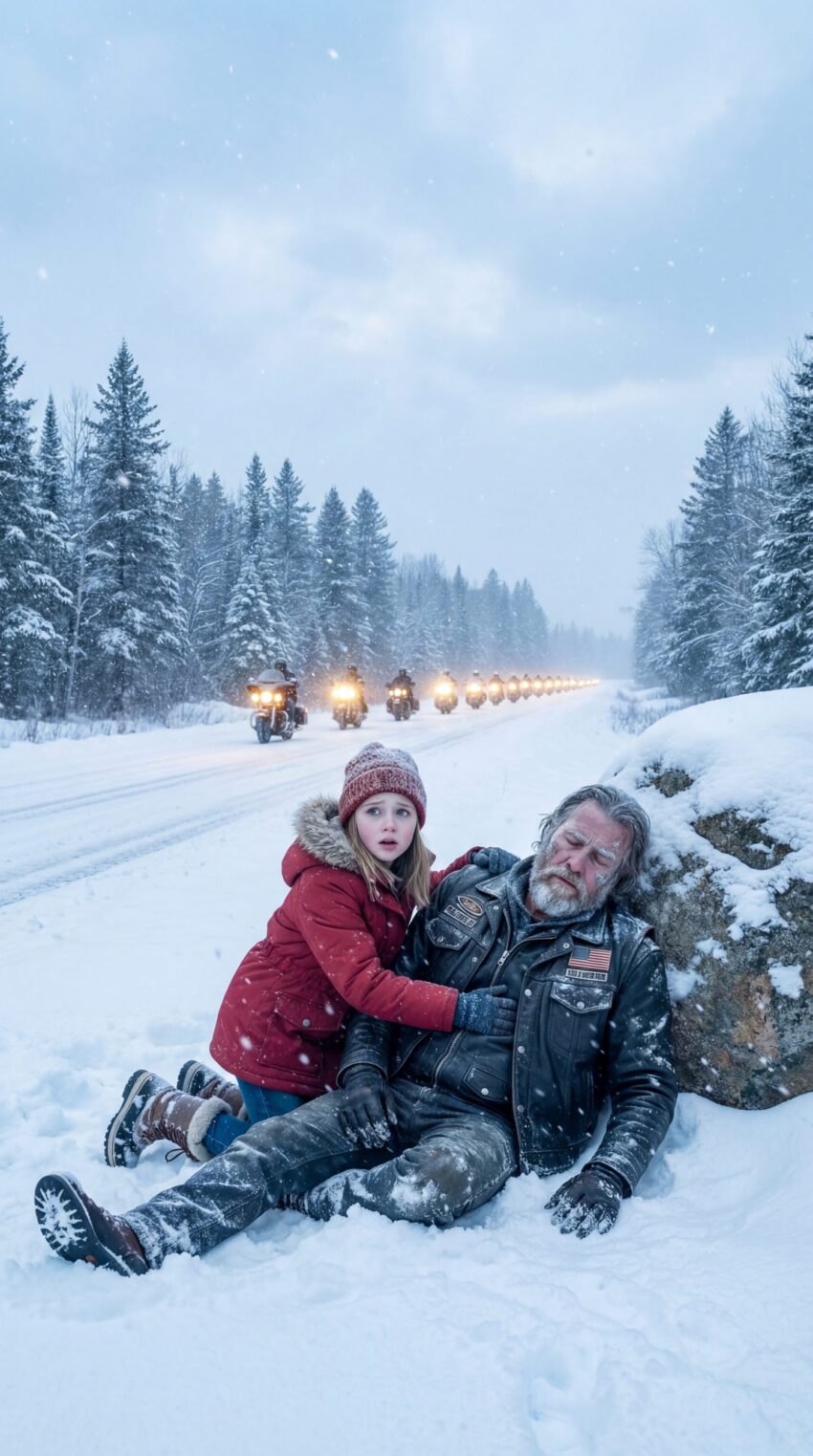
The White Road No One Was Supposed to Survive
The wind came across the flat fields of northern Michigan with a force that made the whole world feel empty. Snow did not simply fall that afternoon. It lashed sideways, wild and sharp, erasing fence posts, road signs, and the thin line between earth and sky. The storm turned everything into a moving wall of white.
Ten-year-old Maren Holloway kept walking because stopping felt more dangerous than moving. Her boots were too big, stuffed with old socks to keep them from slipping off. A plastic sled rattled behind her, tied to her wrist with a fraying length of rope. Inside it were the few things she still called her own: a faded blanket, a stuffed fox with one ear missing, a flashlight that worked only when shaken hard, and a zippered pouch holding papers she did not fully understand but carried anyway because adults always acted like papers mattered more than children did.
Her shoulders ached. Her face stung. Every breath hurt.
She had already been cold for so long that the cold had become part of her thinking. It told her to keep her head down. It told her to stay quiet. It told her not to trust anyone who said they were trying to help. That lesson had come from years of moving between homes that never felt like home, from kind promises that lasted only until doors closed, from adults who filled out forms and smiled with their mouths while never truly seeing her.
So she walked.
She did not know exactly where she was going. She only knew where she did not want to go back.
Then, through the blur of snow, something dark broke the endless white.
At first she thought it was debris. Maybe a broken fence post or a fallen sign. But as she moved closer, her stomach tightened. It was a man. Huge, still, half-covered in drifted snow. A motorcycle lay tipped on its side several feet away, almost buried, its dark metal frosted over.
Maren stopped so suddenly the sled slid into the backs of her legs.
Every thought in her head told her the same thing. Keep going.
A man on the ground meant trouble. Trouble meant police. Police meant questions. Questions meant being taken back.
She swallowed hard and took one step away.
Then she saw it.
His hand moved.
It was barely anything, just the smallest twitch of his fingers, but it was enough to root her to the spot.
“Oh no,” she whispered into the storm. “Please don’t be alive.”
The words came out frightened, not cruel. If he were gone, she could keep walking and tell herself there had been nothing she could do. But if he was still here, still fighting, then leaving would become a choice she would have to carry.
For several seconds she stood there shivering, rope in one hand, storm pressing against her from all sides.
Then she dropped to her knees and crawled toward him.
The Man Beneath the Snow
He was heavier than anyone she had ever been close to. Broad shoulders. Thick arms. A leather vest stiffened by ice. Gray threaded through his beard. Snow clung to his lashes and along the line of his jaw. One side of his face was marked with bruising and a rough scrape near his temple, but what frightened her more than anything was how still he was.
“Hey,” she said, voice trembling. “Hey, can you hear me?”
His eyelids fluttered but did not open.
Maren looked around, as if a better grown-up might appear from the storm and take this choice from her. No one came. There was only the battered motorcycle, the screaming wind, and the man who might not make it through another hour.
She grabbed the front of his vest and pulled.
Nothing.
She changed her footing, dug her heels into the snow, and tugged again with everything in her small body. He shifted perhaps half an inch.
That half inch made her believe it was possible.
It took her nearly twenty minutes to maneuver the plastic sled close enough. Her fingers shook so badly she could hardly work the rope. She pushed, dragged, slipped, fell, got back up, and tried again. More than once she ended up face-first in the snow. More than once she thought she was done. But every time she glanced at him and saw the faint rise and fall of his chest, she kept moving.
“Don’t make me do this by myself,” she muttered through chattering teeth. “At least try.”
The storm swallowed her words, but maybe he heard something, because once, when she nearly lost her grip, his body shifted just enough to help her settle him more firmly onto the sled.
That became their rhythm.
She pulled. He slid. The storm pushed back.
Somewhere ahead, barely visible through the white, stood a small outbuilding near a line of skeletal trees. It might once have been a tool shed or a hunting shelter. Its roof sagged. One window was boarded up. But it was solid, and that made it feel like salvation.
The distance was not far. Under normal conditions, a healthy person could have reached it in minutes.
For Maren, dragging a full-grown man across deep snow in a blizzard, it became the longest stretch of her life.
By the time she finally pulled the sled to the door, her arms felt torn loose from her body. She shoved the door with her shoulder. It opened with a groan. The smell inside was old wood, damp hay, motor oil, and dust. It was not warm, but it was shelter, and shelter was life.
She got him inside inch by inch.
When at last the door was pushed shut behind them, the sudden quiet felt unreal.
Maren stood there swaying, breathing hard, staring at the stranger she had refused to leave behind.
Then she knelt beside him and said softly, “I don’t know who you are, but I’m not letting you disappear out there.”
The Longest Night
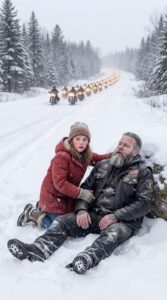
The shed offered only a little protection from the cold. Wind still found its way through cracks in the walls, and the floor held the chill of frozen ground. But without the storm hitting them full force, Maren could think clearly again.
She stripped off his outer gloves, which were stiff with ice, and rubbed his hands between hers. She covered him with the blanket from the sled and then with an old canvas tarp she found hanging from a nail. She searched the corners of the shed and uncovered a dented bucket, a coil of rope, a rusted lantern with no fuel, and an ancient horse blanket eaten by time but still thick enough to help.
Every layer mattered.
She sat beside him, knees drawn up, and listened to his breathing. It was shallow and uneven.
At one point his eyes opened for a second, cloudy and distant.
“Sage?” he murmured.
Maren leaned closer. “No. I’m Maren.”
But his eyes had already closed again.
Later, when the cold seemed to creep into every bone she had, she tucked herself against his side beneath the blankets to share what little warmth she had. It was awkward at first. He was a stranger. He smelled like snow, leather, smoke, and the metallic scent of a road accident. But warmth was warmth, and fear did not have space in a storm like this.
She woke and slept in fragments. She melted clean snow in a tin can she found near the wall, warming it between her palms before bringing a few drops to his lips. Sometimes he swallowed. Sometimes he didn’t. She kept trying.
Outside, darkness came early. Wind battered the shed through the evening and deep into the night.
When he began mumbling again, she listened.
Most of it made no sense. Broken phrases. Half-dreams. A road. A promise. A little girl’s laugh.
Then, clear as a bell in the frozen dark, he whispered, “I should’ve gotten to her sooner.”
Maren stared at him.
A little later he said another name.
“Maddie.”
Not Sage. Not Maren. Maddie.
There was something in the way he said it that made the air ache.
“Was that your daughter?” Maren asked, though she knew he could not answer.
His face tightened as if even in sleep the memory hurt.
Maren had known adults who shouted, adults who lied, adults who forgot. She had known a few who acted kind until no one was watching. But this grief felt different. It felt real. Too heavy to fake.
So she stayed awake longer than she thought she could, rubbing warmth back into his hands, whispering things no one had ever whispered to her.
“You can stay,” she said. “You don’t have to go anywhere tonight.”
Two People Holding On
Morning did not bring sunshine. It brought a dim gray light pressing through the cracks in the boards and a silence that felt temporary, as if the storm were resting before it started again. Maren’s whole body hurt. Her fingers were raw, her lips split, and every muscle in her back burned.
The man was awake.
Only barely, but awake.
His eyes were a stormy blue, unfocused at first, then slowly sharpening as he realized where he was and who sat beside him.
He tried to move and winced.
“Easy,” Maren said quickly. “You hit something. Or fell. Or both.”
He looked at her as though he could not fit her into the picture in his mind. A small girl in a torn coat. A stuffed fox tucked beneath one arm. Snow in her hair. A face too young to look that tired.
“You got me in here?” he asked, his voice rough as gravel.
She nodded.
He stared at her in disbelief. Then his gaze shifted toward the door, toward the muffled white world outside, and back again.
“By yourself?”
“There wasn’t anybody else.”
For a long moment neither of them spoke.
Then he swallowed and said, “My name’s Boone Carver.”
It suited him. Solid. Weathered. Worn at the edges but unbroken.
“Maren.”
He repeated it slowly, as if it mattered enough to remember exactly right.
As the day stretched on, speech came to him in pieces. He had been riding back from Traverse City when the storm turned worse than forecast. His bike had skidded on black ice near an empty county road. He remembered trying to correct, remembered the violent slide, remembered standing for a second and then nothing.
Maren told him only the simple version of how she had found him. She did not mention the moment she almost walked away.
He noticed the sled. The toy fox. The careful way she flinched whenever anyone might ask too many questions.
He did not press.
By afternoon, while the storm rose again, he drifted in and out of sleep. Whenever fever dragged him under, he spoke about Maddie.
Maddie loved peppermint sticks.
Maddie hated itchy sweaters.
Maddie used to count motorcycles by color whenever she waited for him at the clubhouse.
Maddie had been eight when a winter storm changed everything.
The story never came in a straight line. It arrived in fragments, the way broken hearts often speak. But Maren understood enough. Boone had once had a daughter with a laugh bright enough to fill a room. And then, one terrible winter, he had lost her. Not because he didn’t love her. Not because he stopped trying. But because life sometimes opens its hand and lets something precious fall through.
That night, when the storm leaned hard against the shed again, Maren sat close beside him and listened to the wind.
“I used to think if I ever disappeared,” she said quietly, “it would take a while before anybody noticed.”
Boone turned his head toward her.
His face was pale, but his eyes were clear now.
“I noticed,” he said.
She looked down fast, pretending to adjust the blanket so he would not see the tears gathering there.
The Sound Coming Through the White
By the third morning, the storm had finally broken.
Sunlight did not exactly shine, but the world outside was no longer moving. Snow lay high and clean over the fields. Trees stood still. The sky had that pale silver look winter sometimes wears after spending all its rage.
Boone was stronger, though not strong enough to stand without help.
Maren opened the shed door a crack and stared out at the white distance.
For the first time in days, the world felt possible again.
Then she heard it.
A faint sound at first. So low she thought she had imagined it.
A rumble.
It rose from far away, traveled through the frozen ground, and entered the shed before it fully reached her ears. Boone heard it too. His expression changed instantly. Not fear. Recognition.
The sound grew louder.
Engines.
Many of them.
Maren’s heart slammed against her ribs. Every old fear came back at once. Adults finding her. Strangers deciding her future. Hands guiding her somewhere she did not want to go.
She backed away from the doorway and grabbed her toy fox.
“Who are they?” she asked.
Boone pushed himself upright with visible effort, listening hard.
Then, despite the pain on his face, he almost smiled.
“My brothers,” he said.
The motorcycles came over the rise in a staggered line, dark against all that white. Dozens of riders. Leather jackets. Headlights. Chrome reflecting the cold morning light. They rolled toward the shed like a wave of thunder and memory.
When they cut their engines, the silence afterward felt even bigger than before.
A tall man with a silver beard jumped off the first bike and reached the shed in long strides. Another rider, broad-shouldered and red-faced from worry, was right behind him.
The door swung wide.
For one terrible second Maren shrank back, ready to run even though there was nowhere to go.
Then the silver-bearded man looked from Boone to Maren, took in the blankets, the sled, the tiny melted-snow can on the floor, and removed his gloves slowly, almost reverently.
“Well, I’ll be damned,” he said softly. “A little girl kept you alive.”
Boone let out a shaky breath.
“Looks that way.”
The men who followed did not rush in with chaos. They moved carefully, respectfully, like people entering a church. Some checked Boone’s injuries. One brought in medical supplies from a saddlebag. Another set down hot broth from a thermos. A woman rider with a calm face and dark braid knelt to Maren’s level and asked if she could look at her hands.
Maren hesitated.
Boone noticed.
“You’re safe,” he told her. “Nobody here’s going to force a thing.”
Something in his voice made her believe him.
So she let them help.
What Family Sometimes Looks Like
It turned out Boone Carver was not simply a rider passing through a storm. He was one of the founding members of a long-standing motorcycle brotherhood based outside Petoskey, a group that had spent the last two days searching county roads, back routes, and snowed-over shoulders after he failed to arrive home.
They had found the wrecked tracks that morning.
What they had not expected to find was the child who had carried him through the worst part.
While one of the riders radioed for emergency support and another checked Boone’s ribs, the silver-bearded man introduced himself as Wade Mercer.
“Boone talks too little and rides too far in winter,” Wade said. “That part’s on him. But you saving him? That part we won’t forget.”
Maren did not know what to do with words like that. Most praise in her life had come with conditions attached. Clean your room. Be grateful. Smile for the caseworker. Say thank you properly.
This sounded different.
Real.
As the morning unfolded, pieces of Boone’s story were filled in by the people who knew him best. Maddie had been his daughter. Years earlier, during another bad winter, a chain of delays and mistakes had kept him from reaching her in time during a medical emergency. Since then, he had become quieter, harder on himself, always carrying the idea that he had failed the person he loved most.
Maren listened in silence.
No one tried to make the story dramatic. No one reached for cruel details. The sorrow was already heavy enough without embellishment.
Boone looked at her from where he sat propped against the wall in borrowed blankets, his face lined with exhaustion and gratitude.
“I couldn’t get back to my little girl,” he said quietly. “But somehow, in the middle of this storm, another little girl found me anyway.”
Maren did not trust herself to answer.
The woman rider with the braid, whose name was Colleen, wrapped clean bandages over Maren’s cracked hands and tucked warming packs into her coat.
“You’ve been carrying grown-up weight for too long,” Colleen said.
Maren blinked hard and looked away.
Outside, more riders stood in the snow, keeping respectful distance, speaking in low voices. Not one of them looked at her like she was a problem to be solved. They looked at her like a child who had done something brave and should have been protected long before now.
That realization nearly undid her.
The Place Where the Cold Finally Broke
By the time emergency crews arrived, the worst danger had passed.
Boone would need treatment, rest, and time. Maren needed warmth, food, and adults who could be trusted. Wade made calls. Colleen stayed beside her. Boone refused to let anyone talk about next steps as though Maren were not in the room.
For perhaps the first time in her life, decisions involving her were spoken around her, not over her.
When they helped Boone onto a stretcher, he reached for her hand.
She stepped closer.
His grip was weak, but steady.
“You didn’t walk away,” he said.
Maren shook her head.
“I almost did.”
He looked at her for a long, understanding moment.
“But you didn’t.”
Those four words settled deep inside her.
Later, when one of the support workers asked whether Maren had any family she wanted contacted, she opened her mouth and then closed it again. The honest answer was complicated. There were names on paper. There were addresses once used. There were places she had stayed. But family, in the truest sense, had always felt like something happening to other people.
Wade glanced at Boone, then at Colleen, then back at Maren.
No one made promises too large for the moment. No one tried to script her future in a single sentence.
But before the ambulance doors closed, Boone looked at her and said, “Wherever this goes next, you’re not facing it by yourself.”
For a child who had built her whole life around not expecting anyone to stay, those words landed like warmth after endless winter.
The motorcycles started up again one by one as the vehicles prepared to leave. Their engines rolled across the snow-covered road, not harsh now but steady, almost protective.
Maren stood wrapped in a heavy borrowed coat, her toy fox tucked beneath her arm, and watched them.
A few days earlier, the sound of those engines would have meant danger in her imagination. Now it meant something else.
Search.
Loyalty.
People who came back.
The storm had taken almost everything familiar from the landscape. But in the blank white silence it left behind, something unlikely had been built between a runaway child and a grieving man who had nearly disappeared into the snow.
Not a miracle in the dramatic sense.
Something quieter than that.
A reason to keep believing that even after the hardest winters, human hearts can still find one another on the loneliest roads.
Maren did not yet know what her life would look like in the weeks ahead. She did not know what papers would be signed, what calls would be made, or which doors might open next. But as she stood there surrounded by people who had crossed miles of frozen road because one of their own had not come home, she understood something she had never fully trusted before.
Being found could be as life-changing as surviving.
And sometimes the people who arrive like thunder are the very ones who teach you what gentleness feels like.
At the edge of the white Michigan morning, with Boone still alive and fifty engines waiting nearby, Maren let herself hold one impossible thought close:
Maybe the world had not finished making room for her after all.
The cold had nearly taken them both.
Instead, it brought them to the same door.
Those who have been overlooked the longest are often the ones who learn deepest compassion, because they know exactly how much a single act of kindness can matter when the world feels empty.
Real strength is not always loud, and it does not always come from size, power, or age; sometimes it lives inside a tired child who decides that another life is worth saving.
A broken heart does not stop loving simply because it has known loss, and sometimes the people carrying the heaviest sorrow are still able to become shelter for someone else.
Family is not only about blood, paperwork, or the names written on official forms; sometimes it begins with the people who show up, stay close, and refuse to let you face the cold alone.
There are moments when one small decision changes the direction of two lives at once, and those moments often arrive quietly, disguised as compassion in impossible conditions.
No child should have to prove they are brave in order to be cherished, yet when they do, their courage reveals truths that many adults have forgotten.
Grief can make a person feel as though all warmth has left the world, but even then, connection can return in unexpected ways and remind them that love still has somewhere to go.
Being rescued is not always about helicopters, sirens, or dramatic scenes; sometimes it begins when one wounded soul recognizes another and says, in the simplest way possible, I see you.
Hope does not always appear as sunlight after a storm; sometimes it sounds like engines in the distance, footsteps at the door, and voices that finally treat your life like it matters.
The most beautiful bonds are often formed not when life is easy, but when two strangers meet at the edge of endurance and choose, against all odds, not to give up on each other.