The Sound That Stopped the Street
The first sound was not a siren.
It was a body hitting pavement.
A hard, ugly sound that seemed to bounce off the storefront windows and hang in the afternoon air longer than it should have. For one strange second, the whole block in Riverton, Ohio, felt as though it had forgotten how to breathe.
Then came the cry.
Not from the man on the ground.
From the little girl standing a few feet away.
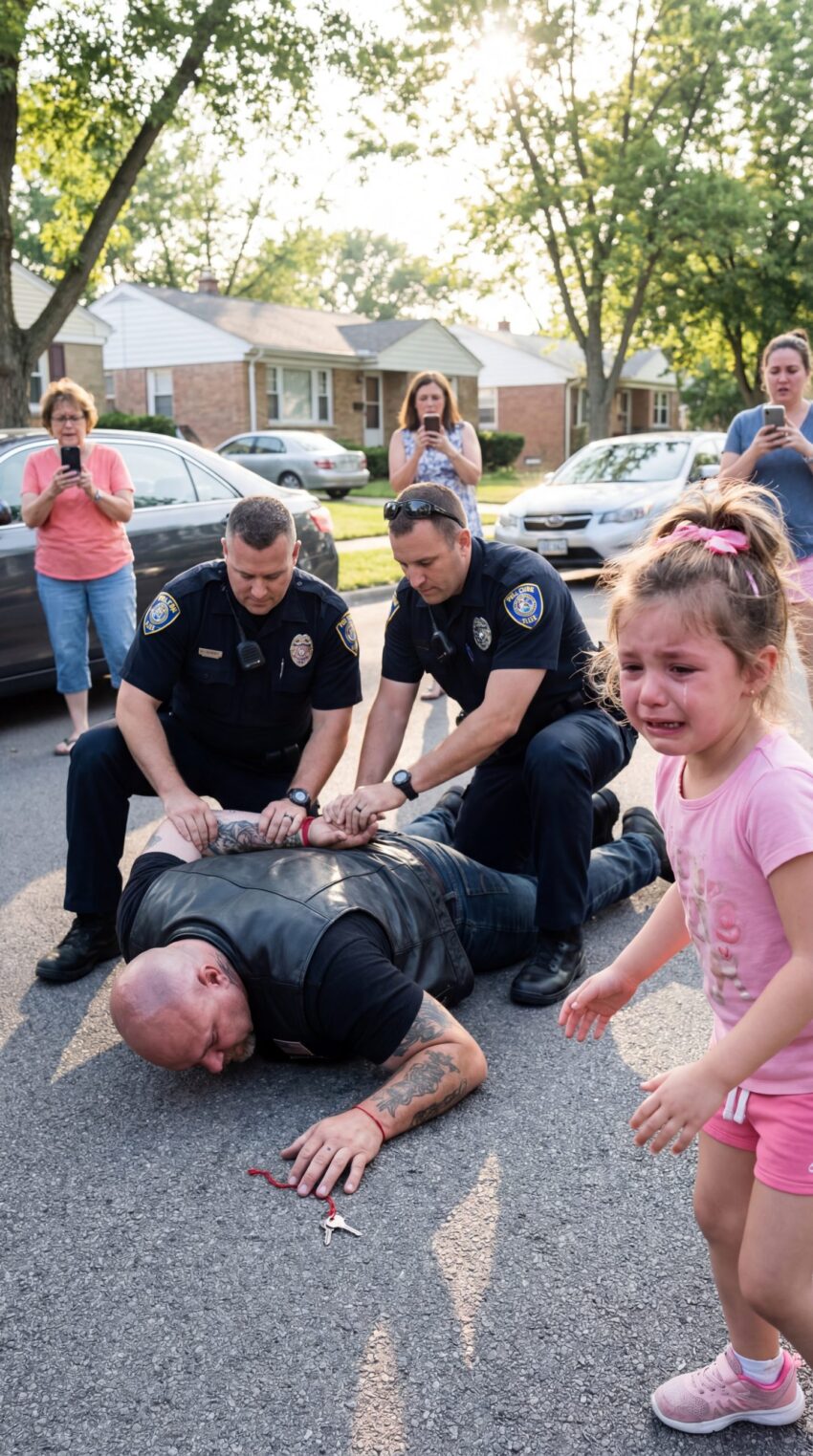
I was across the street when it happened, carrying a paper bag of groceries I had just picked up from the corner market. One second the biker had been standing near the curb with both hands lifted slightly away from his sides, still as a statue. The next second, two officers had rushed him, forced him down, and pinned him to the asphalt while people on the sidewalk froze in place.
Phones appeared in people’s hands almost instantly.
A woman near me whispered, “What did he do?”
No one answered her.
No one knew.
That was the part that bothered me most even before I understood the rest. The man did not struggle. He did not shout. He did not curse. He did not try to run. He went down hard, but after that he stayed still, as if he had already decided that resistance would only make things worse.
One of the officers barked at him to keep his face down.
The other pulled his arms behind his back.
The little girl stared at him with tears streaming down her cheeks, her whole body trembling with the effort of trying not to fall apart. She looked no older than eight. Her sneakers were untied. Her dark curls had slipped loose from the pink ribbon trying to hold them together. She looked like a child who had run outside too fast and forgotten everything except fear.
Then I saw what the biker still had clutched in one hand.
A small silver key.
Old, worn, scratched by time.
A thin red string was tied around the top.
It was such a tiny thing to stand out in a moment that violent, but somehow it did. Even with his cheek pressed to the road, he still had not let it go.
The girl took one stumbling step forward. A bystander tried to stop her, reaching for her shoulder, but she pulled away and shouted through her tears.
“Stop! You’re hurting him!”
The officers did not turn.
Then she screamed again, louder this time, her voice cracking with panic and something deeper than panic.
“He promised my mom he would bring it back!”
And just like that, the street changed.
Not completely.
Not all at once.
But enough.
Enough for one officer to hesitate.
Enough for the crowd to stop whispering.
Enough for every person there to realize that maybe this was not what it looked like.
The Little House on Marigold Street

The girl’s name was Sadie Mercer.
Before that afternoon, most people would have told you she came from one of the quietest houses on Marigold Street. It was a small white house with a porch that leaned a little to one side and flowerpots that were always somehow both overwatered and alive. Wind chimes hung near the front door and never seemed to stop singing, even on days without much wind.
Sadie lived there with her mother, Laurel Mercer.
Just the two of them.
No father in sight. No one openly discussed it. Riverton was the kind of town where people noticed everything and still managed to pretend they noticed nothing.
Laurel was polite but private. She worked long hours, kept to herself, and always looked a little more tired than she let on. If she smiled at you, you felt lucky. If she trusted you with more than small talk, you knew it meant something.
Sadie was the opposite.
She was bright, talkative, restless, and curious in the way only children can be when life has not yet convinced them to guard their hearts. She asked questions adults did not know how to answer. She waved at strangers as if she had known them forever. She carried the world lightly, even though there were signs she had learned too early that life could turn heavy without warning.
A few weeks before the arrest, I had seen her crouched on the sidewalk drawing flowers in chalk. When she stood too fast, something slipped from her coat pocket and landed by her shoe.
A silver key with red string tied around it.
I remember because she snatched it up so quickly that I laughed and said, “That must be important.”
She looked up at me with complete seriousness and answered, “My mom said somebody has to come back for it one day.”
There was nothing playful in her voice. No childish make-believe. It sounded like she was repeating instructions she had been told not to forget.
I remember asking, “Who’s coming back?”
She only shrugged.
Then she tucked the key away and went back to drawing flowers like the question had never mattered.
At the time, it seemed strange.
Later, it became everything.
The Man on the Motorcycle

The biker first appeared on a Tuesday afternoon.
No one knew his name. No one knew where he had come from. He rode a weathered charcoal-colored cruiser that looked older than some of the houses on the street. He parked across from the Mercer home, stayed seated for a while, then stood beside the bike and waited.
That was it.
He did not knock on the door.
He did not walk into the yard.
He did not call out.
He simply stayed there.
The next day he came back.
And the day after that.
Always around the same time, late afternoon, when school buses were gone and the sun started lowering toward evening. He wore a dark leather vest over a faded gray shirt, heavy boots, and an expression that looked less threatening than worn down. He was broad-shouldered and rough around the edges, with the kind of face that made people form opinions before he spoke a single word.
That was exactly what happened.
Neighbors began talking.
Too quietly at first.
Then more openly.
“He keeps watching the house.”
“He’s out there every day.”
“Why is he always looking this way?”
The most unsettling part, people said, was that sometimes Sadie would step onto the porch and stare back at him.
Not frightened.
Not exactly comfortable either.
Just waiting.
Watching.
As if both of them were standing inside some unfinished moment no one else had permission to understand.
One evening, I saw her walk to the edge of the yard and reach into her pocket. She held something out toward him with a trembling hand.
The silver key.
The biker looked at it for a long time.
But he did not take it.
He stayed where he was, like coming any closer might break something fragile between them.
The look on his face was not greed, or guilt in the ordinary sense, or anger. It was the kind of pain a person wears when regret has become part of their bones.
After that, people got nervous faster.
One neighbor said he was lingering too long.
Another said he had seen him glance toward the house after dark.
Another said it was not normal for a man like that to keep showing up where a child lived.
Someone finally called the police.
The officers who came that first time stayed only a few minutes. They spoke to him. They spoke to no one else. Then they left. Whatever happened in that conversation did not solve anything, because he returned again the next day.
And the next.
And the next.
A Promise Buried in Silence
Then one evening, Sadie did not come outside.
That was the first day the biker truly looked lost.
He waited longer than usual. The neighborhood lights flickered on one by one. Dogs barked from fenced yards. The street grew dim. Still he did not leave.
At last, he got off the motorcycle and walked slowly toward the Mercer gate.
He stopped there.
No farther.
With the porch light glowing weakly over the front steps, he reached into his jacket pocket and pulled out something small that flashed silver under the yellow light.
Another key.
Same size.
Same worn metal.
Same red string tied at the top.
I felt a chill all the way down my back.
There were two of them.
That changed everything even before we knew how.
The front door opened.
Sadie stood there, pale and red-eyed, like she had been crying for a long time. She looked from his face to the key in his hand. Though I could not hear her, I saw her lips move.
Whatever she asked him, it made his shoulders drop in a way that was almost unbearable to watch.
He took one careful step forward.
That was when the sirens came.
Not distant.
Not passing by.
Coming for him.
Police cruisers turned onto Marigold Street so fast that everyone came to their windows. Doors opened. Porch lights flared. Fear moved faster than reason.
The officers stepped out and shouted for him to keep away from the house.
He obeyed at once.
They told him to put his hands where they could see them.
He did.
They ordered him to the ground.
He lowered himself without argument, without resistance, like a man who had already rehearsed this possibility a hundred times in his mind.
By then the neighbors had gathered.
So had their assumptions.
“That’s the guy.”
“I knew something was wrong.”
“He’s been watching that little girl for weeks.”
Words like those spread quickly because they fit a story everyone thought they understood.
No one wanted to be the person who hesitated if a child might be in danger. That instinct was human. It was protective. It was understandable.
But understandable and correct are not always the same thing.
What the Child Knew
When the officers forced him face-down onto the pavement, Sadie bolted from the porch with a cry that cut through the noise of the street. She ran so fast I thought she would fall.
“Please stop!” she shouted. “He’s not doing anything bad!”
One officer held out an arm to keep her back.
She slipped around it anyway.
“He’s not taking it,” she cried. “He’s giving it back!”
The words seemed to confuse everyone at once.
The officer closest to her frowned. “Giving what back?”
Sadie pointed at the biker’s hand.
At the key.
At that tiny, ordinary-looking object that suddenly felt heavier than anything else on the street.
The biker finally spoke then. His voice was low and strained, as if the words had scraped against his throat on the way out.
“I told her mother I would return it.”
The officer paused. “Whose mother?”
The man shut his eyes for a second before answering.
“Sadie’s.”
The girl’s face crumpled even further.
“You remember?” she whispered.
He gave one small nod.
Then, slowly, he opened his hand.
The silver key lay in his palm, scratched and dull, the red string faded but still intact.
Sadie reached into her own pocket with shaking fingers and pulled out the matching one she had carried all this time.
A murmur moved through the crowd.
Two keys.
A pair.
A story none of us had known.
The officer eased some of the weight off the biker’s back but did not fully let him up yet. “You need to explain,” he said, and for the first time his voice held more caution than certainty.
The biker swallowed hard.
His name, we would soon learn, was Wade Holloway.
And the story he had been carrying was far older and heavier than any of us had guessed.
The Night He Failed
It came out in pieces.
Not like a man making excuses.
Like a man dragging up something he had buried because living with it hurt less than speaking it aloud.
Years earlier, Wade had been passing through Riverton on his motorcycle after picking up a repair job outside Columbus. He had stopped at a gas station on the edge of town late one night when Laurel Mercer approached him.
She had been scared.
Not panicked in the loud, visible way people expect. Worse than that. Quietly scared. The kind that lives behind the eyes and makes a person glance over their shoulder even when no one is standing there.
She had asked for a ride.
Not home exactly. Just away from where she was.
Wade said yes.
He told her she would be safe with him.
As she climbed on behind him, she took a small silver key from her bag. Then she showed him another one exactly like it, tied with the same red string.
She explained that one belonged to her daughter. The other she kept herself. Matching keys to matching lockboxes, she had said, though Wade later admitted he had not understood all of it then. What he did understand was this: Laurel believed something might happen. She had made preparations the way frightened parents sometimes do when they cannot control the world but still need one thing to remain certain.
Before Wade dropped her off a few streets away from where she asked him not to follow, she pressed one key into his hand.
“If I can’t come back for this,” she had told him, “promise me you’ll bring it to Sadie.”
Wade had frowned and asked why she would say something like that.
Laurel only replied, “Because sometimes a child needs proof that her mother did not forget her.”
He promised.
He meant it.
But life is not always cruel in dramatic ways. Sometimes it is cruel in quiet, lingering ones.
The next morning Wade came back to the area where she had gotten off his motorcycle. He never found her.
He heard later that she had left town.
Another person said she had taken work in another county.
Someone else said they had seen her at a bus station.
Nothing was clear. Nothing held.
He told himself that maybe the promise no longer mattered because she had returned to her daughter another way. He told himself it was not his place to walk into a child’s life with half a story and a pocketful of guilt.
He rode away with the key still in his jacket.
Months passed. Then more time. The promise became harder to fulfill the longer he waited. Shame grew where action should have been.
Eventually he came back to Riverton and learned Laurel had died after a period of illness no one had spoken openly about. Sadie had remained in the house, cared for by relatives for a while and then by a family friend next door who checked on her daily.
By then Wade no longer knew how to explain why he had taken so long.
So he did the worst thing a guilty person can do.
He delayed again.
He watched from a distance.
He told himself he was trying to find the right moment.
Really, he was trying to gather the courage to face a little girl and admit he had failed her mother once already.
The Street Learns the Truth
When Wade finished speaking, the whole street seemed to sink into a silence that felt almost ashamed.
The neighbors who had whispered the loudest looked down.
The people still holding their phones lowered them.
One of the officers asked quietly, “Why didn’t you just tell someone this from the beginning?”
Wade let out a breath that sounded older than he did.
“Because I didn’t think any version of it would make me look like the kind of man she should trust.”
No one had a quick answer for that.
It was a heartbreaking sentence because it was partly true. He looked rough. He looked intimidating. He had shown up day after day without explanation. From the outside, suspicion made sense.
Sadie stepped closer, tears still shining on her cheeks.
“My mom told me somebody would come back one day,” she said. “She said if he came, I should listen.”
Wade stared at her as if her words hurt and healed him at the same time.
The officer at last removed the cuffs.
He helped Wade sit up, then stand. Nobody said much as he got to his feet. The mood on the street had changed too much for simple sentences. It was no longer about whether a child needed protection. It was about the painful truth that people had tried to protect her from the wrong thing.
Sadie opened her hand and showed him the key she had kept all those years.
He looked at the matching one in his palm.
Then, with a care that made the whole moment feel sacred, he placed it in her hand beside the other.
The two keys rested together at last.
Sadie closed her fingers around them and drew in a shaky breath.
Then she did something no one there expected.
She stepped forward and hugged him.
Not because children do not understand fear.
But because children sometimes understand sorrow faster than adults do.
Wade’s face crumpled. He bent carefully, as though afraid of breaking under the weight of one small act of grace. Tears slid down his cheeks, and he did not bother hiding them.
No one moved.
No one interrupted.
For the first time since the police cars had turned onto the block, nothing felt loud anymore.
Just human.
What Was Inside the Lockbox
A few days later, with one officer, Sadie’s caretaker, and two witnesses present, the little lockbox those keys belonged to was finally opened in the Mercer house.
Inside were letters.
Several for Sadie.
One for “The man who kept his promise, even if it took time.”
There was also a photograph of Laurel holding Sadie as a toddler, both of them laughing into sunlight, and a folded piece of paper listing names, dates, and details that answered practical questions Sadie would one day need answered. Laurel had prepared for uncertainty the best way she could. She had hidden love inside instructions, memory inside metal, and hope inside a box she prayed would not be opened too soon.
Sadie read the first letter with tears running silently down her face.
Then she asked Wade to read the one addressed to him.
He refused at first.
She insisted.
So he read it on the porch while the afternoon light turned warm around them.
Whatever Laurel wrote there changed something in him. You could see it happen. Not all wounds close at once, and guilt does not vanish because someone forgives you. But sometimes forgiveness gives a person enough room to begin breathing again.
Wade did not stay away after that.
He did not become family overnight, and no one pretended life suddenly turned simple. But he stopped standing across the street like a ghost chained to the past. Instead, he came to the porch, knocked on the door, and spoke like a man who had finally learned that unfinished promises only heal when brought into the light.
As for the neighbors, we became kinder in the way people sometimes do after being reminded how wrong appearances can be. We still believed in protecting children. We still understood caution. But we also learned that not every silent figure at the edge of a story is the villain people imagine.
Some are just carrying grief with nowhere gentle to set it down.
And sometimes the person everyone fears is only the person who waited too long to do the right thing, then showed up anyway.
That afternoon on Marigold Street stayed with me for years.
Not because the officers came.
Not because the crowd judged too quickly.
Not even because a little girl’s voice stopped a whole street.
It stayed with me because of the two silver keys.
Because somewhere in the middle of fear, misunderstanding, and public shame, a promise still found its way home.
Sometimes life places people in front of us who seem frightening, strange, or impossible to understand, but if we pause long enough to look beyond the surface, we may discover not danger, but a wounded heart still trying to keep one meaningful promise alive.
A person can make one painful mistake, carry the weight of it for years, and still choose to return, which reminds us that courage is not always loud or flawless, because sometimes courage is simply coming back to finish what fear once made us leave undone.
Children often see truth more clearly than adults because they listen with the heart before they judge with the eyes, and that is why one trembling little girl could understand the sorrow in a man long before a whole street full of grown people did.
We should never stop protecting those who are vulnerable, but true protection also requires wisdom, patience, and humility, because rushing to conclusions can sometimes wound the very people we are trying to keep safe.
Guilt can trap a person in silence for years, yet even a delayed act of honesty can still open the door to healing, proving that it is never completely too late to do what is right if love is still guiding the way.
The deepest promises are not always written in grand words or public vows, but in small objects, quiet instructions, and ordinary moments that become sacred because someone chose to remember when forgetting would have been easier.
Forgiveness does not erase pain or rewrite the past, but it gives broken people a place to stand again, and sometimes one gentle act of mercy can do more to restore a soul than years of punishment ever could.
We live in a world that teaches us to react quickly, assume quickly, and speak quickly, yet stories like this remind us that truth often arrives slowly, and only those willing to listen carefully will ever hear its full voice.
Love has a strange and beautiful way of surviving through absence, through fear, through delay, and even through human failure, because when love is real, it keeps reaching back across time until it finally touches the person it was meant to find.
In the end, what stays with us is not only who was wrong or who was right, but who chose compassion after the truth came out, because that is the moment when pain stops being just pain and begins turning into something that can heal