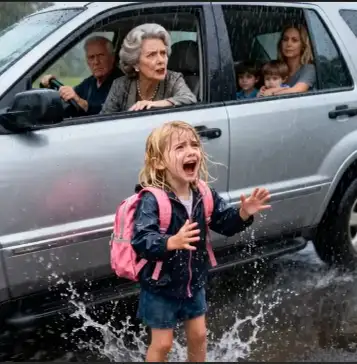
When she ran up to the car expecting a ride home, mom rolled down the window and said, “Walk home in the rain like a stray.” My daughter pleaded, “But grandma, it’s pouring and it’s miles away.” They just drove off, leaving my six-year-old standing there soaked and crying…
At school pickup, my parents drove off with my sister’s kids right in front of my daughter. When she ran up to the car expecting a ride home, mom rolled down the window and said, “Walk home in the rain like a stray.” My daughter pleaded, “But grandma, it’s pouring and it’s miles away.” They just drove off, leaving my six-year-old standing there soaked and crying…
The rain fell in relentless sheets, hammering the asphalt and turning the school parking lot into a blur of gray and silver, each drop a reminder of the storm brewing both outside and within my chest. At pickup time, I had been sitting in a budget meeting, the fluorescent lights buzzing overhead, when my phone vibrated violently across the polished conference table. Mrs. Patterson’s name flashed on the screen, and an icy dread spread through me before I even answered
Years of sacrifices and silent generosity flashed before me as I navigated the slick streets. My parents had always favored Miranda, the younger daughter who had stayed close to home, married early, produced grandchildren first. But leaving my six-year-old in a thunderstorm, telling her to walk home like a stray, revealed the true extent of their cruelty. Every birthday gift I’d purchased, every family vacation I’d funded, every tuition check and emergency dental payment—they all came flooding back, a tally of generosity exploited and returned with contempt.
Back home, I ran a bath for Lily, the warm water enveloping her small, shivering body. I made her hot chocolate, the sweet steam filling the kitchen as I dried her tears and held her close, whispering assurances. “You’ll never have to see them again if you don’t want to,” I promised. Her small arms tightened around me, a grip filled with love, trust, and unspoken questions. Her tears soaked into my shirt, and yet in that moment, they also soaked into my resolve, reinforcing every decision I had made in the storm’s aftermath.
Once Lily was safely tucked into bed, her soft breathing slowly evening into calm, I sat at my laptop and opened my banking apps. For years, I had been the invisible engine of my family’s finances. Nearly $3,000 a month went to my parents’ mortgage, another $800 to their car, $600 for health insurance, plus utilities, HOA fees, and even their country club membership so my mother could maintain appearances among her friends. On top of that, I had been supporting Miranda and her family, covering private school tuition, car leases, vacations, and emergency expenses that never ended, adding up to nearly $90,000 a year.
The numbers blurred and twisted in my mind, forming a damning portrait of misplaced loyalty. Every dollar I had sacrificed, every hour of overtime, every skipped family gathering for my own child—all spent propping up people who would abandon my daughter in the rain without a second thought. As I meticulously reviewed transactions, emergency expenses, and gifts, the sum made me physically recoil: over $370,000 in just four years, money I had given freely, blindly, while being met with betrayal and emotional cruelty in return.
I began severing ties with precision. Automatic payments for the mortgage, car, and utilities were canceled. Health insurance policies removed. School tuition for Miranda’s children stopped immediately. Every financial pipeline connecting me to my parents and sister was methodically dismantled, leaving them dependent on nothing but themselves, and for the first time in years, the scales of power began to tip. I sat back, staring at the screen, stomach twisting with disbelief at the scope of the exploitation I had allowed, and at the same time, a sense of clarity and cold determination washed over me.
David found me at 11 p.m., weary but alert, leaning over my shoulder at the spreadsheet. “Jesus Christ,” he said softly, eyes wide at the staggering total. I whispered, almost to myself, “I’ve been a fool.” He shook his head, hands on my shoulders. “No,” he said firmly, “you’ve been generous to people who didn’t deserve it. That’s different.” His voice carried the kind of steady conviction I needed to anchor me.
Sleep came fitfully that night. I kept seeing Lily’s face in the downpour, hearing the echo of my mother’s words in my head, the casual cruelty slicing through my veins. Those were the people I had sacrificed for. Those were the people I had worked overtime for, worried over, given financial lifeblood to. And yet, here was the ultimate betrayal: my daughter, standing alone in the storm, abandoned by her own family.
The next morning, I took Lily to her favorite breakfast spot, watching her laugh and chatter like a normal six-year-old, her small hands clutched around a steaming mug of hot chocolate, oblivious to the full scope of the cruelty she had narrowly escaped. I knelt beside her in the parking lot afterward, rainlight shimmering off the wet pavement. “Mommy,” she asked softly, “are Grandma and Grandpa mad at us?” I met her eyes, steady, and shook my head. “They made a bad choice, sweetie. Sometimes grown-ups make bad choices, and there are consequences, but you didn’t do anything wrong. None of this is your fault.”
She pressed herself to me, her warmth and trust a beacon amid the chaos. “I love you, Mommy,” she whispered. “I love you too, baby, so much,” I replied. And in that moment, the decision was final. I pulled out my phone and sent a single, decisive group text to my parents and sister: After what you did to Lily today, every payment I’ve been making stops immediately. You’re on your own. Don’t contact me or my daughter again. Then I turned off my phone, leaving the storm and betrayal behind.