It was 11:23 p.m. in the middle of nowhere, rural Pennsylvania. The kind of winter night where the cold feels alive, gnawing at your bones the moment you step outside. Our roadhouse was closing down for the night, the low rumble of Harley engines idling in the parking lot as white exhaust drifted into the black sky. Just another Saturday night wrapping up like a hundred others before it.
I was pulling the heavy front door shut when I heard something strange cutting through the growl of the bikes.
The faint crunch of small footsteps on frozen gravel.
At first, I figured one of the guys had come stumbling back because he forgot his phone on the bar. I turned around with a joke already forming in my mouth.
But the words died before they reached my tongue.
Standing under the dim yellow light at the edge of the parking lot was a little girl.
She couldn’t have been older than seven.
She just stood there, perfectly still, staring at me as if she had stepped out of another world. Her thin purple fleece pajamas clung to her legs, darkened by melted snow around the ankles. She had no coat, no gloves, no hat.
But what made my heart stop was when I looked down.
She was barefoot.
Barefoot on solid ice.
A trail of tiny red footprints stretched behind her across the frozen lot, leading back toward the woods. She was shaking so violently that her whole body trembled, her teeth chattering loud enough to cut through the rumble of the engines.
Everything else faded away.
The cold. The bikes. The tough-guy noise of the night.
All of it vanished the moment I saw that kid.
I’ve lived a hard forty-four years. You don’t wear the patch on my back without seeing the worst parts of life. People see the leather vest, the scars on my knuckles, the size of me—and they cross the street before I even get close.
I understand why.
To most folks, I look like trouble.
What they don’t see are the things I carry underneath that leather. The quiet hospital room from years ago. The sterile smell. The way a tiny hand slipped out of mine one last time while machines hummed and monitors blinked.
That kind of grief doesn’t leave a man.
It just waits.
And when you see a child in danger, it wakes up like a fire in your chest.
I dropped to one knee right there on the ice, the cold soaking through my jeans. I tried to make myself smaller, less frightening.
“Hey there, sweetheart,” I said softly, forcing my gravel voice to calm down. “You’re safe now. Just stay right there for me, okay?”
She didn’t move.
Those huge dark brown eyes stared at me, wide with a terror no child should ever understand.
Her tiny fist was clenched tightly against her chest, gripping something silver.
Slowly, with trembling fingers, she opened her hand.
A wedding ring.
Even in the dim parking lot light, I could see the dark, rusty stain smeared across the band.
She took a shuddering breath and looked straight into my eyes.
Then she whispered five words that will echo in my nightmares forever.
“He made Mommy stop screaming.”
For a moment, the entire world tilted.
A wave of rage exploded in my chest, hotter than the engine block of the bike beside me. But rage wouldn’t help her.
So I swallowed it down.
“Easy, sweetheart,” I said quietly. “I got you.”
I pulled open my leather cut, unzipping the hoodie underneath and stripping down to my thermal shirt in the brutal cold. Then I wrapped the heavy jacket around her tiny frame. The leather swallowed her completely, the smell of gasoline and road dust clinging to it like armor.
To most people those smells mean danger.
But tonight they were protection.
I lifted her carefully into my arms.
She weighed almost nothing.
And she was freezing.
“Rocco! Tiny!” I roared across the lot. “Kill the engines! Now!”
The bikes shut off instantly.
Five big men turned toward us, their faces changing the moment they saw the bundle in my arms.
They ran over, boots crunching through the snow.
“Unlock the door,” I barked at Rocco. “Crank the heat. First aid kit now. Dutch, call 911—tell them we’ve got a child with severe hypothermia and a possible homicide nearby.”
No one argued.
Within seconds the roadhouse doors were open and warm air spilled into the freezing night.
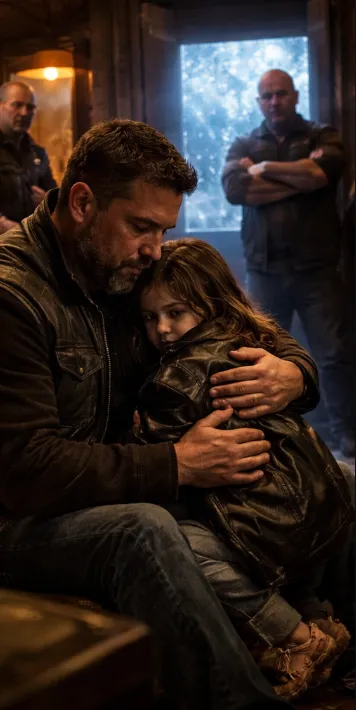
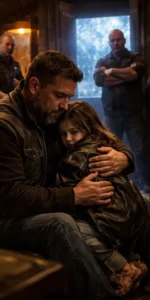
Inside, I sat on a barstool near the heater, rubbing the girl’s tiny feet between my hands. Her skin was pale and stiff, her eyes beginning to glaze as shock crept in.
She pressed her face into my chest.
“He’s coming,” she whispered weakly. “He follows the tracks.”
I looked up at my brothers.
No one said a word.
They didn’t need to.
Tiny—a six-foot-seven mountain of a man who had survived two tours in Afghanistan—walked to the front door and locked it. Then he planted himself in front of the glass with his arms crossed.
One by one, the rest of the club took positions beside him.
We weren’t just a bunch of bikers.
We were a family.
And nobody hurts a kid on our watch.
Ten minutes later, headlights swept across the front window.
A pickup truck roared into the parking lot, sliding sideways on the ice before grinding to a stop.
The driver jumped out.
Big guy. Hunting jacket. Panic written all over his face.
But panic wasn’t the thing I noticed.
What caught my eye were the dark stains splattered across his boots.
The same color as the stain on that ring.
He ran up to the door and pounded on the glass.
“Let me in!” he shouted. “My daughter! Is she in there?”
Tiny didn’t move.
The man pressed his face against the window.
“She sleepwalks!” he yelled. “She wandered off! She’s sick!”
Tiny just stared at him through the glass, his expression carved from stone.
“Open the damn door!” the man screamed, the mask slipping. The panic in his voice twisted into something uglier. Something dangerous.
Then he reached toward his waistband.
That was his mistake.
Inside the roadhouse, five bikers didn’t move a muscle.
We simply waited.
We waited exactly four minutes.
And then red and blue lights exploded across the snowy trees.
State Police cruisers screamed into the lot.
The troopers dragged him to the ground while he thrashed and screamed. They found the knife tucked inside his jacket.
Later, they found the cabin three miles deep in the woods.
They found his wife there.
The little girl had run three miles through the freezing forest.
Barefoot.
In the dark.
Just to survive.
The paramedics tried to take her from my arms when the ambulance arrived.
But she wouldn’t let go of my vest.
So I climbed into the ambulance with her.
I held her hand the entire ride to the hospital.
The same way I once held my daughter’s hand years ago, wishing for one more chance.
She survived.
The frostbite was bad, but she kept all her toes. Her aunt arrived three days later to take her home.
Before they left, the nurses told me she wanted to see “the giant.”
I stepped into her hospital room, suddenly feeling too big for the small space.
She looked up at me and smiled weakly.
Then she handed me a drawing.
It showed a stick-figure little girl standing in the middle of five large dark shapes.
Above them, written in crooked crayon letters, were two words.
“Roving Angels.”
I still keep that drawing taped inside my locker at the clubhouse.
People can believe whatever they want when they see the leather jackets and hear the thunder of our bikes. They can cross the street and whisper about monsters.
I don’t mind.
Because on the coldest night of the year…
The monsters were the ones who kept the light on.