I offered twenty one million dollars to anyone who could earn my dog’s trust.
To the press in New York, it looked like another spectacle from an eccentric billionaire. To me, it was surrender—the quiet confession that I no longer knew how to save the only creature I truly loved.
My name is Adrian Montgomery. Some call me a titan of finance. Others prefer visionary. I think of myself as a man who clawed his way up from a cramped apartment in Brooklyn, where sirens were more common than birds. I built an empire that now stretches through the glass towers of Manhattan. My wealth could purchase privacy, influence, favorable headlines.
It could not purchase peace.
My dog, Atlas, was a massive German Shepherd with dark amber eyes that seemed older than memory itself. He had been given to me by my childhood neighbor, Mr. Harrison, the only adult who ever taught me that loyalty isn’t a transaction. When he handed me the small, clumsy puppy, he also pressed a silver compass into my palm.
“This dog won’t protect you from the world, Adrian,” he’d said. “He’ll protect you from forgetting who you are.”
For years, Atlas was my shadow. In tense board meetings, he lay calmly at my feet, steady and alert. When I worked late, he slept beside my desk. His presence grounded me in ways no advisor ever could.
Then, six months ago, everything shifted.
Atlas began pacing the marble floors of my estate in Westchester. His nails scraped in restless circles. He growled at empty corners. He lunged at shadows with a fury that left even my security team unsettled. The best trainers flew in from Chicago and Dallas. A former military K-9 handler spent two weeks trying to “reassert control.”
They all failed.
Veterinarians ran every test imaginable—neurological scans, blood panels, behavioral assessments. Nothing was wrong.
Except that Atlas wouldn’t let me come near him. If I stepped within a few feet, he snarled, teeth bared, as if I were a stranger.
My board of directors, led by Charles Whitmore, began whispering about liability. Public image. Risk exposure.
“Euthanasia is the responsible choice,” Charles told me more than once. “Quietly. Discreetly.”
But I would not betray the one being who had stood beside me when I had nothing.
So I made the offer public: one million dollars to anyone who could earn Atlas’s trust. Not dominate him. Not drug him. Earn his trust.
The story exploded online. Trainers arrived in tactical gear, armed with gadgets and arrogance. Atlas drove them out within minutes. We built a reinforced enclosure in the garden for safety.
I was ready to end the spectacle when something unexpected happened.
One gray afternoon, security called to say a young woman was at the gate asking about the reward. She wore worn jeans and an oversized sweatshirt. She couldn’t have been more than nineteen. No shoes. No résumé. No credentials.
Her name was Lily Brooks. She lived in a shelter not far from the industrial docks.
“Let her in,” I said, though I couldn’t explain why.
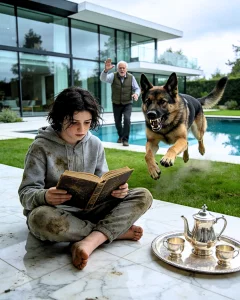
Lily walked into the garden slowly, without fear. She carried nothing—no leash, no treats, no tools. She sat cross-legged several yards away from Atlas and pulled a tattered paperback from her pocket.
Then she began to read aloud.
Her voice was soft, steady, almost rhythmic.
Atlas charged with a roar that made my heart slam against my ribs. His teeth stopped inches from her face.
She didn’t flinch.
She didn’t scream.
She kept reading.
“The river doesn’t fight the stone,” she murmured from the page. “It shapes it.”
Time stretched.
The board watched through reinforced glass, pale and silent.
Minutes became an hour. Atlas’s rigid ears slowly lowered. His breathing softened. He stepped back, then forward again, uncertain.
Eventually, he did something I hadn’t seen in months.
He lay down.
Then, carefully, he rested his heavy head in her lap and released a long, exhausted sigh.
I felt something inside my chest break open.
I moved toward them slowly. “How?” I asked, my voice unsteady.
Lily looked up at me with clear, unwavering eyes. “He’s not unstable, Mr. Montgomery,” she said. “He’s afraid.”
“Afraid of what?”
“Of something that doesn’t belong here,” she replied.
She pointed toward the small silver tray where my afternoon tea was served each day. Always prepared by Charles’s personal assistant.
“I’ve stayed in shelters,” she continued quietly. “They use mild sedatives sometimes to calm aggressive strays. I recognize the smell. It’s faint. But it’s in your tea.”
The words landed like ice water.
I ordered immediate testing.
The results confirmed it: small, consistent doses of a neuroinhibitor—too subtle to cause alarm, enough to cloud judgment over time.
By evening, the larger picture came into focus. Charles Whitmore and two board members had drafted documents to declare me medically unfit to oversee the Montgomery Trust, a multi-billion-dollar fund controlling philanthropic and corporate interests. With medical doubt surrounding me, they would assume control.
Atlas hadn’t gone mad.
He had been trying to warn me.
Authorities were contacted. Charles was escorted out of my own home in handcuffs, his expression stripped of its usual confidence.
When the chaos settled, I wrote a check for one million dollars and handed it to Lily.
She pushed it back.
Instead, she reached into her sweatshirt pocket and pulled out a silver compass.
Identical to mine.
“My grandfather told me if the air ever felt heavy,” she said softly, “I should find the man with the dog named Atlas. He said the dog would finish what he started.”
Mr. Harrison.
The realization felt like the closing of a circle I hadn’t known was open.
I didn’t give Lily the money.
I offered her something different.
I appointed her Director of Community Initiatives within the Montgomery Trust. I arranged for her education, housing, stability. But more importantly, I gave her a place at the table—not as charity, but as someone whose judgment had already saved everything I built.
Now I sit in the garden most evenings watching Lily run barefoot through the grass while Atlas follows, tail swaying in easy contentment. The air feels lighter.