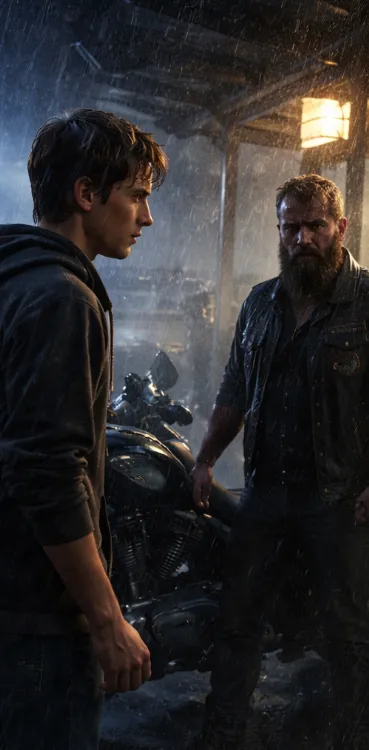
Rain slammed against the pavement so violently it seemed to bounce back up in shimmering silver mist. The neighborhood had retreated early into warmth and light, windows glowing softly while the storm swallowed the streets outside. No one had any reason to be out there, not in weather like that, not unless they had nowhere else to go.
Liam nearly missed him.
He was rushing home from his evening shift, head down, hoodie soaked through, when something caught his eye near the old, abandoned service station at the edge of the block. A motorcycle leaned crooked beneath a rusted, broken awning, and beside it stood a man—huge, unmoving, drenched to the bone. Even from a distance, there was something intimidating about him, something that made most people cross the street without thinking.
Liam slowed.
At school, he was invisible. Not bullied, not admired—just there. A shadow in the hallway, a quiet presence filling a desk. Seventeen years old, and he had already learned the unspoken rules of his town: keep your head down, don’t invite trouble, and never, ever talk to strangers who look like they could crush you without trying.
He could have walked past.
Most people would have.
But something in him tightened, like a thread being pulled, and before he could talk himself out of it, he stepped off the sidewalk and into the rain.
“Need some help?”
The man turned slowly, and up close, he was even more imposing. His beard was streaked with gray, framing a face carved in hard lines, eyes sharp despite the water dripping from his brow. His leather vest was heavy with patches Liam couldn’t make out in the dark.
“Fuel line’s cracked,” the man said, voice rough and low. “Phone’s dead. Unless you’ve got a spare hose and a charger in that backpack, kid, you can’t help.”
Liam hesitated, gripping the straps of his bag. “I don’t. But… I live two houses down. There’s a garage. Tools. And it’s dry.”
The man stared at him for a long moment, rain running down his face like melted glass. Then, finally, he gave a single nod.
“Lead the way.”
They walked together through the storm, Liam guiding while the stranger pushed the heavy black bike beside him. It felt surreal, like stepping into someone else’s life. When they reached Liam’s house, he lifted the garage door, and the man rolled the motorcycle inside, bringing with it the smell of oil, gasoline, and wet leather.
For a while, neither of them spoke much.
Liam grabbed towels, brewed coffee with shaking hands, and held a flashlight steady while the man worked with practiced precision. His name, he said simply, was Bear.
Despite his size, Bear moved carefully, methodically, as if the machine in front of him deserved respect. He didn’t make a mess, didn’t bark orders, didn’t act like the monster Liam had expected.
The longer Liam watched him, the more the fear dissolved into something quieter—curiosity, maybe even trust.
“You live here alone?” Bear asked at one point, glancing toward the kitchen.
“Just me and my mom,” Liam said. “She works nights at the hospital.”
Bear nodded slowly, studying him in a way that felt less threatening and more… measuring.
“You’re a good kid,” Bear said. “Most people would’ve locked their doors.”
Liam shrugged, unsure what to say. “It was raining.”
Bear let out a low chuckle. “Yeah. It was.”
When the bike finally roared to life, the sound filled the garage like thunder trapped in metal. Bear wiped his hands, took one last look at Liam, and climbed onto the machine.
“Thanks for the coffee,” he said.
And just like that, he was gone—taillight fading into the storm, swallowed by darkness and rain.
Liam locked up, went inside, and went to bed.
He thought that was the end of it.
He was wrong.
The next morning, the world didn’t wake up quietly.
It roared.
Liam jolted upright as a deep, rolling thunder shook the walls of his room. For a split second, he thought the storm had returned—but this sound was different. He rushed to the window, heart pounding.
The street was unrecognizable.
Dozens of motorcycles lined the curb in perfect formation, chrome gleaming under the pale morning sun. Riders stood beside them—men and women in leather and boots, arms crossed, silent and still. It looked less like a neighborhood and more like a scene pulled straight from a movie.
Liam’s breath caught.
Downstairs, the front door creaked open. He ran down to find his mother in the hallway, clutching her robe, her face pale as she stared through the peephole.
“Liam, stay back,” she whispered. “I’m calling the police.”
“Wait,” Liam said quickly, his pulse racing. “I… I think I know them.”
He opened the door before fear could stop him.
The air outside was heavy with silence, broken only by the faint ticking of cooling engines. Every house on the block was watching—curtains slightly drawn, blinds barely open, eyes hidden behind glass.
At the front of the group stood Bear.
He removed his helmet and stepped forward, his presence commanding but calm. Liam’s neighbors shifted behind their windows, bracing for something violent, something dangerous.
But that’s not what happened.
Bear stopped at the base of the porch steps and, instead of advancing, he stepped back.
Then he bowed his head.
“Morning,” Bear called out, his voice carrying across the entire street. “Sorry for the noise, ma’am. We just had a debt to settle.”
The tension in the air didn’t break—it transformed.
Bear snapped his fingers, and another rider approached, carrying a large, heavy case. He walked up the steps and placed it carefully on the porch before stepping back.
Liam stared.
It was a brand-new mechanic’s tool set—top-of-the-line, the kind he had only ever seen in catalogs, the kind he knew he could never afford.
“Your boy’s got a steady hand,” Bear continued, loud enough for every listening neighbor to hear. “And a good heart. He opened his door when everyone else hid.”
Bear’s eyes met Liam’s.
“The Iron Kings don’t forget kindness. And we don’t forget our friends.”
A murmur rippled through the unseen audience behind curtains and blinds.
Bear extended his hand.
For a moment, Liam hesitated—not out of fear, but because he understood something had changed. This wasn’t just gratitude. This was recognition. A line had been crossed, and there was no stepping back.
He reached out and took it.
The handshake was firm, grounding, and final—like a promise sealed without words.
“You ever need anything,” Bear said quietly, just for him, “you call. You’re under our wing now, ghost.”
Then he turned, gave a sharp signal, and the silence shattered into thunder as engines roared back to life. One by one, the riders mounted their bikes and pulled away in perfect formation, leaving behind nothing but the fading echo of power and presence.
Liam stood there, unmoving, the tool set at his feet.
Across the street, Mr. Henderson—who had never spoken to him once in three years—lifted a hand in a stunned, almost hesitant wave.
Liam blinked.
Then he waved back.
For the first time in his life, he wasn’t invisible anymore.
The street slowly returned to normal, but something fundamental had shifted. The same houses stood, the same sidewalks stretched on—but Liam knew they would never look at him the same way again.
And neither would he.
Because that morning, he learned something no classroom could ever teach.
Real strength wasn’t about how loud you could roar, or how dangerous you looked. It was about what you chose to do when no one was watching.
And sometimes, a single act of quiet kindness in the dark… comes back to you in the light—loud, undeniable, and impossible to ignore.