Thanks for coming from Facebook. We know we left the story at a difficult moment to process. What you’re about to read is the complete continuation of what this experienced. The truth behind it all.
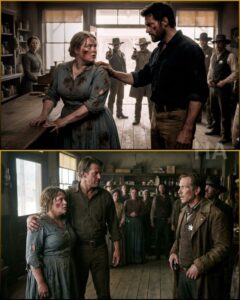
The bell over the door jingled again, this time slower.
Three men stepped inside as if the room already belonged to them.
They wore dust-colored coats, wide hats pulled low, and U.S. Marshal badges that flashed bright against a world made of brown. Revolvers sat ready on their hips, hands already resting where they could draw without thinking. The lead marshal’s boots did not hesitate. He walked with the confidence of a man who had never had to ask permission in his life.
He didn’t ask who the woman was.
He said her name like a sentence.
“Maeve Callahan.”
The woman jerked backward as if the sound itself struck her. Her shoulders hit the counter. The back exit was too far away, beyond a stretch of staring bodies that suddenly refused to see her at all. The front door was blocked by federal law.
“You’re under arrest,” the marshal said. “Theft of federal documents. Assault on an officer. Hands where I can see them.”
Maeve’s mouth opened, but whatever defense she had prepared dissolved into panic. Her hands lifted halfway, shaking, and then dropped again because they didn’t know what shape surrender was supposed to take.
She wasn’t fast enough. She wasn’t strong enough. And the town… the town was not brave enough.
A silence thick as wet wool settled over the store.
Then a shadow fell across her shoulder.
A hand landed there, large and steady, the kind of hand that had known heat and iron and hard work. It didn’t squeeze her like a threat. It didn’t pat her like pity. It simply claimed the space the way a mountain claims the sky, immovable and unapologetic.
A man stepped forward from the edge of the crowd like he’d been there the whole time.
Everyone in Pine Hollow knew him, even if most of them had never spoken to him for more than a handful of words.
Eli Rourke. The blacksmith. The solitary mountain of a man who lived beyond the tree line in a cabin where smoke rose alone and no laughter ever carried on the wind. Men respected him the way they respected storms: not because they understood him, but because they knew better than to pretend he was harmless.
Eli didn’t raise his voice. He didn’t touch a gun.
He simply looked at the marshals and said, calm as iron cooling in a trough, “She’s my wife.”
The words landed on the room like a hammer strike.
The lead marshal’s eyes narrowed. “No marriage record. Not here. Not in the county.”
“We were married in Utah,” Eli replied. His voice didn’t change. “Last month. Papers haven’t been filed yet.”
Maeve’s heart slammed so hard it hurt. She stared up at him, at the blunt planes of his face, the scar along his jaw, the eyes that looked like they had watched the world break and decided not to flinch anymore. She understood in a flash that he was lying, and that his lie was the only rope hanging over her head.
“It’s true,” she whispered, forcing the words to sound real enough to become a lifeline. “I’m… I’m his wife.”
The marshal hesitated, and in that hesitation the whole store seemed to inhale. He weighed risk against certainty. Not because he doubted himself, but because he doubted the trouble Eli Rourke might bring if pressed.
“We’ll verify,” the marshal said at last, lowering his revolver a fraction. “If you’re lying, Rourke, I’ll come back and take you both.”
The three men backed toward the door with the slow confidence of wolves that believed the deer would still be there tomorrow. Outside, hooves clopped. The bell jingled like a warning as the door shut behind them.
The store remained frozen.
Maeve trembled on the floor, barely breathing now that she had permission to breathe at all.
Eli leaned down, close enough that only she could hear him.
“I lied,” he murmured. His voice was low, but there was an edge under it, something darker than kindness. “Because I know men like that don’t let you live once they’ve decided what you are.”
He straightened, and the calm on his face sharpened into something that felt like a demand.
“Now you owe me the truth,” he said. “Before we find out what kind of trouble just rode into my life.”
Maeve swallowed. Her mouth tasted like dust and fear.
Outside, Pine Hollow looked harmless, the way most small towns did from a distance. A stripe of buildings pressed along the dirt road as if trying to hide from the wind. A saloon with swinging doors that never fully stopped swinging. A post office that doubled as the only place to hear news from the rail line. A church that filled on Sundays and emptied the moment trouble started.
And at the center of it all, the general store where flour, nails, coffee, and gossip were sold with the same casual certainty.
In Pine Hollow, information traveled faster than horses. A whispered name could become a mob by sunset. And when a man wearing a marshal’s badge spoke a woman’s name out loud like a verdict, the town didn’t care what the truth was. They heard only one thing:
You’re finished.
That was why Maeve’s collapse on the floor had terrified everyone into stillness. They weren’t just watching a stranger beg. They were watching federal law breathe inside their walls, and they knew what happened to people who got in its way.
Eli Rourke should have been the last man to step into that moment. He didn’t drink at the saloon. He didn’t linger on the boardwalk. He came into town only when someone needed a horseshoe, a wagon hinge, a new latch for a door. He spoke in short sentences, collected payment, and disappeared back to the edge of the woods.
There were stories about him because a quiet man in a loud town always collects stories. That he’d killed a bear with a hammer. That he’d once worked for the law and didn’t anymore. That his hands were too steady and his eyes too watchful for a man who claimed to want nothing but peace.
And there was one detail everyone agreed on because it was so easy to notice.
No one had ever seen Eli Rourke near a woman in the way that created gossip. No courting. No dances. No lingering smiles, nothing.
So when he stepped forward and claimed Maeve Callahan as his wife, it didn’t just confuse the marshals. It shocked the town so deeply that for a second even fear loosened its grip.
If Eli was lying, he wasn’t just risking trouble. He was inviting it.
And Maeve made no sense as a wife to anyone watching. She looked wrecked and exhausted, bruises blooming on her skin like someone had tried to teach her a lesson with fists. She wasn’t carrying a satchel or a plan. She was carrying only desperation.
Outside, the three marshals mounted up without urgency. Their confidence wasn’t built on evidence alone. It was built on certainty, on the belief that the world would bend the way they expected it to bend.
Which raised a question that sat heavy in the air even after they left:
If Maeve was only a fugitive passing through, how had they reached Pine Hollow so fast?
How had they known to look for her in a town small enough to miss on a map?
And why did they ride like they already owned the ending?
That night, Maeve sat at Eli’s rough wooden table inside his cabin. Her hands were wrapped around a tin cup of water she hadn’t tasted. The forge outside had gone quiet. The last glow of iron had faded to dull red, then black. Inside, only lamplight and tension remained.
Eli sat across from her, elbows on the table, posture still, as if he could become part of the furniture if he chose. But his eyes were alive, sharp and watchful.
“You said I owe you the truth,” Maeve began. Her voice was steadier now, though exhaustion still threaded through it like frayed rope. “You do deserve it.”
She didn’t start with the accusation. She started with the loss, because loss was where her life had tipped.
“In 1875,” she said, “a fever rolled through Denver. It took both my parents in a week.”
She stopped, because even now the memory tightened her throat.
“I was twenty-five. Old enough to understand death, young enough to feel it like betrayal. There was no property to speak of. No brothers. No place for me that didn’t come with conditions.”
Eli’s gaze didn’t leave her face. He didn’t interrupt. He didn’t soften either, but Maeve realized that his silence wasn’t indifference. It was attention, heavy as a blanket.
“I was sent to my only living relative,” Maeve continued. “My uncle. Horace Callahan.”
Eli’s eyebrows flicked up a fraction. Not recognition, exactly, but the kind of reaction that meant a name had weight.
“Horace was a land broker,” Maeve said, bitter edges creeping into her voice now. “Polished boots. Polished words. He moved deeds across desks the way other men move cards across saloon tables.”
She drew in a breath and forced herself to keep going, because stopping meant drowning again.
“At first he treated me like a burden. Then like help. I copied letters. Kept accounts. Organized ledgers.” Her fingers tightened on the tin cup. “And that’s where I started noticing things that didn’t fit.”
Eli leaned forward slightly. “What kind of things?”
“Parcels sold twice,” Maeve said. “Titles transferred without proper signatures. Land promised to homesteaders that had already been pledged elsewhere.” She let the words sink in. “Men came into his office with hope in their faces and left with nothing but papers that were already worthless.”
She swallowed.
“I confronted him once. I told him he was stealing from people who had nothing.”
“And?” Eli asked.
Maeve’s mouth twisted. “He smiled like I was a child complaining about weather. He said, ‘I’m investing in opportunity.’”
She stared down at the table. “I didn’t stop looking after that. I copied entries. Dates. Payments. Names. I thought… I thought if I collected enough, the law would have to listen.”
Eli made a sound that wasn’t quite a laugh, but wasn’t kind either. It was a short exhale through his nose, as if the idea of law and justice sharing a room was a story he’d heard before.
Maeve’s eyes lifted. “I know how it sounds.”
“No,” Eli said quietly. “I know exactly how it sounds.”
Her mouth went dry.
“I took the ledgers to a marshal in Denver,” Maeve continued, voice tight now, because the memory was sharp and fresh like a cut that never healed. “I believed a badge meant protection.”
“What happened?” Eli asked, though something in his eyes already suggested he knew.
Maeve’s voice dropped. “He recognized the names.”
Eli’s jaw clenched.
“The marshal was on Horace’s payroll,” Maeve said. “I realized it too late. Within hours I was accused of theft. Of assaulting a federal officer during questioning. Of fabricating records to extort my own uncle.”
Her shoulders slumped as if the words themselves weighed too much.
“The charges spread faster than I could defend myself. Horace called me unstable. Ungrateful. Dangerous. And people believed him because… because a woman who doesn’t fit into their idea of pretty or soft is easier to label as monstrous.”
Eli’s gaze hardened, and Maeve felt something like shame flare, not because she believed the townsfolk, but because she had lived long enough under their eyes to carry their judgments like stones.
“So I ran,” she said. “Not because I was guilty, but because I understood how quickly the law can be turned into a shovel.”
She looked up at Eli then, and for the first time her eyes didn’t plead. They held steady.
“My goal was simple,” she said. “Get the evidence to someone clean. Someone beyond Horace’s reach. Prove I’m not a criminal, I’m a witness.”
A silence settled between them, thick and meaningful.
Eli leaned back in his chair slowly, as if his body needed time to settle around what his mind was doing.
“You tried to trust the law,” he said at last, voice quiet. “And the law tried to bury you.”
Maeve’s heart stuttered. “You sound like you’ve been there.”
Eli stared into the lamplight as if it showed him something from ten years ago.
“I was a deputy marshal once,” he said.
Maeve blinked. “You were… law?”
“In Wyoming Territory,” he continued, and his voice tightened around the words like a fist. “Under a man named Caleb Harlan.”
Something in the way he said the name made it clear it wasn’t just a memory. It was a scar.
“I found proof he was taking bribes,” Eli said. “Smugglers. Land sharks. Men who paid to keep their hands clean on paper. I reported it.”
Maeve leaned forward, her tin cup forgotten. “And?”
Eli’s mouth set. “Two days later, I was in irons, charged with the same crime.”
Maeve’s breath caught.
“I was supposed to stand trial,” he went on. “But I knew how it would end. Harlan had friends. Money. I would’ve been convicted before I opened my mouth.”
“So you ran,” Maeve whispered.
“I disappeared,” Eli corrected. “Changed my name. Learned to swing a hammer instead of a badge. Built a life small enough to hide in.”
The confession hung between them, not as a request for sympathy, but as an explanation for why he had stepped forward in the store. Maeve understood suddenly that Eli’s lie hadn’t been kindness alone.
It was recognition.
He had seen in her the same shape of danger he had lived through: the moment when the law stops being a shield and becomes a weapon.
And maybe, though he didn’t say it aloud, he had also seen the other risk.
If Maeve was captured and questioned hard enough, the marshals might dig into anyone who helped her. They might uncover the deputy who vanished before sentencing. Eli’s quiet life might shatter the moment her name was dragged across more desks.
Saving her was compassion wrapped in self-preservation.
Which didn’t make it less real.
It made it human.
The next morning, Eli didn’t offer Maeve softness. He offered structure.
“You’ll stay here,” he said, standing near the forge doorway as early light filtered through pine branches. “For now.”
Maeve watched him carefully. Up close he was even more imposing than he’d looked in the store, all broad shoulders and scarred hands and a face that had learned to survive without asking permission.
“You barely know me,” she said. “I could be exactly what they claim.”
Eli’s eyes flicked to her, calm and assessing. “No.”
“How can you be sure?”
“Guilty people don’t run into crowded rooms and beg for help,” he replied. “They run away from witnesses.”
Maeve’s throat tightened. The truth of that hit deeper than comfort, because it meant Eli wasn’t saving her out of hope. He was saving her out of logic. And logic was reliable in a way hope rarely was.
“I don’t have the ledgers anymore,” Maeve admitted. “The marshal took them.”
Eli stepped closer, not threatening but firm, like a man who had decided where the boundary was and wasn’t interested in arguing about it.
“I put my neck under a federal gun for you,” he said. “That wasn’t charity. If you stay here, you do what I say. You don’t wander. You don’t talk to strangers. You don’t make this harder than it already is.”
“What do you want?” Maeve asked, even as fear fluttered in her stomach.
“The whole truth,” Eli said. “And obedience.”
His tone wasn’t cruel. It was practical, the way you spoke when you were building something and knew which nails could not bend.
Maeve held his gaze, and in return he gave her the bluntest promise she’d heard in months.
“I keep you alive.”
She considered her options.
She had none.
“All right,” she said quietly. “I’ll follow your lead.”
Their agreement wasn’t romance. It wasn’t trust. It was survival.
But even as they spoke, Eli’s eyes shifted toward the road beyond the trees.
“They’ll come back,” he said.
Maeve’s spine tightened. “How do you know?”
“Men like that don’t leave unfinished business,” he replied. “Not when reputation is involved.”
He stepped outside, scanning the pines, the stretch of dirt leading toward town. No horses yet. No dust cloud. But the air felt unsettled, as if it was holding its breath.
“And next time,” Eli added, voice lower, “they won’t ask questions. They’ll make an example.”
Maeve stepped into the doorway beside him, and for the first time since she’d run into Pine Hollow with fear in her lungs, she understood something clearly.
This wasn’t just about her innocence.
It was about power. About who controlled the story.
And the marshals would not tolerate a narrative that challenged theirs.
Living under one roof proved more dangerous than either of them expected, not because of what happened inside the cabin, but because of what happened outside it.
Pine Hollow was small. Small enough that a new curtain in a window could become an afternoon conversation. Small enough that if Eli Rourke, the solitary blacksmith, suddenly had a wife, every pair of eyes would notice.
On the third day after the marshals left, Maeve insisted on going into town.
“If I hide,” she said, tying her bonnet with steady fingers, “they’ll know something’s wrong.”
Eli hesitated. Every instinct told him to keep her inside the tree line, away from curiosity. But Maeve was right. Fear drew attention. Normality concealed it.
So they walked together.
The general store fell silent when they entered, as if the building itself remembered the gunshot.
Maeve felt the weight of stares, measured and skeptical. A woman at the counter looked her up and down with the kind of judgment that didn’t even pretend to be polite.
“Mrs. Rourke,” the shopkeeper said slowly, testing the words like he expected them to break. “Didn’t know Eli had… family.”
Maeve forced a smile. “Neither did I, until recently.”
The line earned a few uneasy chuckles, and Maeve understood the mechanics of survival in that moment. Humor wasn’t joy. It was a tool, a way to make people comfortable enough not to ask harder questions.
She bought flour and coffee while women pretended not to stare. Eli stood beside her like a wall, large and unmovable, daring anyone to question what they saw.
But suspicion lingered.
By the time they left, Maeve understood something bitter: pretending to be a wife meant being watched like one.
That night, she said quietly, “I’m putting you at risk.”
Eli didn’t look up from the piece of iron he was shaping. “You already did. Now we manage it.”
The second blow came when Maeve admitted what she remembered from the ledgers.
“I can’t recall every line,” she said, seated at the table again, “but I remember patterns. Names. The way payments were marked in code.” She lifted her gaze. “Enough to know where the bodies are buried, even if I don’t have the shovel anymore.”
Eli’s eyes sharpened. “If the originals are gone, we build new proof.”
“How?” Maeve asked, and she hated how small her voice sounded.
“Not from paper,” Eli said. “From people.”
Maeve’s stomach turned. “People are afraid.”
“Not all of them,” Eli replied. “Corruption always leaves a trail of the cheated.”
It was a dangerous idea. Questioning settlers meant stirring dust powerful men preferred buried. But Maeve had run too long to keep pretending fear was safety.
Within days, Eli noticed a rider lingering near the edge of his property. Not a townsman. Not a drifter. Watching.
“They’ve posted someone,” Eli told Maeve that evening, his gaze fixed beyond the trees.
Maeve’s blood ran cold. “Horace or the marshals.”
Inside, tension coiled tighter. Maeve struggled with guilt, because every hammer strike from Eli’s forge sounded like another reminder that he had chosen this battle because of her.
She offered to leave more than once.
“Go where?” Eli asked bluntly. “Back into their hands?”
Maeve had no answer.
And yet, amid danger, something unexpected grew, not as a sudden burst of romance, but as a slow, stubborn thread of care. In the quiet of evenings, Maeve cooked simple meals while Eli worked iron into shape. Once, when a spark caught Eli’s wrist and left a raw burn, Maeve grabbed his hand without thinking, cooled it with water, wrapped it in clean cloth.
Eli watched her, not as a fugitive, not as a burden, but as a person capable of tenderness even while carrying fear.
“You don’t have to take care of me,” he said, voice rough.
“Yes,” Maeve replied softly. “I do.”
The words lingered between them like smoke that wouldn’t clear.
Later, by firelight, Maeve confessed what she had never dared say aloud.
“I’m tired of running,” she said, staring at the dancing flame. “Tired of being the easy one to blame. Tired of living like my body makes me guilty before I even speak.”
Eli’s jaw tightened, not with impatience but with something that looked like recognition.
“Then we stop running,” he said.
Emotion made them vulnerable. Attachment made them visible. And visible people could be used.
When the third test arrived, it came with hooves.
Not one horse. Several.
The sound rolled through the trees and stopped outside the forge like a held breath finally exhaled.
Eli rose slowly from his chair. “They didn’t come alone,” he said. “And this time they brought someone who thinks he owns you.”
Maeve’s hands shook despite her effort to steady them. “Horace.”
Eli moved to the door, but he didn’t open it immediately. He listened first, because he understood performance. He understood intimidation as theater.
“They’re making sure the sound carries,” he murmured. “That means they don’t just want you. They want witnesses.”
The knock came hard and deliberate.
“Rourke!” a familiar voice called. “Open up!”
Eli opened the door.
Three U.S. marshals stood on the threshold, and beside them, smiling thinly under a dust-coated hat, stood Horace Callahan.
Maeve’s breath caught in her throat. Even in the dim light, Horace looked clean in the way men with money always did, as if dirt respected him enough not to cling. His boots were polished. His gloves fit snug. His smile was practiced.
“Well,” Horace said smoothly, eyes sliding past Eli to land on Maeve. “There she is. My wayward niece.”
“She’s my wife,” Eli replied evenly.
Horace laughed, a short sound that carried no warmth. “Is that what she told you?”
The lead marshal stepped forward. “We have reason to believe Maeve Callahan is harboring stolen federal documents and has fled lawful arrest.”
“She has neither,” Eli answered.
Horace tilted his head, studying Eli like a piece of property he might purchase if it looked useful. “Careful, blacksmith. Lying to a federal officer is a serious offense.”
The words were meant for the crowd already gathering down the road. Townsfolk drifted closer, drawn by raised voices the way moths drift toward flame. This wasn’t a quiet arrest.
It was a spectacle.
Maeve saw it instantly. They weren’t rushing in. They weren’t dragging her out. They were here to humiliate Eli publicly, strip his credibility in front of Pine Hollow, make him look like a fool protecting a criminal.
If they couldn’t take her easily, they would destroy him instead.
The marshal’s gaze sharpened. “Unless you’d like to explain why a former deputy from Wyoming is suddenly so protective.”
Maeve’s blood turned to ice.
Eli didn’t move.
Horace’s smile widened, and Maeve understood the true danger. Horace didn’t just want her captured. He wanted Eli exposed. He wanted the town to see Eli not as a blacksmith, but as a fugitive with his own secrets, so no one would stand beside him.
Maeve stepped forward, her voice breaking through the tension.
“Leave him out of this,” she said. “This is about me.”
Horace looked pleased, as if she’d delivered the line he’d been waiting for. “Oh, Maeve,” he said softly. “It’s about much more than you.”
The marshal stepped closer. “We’re prepared to search the premises.”
Eli shifted, blocking the entrance fully. “If you have a warrant signed by a judge,” he said calmly, “present it.”
Silence.
Horace’s jaw tightened. No warrant. Just intimidation.
The marshal’s eyes hardened. “You’re making this difficult.”
“No,” Eli replied. “You are.”
Behind him, Maeve felt something shift in the air, the moment a line is drawn and everyone suddenly knows which side they’re standing on.
Eli’s voice dropped low, steady, carrying without shouting.
“You want her?” he said. “You go through me.”
The crowd had gathered fully now. Pine Hollow had seen fistfights, drunken standoffs, cattle disputes. But it had never seen Eli Rourke plant himself like a wall and tell the federal law to find another door.
Horace removed his gloves slowly, theatrically. “Let’s end this,” he said. “Arrest her.”
The marshal took one step, and then another voice cut through the air like a blade.
“That will not be necessary.”
Heads turned.
A rider approached from the south road, dust trailing behind. He dismounted without hurry, as if he had all the time in the world and intended to use it. He was older, gray at the temples, dressed plain but with the quiet authority of a man who didn’t need to prove he mattered.
Judge Samuel Whitlow.
In his hand was a folded document sealed in red wax.
Horace’s confidence faltered for the first time.
“Judge,” the marshal said stiffly. “This is federal jurisdiction.”
“Corruption is always my jurisdiction,” Judge Whitlow replied, voice calm as a river that had carved stone for years.
He stepped between Eli and the marshals and unrolled the document where everyone could see the seal.
“I have concluded an independent inquiry into land acquisitions filed under Horace Callahan’s authority in Denver and surrounding counties,” the judge announced, loud enough for the whole street. “Multiple signatures were forged. Titles altered. Federal officials bribed.”
A murmur swept the crowd like wind through dry grass.
Horace’s face paled. “You can’t prove that.”
“I already have,” the judge replied, and his tone held the finality of a door being locked. “I have sworn affidavits from two clerks pressured to falsify reports. I have statements from settlers sold land they never truly owned. And I have evidence that the charges against Maeve Callahan were fabricated to silence her testimony.”
The marshal shifted uneasily.
Judge Whitlow turned his gaze on him. “You will surrender your badge and sidearm. Effective immediately.”
Silence heavier than gun smoke.
For a moment no one moved, and the town’s breath seemed to hang in the air. Then the younger marshal, uncertain, slowly unpinned his badge and handed it forward. The lead marshal hesitated longer, but under the judge’s steady stare, he did the same.
Horace’s voice cracked. “This is absurd. She stole my books!”
Maeve stepped forward before fear could reclaim her. Her hands trembled, but her voice held.
“I did not steal from you,” she said clearly. “I tried to expose you.”
She turned so the town could see her face, bruises and all, the proof of what bought law looked like when it touched flesh.
“I was never running from the law,” Maeve said. “I was running from men who purchased it.”
The words landed like a stone dropped in still water, sending ripples through every face watching.
Eli felt something inside him loosen, something he’d carried for ten years. Because hearing Maeve say it out loud reminded him of the truth he’d buried: silence doesn’t keep you safe. It only keeps corruption comfortable.
Judge Whitlow nodded once. “Maeve Callahan is cleared of all charges. The accusations against her were fabricated.”
Two county deputies rode in moments later, summoned earlier by the judge’s investigation, and took Horace by the arms.
Horace struggled, his polished composure cracking. “You’ll regret this!” he shouted at Maeve. “You’re nothing without my name!”
Maeve didn’t flinch. Her voice was quiet, but it carried.
“I never needed it.”
They led Horace away down Main Street, past the general store, past the saloon, past every face that had once believed him. The disgraced marshal followed in silence, badge gone, authority stripped away.
For the first time, Pine Hollow saw what a badge without integrity truly was.
Just metal.
No one cheered. Justice on the frontier was rarely loud. It was heavy. It settled into the bones and made you feel the cost of what it took to arrive.
Maeve stood still long after the horses disappeared in a cloud of dust. Her hands trembled, not from fear this time, but from release. Months of running, hiding, doubting herself drained out all at once, leaving her hollow and strangely light.
One by one, townspeople approached, not as a mob now, but as individuals forced to face themselves.
Mrs. Miller from the bakery cleared her throat, eyes avoiding Maeve’s. “I suppose… we misjudged you.”
A ranch hand removed his hat. “Didn’t think a woman could stand up to a man like that.”
Maeve didn’t ask them to feel guilty. She didn’t demand apologies like trophies. She only wanted space to breathe, because breathing had been the one thing no one could do for her.
Eli remained near the forge, quiet as always. He hadn’t sought recognition. He hadn’t expected gratitude. But as he watched the empty street, something shifted inside him.
For years he’d carried the weight of a false accusation, living half-hidden, convinced that stepping forward would destroy him again.
Today he had stepped forward.
And the world had not ended.
Evening settled over Pine Hollow, turning the sky amber. The forge fire burned lower. The ringing of iron against steel faded into cool dusk.
Eli finally set his hammer down.
Maeve moved beside him and sat on the worn wooden bench outside the workshop. For the first time since arriving, she wasn’t scanning the horizon for riders. For the first time in a decade, Eli wasn’t scanning it for ghosts.
They sat in silence long enough for the quiet to become something other than tension.
After a while, Maeve spoke, voice soft. “You didn’t have to do any of this.”
Eli’s eyes stayed on the hills. “Neither did you.”
Maeve frowned. “What do you mean?”
“You could’ve kept your head down in your uncle’s office,” Eli said. “Could’ve told yourself it wasn’t your problem. You didn’t.”
Maeve’s throat tightened, because she hadn’t realized until now how badly she’d needed someone to name her courage without mocking it.
“I thought being honest would protect me,” she admitted. “I thought the law cared.”
Eli’s mouth set, but his voice gentled, just slightly, like a hand easing pressure off a bruise.
“The law is a tool,” he said. “In the wrong hands, it builds cages. In the right hands, it breaks them.”
Maeve looked at him then, really looked, and saw the exhaustion under his steadiness. Saw the man who had been living in hiding, not because he was guilty, but because he had been taught that truth could get you killed.
“What happens now?” she asked.
Eli took a slow breath. “Now you decide what you want besides survival.”
The question felt strange, like being asked what you want to eat after years of hunger. Maeve stared at her hands, at the scars and scrapes and the evidence of her running.
“I want to stop being afraid,” she said finally. “Not just of Horace. Of everyone. Of being seen.”
Eli nodded once, like he understood the weight of that.
“And you?” Maeve asked. “What do you want?”
Eli’s gaze remained on the horizon, but his voice carried a new steadiness, less like a wall and more like a road.
“I want to stop living like my past owns me,” he said. “I told you I disappeared. I didn’t tell you what I’ve been doing since.”
Maeve turned toward him.
Eli looked at her then, direct and unflinching. “I’ve been gathering names. Quietly. The men Harlan worked with. The deals. The bribes. I never had the nerve to step back into that fight alone.”
Maeve’s breath caught. “You still want to expose him.”
“I still want the truth,” Eli said, and the words sounded less like revenge and more like the kind of justice that heals rather than burns. “Not because I want him ruined, but because I don’t want another person to go through what we did.”
Maeve felt something warm and sharp bloom in her chest, a feeling she hadn’t let herself touch in a long time.
Hope.
Not the thin kind that snaps. The stubborn kind that builds.
She reached out, hesitated only a second, then placed her hand over Eli’s on the bench. His skin was rough, scarred, warm. He didn’t pull away. He didn’t tighten either. He simply let the contact exist, as if acknowledging that two people who had been running had finally found stillness beside each other.
“What about your lie?” Maeve asked quietly. “The one that saved me.”
Eli’s eyes held hers. “It started as protection.”
“And now?” Maeve whispered.
Eli’s throat moved as he swallowed. “Now it feels like the truest thing I’ve said in years.”
Maeve’s heart stumbled. “Eli…”
“I’m not asking you for a fairy tale,” he said, voice low. “I know what you’ve lived through. I know what it costs to trust anyone. But if you want a home while you rebuild your life, you have one here. If you want a name that isn’t stained by Horace’s lies, you can share mine for real this time. No performance. No audience.”
Maeve’s eyes burned, and she hated that tears still came so quickly, like her body hadn’t learned yet that she was safe.
“You’d marry me,” she said, and the words sounded half like disbelief, half like fear.
Eli’s gaze didn’t waver. “If you choose it.”
Maeve sat back, because choice was a dizzying thing after months of being chased. She looked out at Pine Hollow, at the main street that had once felt like a trap and now looked like a place where truth had finally spoken louder than rumor.
She thought of her parents, of the life she’d lost. She thought of her uncle’s office, the suffocating smell of ink and greed. She thought of the gunshot that had cracked the town open and spilled her desperation onto the floor of the general store.
And she thought of Eli Rourke’s hand on her shoulder.
Steady. Possessive in a way that had not stolen her, but shielded her.
Maeve took a breath that went all the way down to her ribs.
“Yes,” she said, and her voice didn’t shake this time. “But not because I need saving.”
Eli’s eyes softened, the smallest shift, like winter sunlight touching stone.
“Then why?” he asked.
Maeve’s fingers tightened over his hand. “Because you saw me at my worst and didn’t turn away. Because you told a lie that cost you safety just to buy me one more day to breathe. Because if we’re going to fight this world’s crooked men… I’d rather do it with someone who knows what it means to stand in a doorway and say no.”
Eli nodded once, slow.
“Then we’ll do it right,” he said. “Not in front of gawkers. Not with rumors. We’ll go to the church, sign the record, and give them paper they can’t pretend doesn’t exist.”
Maeve laughed, a short, surprised sound that felt unfamiliar on her tongue. “You talk like a man who’s tired of hiding.”
“I am,” Eli said.
The forge behind them cooled into darkness. The sky deepened into purple. Crickets began their steady song as if the earth itself was reminding them that life kept moving, even after fear tried to stop it.
In the West, the law wasn’t always written in books. Sometimes it was written in the weight of a purse, in the silence of men who looked away. But every so often, someone stood up, steady and unyielding, and forced truth into the open.
Eli’s lie had begun as protection. A single sentence spoken to stop handcuffs.
Yet that lie had cracked something open in Pine Hollow. It reminded a town that justice was not whatever wore a badge, and courage was not always loud.
Sometimes courage was simply a hand on a stranger’s shoulder, saying, Not today.
Maeve had run from men who twisted the law to serve themselves. She survived because one person chose not to let fear decide for him. And sometimes, that was all it took to change the course of a story.
A false marriage had saved her life.
And in time, that falsehood became the most honest promise either of them had ever made.