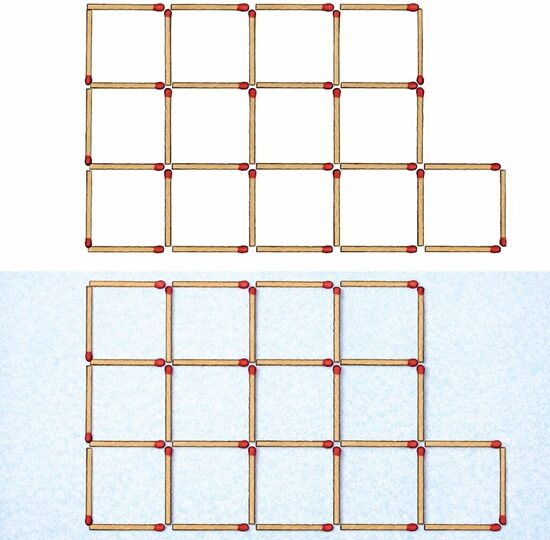
Visual puzzles have always fascinated people across generations, challenging the human brain to recognize patterns and hidden objects.
Among these puzzles, identifying squares within a seemingly simple grid remains one of the most engaging exercises.
The puzzle begins with an image composed of several intersecting lines forming a large square divided into smaller segments. At first glance, it appears ordinary, yet a closer inspection reveals multiple squares of varying sizes hidden within the structure.
Many people approach this type of puzzle by only counting the most obvious squares. They often overlook the additional layers of squares created by combining smaller squares into medium or larger formations within the grid.
In this specific puzzle, participants are presented with a question: “How many squares can you find in this image?” The challenge lies not only in spotting the small individual squares but also recognizing the composite ones.
To solve similar puzzles, it’s helpful to adopt a strategy. Start by counting all the smallest units, then gradually combine them to form larger squares, ensuring that no potential combination is overlooked.
Another technique is to trace the squares with a finger or a pencil when working on paper. This physical engagement often improves spatial awareness, helping to identify squares that might otherwise go unnoticed.
Such puzzles are widely used in educational settings to enhance critical thinking, attention to detail, and pattern recognition skills. Teachers often introduce these exercises to develop problem-solving abilities in students.
Furthermore, these visual challenges appeal to adults as well, serving as a form of mental exercise. Regular practice with such puzzles can improve cognitive flexibility, focus, and visual memory over time.
The “bonus puzzle” included in this image adds another layer of complexity. Participants are asked to determine the number of circles in each box, providing an additional challenge beyond counting squares.
The answers to the circle puzzle vary depending on the configuration within each box. Box 1 contains 11 circles, Box 2 also contains 11 circles, Box 3 has 14, Box 4 contains 22, and Box 5 contains 24 circles.
Counting circles requires a slightly different approach than counting squares. Circles can overlap, be nested, or be partially obscured by other shapes, requiring careful observation to avoid mistakes.
Many people make errors in counting circles because they overlook the smallest or partially hidden circles, similar to how medium and large squares are often missed in the square puzzle.
To accurately solve the circle challenge, one can start by identifying the largest circles in the box and then systematically count the smaller ones within each larger circle. This ensures that no circle is double-counted or missed.
These types of puzzles are popular on social media and educational websites because they provide a satisfying “aha moment” when all hidden elements are correctly identified.
Puzzle enthusiasts often share these images to test friends and family, sparking conversation and friendly competition. Such interactions help enhance observational skills while promoting social engagement.
The appeal of counting squares and circles lies in their simplicity and universality. Shapes like squares and circles are fundamental in geometry, making them accessible to people of all ages and educational backgrounds.
Visual puzzles like this also highlight the brain’s natural tendency to categorize and group objects. Our visual system prefers patterns, and puzzles exploit this tendency to create intriguing challenges.
Another interesting aspect of these puzzles is that they reveal how perception can differ among individuals. While some may immediately spot all 16 squares, others may struggle with counting beyond the obvious four or nine squares.
Persistence is key when solving such puzzles. Repeatedly analyzing the image from different angles or perspectives can uncover hidden shapes that were not initially apparent.
For educators, this type of puzzle is valuable because it teaches patience and attention to detail. Students learn to examine each component carefully rather than rushing to a conclusion based on first impressions.
Additionally, solving puzzles enhances memory skills. Remembering which shapes have already been counted helps prevent duplication and improves one’s ability to track complex visual information.
Puzzles like these also encourage logical thinking. To identify all possible squares, one must understand how smaller units combine to form larger ones, applying reasoning alongside visual observation.
In competitive settings, puzzle challenges often reward speed and accuracy. Individuals who can quickly identify hidden squares and circles demonstrate sharp analytical skills and mental agility.
From a neurological perspective, visual puzzles stimulate areas of the brain responsible for spatial reasoning, pattern recognition, and problem-solving, making them a beneficial cognitive exercise for both children and adults.
Moreover, they foster creativity. Observing and mentally manipulating shapes allows the brain to explore alternative ways of seeing the same visual information, which can have applications beyond puzzles.
Many enthusiasts keep collections of puzzles similar to this one, ranging from beginner to expert levels. These collections provide ongoing challenges that help maintain cognitive sharpness over time.
Some puzzles also integrate additional elements, such as color coding or shading, to increase difficulty. This requires solvers to not only count shapes but also differentiate subtle visual cues.
Online platforms often feature leaderboards and timed challenges for puzzles like these, encouraging users to improve their speed and accuracy while engaging with a global community of puzzle lovers.
For casual solvers, these puzzles can serve as a relaxing activity. Focusing on counting shapes and identifying patterns can be meditative, providing a break from digital distractions or stressful tasks.
The satisfaction derived from successfully solving such a puzzle is psychological as well as cognitive. Completing the challenge triggers a sense of achievement, boosting confidence and reinforcing problem-solving persistence.
Educators and parents may also use these puzzles to introduce young learners to geometric concepts, such as squares, rectangles, and circles, as well as the relationships between different-sized shapes.
For students preparing for competitive exams, practicing visual puzzles can be particularly helpful. Many standardized tests include spatial reasoning or pattern recognition sections that are similar in nature.
Analyzing this specific puzzle reveals why some individuals miss the total number of squares. Often, attention is drawn to the largest square or the smallest visible units, overlooking intermediate formations.
By taking a structured approach—counting small squares, then medium, then larger, and finally the largest—solvers ensure that every square is accounted for without skipping any hidden combinations.
The same systematic approach applies to counting circles. Identifying largest elements first and working inward prevents miscounts, allowing for a precise tally of all shapes within the puzzle.
Visual puzzles like this also enhance observational patience. The process requires slowing down and analyzing each segment carefully, which translates into improved focus in everyday tasks and academic activities.
Beyond personal skill development, puzzles like these foster engagement in social environments. Discussing potential solutions with friends or family encourages communication, collaboration, and friendly debate.
In summary, the square puzzle challenges the observer to identify 16 distinct squares, ranging from the smallest 1×1 squares to the largest 4×4 square encompassing the entire grid.
The bonus circle puzzle further engages the solver, requiring careful observation to count circles accurately within each of the five boxes, ranging from 11 to 24 circles depending on the arrangement.
Both challenges illustrate the value of visual exercises in developing cognitive skills, including attention to detail, spatial reasoning, pattern recognition, and logical thinking.
Ultimately, puzzles such as these remind us that even seemingly simple images can contain hidden complexity. Careful analysis and structured thinking reveal surprising details that are easy to overlook.
Whether for education, entertainment, or cognitive training, visual puzzles remain a timeless tool for sharpening the mind while offering an enjoyable and rewarding challenge