Rain on a tin roof usually knocked me out. A steady dull percussion that swallowed the city and left only clean edges, wood grain straight lines, and the honest weight of tools. That night, the rain wasn’t the loudest thing on the block. Cardboard scraped over wet pavement. A box thutdded, another dragged, and underneath it all the small, broken sound of someone trying to cry without letting the whole neighborhood hear.
I stood at the mouth of my garage with a mug of black coffee warming my hands, watching the driveway next door turn into a disaster scene under a flickering street lamp. Magnolia Ruiz moved like she was fighting the world and losing by inches. She was 36, sharp enough to cut glass.
Usually the kind of woman who walked with purpose and made other people step aside. Tonight she looked smaller, not weak, just pressed down by something that wouldn’t stop pressing. A soaked tank top clung to her hair, stuck to her neck, and she was wrestling a soggy box into the back of a hatchback that looked two sizes too small for her life. The trunk wouldn’t close.
She shoved. It bounced. Then her shoulder hit the latch and she froze, breathing hard, blinking fast at the rain like it had personally offended her. Water ran down her cheeks. Maybe it was rain. Maybe it wasn’t. She didn’t wipe it away either way. I should have gone back inside. My life was built for quiet, for repeatable systems.
My chisels were arranged by size. My clamps hung in neat rows. I swept the shop floor twice a day because disorder was a termite. I didn’t let it in. I built custom furniture because wood didn’t lie to you and it didn’t change the terms halfway through the month. But the trunk still wouldn’t close and Magnolia’s hands were shaking as she tried again.
I stepped out into the rain. You’re going to ruin those books. I called voice cutting through the downpour. Magnolia spun around like she’d been waiting for the world to take one more shot. She wiped her face with the heel of her hand, smearing water across her cheek. “River,” she said flat as a slam door. “Go away. I don’t need an audience.
I’m not an audience.” I nodded toward the open hatch. I’m a neighbor with a tarp. I didn’t wait for permission. I went back into my shop, grabbed the heavy canvas dropcloth I used for staining, and carried it out. The rain slapped it as I threw it over the open trunk, tucking the edges down like I was covering a half-finish table.
Magnolia watched me for a beat, jaw tight. “Bry kick you out?” I asked, leaning against her car, ignoring the water soaking my gray t-shirt. He gave me 3 days, she snapped, voice shaking with rage, trying to sound like control. Said he’s renovating so he can double the rent. Legally, he can’t. Practically, she jerked her chin toward the porch.
He changed the locks while I was at the grocery store. My stuff is on the steps like trash. I looked at the pile boxes, a suitcase, a lamp with a crooked shade, a laundry basket, things shoved into plastic bags like someone had packed a life in a hurry. 3 days isn’t enough to find a place in this market, I said. No kidding.
She swallowed eyes flicking once to the street, then back. I’m going to a motel. With all this, I gestured. You’ll be paying storage fees before midnight. Her fingers curled around the edge of a box hard enough to warp the cardboard. I don’t have a choice, River. The words left my mouth before I could measure them.
You could move in with me, I said like it was a joke I didn’t have to own. I’ve got dry floors and too much square footage. She went still. Rain dripped off the tip of her nose. Her eyes searched my face for the punchline I hadn’t written. Huh? She said, and there wasn’t a single laugh in it. Good night, River.
She climbed into the hatchback, slammed the door, and the tail lights vanished down the street. I stood in the rain for a long second with the tarp sagging on my arm, feeling like an idiot who’d offered a life preserver and forgotten to check if he could swim. When I went back inside, the silence wasn’t peaceful. It was heavy.
The next morning, the rain stopped and left the world smelling like wet asphalt and ozone. I was in the shop running walnut through the planer when a knock hit the side door. Short, precise, like the person on the other side didn’t believe in wasting motions. I shut off the machine. The sudden quiet rushed in. Magnolia stood in the doorway, hairdamped trench coat over yesterday’s closed travel mug clutched in her hand like it was the only warm thing she trusted.
The tremor in her fingers shook the coffee inside the lid. Her eyes kept darting to the street, expecting a familiar figure to appear out of nowhere. “Was that a joke?” she asked. I wiped my hands on a rag buying half a second. Was what a joke last night? She didn’t blink. Move in with me.
Was that a joke or an offer? My instincts started drawing red lines in my head. Complication, risk, temporary people broke permanent routines. But Magnolia stood there anyway, chin up like she’d rather choke on pride than ask twice. The guest unit’s empty. I said it’s storage right now. Lumber and finishes. It’s not a hotel. I don’t need a hotel.
Her grip tightened on the mug. I need a door that locks and a landlord who isn’t Barry. I charge rent, I said, testing the edges. I pay rent, she shot back. Market rate, half market rate, I said. And you cook three nights a week. Her eyebrows lifted. Excuse me. I eat takeout over the sink, I said. It’s depressing.
You cook real food. I smell it over the fence. That’s the deal. For the first time, the corners of her mouth twitched. Not quite a smile, but something that said she’d found a crack of normal in the wreckage. “Deal,” she said. By noon, her life was in my living room. And by late afternoon, the arrangement stopped feeling like a joke and started looking like a full-scale move.

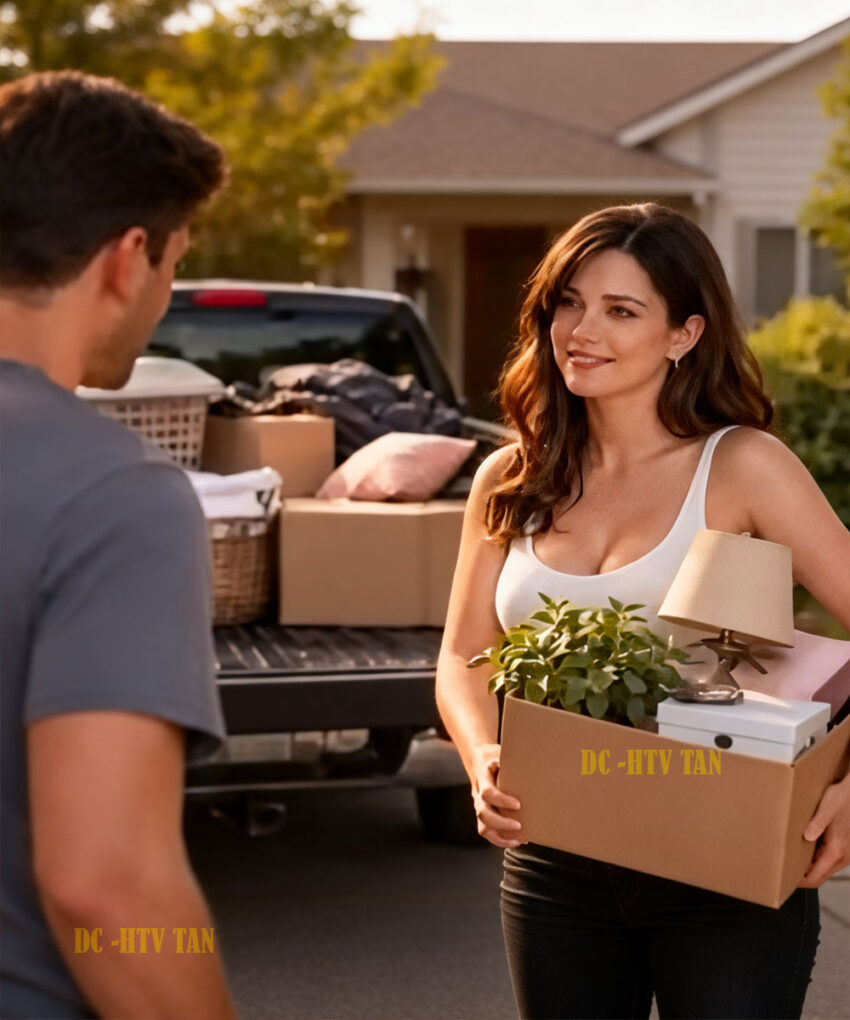
A black pickup rolled into my driveway, like a moving crew with a heartbeat. The bed was loaded with boxes, a laundry basket stuffed with towels, a folded comforter, and a pink pillow that had no business anywhere near my Spartan house. Magnolia climbed down from the passenger side and met my eyes over the tailgate. Sunlight caught in her hair, warm and almost gentle, an unfair contrast to the way her life was in pieces.
She walked toward me, carrying one heavy cardboard box. A small potted plant sat on top leaves trembling in the breeze. A little table lamp was wedged beside it, shade tilted like it refused to give up on being useful. You weren’t kidding, I said. I wasn’t. Her smile was tired, brave, and not asking for pity.
And I don’t want sympathy. I want a plan. That was my language. I stepped forward and took the box from her without asking. Not because she couldn’t carry it she could, but because my body had already chosen a side. I set it on the porch, then went back to the truck and started unloading in clean, efficient stacks.
Kitchen items together, office gear together, clothing in one pile. Anything with stamps or logos or her name on it went into a plastic bin I insisted on. Why are you sorting? She asked, watching me like she was recalibrating. Because if Barry escalates, we need to find things fast, I said. Passport. Lease. Anything with your name on it.
Her expression sharpened. You think he’ll try something tonight? I think Barry wakes up and chooses violence like it’s a hobby. As if summoned, the screen door next door slammed. Barry stomped onto his porch, red-faced, staring at the truck bed like it was a personal insult. “Hey,” he barked.
“This is private property. You can’t dump her junk over there.” I didn’t stop moving. I carried a box to the porch, set it down, and looked at him like he was a bad measurement. “Mnolia’s belongings were dumped on your porch after you changed the locks,” I said, calm. “That’s the private property problem.” Barry jabbed a finger at me.
You think you’re some hero? She’ll leave and then you’ll still be stuck next to me. I took my phone out and started recording. No theatrics, just a steady lens. Say that again, I said. Barry froze for half a second. Then his ego one. She’s a problem, tenant, he shouted. And you’re running an illegal shop back there.
One call to the city already permitted, I said. But thanks for the reminder that you like paper trails. Magnolia stepped to my side. She didn’t shrink. She didn’t apologize for existing. She stared at Barry like he was a stain that hadn’t noticed the cleaner. “Touch my things again?” she said, voice cool. And I filed for an emergency order.
I have photos of the lock change and timestamped texts. Barry’s eyes flicked to the phone in my hand. His mouth worked. No sound came out. Go inside, Barry. I said. We’re done. He spit into the grass and stormed back into his house. When he disappeared, Magnolia exhaled like she’d been holding her lungs hostage.
You record everything she said softer. I build things, I replied. I also document threats. Her gaze dropped to my hands, sawdust under the nails, knuckles steady. River, she said, and this time there was respect in it, unguarded. Thank you. I didn’t make it sweet. I didn’t make it romantic. I just nodded and went back for the next box because the fastest way to keep panic from taking a seat in your chest is to keep moving.
The first collision wasn’t romantic. It was logistical. My duplex was designed for one person me. The guest unit was connected to the main house by a shared laundry room and a narrow hallway I usually kept shut like a door between two worlds. I came in at 6 covered in sawdust and found Magnolia standing in the guest room with her hands on her hips staring at the bed frame like it had insulted her. “It squeaks,” she said.
It works, I replied, grabbing a bottle of water from the fridge. River, if I turn over, it sounds like a train wreck. She rubbed her forehead. I have a client call with Tokyo at 4:00 a.m. I can’t have a train wreck in the background. I stared at the cheap metal frame I’d bought off Craigslist for emergencies. The part of me that couldn’t ignore a splintering beam woke up fully.
“Move,” I said. I went to the garage and came back with a drill, a socket wrench, and graphite lubricant. I dropped to my knees and started tightening bolts with methodical focus. Magnolia stood too close. I could smell her perfume, vanilla, and old paper. The scent didn’t belong in my workshop brain, and my pulse didn’t care.
10 minutes later, I stepped back. Try it. She sat. She bounced. Silence. her eyes lifted to mine surprise, softening her mouth. “You’re handy. I build furniture,” I said. “It would be embarrassing if I wasn’t.” She let out a small breath like a laugh she didn’t fully trust yet. Most guys would have told me to deal with it.
“I don’t like noise,” I said, turning away so she wouldn’t see the heat creeping up my neck. and I don’t want to hear you rolling around at 4:00 a.m. The words landed heavier than I meant them to. Magnolia’s gaze flicked to my face, then down, then back up, like she was deciding what kind of man I was when I wasn’t thinking.
Right, she said, voice lower. Because of Tokyo. Right, I walked back to my side of the house with my heartbeat hammering a rhythm that had nothing to do with carpentry. 3 days in, she was in my kitchen. Not the guest kitchenet, my kitchen. Granite island, good knives, everything where it belonged. Ingredients were spread across the counter like a war map.
Lime, cilantro, a bowl of chopped onions, a skillet already heating. Boundary violation, I said, leaning in the doorway. The stove in the guest unit barely boils water, she shot back without looking up. Her knife hit the board in crisp, clean chops. And you said, “I cook.” “Don’t rewrite the deal.” I meant simple stuff. I looked at the spread.
This looks like an event. It’s tacos river. Sit down. I sat because my body did that thing where it obeyed a voice that sounded like it expected compliance. She worked with focus, efficient, precise. Oversized reading glasses kept sliding down her nose. And every time she pushed them up with the back of her wrist, something in my chest pulled tight in a way that had no business being true.
“Bry came by today,” she said casually, like she was telling me the weather. The air in the kitchen changed. “What did he want?” “He wanted to know if I had a lease with you.” She tossed cilantro into a bowl. He said, “If I’m paying rent, you need a different permit for the property.” Multif family zoning, rental license, whatever word he thought would scare me.
My jaw tightened. It’s a duplex. It’s zoned for two. He also mentioned your shop. She finally looked up, eyes steady. Said, “If the city looks closely at the tenant situation, they might look closely at the sawdust, too.” My chair scraped as I stood. The shop was my life. I had permits, real ones. But Barry was the kind of guy who hunted for tiny paperwork sins like it was sport. “Don’t talk to him,” I said.
“I didn’t.” Her voice stayed calm. He yelled it from the sidewalk. A beat passed. Her eyes stayed on mine, not flinching from the tension. “If me being here puts your shop at risk,” she said, “I can go to a motel. No. The word came out too fast. Magnolia held still, measuring the shape of it. Why? She asked. You barely know me.
Because he’s a bully, I said, grabbing a beer from the fridge just to give my hand something solid. And I don’t let bullies win. You stay. I’ll handle Barry. I can handle myself. River. Her tone sharpened pride like a blade. I’m 36, not a damsel. I know, I said. That’s why you’re terrifying. Her laugh broke loose, rich reel, and suddenly the kitchen felt warmer.
She slid a plate toward me. Eat. I did. The tacos tasted like someone had decided I deserved better than eating over the sink. The next two weeks settled into a rhythm that should have unsettled me more than it did. I woke at 5. The grinder in her unit kicked on at 5:15. We passed in the hallway.
No big talks, just a nod, a look, the quiet awareness of another person sharing air. Then one Tuesday, the rain came back in sheets. I was racing a glue up in the shop, trying to clamp four corners at once, sweat running down my spine, while the clock in my head counted minutes before the adhesive set. A hand appeared at the edge of my vision, holding a clamp steady.
Magnolia stood in the doorway, not wearing her client armor, hair loose sleeves shoved up. She’d pulled on one of my old flannels like she’d reached into my world and taken what she needed without apology. Tighten it, she said. I’ve got this side. We worked without chatter. She watched my hands once, then mirrored me like she understood systems instinctively.
When we finished, we were inches apart, breathing hard in the damp air. I noticed sawdust caught in her hair, tiny flexcks clinging like gold in the dim shoplight. “You’ve got sawdust in your hair,” I said. “Occupational hazard,” she murmured. “Living with a lumberjack.” The word lumberjack shouldn’t have done anything to me. It did.
My fingers twitched like they wanted to brush the dust away. I kept my hands in my pockets. Temporary people didn’t get permanent touches. Thanks, I said, stepping back. I’ve got it. Her eyes searched mine for a second like she was testing a door to see if it was locked. Then she nodded and left. That night, I found her hunched over a wobbly card table in the guest unit, rubbing her temple between emails.
Her laptop screen reflected in her glasses, blue light, turning her tired into something sharp. I didn’t say anything. I went into the shop and pulled out a live edge maple slab I’d been saving for a someday project. I planned it, sanded it to silk, set hairpin legs. Before sunrise, while the shower ran and steam fogged the bathroom window, I carried the finished desk into her unit and swapped it for the card table.
That evening, after I came back in with sawdust still clinging to my forearms, I saw a note on the counter. No words, just a small heart drawn in tight, careful lines, wood grain shaped into something soft. I taped it to my fridge like it was a receipt for something I couldn’t return. The notice arrived on a Friday.
We were actually laughing magnolia describing a client who wanted a logo that looked like the sound of a dolphin me choking on my beer because my brain tried to picture it and failed. The doorbell cut through the moment. A courier stood on the porch with a stiff envelope. River Campbell. Yeah. Sign here. I signed. I tore it open.
City zoning department violation. Operating a commercial manufacturing enterprise in a residential zone without a variance. Cease operations in 48 hours pending inspection. Barry’s fingerprints weren’t on the paper, but I could feel them anyway. Magnolia stepped behind my shoulder, reading over my arm.
Her breath hitched once. This is because of me,” she said, voiced tight. “He saw the car, he saw the move. It doesn’t matter,” I said. But my mouth tasted like metal. “I have commissions due next week. If I shut down, I lose the contracts. If I lose the contracts, I don’t pay the mortgage. I can fix this,” she said fast. “I’ll pack a bag.
I’ll go tell Barry I’m gone.” “That won’t stop the inspection,” I snapped. and the sharpness cut too deep. I saw her flinch like I’d thrown something. Regret hit me immediately. I dragged a hand over my face. I’m sorry. Magnolia stayed quiet, eyes locked on the notice, as if she could burn a hole through it.
The shop is everything I said softer. I know, she replied. And the way she said it wasn’t pity. It was understanding, the kind that didn’t ask you to be less. We stood in the kitchen like two people watching a storm gather. Then she lifted her head. “What’s your plan?” I turned the paper over, scanning the contact information like it was a blueprint.
“We fight him,” I said. “But we do it clean.” Her gaze held mine for a beat, steady waiting. I stepped closer, heat and adrenaline mixing with fear until the distance between us felt like a mistake. My hand went to her waist. I didn’t yank. I didn’t trap. I paused just long enough to feel her inhale to see her fingers lift toward my chest like she’d already chosen.
Then I pulled her in. She gasped, palms flattening on my shirt. And when I kissed her, she met me. Fierce present hands sliding up to tangle in my hair, holding me like she wasn’t going anywhere. When I pulled back, our foreheads touched. Her breath was warm against my mouth. “Stay,” I said, voice rough. Magnolia’s lips brushed mine again.
An answer before words. Okay, she whispered. The next morning, I woke to movement and the soft click of keys. Magnolia’s door was half closed. Lights spilled from the crack. I walked down the hall and stopped short. She was at the new desk laptop open shoulder squared jaw set. On her screen, a county records portal scanned PDFs, an LLC lookup page, a chain of emails.
She clicked between tabs like a woman used to pulling threads until the fabric tore. In one window, a property manager agreement. In another, an invoice template titled Magnolia Interiors. In another, a zoning code PDF with highlighted sections and margin notes. The bathroom fan kicked on. A minute later, I heard her voice through the thin wall, low controlled, sharp enough to slice.
No, she said into the phone. I’m not asking. I’m notifying you. If you want this handled quietly, you answer now. Silence, then colder. I have your name on the filings, and I have his notices in writing. I backed away, heart thutting. Magnolia wasn’t scrambling. She was hunting. I didn’t chase her when she finally came out.
I didn’t ask questions that sounded like I doubted her. I did the only thing I knew how to do when something tried to break my structure. I built a stronger one. I pulled my permit folder from the safe insurance certificates, mortgage papers, and added Barry’s threats to it. The video from the porch, photos of Magnolia’s belongings on wet steps, screenshots of his texts with timestamps.
Then I drove to the 24-hour print shop and made hard copies because paper was harder to lose. On the way back, I stopped at the hardware store. Motion lights, a two camera kit, a steel hasp for the side gate. By midnight, the sideyard was lit like a runway. One camera watched the driveway, one watched the shop door.
The hasp clicked into place with a finality I could feel in my bones. When I came inside, Magnolia sat at the kitchen table with her laptop still open, eyes rimmed with fatigue, but burning with focus. She looked at the new lights through the window. You installed those? Yeah. And the cameras? Yeah. Her shoulders loosened a fraction like the world had gotten less sharp around the edges.
You didn’t have to, she murmured. I’m not doing it because I’m scared. I said, then let the truth land where it belonged. I’m doing it because I don’t let anyone threaten what’s mine. And right now, Barry is trying to take my shop and your peace at the same time. Magnolia stared at me for a long beat. Then she nodded once acceptance, not gratitude.
Okay, she said. Then we fight like adults. The inspection was scheduled for Tuesday at 8. Tuesday morning arrived bright and too calm. A gray-faced city inspector pulled up with a clipboard and a neutral expression that said he’d seen every version of every excuse. Barry was already there on the sidewalk, smirking like he’d booked front row seats to my failure.
Mr. Campbell, the inspector said. We have a report of industrial noise and commercial sales in a residential zone. My shop is permitted. I said carefully. No walk-in retail by appointment offsite. I build furniture. Barry cut in loud. He runs a business back there. Website priceless deliveries. He’s running a factory.
The inspector’s pen hovered. Magnolia stepped onto the porch behind me. She wasn’t wearing a trench coat today. She wore a tailored blazer and a clean white top hair pinned back earrings, small and sharp. She looked like the kind of woman who didn’t ask permission to speak. Good morning, she said to the inspector, tonecomm professional.
Before we start, I want to clarify the use classification. The inspector blinked. Ma’am Magnolia walked down the steps, stopping beside me. Not behind, beside. This is not a retail storefront, she said, and the words came out smooth as a practiced presentation. Under city code 14C, a resident artisan and fabrication studio is permissible as a home occupation, provided it meets the performance standards.
No walk-in sales, no signage, and decibel levels within limits. Mr. Campbell’s work qualifies as custom fabrication, not industrial manufacturing. Barry barked a laugh. She’s just his tenant. Magnolia didn’t look at him. She reached into her pocket and handed the inspector a business card like it was a credential.
Magnolia Interior’s principal designer. Then she handed him a thin folder. Inside her business license, a signed independent contractor agreement, commissioning River for prototype fabrication, and a one-page compliance sheet listing the specific sections of the municipal code she’d referenced. The inspector’s eyes moved over the paperwork.
You reside here, “I do,” Magnolia said, not flinching. “And to make that clear, here is the executed lease addendum. Coccy is permitted under the existing duplex zoning. Barry’s face reened. “You’re lying.” She lived next door. Magnolia’s expression didn’t change. She pulled out her phone. “Actually,” she said and tapped the screen.
“We can clarify Barry’s authority right now.” The call connected with a soft chime. Speaker phone. A woman’s voice came through crisp, older controlled. “This is Judith Henderson.” Barry went rigid. Magnolia held the phone so the inspector could hear. Mrs. Henderson, thank you for picking up. You’re on speaker with a city zoning inspector and Mr. Barry Collins.
A pause. Then of course he’s there. Barry found his voice. Judith, this is Don’t Mrs. Henderson cut in. Do not use my first name like we’re friends. The inspector’s brow lifted. Ma’am, I’m Inspector Walsh with the city. I have a complaint regarding this address and adjacent property management. Inspector Walsh, Mrs.
Henderson said, and her tone shifted into business. Barry Collins is not authorized to issue evictions, change locks, or represent ownership on my behalf. He is a contracted property manager with limited authority. As of this moment, his contract is terminated. Barry’s mouth fell open. You can’t, he started. Barry, Mrs.
Henderson, said, and the calm in her voice was the most humiliating kind of anger. I have the emails. I have the photos Miss Ruiz sent me. I have your text messages where you threatened her. You are done. You will return any keys you have by end of day. If you step onto my property again, I will have you trespassed.
The inspector looked at Magnolia’s phone and then at Barry, then at the adjacent house like the whole situation had just snapped into focus. Mrs. Henderson, the inspector said, “Thank you for my report. Can you confirm ownership and management structure?” I can, she replied. Henderson Holdings LLC owns the property next door and I am the managing member.
I will email you the signed management termination and ownership documents within the hour. Digitally signed. Magnolia tapped her screen and pulled up an email thread already drafted. She angled it so the inspector could see the subject line. Ownership confirmation plus termination notice. Signed docks attached. The inspector nodded once pen finally moving.
That will be sufficient. Barry stood on the sidewalk, red-faced and suddenly small under the morning sun. Magnolia Barry spat, trying to salvage pride with venom. Magnolia didn’t even glance at him. She kept her eyes on the inspector voice even. Inspector Walsh, we’re compliant. If you need decel readings, I can provide them.
If you need proof of off-site client appointments, I can provide those as well. The inspector flipped through the folder again, slower now, like he was looking for reasons to agree with her because the paperwork was clean. This appears to meet home occupation standards, he said. As long as there is no customer foot traffic and no retail signage, you’re within the code.
I’ll close this as compliant pending receipt of the ownership documents from Mrs. Henderson. He glanced at Barry. Your complaint is noted. Your standing is not. Barry’s face went pale in stages. Mrs. Henderson’s voice came through the speaker one more time like a final nail. Barry, you are not to contact Ms.
Ruiz again. Anything you have to say goes through my attorney. Magnolia ended the call. The silence that followed tasted like victory. When the inspector drove away, the driveway felt too bright. Magnolia let out a breath, shoulders dropping for the first time in days. Her eyes flicked toward the shop, the lights, the cameras, the lines I’d drawn in steel and glass.
“You built a fortress,” she said quietly. “It’s a deterrent,” I replied. She stepped closer, studying my face like she’d been doing it for weeks and only now found the right angle. “You didn’t panic,” she said. “I did.” I admitted I just didn’t give Barry the satisfaction of seeing it. Magnolia’s mouth softened.
Good. Across the street, Barry stood frozen on the sidewalk phone in his hand like it had suddenly become a paperwe. For the first time since she arrived on my porch with shaking coffee, he looked powerless. And Magnolia looked safe. Two days later, rain returned as a soft morning drizzle. I was in the kitchen making coffee.
Two cups without thinking about it. The second mug sat there like it belonged. Magnolia walked in holding a piece of paper. Her hair was still damp and she wore one of my flannels like it had always been hers. “I turned down the offer,” she said. My stomach tightened. “What offer? Mrs. Henderson offered me my place back.
Magnolia said, “Old rent, 12 months, formal apology.” My pulse knocked once against my ribs. “That’s what you wanted.” “It was,” she said, and her voice didn’t carry triumph. It carried decision. She slid the paper across the island. “A lease, not for the guest unit. For the whole house, co-enants River Campbell and Magnolia Ruiz.
” I stared at the page until the letters sharpened into meaning. My fingers hovered above it, not touching yet, like a man approaching a hot surface. “I don’t want to be your tenant,” Magnolia said. “And I don’t want to be your boss. I want to be your partner in the lease, in the bills, in the choices.” “The kitchen was quiet enough that I could hear the rain tapping the window and the faint hum of the refrigerator.
I picked up the pen on the counter. The plastic barrel felt warm from the room. The tip met the paper with a tiny scratch grit against fiber. And my hand paused at the edge of my name. For years, I’d measured safety by what I could control, the distance I kept, the doors I locked, the variables I refused to invite inside. But the moment the ink started flowing, that old equation broke apart in my chest.
My heartbeat thutdded hard, loud like a hammer on a stubborn nail. I signed. The final stroke of my last name landed, and something in me loosened, not into weakness, into relief. Magnolia’s breath caught just once. I set the pen down and looked at her. Really looked at her, seeing every tired night, every clenched jaw, every steady choice she’d made when it would have been easier to run. “You sure?” I asked.

Magnolia stepped closer until the smell of vanilla and rain filled my space. I don’t do temporary, she said softly. Not anymore. I reached for her hand going to her waist slow enough for her to lean in on her own. She did. Her fingers curled around the back of my neck like she’d found the place she’d been looking for.
Does this mean I have to fix your IKEA furniture forever? I murmured voice rough with a smile I couldn’t hide. Magnolia’s laugh was quiet and warm. Read the fine print carpenter. It’s a lifetime contract. Good, I said. I kissed her firm, certain, and earned. She kissed me back like the word home had finally found a body. Outside, the rain kept falling.