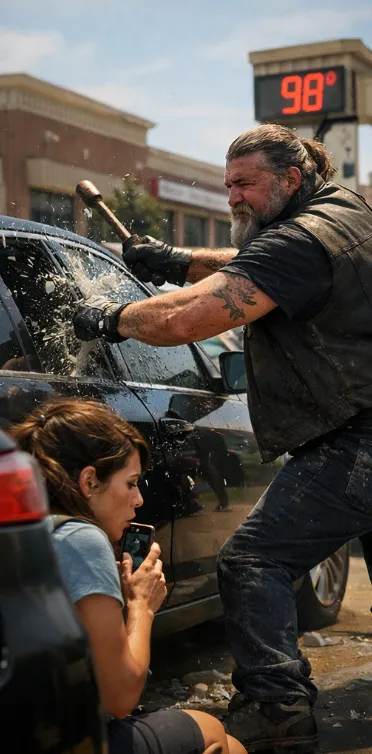
The first sound was the crack of glass, sharp enough to cut through the suffocating summer heat.
For a split second, everyone in Cedar Run Plaza froze.
It was the kind of noise that instantly rewrote the scene around it—turning a quiet afternoon of errands into something tense, dangerous, unpredictable.
And for a moment, I thought I was about to witness a crime.
The heat that afternoon wasn’t simply uncomfortable. It was oppressive in a way that made the entire town feel like it had been sealed inside a slow cooker. Mid-July in Redfield, Texas had a reputation for punishing the careless, and the air that day felt thick enough to chew.
Outside the credit union, a digital temperature sign blinked 98°, though the number felt like a polite lie. The asphalt of Cedar Run Plaza shimmered beneath the sun, turning parked cars into gleaming mirrors and metal ovens.
I was thirty-four and tired in a quiet, unremarkable way.
My name is Elena Morris, and I teach art to middle schoolers who think acrylic paint belongs on desks, walls, backpacks, and occasionally the ceiling. My backseat was a chaotic nest of poster boards, half-dried paint trays, and lesson plans that smelled faintly of tempera.
All I wanted was to get home before my car turned into a furnace.
The headache behind my eyes had been building since noon as I crossed the plaza parking lot, shielding my face from the glare. A normal afternoon. An ordinary walk to my car.
Then I heard it.
At first it was distant, low and vibrating—more sensation than sound. A deep mechanical growl that rolled through the air and into my chest before my brain registered what it was.
A motorcycle.
Not the quiet commuter kind either. This one sounded like it had been built to announce itself to the entire county.
I slowed instinctively, turning just as the bike rolled into the row behind me. Chrome flashed violently under the sunlight.
It was massive.
The motorcycle was matte black, battered in the way machines become when they’ve traveled more miles than most people ever will. Scratches cut through the paint, exposing bare metal beneath like old scars.
The man riding it looked just as weathered.
He was enormous—broad shoulders stretching the seams of a leather vest that seemed absurd in the brutal heat. Tattoos covered both arms, the ink dark and dense against sunburned skin. A steel-gray beard spilled down the front of his chest.
A pair of aviator sunglasses hid his eyes.
When he shut off the engine, the silence felt sudden and wrong.
I had stopped walking.
He didn’t park properly. He didn’t circle the lot looking for space. Instead, he guided the motorcycle directly beside a sleek black Aurelius V8 sedan parked two rows away.
Even from a distance, the car looked expensive.
Its paint was flawless. Its tinted windows were dark enough to hide whatever—or whoever—sat inside.
Luxury cars always look slightly arrogant sitting in strip mall parking lots, like they wandered into the wrong neighborhood by mistake.
The biker didn’t get off immediately.
He simply sat there, staring at the rear passenger window.
Something about the stillness tightened in my chest.
Then he swung his leg over the seat.
From one of the saddle bags, he pulled out a rusted tire iron.
My stomach dropped.
It wasn’t subtle. It wasn’t a tool you carried accidentally.
It looked heavy, worn, the kind of object that had lived through more than a few confrontations.
Without thinking, I ducked behind a nearby SUV, my pulse suddenly hammering as I pulled my phone from my bag.
This is how it starts, I thought.
This is how people end up recording something terrible.
My fingers trembled as I dialed 911.
“He’s going to break it,” I whispered, half to myself, watching from behind the car. “He’s actually going to break the window.”
The biker didn’t hesitate.
He planted his boots firmly against the asphalt, lifted the tire iron above his shoulder, and swung.
CRACK.
The sound of laminated glass collapsing inward was sickening—like bone snapping under pressure. The window didn’t explode outward like in movies. Instead it buckled inward, splintering into thousands of glittering fractures.
“911, what is your emergency?” the operator said brightly through my phone.
I didn’t answer.
Because the biker didn’t reach inside to steal anything.
He dropped the tire iron with a loud metallic clang and shoved both arms through the shattered window without hesitation, ignoring the jagged edges slicing at the leather vest across his chest.
Then he pulled something out.
Not something.
Someone.
A tiny body in a damp blue t-shirt emerged from the car.
My breath caught in my throat.
It was a toddler.
The boy looked no older than two. His skin had turned a terrifying shade of deep red, his head hanging limply against the biker’s tattooed forearm.
Inside that sealed black car, baking beneath the Texas sun, the temperature must have been unbearable.
An oven.
“Oh my God,” I gasped into the phone. “He’s—he’s saving a baby. Send an ambulance. Please. Cedar Run Plaza.”
I hung up and ran.
Fear of the biker evaporated instantly, replaced by the raw adrenaline of a teacher who recognizes what a child looks like when they’re slipping away.
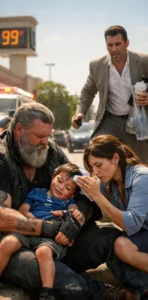
By the time I reached them, the biker was sitting on the curb.
The huge man had folded himself protectively around the tiny child in his arms. He had already stripped off his leather vest and draped it above the boy’s head to block the sun.
His rough, grease-stained fingers tapped gently against the toddler’s cheek.
“Come on, little man,” he murmured, his voice low and gravelly. “Breathe for me.”
I dropped to my knees beside him.
The heat radiating from the child’s skin was frightening.
“I have water,” I said quickly, digging through my bag. “Ice water. I carry it for class.”
The biker looked up.
Without the sunglasses, his eyes were visible.
They weren’t cold.
They were pale blue and wide with panic.
“Get it. Now.”
I unscrewed the thermos and poured the freezing water onto a clean art rag. Carefully, I dabbed the boy’s forehead, his neck, the inside of his wrists.
The biker held him steady, rocking slightly, whispering nonsense words that sounded strangely tender coming from someone so intimidating.
For a long, unbearable minute, nothing happened.
Then the boy coughed.
A weak, rasping cry followed—thin and shaky but unmistakably alive.
The sound hit me like music.
The biker exhaled deeply, the tension draining from his shoulders like air escaping a tire.
For a moment, we just looked at each other.
A silent acknowledgement passed between us.
Then a furious voice shattered the moment.
“What the hell do you think you’re doing?!”
We both looked up.
A man in a crisp linen suit was sprinting across the plaza from the direction of the shops. He carried a dry-cleaning bag in one hand and a latte in the other.
But his eyes weren’t on the child.
They were locked on the shattered car window.
“My car!” he shouted, horror twisting his face. “You smashed my window!”
He skidded to a stop in front of us, panting and red-faced.
“You freak!” he yelled at the biker. “Do you know how much that glass costs? I’m calling the cops! You can’t just—”
The biker slowly stood.
He didn’t rush.
He unfolded upward until his full height blocked the sunlight.
Then he stepped forward, placing himself squarely between the suited man and the child.
The father’s rant faltered.
His eyes finally drifted downward toward the curb.
For the first time, he saw the boy.
“Tyler?” the man whispered.
The color drained from his face.
“I—I was only inside for five minutes.”
The biker stepped closer.
The air between them crackled with something far more dangerous than the violence I had feared earlier.
This wasn’t rage from a criminal.
It was fury from someone protecting the helpless.
“Five minutes in this heat is a death sentence,” the biker said quietly.
He pointed toward the bank sign across the lot.
99°.
The man’s voice shrank instantly.
“I left the AC on,” he stammered. “The engine must have shut off. It has an auto shutoff feature—I didn’t know—”
The biker leaned down until their faces were inches apart.
His voice dropped to a low growl.
“You left him behind glass.”
The man swallowed hard.
“You worry about that window again,” the biker continued, “and I’ll give you a reason to need an ambulance too.”
Sirens began wailing in the distance.
The ambulance arrived first, lights flashing violently against the glass storefronts. Paramedics rushed straight toward the curb, gently lifting the crying boy onto a stretcher.
A police cruiser followed close behind.
Officers approached the father, who had collapsed into frantic apologies and half-formed explanations about car technology and bad luck.
I stood slowly, brushing dust from my skirt.
When I turned to thank the biker, he was gone.
For a moment I thought I had imagined him.
Then I heard the quiet rumble of the motorcycle engine starting.
Across the lot, the matte black bike rolled backward from its spot.
He didn’t rev the engine.
He didn’t wait for anyone to recognize what he had done.
He simply turned toward the exit.
As the motorcycle disappeared into the shimmering heat of the Texas highway, the broken glass around the car sparkled like scattered diamonds.
At my feet lay the rusted tire iron he had left behind.
I picked it up.
The metal was still warm from his hands.
An officer walked toward me, eyeing the shattered window.
“Evidence?” he asked.
I looked toward the ambulance as its doors closed around the crying, living boy.
Then I shook my head.
“No,” I said softly.
“A master key.”