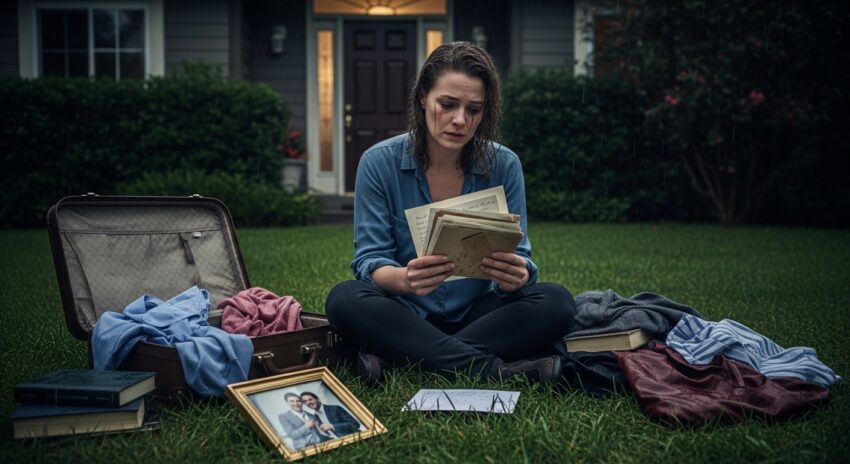
The suitcase hit the wet pavement with a sound like a gunshot. It was a cheap, nylon thing we’d bought for our honeymoon in Maine, now bursting at the seams with his flannel shirts and the “coldness” I could no longer stomach.
“Get out, Caleb!” I screamed, my voice cracking against the Portland rain. “Go be a statue somewhere else! Go be invisible in someone else’s house!”
He didn’t yell back. He never did. He just stood there on the porch, his eyes like two flat, grey stones, watching his life scatter across the driveway. That was his “thing”—the silence. The way he’d look right through me when I was doubled over in pain, or the way he’d walk out of the room when I started to cry. I called it apathy. I called it heartless.
I thought I was finally standing up for myself. I thought I was purging a man who had stopped loving me the moment life got hard.
But an hour later, sitting on the floor of our empty closet, I found a dented metal cigar box tucked behind the insulation. Inside weren’t secrets of an affair or hidden money. There were dozens of scraps of paper—napkins, receipts, torn notebook pages. All of them addressed to a God he never talked about.
And as I read the first one, the floor seemed to drop out from under my life.
“Please,” it read in his jagged shorthand. “She can’t take any more. Give the pain to me. Break my bones, cloud my mind, just let her have one morning where she wakes up and doesn’t want to die. I’m staying quiet so she doesn’t see me breaking. If I break, she has nothing to lean on. Please. Take me instead.”
I realized then that while I was screaming at him for being a wall, he was actually a dam—holding back a flood of grief I was never meant to drown in.
Would you like to read the rest?
CHAPTER 1: THE SOUND OF BRIDGES BURNING
The rain in Oregon doesn’t just fall; it possesses. It seeps into the wood of the Craftsman houses, it settles into the marrow of your bones, and if you aren’t careful, it turns your heart into a piece of damp lint.
I stood in the center of our bedroom, the air tasting like ozone and old resentment. My hip was screaming—a sharp, white-hot poker of nerve pain that had become my constant companion since the accident three years ago. Chronic pain is a thief. It steals your personality first, then your patience, and eventually, it steals the people you love because you become a person who is impossible to inhabit a room with.
“Say something,” I hissed.
Caleb was folding a shirt. A simple, blue button-down I’d bought him for his thirty-fifth birthday. He folded it with agonizing precision, smoothing the sleeves as if he were preparing a body for a wake.
“There’s nothing left to say, Elena,” he whispered. His voice was a low hum, devoid of the jagged edges I wanted. I wanted him to roar. I wanted him to tell me I was being a bitch. I wanted him to fight for the space we shared.
“Nothing left? I’m dying in front of you!” I grabbed a glass lamp from the nightstand—a wedding gift from his mother—and hurled it. It didn’t hit him. It shattered against the doorframe, sending shards of milk-glass skittering across the hardwood like tiny icebergs.
He didn’t even flinch. He didn’t look at the glass. He just placed the folded shirt into the open suitcase on the bed.
That was the “Coldness.” That was the wall that had been building brick by brick for three years. When I went through surgeries, he sat in the waiting room and read the news. When I cried in the bathtub because I couldn’t reach my own feet to scrub them, he’d stand outside the door, ask if I was “okay,” and then walk away when I didn’t answer. He was a ghost in a living man’s skin.
“I hate you,” I said, the words tasting like copper. “I hate how much you don’t care. I’d rather be alone than be with a man who treats my suffering like a chore he’s forgotten to do.”
He finally looked at me then. His eyes were bloodshot, the skin beneath them bruised with a fatigue I had been too self-absorbed to notice. But there was no fire there. Just a hollow, echoing emptiness.
“If that’s what you want,” he said. He zipped the suitcase.
I snapped. It was a physical break, a tectonic shift in my brain. I grabbed the handle of the suitcase and dragged it toward the stairs. My hip flared, a lightning bolt of agony shooting down to my knee, but the adrenaline muffled it. I was a woman possessed by the need to hurt him as much as his indifference had hurt me.
“Out!” I dragged the bag down the stairs, the heavy thud-thud-thud of it echoing through the house we’d spent five years renovating. “Get out of this house! Go find someone as dead inside as you are!”
I threw open the front door. The evening air was cold and thick with mist. I hauled the suitcase onto the porch and, with a guttural scream that felt like it was tearing my throat open, I launched it over the railing.
It tumbled down the steps and burst open on the sidewalk. Socks, underwear, books, his shaving kit—everything he owned was suddenly public property, scattered under the dim glow of the streetlamp.
I turned back to him. He was standing in the foyer, his coat on, his keys in his hand. He looked at the doorway, then at me. He didn’t look angry. He looked… relieved? No, that wasn’t it. He looked like a man who had finally reached the end of a very long, very dark tunnel and realized there was no light on the other side.
“You’re making a mistake, El,” he said softly.
“The mistake was thinking you ever had a heart,” I spat.
He nodded once, a sharp, jerky movement. He walked past me, his shoulder brushing mine—a final, electric contact that made my skin crawl—and walked down the steps. He didn’t try to gather his things. He didn’t try to save the expensive camera lens that had rolled into the gutter. He just walked to his old Subaru, got in, and drove away.
The silence that followed was deafening. It wasn’t the peaceful silence of a quiet house; it was the ringing silence of a bomb site.
I stood on the porch for a long time, watching the rain soak into his clothes. Mrs. Gable from across the street was definitely watching through her blinds. She’d probably be calling my sister, Sarah, within the hour. Sarah, who had been telling me for months that Caleb was “checking out.”
“He’s a classic avoidant, El,” Sarah had said over lattes three weeks ago. “He can’t handle your illness, so he’s shutting down to protect himself. It’s selfish. You deserve someone who stays in the trenches with you.”
The trenches. That’s what our marriage had become. A war of attrition.
My hip gave out, and I slumped against the doorframe, sliding down until I was sitting on the cold threshold. The “victory” felt like ash in my mouth. I had won. He was gone. The coldness was out of the house. So why did it feel like I had just cut off my own oxygen supply?
After twenty minutes, the cold became unbearable. I dragged myself back inside, locking the door with a trembling hand. I needed to move his remaining things. I wanted every trace of him gone before the sun came up.
I went to the master closet. It was a walk-in, still smelling of his cedarwood cologne and the leather of his work boots. I began pulling boxes down from the top shelf, throwing things blindly into trash bags. I was manic, fueled by a toxic mix of painkillers and heartbreak.
I reached for a stack of old shoe boxes when my hand brushed something cold and metallic. It was tucked way back in the corner, behind a roll of leftover wallpaper from when we did the nursery—the nursery that stayed empty after the second miscarriage.
It was an old Romeo y Julieta cigar box. Caleb didn’t smoke.
“What is this?” I whispered, my voice sounding thin in the empty room.
I pulled it out. The lid was hinged and stiff with age. I sat down on the floor, my back against the closet wall, and pried it open.
I expected old photos of an ex-girlfriend. Maybe a secret stash of money. Or drugs. At that point, I wanted it to be something terrible. I wanted proof that he was the villain I had made him out to be.
But there were only scraps of paper.
I picked up the one on top. It was a yellowed receipt from a hardware store, dated two years ago—the week after my third surgery, when the doctors told me the pain might be permanent.
The handwriting was Caleb’s. Usually, his script was neat, the mark of a history teacher who graded too many essays. But this was frantic. The pen had pressed so hard it had torn the paper in places.
“March 14th. God, or whoever is listening. I don’t know how to do this. I saw her looking at the medicine cabinet today for too long. She’s losing herself to the hurt. I’m trying to be the anchor, but she’s a storm. I’m staying still so she has something solid to hit, but I’m cracking. Please. If there’s a trade to be made, take my health. Give me the fibromyalgia. Give me the migraines. I’m stronger than she is. I can carry it. Just let her smile again. Just once. I’ll give up everything for one day where she doesn’t hurt.”
My breath hitched. A fluke, I thought. A one-time moment of weakness.
I grabbed another. This one was a napkin from the diner we used to frequent.
“She thinks I’m cold. I can see it in her eyes. She hates me because I don’t cry with her. But if I start crying, I’ll never stop. And if we both drown, who pulls her out? I have to be the stone. I have to be the one who doesn’t feel, so she can feel everything. It’s the only way I know how to love her anymore. Please, don’t let her hate me too much. Just let her get better.”
I began to shake. The papers spilled out into my lap. There were dozens of them. Hundreds.
“June 2nd. She screamed at me for three hours tonight. I just watched the clock. Every minute she spent yelling at me was a minute she wasn’t thinking about the fire in her nerves. I’ll be her punching bag as long as she needs. I can take the hits. Just please, God, take the pain away from her. Take it all. Put it on me.”
“August 12th. Today she asked if I still loved her. I couldn’t say it. If I say it, I’ll break. I’ll fall apart and she’ll see how terrified I am. I have to stay distant. I have to stay ‘cold.’ If I’m cold, she stays angry. Anger is better than despair. Anger keeps her moving. Please, let her keep her anger. Don’t let her fall into the black hole. Take my joy instead. I don’t need it. Just give her a morning of peace.”
The room began to spin. Every memory of the last three years—every time I had called him a monster, every time I had accused him of being a robotic, unfeeling shell—flipped on its axis.
I wasn’t looking at the remnants of a failed marriage. I was looking at the debris of a three-year-long sacrifice.
He hadn’t been avoiding my pain. He had been trying to negotiate with the universe to sub-let it. He had been standing in the room with me, absorbing every blow, every scream, every ounce of bitterness, and he had been doing it in total, agonizing silence because he thought that his strength was the only thing keeping me from shattering.
And I had just thrown him into the rain.
I looked at the last scrap of paper, dated only three days ago.
“I’m losing her. The anger is turning into something else. She looks at me like I’m a stranger. I think she needs to hate me now so she can move on. If my leaving is what it takes for her to find a spark again, then let her kick me out. I’ll go. I’ll take the blame. I’ll be the villain. Just please… let her be okay. Take my heart, it’s already hers. Just take the pain away.”
I clutched the paper to my chest, a sob ripping out of me that sounded like a wounded animal. The chronic pain in my hip was still there, but it was nothing compared to the sudden, crushing weight of the truth.
I had been screaming for a partner to walk through the fire with me, never realizing that Caleb was already standing in the center of the flames, holding up the ceiling so it wouldn’t crush me.
I scrambled for my phone, my hands slick with tears. I dialed his number.
Direct to voicemail.
“Caleb,” I choked out into the recording. “Caleb, please. I found the box. I found the box, Caleb. Please come back. I don’t want to be without the cold. I didn’t know… I didn’t know you were praying for me.”
I ran to the front door, throwing it open again. The street was empty. His clothes were still there, sodden and ruined on the pavement. The blue shirt I had bought him was draped over a hydrangea bush, looking like a discarded skin.
He was gone. And for the first time in three years, the physical pain in my body was completely drowned out by the realization that I had destroyed the only man who had ever truly loved me—not for my strength, but for my brokenness.
I stood in the rain, surrounded by his scattered life, and realized that I had finally gotten what I wanted. I was alone.
And it was the most painful thing I had ever felt.
CHAPTER 2: THE ANATOMY OF A GHOST
The rain in Portland doesn’t just wash things away; it drowns them. It’s a slow, persistent suffocating weight that turns the world into shades of slate and charcoal. By 2:00 AM, the adrenaline that had fueled my rage had curdled into something cold and jagged in my stomach. I was still sitting on the floor of the closet, the cigar box clutched in my lap like a holy relic, or perhaps a ticking bomb.
I had read the letters again. And again. Until the words blurred into grey smears.
“Take the pain away from her. Put it on me.”
Every time I read those lines, I felt a fresh wave of nausea. I thought about all the nights I’d spent screaming at the back of his head while he stared out the window. I thought about the time I’d thrown a book at him because he wouldn’t tell me he was sad that we couldn’t go hiking anymore. He had just picked up the book, placed it on the coffee table, and walked into the kitchen to make me tea.
I called it “The Great Wall of Caleb.” I told my therapist it was emotional abandonment. I told my sister it was the ultimate betrayal—that he was leaving me alone in my suffering while he checked out into a world of stoic silence.
But the letters… the letters told the story of a man who was getting his skin flayed off every single day, just trying to keep the roof from caving in on me. He wasn’t absent. He was a sentry. And I had just fired him with a public execution on our front lawn.
I forced myself to stand up. My hip gave a sickening pop, and a flare of white-hot agony shot through my pelvis. I leaned against the closet door, gasping, waiting for the world to stop spinning. Usually, this was the moment I’d yell for Caleb. He’d be there in seconds, his strong, silent hands guiding me to the bed, his face a mask of calm that I used to find infuriating. Now, there was only the hum of the refrigerator downstairs and the rhythmic drip-drip-drip of the leaky faucet in the master bath.
I was alone. I had finally achieved the solitude I’d claimed I wanted.
“God,” I whispered, the word feeling foreign on my tongue. I wasn’t a religious person. Caleb wasn’t either—or so I thought. “If you’re real… if you actually listen to the things he wrote… tell me where he went.”
Silence. Just the rain.
I grabbed a fleece jacket and a pair of boots, dragging my leg behind me like a broken wing. I had to get his things off the street. The shame of it was starting to set in. What would the neighbors say? What would Jackson say?
Jackson. Caleb’s best friend since high school. If anyone knew where he was, it was Jackson.
I hobbled down the stairs and pushed open the front door. The air was frigid. I walked out onto the pavement, my breath blooming in little clouds of silver. Most of his clothes were ruined—soaked through with mud and oil from the driveway. I began to pick them up, one by one. His favorite flannel. A pair of jeans with a hole in the knee from when we’d planted the garden three years ago. A book on the history of the Pacific Crest Trail.
I reached for a white undershirt and saw a pair of headlights turn the corner. A sleek, black Audi pulled up to the curb, its engine purring with a quiet, expensive aggression.
Sarah.
My sister stepped out of the car, her heels clicking against the wet asphalt. She was wearing a trench coat that probably cost more than my first car, her blonde hair perfectly coiffed despite the hour. She looked like a woman who had her life under control, which was the greatest lie she ever told.
“Elena? What the hell are you doing?” she shouted, rushing toward me. She grabbed my arm, her grip tight and smelling of expensive espresso and the lingering scent of the cigarettes she hid from her husband. “I saw your text. I thought you were joking about kicking him out. Why are you on the ground? You’re going to catch pneumonia!”
“I found them, Sarah,” I said, my voice sounding like it was coming from the bottom of a well. I held up a muddy shirt. “I found his box.”
Sarah didn’t even look at the shirt. She began stuffing his clothes into a nearby trash bag with a ruthless efficiency. “Good. Let the trash take the trash. I told you weeks ago, El. He was a weight. You’re dealing with a chronic illness; you don’t need a husband who treats you like a ghost. He was checking out. I saw the way he looked at you at Thanksgiving—like you were a problem to be solved, not a wife to be loved.”
“No,” I shook my head, my hair sticking to my face. “You don’t understand. I was the one who checked out. I was so busy being the victim that I didn’t see what he was doing.”
Sarah stopped. She stood up, a wet sock in her hand, and looked at me with that pitying expression she used for her “difficult” clients at the law firm. “Elena, you’re in shock. You’re grieving the marriage you wanted, not the one you had. Caleb was cold. He was distant. He didn’t support you.”
“He was praying for me!” I screamed. The sound echoed off the houses, sharp and desperate. “He was writing letters to God asking to take my pain. He was staying quiet so I wouldn’t see him breaking! He thought if he broke, I’d have nothing to lean on!”
Sarah went still. The wind whipped between us, cold and unforgiving. “Letters? What are you talking about?”
I pulled a crumpled piece of paper from my pocket—the one I’d been holding since I left the closet. I handed it to her.
Sarah read it in the dim light of the streetlamp. I watched her face. I wanted her to see the truth. I wanted her to realize that all the advice she’d given me—to “stand up for myself,” to “not settle for his silence”—was based on a lie we’d both constructed.
Sarah’s “engine” was her need to protect me, fueled by the guilt of her own three failed marriages. She saw every man as a potential abandoner. She’d been projecting her own pain onto my life, and I’d let her because it was easier than looking at the complexity of my own husband.
She finished reading and looked up, her eyes wide. For a second, her cynicism cracked. “Oh. El…”
“I threw him out, Sarah. I threw him out like he was garbage.” I collapsed onto the wet grass, the pain in my hip finally winning. “And he just took it. He didn’t even fight back because he thought… he thought it would make me feel better to hate him.”
“We have to find him,” Sarah said, her voice shifting from judge to strategist. “Get in the car. I’m taking you inside, and then we’re calling Jackson.”
An hour later, I was wrapped in a blanket on the sofa, a cup of tea I hadn’t touched cooling on the coffee table. Sarah was pacing the living room, her phone pressed to her ear.
“Jackson, pick up. It’s Sarah. It’s an emergency.” She sighed, dropping the phone. “Straight to voicemail. Just like Caleb.”
“He’s at the garage,” I said suddenly.
Caleb’s best friend, Jackson, owned a small auto-body shop on the edge of the Industrial District. It was a cavernous, grease-stained sanctuary where they spent Sunday afternoons working on Jackson’s 1969 Mustang—a car that had been “three months away from finished” for five years. Jackson was a man of few words, a former Marine who had lost his younger brother in a roadside bombing in Kandahar. His “pain” was a quiet, vibrating grief that he masked with loud engines and cheap beer. His “weakness” was his inability to handle any emotion that couldn’t be fixed with a wrench.
“He wouldn’t go there this late,” Sarah said.
“It’s the only place he has,” I replied. “It’s the only place where he’s allowed to be silent without someone screaming at him for it.”
I stood up, ignoring the protest of my nerves. “I’m going. Drive me.”
“Elena, you can barely walk—”
“Drive me, Sarah. Or I’m taking the Subaru and I’ll probably crash it halfway there.”
The drive to the Industrial District was a blur of neon lights reflecting on wet pavement. Portland at 3:00 AM is a lonely place—a city of bridges and shadows. As we pulled up to “Jackson’s Customs,” I saw the flicker of a light inside. A single, naked bulb hanging over the workbench.
Caleb’s Subaru wasn’t in the lot. But Jackson’s battered Ford F-150 was.
I didn’t wait for Sarah to park. I opened the door and stumbled out, the cold air hitting my lungs like a bucket of ice water. I reached the side door of the shop and pounded on it.
“Jackson! Open up! I know he’s here!”
The heavy steel door groaned open. Jackson stood there, wearing a grease-stained jumpsuit, a half-empty bottle of Rainier in his hand. His eyes were hard, the way they get when he’s thinking about the war. He looked at me, then at Sarah, who was getting out of the car.
“He’s not here, Elena,” Jackson said. His voice was like gravel.
“Don’t lie to me, Jax. I found the box. I know everything. I know why he was being so… so quiet.”
Jackson’s jaw tightened. He looked away, toward the dark interior of the shop where the skeletal remains of the Mustang sat under a tarp. “The box? He told me he buried that thing. Or burned it.”
“He couldn’t,” I choked out. “He kept it in the closet. Jackson, please. I did something terrible. I need to tell him I know. I need to tell him he doesn’t have to carry it anymore.”
Jackson took a long pull from his beer. He looked at me with a mixture of pity and a simmering, quiet anger. “You really don’t get it, do you? He didn’t carry it because he had to. He carried it because he wanted to. That man has been dying for you for three years, Elena. Every time you called him cold, he’d come here and sit in that car and just shake. He’d shake for an hour, then he’d wipe his face, go home, and make you dinner.”
The words were like physical blows. “Where is he, Jackson?”
“He’s gone,” Jackson said. “He came by four hours ago. He looked like he’d seen a ghost. He borrowed my camping gear and the extra gas cans.”
“Camping? In this weather?” Sarah chimed in, walking up behind me. “He’ll freeze!”
“He’s a history teacher, Sarah,” I whispered, my heart sinking. “He knows the woods better than anyone. He used to go to the coast. Near Manzanita.”
Jackson shook his head. “He’s not at the coast. He said he needed to go somewhere where the air was thin. Somewhere he couldn’t hear the noise anymore.”
“The mountains,” I realized. “Mt. Hood. The cabin his grandfather left him.”
“He’s not going to want to see you, Elena,” Jackson said, his voice softening just a fraction. “He’s at his breaking point. A man like Caleb… he only has so much ‘strong’ in him. You pushed him past the redline tonight.”
“I don’t care,” I said, my resolve hardening into something sharp. “I’m not letting him spend one more night thinking he’s a villain. I’m not letting him pray to a God who isn’t answering when I’m right here.”
I turned back to the car, but my hip gave out completely. I hit the ground hard, my palms scraping against the rough gravel of the parking lot.
“Elena!” Sarah knelt beside me, her face pale.
“I’m fine,” I lied, though the world was turning grey at the edges. “I have to go.”
“You’re not going anywhere but the hospital if you don’t slow down,” Sarah hissed. She looked up at Jackson. “Help me get her into the car.”
Jackson sighed, set his beer down, and scooped me up like I weighed nothing. He smelled of motor oil and stale smoke. As he placed me in the passenger seat of the Audi, he leaned in, his face inches from mine.
“He loves you, Elena. More than is healthy for a man to love a woman. But love isn’t a shield. It’s a target. You’ve been shooting at the only person who was willing to take a bullet for you. If you go up there, you better be ready to be the one who does the heavy lifting for once. Because he’s got nothing left to give.”
He slammed the door.
The drive toward Mt. Hood felt like a descent into another world. The rain turned into a thick, wet snow as we climbed the elevation. Sarah drove in silence, her knuckles white on the steering wheel.
“I’m sorry, El,” she said after we’d passed the town of Sandy.
“For what?”
“For telling you he was the problem. I thought I was helping. I thought I was being the ‘strong sister.’ But I was just being a bitter woman who wanted company in her bitterness.”
I looked out the window at the dark trees rushing by. “We both were. We made a monster out of him because it was easier than dealing with the fact that life is just… unfair. My pain isn’t his fault. But it was easier to blame him for not fixing it than to accept that it can’t be fixed.”
We reached the turn-off for the Forest Service road. It was a narrow, winding track of gravel and mud, now covered in a treacherous layer of slush.
“I can’t take the Audi up there,” Sarah said, slowing down. “We’ll get stuck.”
“I’ll walk,” I said.
“It’s two miles, Elena! You can’t walk ten feet without a cane!”
“Then I’ll crawl.”
I opened the door before she could protest. The silence of the mountain was absolute. It was a heavy, velvety quiet that seemed to swallow the sound of the engine. The air was thin and sharp, biting into my lungs.
I took a step. The pain was there, a dull roar now, but I welcomed it. It was real. It was mine. It wasn’t something for Caleb to hide or bargain for.
“Elena, wait!” Sarah scrambled out of the car, grabbing a heavy flashlight from the glovebox. “I’m coming with you.”
“No,” I said, turning to her. “This is the one thing you can’t help me with, Sarah. This is between me and the man I broke.”
“You’ll die out here.”
“I’ve been dead for three years,” I said, and for the first time in a long time, it felt like the truth was leaving my body. “I’m trying to come back to life.”
I began the trek. Every step was a battle. My left leg was a heavy, useless weight, but I used the trees along the path to pull myself forward. The snow was beautiful—large, heavy flakes that settled on my eyelashes and hair. It was so quiet I could hear the blood thrumming in my ears.
“Please, God. Take the pain away from her. Put it on me.”
The words echoed in my head with every heartbeat. I thought about Caleb’s face—the way his brow would furrow when he thought I wasn’t looking. The way he’d touch the empty side of the bed where I used to sleep before the pain made me move to the recliner. He’d been living in a house of mourning while I was still alive.
Halfway up the trail, I fell. My foot caught on a hidden root, and I went down face-first into the freezing slush.
I lay there for a long time. The cold was beginning to numb the fire in my hip, which was a mercy, but I knew it was dangerous. My hands were turning blue. I wanted to just stay there. I wanted to let the snow cover me up and turn me into a permanent part of the mountain.
If I break, she has nothing to lean on.
I saw his handwriting in my mind. The jagged, desperate lines on the back of a grocery list.
“I’m not going to let you break, Caleb,” I whispered into the snow.
I pushed myself up. My muscles screamed. My joints felt like they were being ground together with sand. But I kept moving. I crawled when I couldn’t walk. I dragged myself through the mud, my breath coming in ragged, sobbing gasps.
Finally, I saw it. The cabin.
It was a small, A-frame structure tucked into a grove of towering hemlocks. A faint glow of orange light flickered in the window—a fire. And parked in the small clearing was the Subaru, its roof covered in a fresh layer of white.
I reached the porch, my fingers numb and bleeding from the gravel. I pulled myself up the wooden steps, each one a mountain of its own. I reached the door and leaned my forehead against the rough cedar.
I didn’t knock. I didn’t have the strength. I just turned the handle.
The cabin was warm. It smelled of woodsmoke and dried lavender—his grandmother’s scent. Caleb was sitting on a rug in front of the hearth, his back to me. He was hunched over, his head in his hands. He didn’t have a shirt on, and in the firelight, I could see the tension in his shoulders, the way his spine looked like a row of bared teeth.
He didn’t turn around. He probably thought the wind had blown the door open.
“Caleb,” I croaked.
He froze. His entire body went rigid. Slowly, as if he were afraid I was a hallucination, he turned his head.
His face was a wreck. His eyes were sunken, his cheeks wet. This was the man I had called “cold.” This was the man I had accused of not feeling anything. He looked like he had been hollowed out by a storm.
“Elena?” His voice was a broken whisper. “How… how are you here?”
“I walked,” I said, and then my legs finally gave out.
He was across the room in a second. He caught me before I hit the floor, his arms wrapping around me with a desperate, crushing force. He smelled of smoke and salt and the Oregon woods.
“You’re freezing,” he sobbed, pulling me toward the fire. “You’re bleeding. Elena, what were you thinking? You can’t be out here. Your hip… the pain…”
“The pain is fine, Caleb,” I said, grabbing his face with my frozen hands. I forced him to look at me. “The pain is just part of the weather now. I found the box, Caleb. I read the letters.”
He flinched as if I’d struck him. He tried to pull away, to rebuild the wall, but I wouldn’t let him.
“I read them all,” I said, my tears finally falling, hot and fast. “I saw what you’ve been doing. I saw the trade you were trying to make.”
“It didn’t work,” he choked out, burying his face in my neck. “I tried so hard, El. I tried to take it. I tried to be the one. But you just kept hurting. And the more you hurt, the more I hated myself for not being able to fix it. I stayed quiet because every time I spoke, I felt like I was failing you. I thought if I stayed still, I wouldn’t break anything else.”
“You weren’t failing me,” I said, stroking his hair. “You were the only thing that was real. And I was so afraid of my own body that I made you the enemy.”
We sat there on the floor of the cabin, the fire roaring in the hearth, while the snow piled up against the door. For the first time in three years, there was no anger. There was no “coldness.” There was just two broken people, huddled together in the dark, realizing that while you can’t always stop the rain, you can choose who you hold the umbrella for.
But as the fire began to die down, Caleb looked at me with a sudden, haunting intensity.
“Elena,” he whispered. “I did something tonight. Before I left the house. Before I came here.”
My heart hammered against my ribs. “What? What did you do?”
“I didn’t just write a letter tonight,” he said, his voice trembling. “I went to see Dr. Aris. The one who told us there was no hope for the nerve damage.”
“Why? Caleb, he’s in the city.”
“I didn’t go for a second opinion,” Caleb said, his eyes dark with a secret I wasn’t sure I wanted to know. “I went to tell him I was done. I told him I’d do anything. Any trial. Any experimental surgery. I told him to use me as the control. To cut into me if it meant they could find a way to fix you.”
I stared at him, horror rising in my throat. “Caleb, no…”
“He said there was one thing,” Caleb whispered. “A study in Seattle. But it’s not a surgery, El. It’s a neurological bypass. They need a healthy donor to map the pain response. It’s dangerous. It could cause permanent damage to the donor’s nervous system.”
He took a deep breath, and for a moment, he looked like the man I’d married—strong, resolute, and terrifyingly selfless.
“I signed the papers, Elena. I signed them before I came to the cabin. I was going to leave a note. I was going to go to Seattle and just… let them take it. I thought if I disappeared, you’d think I just walked out. You’d hate me, but you’d be healed.”
I felt the world tilt. The “sacrifice” wasn’t just letters in a box anymore. It was a suicide mission.
“You’re not going,” I said, my voice cold and sharp. “You’re calling them. You’re cancelling it.”
“I can’t,” he said softly. “It’s already started. They’re coming for the first round of testing tomorrow morning.”
The silence of the mountain suddenly felt like a trap. I had found my husband, but in his desperate attempt to save me, he had stepped into a fire he couldn’t walk out of.
And as the last ember in the fireplace flickered and died, I realized that the war for our lives hadn’t ended on the porch in Portland. It was only just beginning.
CHAPTER 3: THE WEIGHT OF A MIRACLE
The fire in the cabin didn’t just die; it surrendered. The last orange glow retreated into the grey ash, leaving us in a darkness so thick it felt like a physical weight on my chest. Caleb was still holding me, his heartbeat thudding against my ear—a frantic, irregular rhythm that reminded me of a bird trapped in a cage.
“You can’t do this, Caleb,” I whispered into the hollow of his collarbone. “You can’t trade your life for my comfort. That’s not how love works. That’s how a ransom works.”
“I’m not trading my life, El,” he said, but his voice lacked its usual steady iron. “I’m trading my silence. I’m trading the powerlessness. For three years, I’ve watched you wither. I’ve watched the woman who used to dance in the kitchen turn into a woman who can’t even look at her own reflection without crying. If this study works… if they can map the neural pathways of your pain using my healthy ones as a bridge… you could walk again. You could live again.”
“And what happens to you?” I pulled back, searching his face in the shadows. “You said ‘permanent damage.’ What does that mean, Caleb? Does it mean you won’t be able to walk? Does it mean you won’t be able to feel my hand in yours?”
He didn’t answer. He just looked toward the window, where the snow was piling up, sealing us into this wooden tomb.
“Jackson told me,” I continued, my voice rising with a frantic edge. “He said you were at your breaking point. But he didn’t tell me you were jumping off the cliff. You’re not a martyr, Caleb. You’re my husband. I don’t want a miracle if it means I have to push you into the grave to get it.”
“The papers are signed, Elena,” he said, finally looking at me. His eyes were flat, the ‘stone’ eyes I had hated for so long. But now I saw them for what they were: the eyes of a man who had already accepted his fate. “The clinic is in Seattle. Dr. Aris is a lead consultant. They’re expecting us at 8:00 AM.”
“Us?”
“I told them I wouldn’t do it unless you were there. Not to watch, but to receive. They’re going to start the baseline mapping tomorrow. It’s… it’s a closed-circuit trial. Very few people know about it because the ethics are… complicated.”
“Complicated is a word for a bad divorce, Caleb. This is a horror movie.”
I tried to stand up, but my hip seized. A jagged bolt of lightning shot from my lower back to my toes, and I collapsed back onto the rug with a cry of pure, unadulterated agony. The physical reality of my brokenness was a cruel joke, a reminder that while my heart was screaming for him to stay, my body was a prison cell begging for a key.
Caleb was on his knees instantly, his hands hovering over me, afraid to touch and afraid to let go. “See?” he choked out, a single tear tracking through the soot on his cheek. “See what it does to you? I can’t live with that anymore, Elena. I can’t sit in a room and watch you break every single hour of every single day. If I have to lose my mind or my legs to stop that… then that’s the price. I’ll pay it. I’ll pay it gladly.”
The descent from the mountain was a nightmare of slush and silence. Sarah was waiting at the base of the trail, her face a mask of terror when she saw Caleb carrying me out of the woods. She didn’t ask questions. She saw the look on his face—the look of a soldier returning from a battle he knew he hadn’t won yet.
We drove through the night. The transition from the rugged, honest cold of the mountain to the sterile, neon-lit sprawl of Seattle felt like moving from one life to another. Caleb sat in the back with me, my head in his lap. He didn’t speak. He just stroked my hair, his touch so light it felt like a ghost’s.
The “Seattle Neuro-Response Center” didn’t look like a hospital. It was a sleek, glass-and-steel monolith tucked away in a quiet corner of the city, overlooking the grey waters of Puget Sound. There were no sirens, no frantic nurses, no smell of antiseptic. It smelled like expensive air and static electricity.
We were met at the door by a man who looked like he hadn’t slept since the nineties. Dr. Julian Vance. He was a tall, skeletal man with skin the color of parchment and eyes that seemed to record everything without judging it. He was a man driven by the “Engine” of pure, cold discovery. To him, we weren’t a grieving couple; we were a data set.
“Mr. and Mrs. Miller,” Vance said, his voice a dry rustle. “I’m glad you made it. Given the weather, I was concerned we’d have to push the window, and the equipment calibration is… delicate.”
“Is it safe?” I asked, my voice trembling as Caleb helped me into a wheelchair provided by a silent orderly.
Dr. Vance looked at me, then at Caleb. “Safe is a relative term in neurology, Mrs. Miller. We are attempting something that has only been done in primate models. We are using a ‘Mirror-Sync’ protocol. We create a digital bridge between your damaged nerves and your husband’s healthy ones. By stressing his system with simulated inputs of your pain, we can identify the exact ‘noise’ your brain is producing and filter it out. Essentially, we are using him as a biological roadmap to find the ‘off’ switch in your spine.”
“And the risk to him?” I demanded.
Vance paused, his long fingers tapping against a tablet. “The risk is ‘Sensory Bleed.’ If the bridge isn’t disconnected at the precise microsecond, his brain may begin to accept your pain as its own. Permanently. He could develop a phantom limb syndrome, or a systemic nerve failure. He is, quite literally, volunteering to be your lightning rod.”
I turned to Caleb, my heart hammering. “Caleb, stop this. Right now. We’re going home. I’ll take the pills. I’ll take the wheelchair. Just don’t do this.”
Caleb leaned down, his face inches from mine. For the first time in years, the wall was gone. I saw the man I’d fallen in love with at twenty-two—the history teacher who believed that every great change required a great sacrifice.
“El,” he whispered, “remember the first house we bought? The one with the dry rot? I told you then that I’d dig out the foundation with my bare hands if I had to, just to make sure you were safe. This is just a different kind of rot. Let me dig it out.”
“I don’t want you to be a hole in the ground, Caleb!”
“I won’t be,” he lied. I knew he was lying. I could see the terror in the way his hands shook, even as his face remained a mask of calm. This was his weakness: he thought his only value was in what he could provide, what he could fix, what he could suffer through. He didn’t realize that I loved him for his presence, not his utility.
They separated us at 7:00 AM.
I was taken to a room that felt like the inside of a cloud—all white, soft edges, and humming machinery. They placed a cap on my head, cold and heavy with electrodes. Sarah was allowed to sit in the corner, her face pale, her usual bravado stripped away.
“He’s doing this for you, El,” she whispered, her voice cracking. “I spent all that time telling you he was a coward because he wouldn’t talk. And here he is… doing the bravest thing I’ve ever seen.”
“It’s not brave,” I sobbed. “It’s desperate. There’s a difference.”
Through a glass partition, I saw Caleb. He was in a twin room, strapped into a chair that looked like an electric chair from the future. They were shaving parts of his head. He looked so small in that sterile room, so vulnerable.
There was a third person in Caleb’s room—a man I hadn’t seen before. He was a burly, middle-aged man with a buzz cut and a tattoo of an anchor on his forearm. Marcus, the head technician. He was a former military medic who had seen a thousand Calebs—men who wanted to carry the world on their shoulders until their spines snapped.
I watched through the glass as Marcus leaned in to talk to Caleb. He didn’t look like a scientist; he looked like a priest hearing a final confession.
“You sure about this, son?” Marcus’s voice came through the intercom, low and gravelly. “Once we initiate the sync, there’s no hitting ‘undo’ if the feedback loop starts. You’re going to feel things that aren’t yours. It’s going to feel like your blood is turning into glass.”
Caleb nodded. He looked at the glass partition, looking for me. When he found my eyes, he gave me a small, sad smile—the kind of smile you give someone when you’re leaving for a long journey and you’re not sure if you’ll recognize the scenery when you get back.
“Do it,” Caleb said.
The procedure began with a low, thrumming sound that vibrated in my teeth. Dr. Vance sat at a console, his fingers flying across the screen like a concert pianist playing a dirge.
“Initiating baseline,” Vance announced.
A sharp, familiar prick of pain flared in my hip. I gasped, clutching the arms of my chair.
“I have the signal,” Vance said. “Syncing now.”
I watched Caleb. His body suddenly jerked. His hands clenched into fists, the knuckles turning white. His eyes flew open, and a sound came out of him—not a scream, but a low, guttural moan that seemed to vibrate the glass between us.
“He’s feeling it,” I whispered, the horror dawning on me. “He’s feeling my hip. He’s feeling the fire.”
“The bridge is holding,” Vance said, his eyes glued to the monitors. “Mrs. Miller, describe your pain level. Scale of one to ten.”
I looked at my leg. Usually, at this time of the morning, it was a seven. A constant, grinding throb.
“It’s… it’s a four,” I said, stunned. “It’s fading.”
“Increasing the draw,” Vance said.
In the other room, Caleb’s back arched. The cables connected to his head tautened. His face contorted into a mask of pure agony—the same mask I had worn for three years. He was sweating profusely, his chest heaving as if he were running a marathon while sitting still.
“Stop it!” I yelled, trying to get out of the chair. Sarah grabbed me, holding me down. “Vance, stop! It’s too much for him!”
“He’s holding,” Marcus said over the intercom, his hand on Caleb’s shoulder. “Steady, kid. Stay with me. Focus on the breathing. Don’t let the pain own the house. Just let it pass through.”
But it wasn’t passing through. I could see it on the monitors—the red lines of my pain were migrating to Caleb’s side of the screen. My body was becoming a calm, blue ocean, while his was becoming a raging, crimson storm.
For the first time in three years, I felt light. I felt… empty. The crushing weight that had defined my existence was gone. I could move my toes without a wince. I could breathe without the sharp catch in my ribs. It was a miracle.
And it was the most disgusting thing I had ever experienced.
I was being built out of his wreckage. Every moment of my peace was a moment of his torture. I looked at him—my silent, “cold” husband—and saw him literally breaking for me.
“Level?” Vance asked.
“Zero,” I whispered, tears streaming down my face. “It’s zero. Now stop. Please, for the love of God, stop.”
“We need ten more minutes to lock the neural bypass,” Vance said, his voice devoid of emotion. “If we stop now, the pain will simply snap back to you like a rubber band, and the trauma to his system will have been for nothing.”
“Ten minutes?” I looked at Caleb. He was shaking now—a violent, systemic tremor. His eyes were rolled back in his head.
“Caleb!” I screamed, hitting the glass. “Caleb, look at me! Come back! Don’t go where I was! Don’t stay there!”
Marcus was leaning over him now, his face grim. “Vance, his heart rate is hitting 160. We’re reaching the threshold for a seizure.”
“Five minutes,” Vance replied.
The room began to smell like ozone. The hum of the machines increased to a high-pitched whine. I watched as the red lines on Caleb’s monitor began to flicker and blur.
“We have a bleed,” Marcus shouted. “The bridge is fracturing! Vance, pull him out!”
“Not yet! The lock hasn’t—”
Suddenly, the power in the room flickered. The monitors let out a long, piercing shriek. Caleb’s body went completely limp, his head falling forward against his chest.
Silence.
A silence so absolute it felt like the end of the world.
“Caleb?” I breathed, my heart stopping.
Marcus was already unstrapping him, his hands moving with frantic precision. “He’s in respiratory arrest! Get the crash cart! Vance, you idiot, you pushed the draw too hard!”
The room erupted into chaos. Nurses flooded in. The sterile, quiet “center” was suddenly a war zone. They pushed me back, Sarah pulling my wheelchair away as they wheeled the defibrillator into Caleb’s room.
“Clear!”
I saw his body jump.
“Clear!”
Again.
I sat in the hallway, my body feeling unnervingly, sickeningly healthy. I could walk. I could run. I could dance. But as I looked through the door at the man who had traded his nervous system for mine, I realized the ultimate irony of his letters to God.
He had asked to take my pain. And God, or Vance, or the universe, had finally said yes.
But as Marcus walked out of the room twenty minutes later, his face pale and his head bowed, I knew that the “trade” wasn’t finished.
“Is he… is he alive?” I asked, my voice a ghost of itself.
Marcus looked at me, and for the first time, I saw the “Pain” in him—the memory of all the men he couldn’t save.
“He’s alive, Elena,” Marcus said softly. “But he’s not there. The bleed… it didn’t just take your pain. It took everything else with it. He’s in a sensory lockout. He’s feeling everything—every sound, every light, every touch—as a physical assault. He’s trapped in a world where the entire universe is a wound.”
I looked at my hands. They were steady. My hip felt like it belonged to a twenty-year-old athlete. I was the miracle.
And my husband was the ghost.
“I have to see him,” I said, standing up. I didn’t need the wheelchair. I didn’t need the cane. I walked toward his room, my heart breaking with every perfectly functional step.
I reached the bed. Caleb was awake, but his eyes were wide and unfocused. When I reached out to touch his hand, he let out a sound of such visceral, agonizing terror that I pulled back as if I’d been burned.
“Don’t,” Marcus whispered from the doorway. “To him, the brush of your skin feels like a blowtorch. He did it, Elena. He took it all. And now, he can’t even let you love him.”
I stood there in the center of my miracle, realizing that the “coldness” I had hated was gone. In its place was something much worse: a man who loved me so much he had made himself untouchable.
CHAPTER 4: THE LANGUAGE OF ASH AND LIGHT
The silence of a hospital at 4:00 AM is a predatory thing. It doesn’t just mean a lack of noise; it’s a heavy, pressurized void that makes you feel like your eardrums might burst from the sheer weight of what isn’t being said.
I stood in the corridor of the Seattle Neuro-Response Center, staring at my own reflection in the darkened glass of a vending machine. I looked… radiant. That was the horror of it. My skin, usually sallow and grey from years of sleep deprivation and systemic inflammation, was flushed with a healthy, rosy hue. My eyes were clear. And when I stretched my arms above my head, there was no catch in my breath, no white-hot jagged edge tearing through my hip.
I was a masterpiece of modern medicine. I was the success story. And every time I took a step, the sound of my own sneakers on the linoleum felt like a betrayal. I was walking on the shards of Caleb’s mind.
“You should eat something, Elena.”
I turned to see Marcus. He looked even more haggard than he had an hour ago. He was holding two cardboard cups of coffee that smelled like burnt beans and desperation. He handed one to me. I took it, and for a split second, our fingers brushed.
I flinched. Not because it hurt—God, it didn’t hurt at all—but because I realized that if I were to touch Caleb like that right now, he would scream until his lungs gave out.
“How is he?” I asked, my voice a ragged whisper.
Marcus leaned against the wall, staring at his boots. “The seizure activity has stabilized. But the lockout is total. Dr. Vance calls it ‘High-Resolution Sensory Processing.’ To you and me, the sound of that air conditioner is background noise. To Caleb, it’s a jackhammer. The light from those fluorescent tubes? It’s a strobe light at a rave. And touch… touch is the worst. His brain can’t distinguish between a caress and a knife wound anymore.”
“Vance did this,” I said, a cold, sharp anger beginning to replace the shock.
“Vance followed the protocol Caleb signed,” Marcus said, though there was no defense in his tone. “But he pushed the draw percentage. He wanted the ‘Perfect Zero.’ He wanted to see if he could completely migrate a chronic pain signature from one host to another. He got his data. He’ll probably get a Nobel nomination. And he’ll never have to look at Caleb again.”
“I want to see him. Properly. Without the glass.”
“Elena, I told you—”
“I don’t care,” I snapped, the fire of my old personality returning, now that it wasn’t being dampened by physical agony. “He is my husband. He didn’t sign up to be a specimen in a jar. If he’s in there, in that hell, I’m not letting him be there alone.”
Marcus looked at me for a long time. He saw the woman Caleb had written about—the “storm” he had been trying to anchor. He sighed and pulled a keycard from his pocket.
“The room is dark. Dead dark. No shoes. No talking above a breath. If he starts to spike, you leave immediately. Understood?”
I nodded.
Entering Caleb’s room was like stepping into a sensory deprivation tank. The air was thick and cool. There were no monitors humming; they had been moved to a central station outside to keep the noise away from him. The only light came from the tiny, dim green glow of an emergency exit sign under the door.
I moved across the room like a thief. For the first time, I was grateful for the absence of my limp. I was silent. I reached the side of his bed.
He was lying perfectly still. His eyes were closed, but his eyelids were fluttering, as if his brain were projecting a movie he couldn’t stop watching. He was stripped to the waist, and I could see the muscles in his chest twitching rhythmically.
“Take the pain away from her. Put it on me.”
He had gotten his wish. The universe had taken his prayer and turned it into a curse.
“Caleb,” I breathed. I didn’t touch him. I just let my voice hover in the air near his ear. “It’s El. I’m here.”
His entire body went rigid. A low, vibrating hum started in his chest—a sound of pure, concentrated effort. He didn’t open his eyes.
“I… I’m walking, Caleb,” I whispered, the tears finally starting to spill, silent and hot. “I’m standing here on two legs. It doesn’t hurt. You did it. You really did it.”
I saw his hand, resting on the rail of the bed. I wanted to grab it. I wanted to pull him to me and tell him that I would find a way to fix this. But I remembered Marcus’s warning. My love was now a weapon. My comfort was a torture device.
“I found the letters,” I said. “I know why you were quiet. I’m so sorry I called you cold. I’m so sorry I didn’t see you. I was so busy looking at my own wounds that I didn’t see you bleeding right next to me.”
His hand moved. Just an inch. His fingers curled, as if he were trying to grasp something that wasn’t there.
“I’m going to get you out of here,” I promised. “I don’t care what Vance says. I don’t care about the study. I’m taking you home.”
The legal battle to get Caleb out of the Seattle Neuro-Response Center was a war of attrition. Dr. Vance, true to his “Engine” of clinical detachment, argued that Caleb was “unstable” and required “controlled observation.” He spoke about “unprecedented neuro-plasticity” and “long-term data collection.”
But he hadn’t counted on Sarah.
My sister, the high-powered attorney who had spent years projecting her own bitterness onto my marriage, finally found a target worthy of her rage. She didn’t just sue the center; she dismantled it. She found the “draw percentage” records Marcus had whispered about. She found the ethical waivers that hadn’t been properly notarized. She turned the “American Dream” of medical progress into a nightmare of liability.
“They played God with my brother-in-law,” Sarah told the board of directors, her voice like a velvet-wrapped hammer. “And they did it for a graph. You have twenty-four hours to release him into private care, or I will make sure the name ‘Vance’ is synonymous with ‘Mengele’ in every medical journal in the Western world.”
Vance didn’t go to jail, but he lost his funding. He was quietly moved to a research position in a windowless basement in the Midwest. It wasn’t justice—justice would have been making him feel the weight of a thousand nerves screaming at once—but it was enough to get Caleb home.
We returned to Portland in the late spring. The rain had finally broken, replaced by the soft, golden light of the Pacific Northwest’s brief and beautiful sun.
The house felt different. It was no longer a “trench.” I had spent weeks preparing it. I had replaced the hardwood floors in the bedroom with thick, plush carpet that muffled every footstep. I had installed triple-pane windows to kill the sound of the street. Every light in the house was on a dimmer, set to a low, amber glow.
Jackson helped me move him. He didn’t say much, but I saw him wipe his eyes when we carried Caleb—now thin and frail—into the master bedroom.
“He’s still in there, Elena,” Jackson said, standing on the porch after we’d settled Caleb in. “He’s just… he’s in deep water. He’s waiting for a line.”
“I’m the line, Jackson,” I said.
“Just don’t pull too hard,” he warned. “He’s fragile.”
Living with the “New Caleb” was a lesson in a different kind of devotion. It wasn’t about the grand gestures or the heated arguments of our past. It was about the architecture of peace.
I spent my days in near-total silence. I learned to cook without banging pots. I learned to communicate through notes I would leave on his nightstand, written in large, clear print so he could read them without having to move his head.
“I went for a run today. Two miles. I saw a hawk near the park. It reminded me of the time we went to the gorge. I’m wearing the blue shirt you liked. It’s soft. I love you.”
He never wrote back. Not at first.
He spent most of his time in the darkened room, wearing noise-canceling headphones and a silk sleep mask. He was a monk in a cathedral of his own making.
The “Pain” of my hip was a distant memory. I was physically stronger than I had ever been. I took over the yard work. I painted the nursery—not as a room for a baby we’d lost, but as a bright, sunny office where I could work as a freelance editor, keeping the lights low so I could check on him every hour.
But the “Weakness” of our new life was the isolation. People stopped calling. Sarah visited, but she couldn’t handle the silence. She’d stay for ten minutes, her eyes darting around the dimmed living room, before making an excuse to leave. Mrs. Gable from across the street stopped bringing over casseroles because the house “felt like a morgue.”
I didn’t care. For the first time in our marriage, I was the one doing the protecting. I was the dam. I was the wall.
Then came the night in July.
A summer storm had rolled in—rare for Portland. The thunder wasn’t loud, but the flashes of lightning were sharp and sudden. I was sitting on the floor at the foot of Caleb’s bed, reading by the light of a single candle.
A crack of thunder shook the house.
Caleb gasped. It was a jagged, panicked sound. I saw him thrashing under the sheets, his hands clawing at the air.
“Caleb! It’s okay. It’s just the rain. It’s just a storm.”
I moved toward him, my instinct to grab him, to hold him down. But I stopped myself. I knelt on the carpet, two feet away.
“Caleb, listen to my voice. Only my voice. Everything else is just noise. The lightning is just light. It can’t touch you. I’m here. I’m the floor. I’m the walls. You’re safe.”
He stopped thrashing. His breathing was fast, shallow.
“Elena?”
The word was so small I almost missed it. It was the first time he had spoken my name in four months.
“I’m here, Caleb.”
“It’s… it’s too much,” he whispered, his voice cracking. “The air… it feels like sandpaper. The sheets… they feel like needles. I can’t… I can’t be in this skin anymore.”
I felt my heart shatter. Not with the old, selfish bitterness, but with a profound, soul-deep empathy. I finally understood the trade. He hadn’t just taken my pain; he had taken the filter that makes life bearable.
“I know,” I said softly. “I know it hurts. But you aren’t alone. I’m right here. I’m not going anywhere.”
“Touch me,” he whispered.
I froze. “Caleb, Marcus said—”
“Touch me,” he repeated, more urgently. “I need… I need something real. If I don’t feel something that I love… I’m going to drift away. Please, El. Just once. Even if it hurts. I need to know you’re not a dream.”
I looked at my hand. It was the hand that had thrown his suitcase into the street. It was the hand that had held the letters to God.
Slowly, with a trembling that had nothing to do with nerve damage, I reached out. I didn’t grab him. I didn’t stroke his skin. I simply laid my palm flat against the center of his chest, over his heart.
He let out a scream.
It was a sound of absolute agony. His body arched off the bed, his muscles corded with tension. I tried to pull away, horrified, but his hand—his thin, shaking hand—came up and clamped over mine, pinning it to his chest.
“Don’t,” he gasped through clenched teeth. “Don’t… let… go.”
I stayed. I watched him sweat. I watched his eyes roll back. I felt his heart hammering against my palm like a trapped bird. I watched the man I loved endure the equivalent of a third-degree burn just to feel the pressure of my hand.
And then, slowly, the tension began to leak out of him.
His breathing slowed. His grip on my hand loosened, but he didn’t let go. He just held it there, his fingers interlaced with mine.
“Better,” he whispered.
“How?” I sobbed. “How can it be better? I’m hurting you.”
“The pain is… mine,” he said, his voice stronger now. “But the touch is yours. I can tell the difference now. I can find you… in the noise.”
We sat there for hours in the dark. My hand stayed on his chest. For the first time, we weren’t two people trying to avoid pain or trade it or bargain it away. We were two people who had accepted that pain was the price of admission for being alive.
Months turned into a year.
Caleb never fully recovered. He would always be sensitive to the world. He would always need the silence and the dim lights. He would never go back to teaching history in a loud, bustling classroom.
But we found a new rhythm.
We became the “Quiet Couple” of the neighborhood. We went for walks at dusk, when the light was soft and the streets were empty. We held hands, but we wore gloves—thin, silk barriers that allowed us to feel the pressure of each other without the “burn.”
I became a writer. I didn’t write about the accident or the surgeries. I wrote about the letters in the box. I wrote about the way silence can be a form of shouting. I wrote about the fact that sometimes, the only way to save someone is to let them save you first.
One evening, I found Caleb sitting on the back porch. He had his headphones off. He was just sitting there, watching the fireflies dance in the tall grass of our overgrown garden.
“You’re okay?” I asked, sitting down beside him.
He smiled. It wasn’t the sad smile from the hospital. it was a real one—the one that reached his eyes.
“I was thinking about the letters,” he said.
“Which one?”
“The last one. The one where I asked God to let me be the villain so you could move on.”
“You were a terrible villain, Caleb,” I said, leaning my head on his shoulder—carefully, so as not to press too hard.
“I know,” he laughed softly. “I’m much better at being the guy who stays.”
I looked out at the garden, at the life we had built out of the wreckage of a miracle. My hip didn’t hurt. My heart didn’t ache. And for the first time in my life, I wasn’t waiting for the other shoe to drop.
Caleb had taken my pain, yes. But in the process, he had taught me how to carry his.
We were no longer a story of a broken woman and a cold man. We were a story of two people who had learned that love isn’t the absence of suffering—it’s the willingness to be the one who holds the light when the world goes dark.
I reached into my pocket and pulled out a scrap of paper. I had started my own box.
“To the God who listened to Caleb,” it read. “Thank you for not taking the pain away entirely. Because if you had, I never would have known the strength of the man who was willing to drown so I could learn how to swim. He’s safe now. We both are.”
I tucked the note into the cedar box on the porch table.
The rain began to fall then—a soft, Oregon drizzle. It tapped against the roof, a gentle, rhythmic sound that used to make me want to scream. Now, it just sounded like a heartbeat.
Caleb reached out and took my gloved hand in his. He didn’t flinch. He didn’t pull away. He just squeezed, a slow, steady pressure that told me everything I needed to know.
I realized then that I hadn’t lost my husband on that porch in the rain. I had simply found the version of him that was meant for me—the one who knew that the most beautiful things in the world are the ones we have to protect the most.
The suitcase I had thrown into the street was gone, long ago replaced by a home that was quiet, and dark, and full of a love so loud it didn’t need a single word to be heard.
I looked at Caleb, my beautiful, silent, untouchable hero, and I knew that as long as there was a breath left in my body, I would be the silence that he needed to finally hear himself.
I had spent years screaming at him to “say something,” never realizing that his entire life was a shout of devotion that I was too deaf to hear.
The last thing I saw before we went inside was the old cigar box, sitting on the shelf. It was empty now. Because the letters weren’t just paper anymore. They were the ground we walked on.
They were the only thing that was real.
I realized that night that I didn’t need a man who would die for me; I needed the man who was brave enough to live in a world that hurt, just so I wouldn’t have to face the darkness alone.
Advice & Philosophies:
Silence is rarely empty: Before you judge someone for their “coldness” or lack of reaction, consider that they might be holding back a flood so you don’t drown. Stoicism is often the highest form of sacrifice.
Pain is a shared currency: In a long-term relationship, the question isn’t “Who is hurting more?” but “How can we carry this together?” When one person tries to take it all, the balance of the soul is lost.
The “Fixer” Trap: You cannot fix someone’s life by destroying your own. True love isn’t about becoming a lightning rod; it’s about building a house that can withstand the storm.
Communication has many languages: Sometimes “I love you” is a button-down shirt folded perfectly, a cup of tea left by the bed, or a letter written to a God you don’t even believe in.
The Miracle of Presence: We often pray for the “pain to go away,” but the real miracle is finding the person who will sit with you in the dark until the sun comes up, even if it burns them to do so.