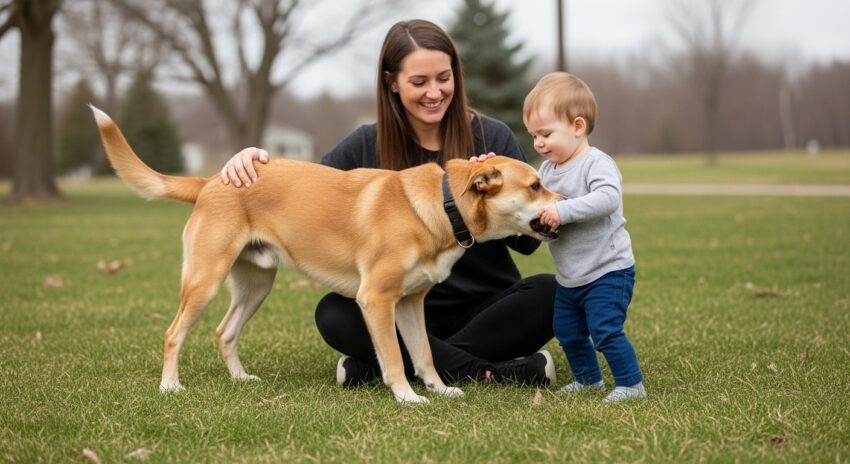
It was 2:15 PM on a blistering Tuesday in mid-July.
The kind of Texas heat that melts the asphalt and forces everyone inside behind drawn blinds and blasting air conditioning.
I was standing in my kitchen, pouring a glass of iced tea, enjoying the absolute silence of the afternoon.
My dog, Brutus, had asked to go out in the backyard about five minutes earlier.
Brutus is a 110-pound Mastiff-Shepherd mix.
I adopted him from a high-kill shelter three years ago. He was battered, covered in scars, and terrified of his own shadow when I first brought him home.
Because of his massive size, his dark brindle coat, and his cropped ears from a previous abusive owner, he looks like an absolute monster.
People cross the street when we go for walks. Mothers pull their strollers closer.
But anyone who actually knows Brutus knows he is a gentle giant. He sleeps with a stuffed lamb. He lets kittens climb on his head. He doesn’t have an aggressive bone in his massive body.
Except, my next-door neighbor, Sarah, never believed that.
Sarah is a young, highly protective mother to a three-year-old boy named Leo.
From the day she moved in, she made her hatred for Brutus very clear. She complained to the HOA about him simply existing in my fenced backyard. She threatened to call animal control when he barked at a squirrel.
She constantly told me that “a beast like that” had no place in a family neighborhood.
Our yards are separated by a relatively low, four-foot wooden chain-link fence. It’s old, and honestly, if Brutus ever wanted to jump it, he easily could. But he never did. He knew his boundaries.
Until that afternoon.
I had just lifted the cold glass of tea to my lips when I heard it.
A scream.
It wasn’t a startled yelp. It wasn’t someone seeing a spider.
It was a blood-curdling, chest-tearing shriek of absolute, primal agony. The kind of sound a mother makes when she is watching her world be violently ripped away from her.
The glass slipped from my fingers.
It shattered against the tile floor, splashing sweet tea and sharp shards of glass across my bare feet. I didn’t even feel it.
My heart stopped dead in my chest.
“LEO!” Sarah screamed. Her voice was cracking, hysterical, filled with a terror that made my blood run ice cold despite the hundred-degree heat outside. “HE’S KILLING HIM! HELP ME! HE’S KILLING MY BABY!”
I didn’t think. I just moved.
I sprinted across the kitchen, my bare feet crushing broken glass, and slammed my shoulder into the back screen door. It flew open, the hinges screaming in protest.
The blast of thick, humid air hit me like a physical wall, but my eyes were already frantically scanning my yard.
Brutus wasn’t there.
My yard was empty.
My stomach dropped into my shoes. A cold sweat broke out across my forehead.
I whipped my head to the right, looking over the low dividing fence into Sarah’s yard.
What I saw in that split second will be burned into my retinas for the rest of my life.
Little three-year-old Leo was on the ground in the middle of his freshly mowed lawn. He was thrashing, his small arms flailing, sobbing so hard he was choking on his own breath.
And standing directly over him was Brutus.
My sweet, gentle rescue dog looked entirely unrecognizable.
His hackles were fully raised, forming a dark, jagged ridge down his massive spine. His ears were pinned flat against his skull. His powerful legs were braced, muscles coiled tight.
And he was growling.
It wasn’t a warning growl. It was a deep, guttural, vibrating roar that sounded like it was coming from a wild predator.
He was snapping his massive jaws violently downward, right at Leo’s squirming body.
“BRUTUS! NO!” I roared, my voice tearing my throat.
He didn’t even flinch. He didn’t look at me. He was completely deaf to my voice, entirely hyper-focused on the screaming child beneath him.
Sarah was sprinting across her patio. She was barefoot, crying hysterically, her face completely pale.
She grabbed a heavy, rusted metal shovel that was leaning against her garden shed.
“GET AWAY FROM HIM!” she shrieked, raising the heavy metal blade high above her head. “I’LL KILL YOU! I’LL KILL YOUR FUCKING DOG!”
Panic, absolute and blinding, consumed me.
Everything Sarah had ever said about Brutus flashed through my mind.
He’s a beast.
He’s unpredictable.
He’s going to snap one day.
Had she been right? Had my dog, the creature I trusted implicitly, suddenly snapped? Was I watching my dog maul a toddler to death?
I sprinted for the fence. I didn’t care about the sharp wire at the top. I threw my entire body weight over the barrier.
The metal caught the fabric of my shirt, tearing it and slicing a deep gash into my side, but the adrenaline masked the pain entirely. I tumbled into Sarah’s yard, hitting the hard dirt and rolling.
I scrambled to my feet, my lungs burning, dirt coating my bleeding skin.
“Brutus, LEAVE IT!” I screamed the ultimate command, the one we had trained on for hundreds of hours.
Instead of backing away, Brutus did something horrifying.
He lowered his massive snout and violently shoved Leo’s chest, pinning the crying child flat against the grass.
“NO!” Sarah shrieked.
She was there. She was right on top of them. She swung the heavy metal shovel down with all her might, aiming directly for the back of Brutus’s skull.
If that shovel hit him, it would split his head open. It would kill him instantly.
I had a split second to make a choice.
Do I let her kill my dog to save her son? Or do I stop her, risking the child’s life if Brutus truly was attacking?
I lunged forward, throwing my body horizontally through the air.
I didn’t tackle the dog. I tackled the mother.
I hit Sarah squarely in the waist just as the shovel came down. The heavy metal blade missed Brutus’s head by less than an inch, burying itself deeply into the Texas dirt with a sickening thud.
Sarah and I crashed to the ground in a tangle of limbs.
She was fighting like a wild animal, fueled by a mother’s sheer desperation. She clawed at my face, her nails digging into my cheek.
“Let me go! He’s eating my baby! He’s killing my son!” she sobbed wildly, punching my shoulders, trying to crawl over me to get to the shovel.
“Brutus, back away! BACK AWAY!” I screamed over her, trying to hold her down while looking at my dog.
But Brutus ignored us both.
With Sarah disarmed and me on the ground, Brutus let out one final, deafening roar.
He lunged his face directly into the thick grass beside Leo’s neck.
I squeezed my eyes shut, bracing for the horrifying sound of teeth tearing into flesh. I braced myself for the blood. I braced myself for the reality that my dog had just destroyed a family.
But the sound that followed wasn’t a scream.
It was a sharp, furious hiss.
And then, a sound I will never, ever forget.
A dry, violent, terrifying rattle.
Chapter 2
The sound of that rattle cut through the thick, oppressive summer air like a jagged blade.
It wasn’t a faint, distant warning. It was loud. It was violent. It was right next to my face.
It was the unmistakable, bone-chilling vibration of a massive Western Diamondback rattlesnake, fully coiled, highly agitated, and ready to pump a lethal dose of hemotoxic venom into whatever was in front of it.
Time stopped.
The frantic, hysterical thrashing of the mother beneath me suddenly ceased.
Sarah went completely rigid. Her nails, which had been digging deeply into my cheeks just a fraction of a second earlier, suddenly went slack. Her eyes, wide and bloodshot from crying, darted past my shoulder toward the sound.
I slowly turned my head, the dirt scraping against my jaw.
Brutus wasn’t attacking little Leo.
He was standing entirely over the crying boy, using his massive 110-pound body as a physical, impenetrable shield.
And locked securely between his powerful jaws, thrashing wildly in the air, was the largest rattlesnake I had ever seen in my entire life.
It was easily five feet long, thick as my forearm, its diamond-patterned scales a blur of furious motion.
The snake was wrapping the lower half of its muscular body around Brutus’s front leg, desperately trying to gain leverage, its rattle shaking so fast it sounded like a high-pressure steam valve.
Leo was directly underneath them, screaming, his hands covering his face, completely unaware of how close he had just come to a brutal, agonizing death.
Brutus had seen the snake in the grass before anyone else.
He had jumped the fence—the fence he never, ever crossed—sprinted across the neighbor’s yard, and forcefully shoved the toddler out of the strike zone just as the snake reared back.
My dog wasn’t trying to tear a child apart.
He was taking a bullet for a boy whose mother hated him.
“Oh my god,” Sarah breathed out. The sound barely escaped her lips. It was a hollow, breathless whisper of absolute horror and shattering realization. “Oh my god.”
She wasn’t looking at a monster anymore. She was looking at a savior.
Brutus let out a muffled, furious growl through his clenched teeth.
He planted his front paws firmly into the dirt, bracing his muscular shoulders, and violently whipped his massive head from side to side.
He was using the classic terrier shake, a primal instinct designed to snap the spine of a predator.
The force of his movement was incredible. The snake’s heavy body slammed against the hard Texas ground with a sickening, wet thud. Once. Twice. Three times.
I scrambled off Sarah, ignoring the searing pain in my feet where the broken glass from my kitchen floor was still embedded.
I grabbed Sarah by the collar of her shirt and violently yanked her backward, dragging her across the grass, away from the thrashing chaos.
“Get Leo! Get him now!” I screamed at her, my voice cracking.
Sarah scrambled on her hands and knees. She didn’t even stand up. She lunged forward, grabbed her screaming toddler by the waist, and pulled him fiercely to her chest. She scrambled backward on the grass, putting ten feet of distance between them and the dog.
She was sobbing hysterically, burying her face into her son’s neck, checking his arms, his legs, his face.
“Are you bitten? Leo, did it get you? Did it get you?” she cried frantically.
But Leo didn’t have a single puncture wound. He was just terrified, covered in dirt, and crying for his mother.
Brutus had reached him in time.
I turned my attention back to my dog.
Brutus gave the snake one final, violent shake. The rattling sound abruptly stopped. The thick, muscular body of the diamondback went completely limp, hanging loosely from my dog’s jaws like a thick piece of rope.
The threat was neutralized. The snake was dead.
Brutus stood there for a second, his chest heaving, his breathing ragged and heavy.
Then, he slowly opened his mouth and dropped the mangled snake into the grass.
“Good boy,” I gasped out, my entire body shaking so violently I could barely stand. Tears of relief hot and fast blurred my vision. “Brutus, come here. Good boy. You did it. It’s over.”
I took a step toward him, my arms outstretched, wanting nothing more than to bury my face in his coarse fur and hold him.
But Brutus didn’t run to me.
He didn’t wag his tail.
Instead, he took one single, unsteady step backward.
His massive front right paw buckled underneath him.
He let out a sharp, high-pitched whimper—a sound I had never heard come from my tough, stoic rescue dog.
My heart completely stopped. The relief I felt just seconds ago vanished, replaced instantly by a cold, suffocating wave of pure dread.
“Brutus?” I called out, my voice trembling.
He looked at me. His beautiful, expressive brown eyes were wide with confusion and pain.
And that’s when I saw it.
On the right side of his snout, just above the black leather of his nose, were two distinct, bleeding puncture wounds.
The blood was dark, oozing slowly down his muzzle, mixing with his saliva.
The snake hadn’t gone down without a fight. In the split second before Brutus snapped its spine, the diamondback had managed to sink its fangs deep into the soft, vascular tissue of his face.
“No,” I whispered. “No, no, no.”
I dropped to my knees in the grass right beside him. I didn’t care that the dead snake was only inches away.
I grabbed his heavy head in my hands. The right side of his face was already beginning to swell. It wasn’t a slow progression. It was happening right in front of my eyes, the venom rapidly destroying the tissue and flooding his system.
“He’s bitten,” I screamed, looking back at Sarah. “He got bit!”
Sarah looked up from Leo. Her face was entirely drained of color, pale as a ghost. The heavy metal shovel she had nearly used to kill him was still sticking upright in the dirt, a horrifying monument to how wrong she had been.
“Oh my god,” she sobbed, holding Leo tighter. “He saved him. He saved my baby.”
“He’s going to die if we don’t move!” I yelled, the panic fully taking over my body.
Rattlesnake venom is fast. A bite to the face is even faster because it’s so close to the brain and airway. If his throat swelled shut, he would suffocate before the venom even stopped his heart.
Brutus whimpered again and his back legs gave out.
My massive, 110-pound giant collapsed heavily onto his side in the grass. He was panting rapidly, his breathing already sounding wet and restricted. His eyes were starting to glaze over, staring blankly at the wooden fence he had just leaped over.
I slid my arms under his heavy torso, trying to lift him.
It was like trying to lift a boulder. He was dead weight. The venom was acting as a paralytic, shutting down his muscles.
“Brutus, up! Come on, buddy, you gotta help me,” I pleaded, straining every muscle in my back and arms.
I managed to get his front half off the ground, but my bare feet slipped in the grass. I fell backward, dropping him heavily back onto the dirt.
I screamed in frustration, tears streaming down my face. I was completely helpless. I couldn’t carry him by myself.
Suddenly, I felt hands beside mine.
I looked over, startled.
It was Sarah.
She had left Leo sitting safely on her patio chair and sprinted back over to us. Her nice white summer dress was covered in mud, her knees were stained green from the grass, and her face was streaked with dirt and tears.
This was the woman who had called animal control on my dog. The woman who had petitioned the neighborhood association to have him removed. The woman who, just three minutes ago, had tried to crack his skull open with a shovel.
She slid her hands deeply under Brutus’s hindquarters.
“Grab his front,” she commanded, her voice suddenly steady, completely stripped of her previous hysteria. “On three. One, two, three!”
Together, we heaved.
Brutus let out a low groan of pain as we lifted his massive, dead-weight body off the ground.
My muscles burned, my sliced foot screamed in agony with every step, but I didn’t stop. We awkwardly shuffled across the grass, carrying him like a heavy piece of furniture.
“My truck,” I grunted. “It’s in the driveway. The keys are in the ignition.”
We hit the dividing fence. There was no way we could lift him over it.
“The gate!” Sarah yelled. “Go through my side gate!”
We stumbled toward the side of her house. Sarah kicked the wooden gate open with her bare foot, and we hurried down the concrete pathway toward the front yards.
Brutus’s head was resting against my chest. His breathing was getting shallower, turning into a terrifying, raspy wheeze. The swelling had rapidly spread from his snout up to his right eye, completely forcing it shut. The skin felt hot, unnaturally tight, and stretched to its absolute limit.
“Hold on, buddy. Just hold on,” I kept whispering into his ear, my tears dropping onto his brindle fur.
We reached my truck—an old, beat-up Ford F-150 parked out front.
Sarah didn’t hesitate. She threw open the back passenger door.
We practically threw him onto the backseat. He landed with a heavy, limp thud. He didn’t try to correct his posture. He just lay there on his side, his large tongue hanging out of his mouth, his chest rising and falling in rapid, shallow jerks.
I slammed the door shut and ran to the driver’s side.
I expected Sarah to go back to her son. I expected her to wave me off and deal with the shock of what had just happened.
Instead, she yanked open the rear door on the opposite side and climbed directly into the backseat with him.
“What are you doing?” I asked, completely bewildered, pausing with my hand on the steering wheel. “Leo is on the patio!”
“My husband is working inside, he’ll hear him,” Sarah said quickly, already pulling her cell phone out of her pocket. “Drive. Just drive! I’ll hold his head. I’ll keep him awake.”
I didn’t argue. There was no time.
I jammed the key forward, the engine roaring to life. I slammed the truck into reverse, tires screeching aggressively against the hot asphalt as I backed out of the driveway, completely ignoring the mail truck coming down the street.
I shifted into drive and slammed my foot onto the gas pedal. The heavy truck lurched forward, throwing me back into my seat.
We lived in a typical suburban Texas neighborhood. The nearest emergency veterinary clinic was exactly fourteen miles away, straight down the busy interstate. In normal afternoon traffic, it was a twenty-five-minute drive.
Brutus didn’t have twenty-five minutes.
Looking at him in the rearview mirror, I knew he didn’t even have ten.
“He’s struggling to breathe,” Sarah shouted from the back.
I glanced back. She had pulled Brutus’s heavy, swollen head onto her lap. The woman who had been terrified of this dog for a year was now running her fingers through his fur, her pristine dress soaking up the blood and saliva dripping from his swollen mouth.
“Keep his airway straight!” I yelled back, swerving aggressively around a slow-moving sedan. “Don’t let his neck bend! Keep him looking forward!”
“I got him, I got him,” she kept repeating, crying openly now, rocking back and forth as she cradled the massive dog’s head. “I’m so sorry, Brutus. I’m so sorry. You’re a good boy. You’re the best boy. Please don’t die. Please don’t die.”
I hit the on-ramp for the interstate and pushed the pedal straight to the floorboard.
The speedometer climbed rapidly. Sixty. Eighty. Ninety-five miles an hour.
The truck was shaking, the wind roaring outside. I laid on the horn, a continuous, blaring siren, flashing my brights at anyone in the left lane. Cars swerved out of my way, drivers honking and throwing their hands up in anger, but I didn’t care.
I would crash this truck before I let my dog die in the backseat.
“Call the vet!” I shouted to Sarah over the roar of the road. “Look up Westside Emergency Vet! Tell them we are coming in hot with a massive rattlesnake bite to the face. Tell them to get the antivenom ready right now!”
I heard Sarah aggressively tapping on her phone screen, her hands shaking violently.
“Speakerphone!” she yelled, putting the phone down on the seat.
“Westside Emergency Pet Clinic, this is—”
“Listen to me!” I screamed toward the phone, not taking my eyes off the highway. “I am five minutes away! I have a 110-pound Mastiff mix. Western Diamondback bite, direct hit to the snout! Swelling is massive, airway is compromised, he is lethargic and going into shock. You need to have a team at the front door with a gurney and antivenom the second I pull up, do you understand me?!”
There was a split second of silence on the other end. The receptionist heard the sheer panic and absolute authority in my voice.
“Yes, sir. We are preparing a crash cart and drawing the antivenom now. Pull directly up to the red emergency doors. We will be waiting.”
“Thank you!” I yelled, and Sarah ended the call.
I checked the rearview mirror again.
Brutus’s eyes were rolling to the back of his head. The white sclera was visible, his pupils completely blown out. The swelling had completely overtaken the right side of his face, making him look grotesque and distorted. His breathing wasn’t just raspy anymore; it was a horrifying, bubbling wet sound.
His lungs were filling with fluid.
“He’s stopping!” Sarah screamed, pure terror in her voice. “He’s not breathing! He stopped breathing!”
“No, no, no!” I roared, hitting the steering wheel with my fist. “Brutus! Stay with me!”
I saw the exit for the veterinary clinic. I didn’t brake. I took the curve at seventy miles an hour, the truck leaning so hard on its suspension I thought we were going to flip. The tires screamed, smoking against the pavement as I drifted around the bend.
I blew straight through a red light at the bottom of the exit ramp, nearly getting broadsided by a delivery truck. The driver laid on his horn, but I was already past him, accelerating down the feeder road.
“Three minutes, Brutus! We are right here!” I yelled, though I didn’t know if he could hear me. I didn’t know if he was even still alive.
I saw the blue sign of the clinic up ahead.
I swerved into the parking lot, jumping the concrete curb with a violent bounce that sent Sarah crashing against the door panel.
I aimed the truck directly at the double red glass doors of the emergency entrance and slammed on the brakes.
The heavy truck skidded violently, stopping less than three feet from the glass.
I didn’t even put the truck in park. I threw open my door, completely ignoring the sharp pain of the broken glass in my feet hitting the searing hot pavement, and sprinted to the back door.
I yanked it open.
Through the glass of the clinic doors, I saw three people in blue scrubs running toward us, pushing a stainless steel rolling gurney.
I reached into the backseat, grabbed my 110-pound dog by the shoulders and hips, and dragged his lifeless body out of the truck.
Chapter 3
The stainless steel wheels of the gurney rattled violently against the concrete.
I hooked my arms deep under his front armpits, my hands slipping on the slick mixture of his sweat and blood. I felt the unnatural, feverish heat radiating from his swelling chest.
His massive head lolled backward, heavy as a cinderblock. A thick, ropy string of bloody saliva trailed from his slack jaw, splattering onto the hot pavement.
“One, two, three, lift!” shouted a male veterinary technician in dark blue scrubs.
We heaved him upward. Brutus’s 110-pound frame hit the metal surface of the gurney with a heavy, lifeless thud. His legs splayed out unnaturally at odd angles. He didn’t twitch. He didn’t groan.
He was completely limp.
“We got him! Move, move, move!” the lead technician yelled, grabbing the front railing of the cart.
They didn’t wait for me. They spun the gurney around with practiced precision, the wheels catching the edge of the rubber matting by the door, and sprinted backward into the clinic.
The automatic double glass doors slid open just in time.
I tried to follow them. I took one step onto the smooth linoleum floor of the lobby, and my body instantly betrayed me.
The adrenaline that had been flooding my system, masking the physical trauma of the last fifteen minutes, suddenly evaporated. The sharp, agonizing reality of my injuries hit me like a freight train.
The bottom of my right foot felt like it was on fire. I looked down.
I was leaving dark, thick bloody footprints across the pristine white floor of the clinic. The large shard of glass from the shattered iced tea pitcher in my kitchen was still deeply embedded in my heel, grinding against the bone with every step I took.
My knees buckled.
I reached out, desperately grabbing the edge of the high reception desk to stop myself from hitting the floor.
“Sir! Sir, you need to sit down!” a receptionist yelled, rushing out from behind the counter. She was young, maybe in her early twenties, her eyes wide as she took in the horrific state I was in.
I was covered in dirt, my shirt was ripped completely open on the side, revealing a long, bleeding gash from the top of the chain-link fence, and my hands were coated in my dog’s blood.
“No,” I gasped out, my lungs burning, struggling to pull air into my chest. “I need to go back there. I need to be with him.”
“You can’t go back there,” she said firmly, grabbing me by the elbow and steering me toward a row of plastic waiting room chairs. “They are intubating him right now. They need the room clear to work. Please, sit down before you pass out.”
I collapsed heavily into the rigid plastic chair. I buried my face in my trembling, blood-stained hands.
The clinic lobby was dead silent, save for the hum of the air conditioning unit and the frantic, muffled shouts echoing from behind the thick wooden doors of the treatment area.
Push the epi! Get a line in the left leg, the right is collapsing! I need that antivenin reconstituted right now!
Every shouted command felt like a physical blow to my chest.
I squeezed my eyes shut, but all I could see was the image of Brutus standing over little Leo. All I could see was the massive, furious diamondback wrapping around his leg. All I could hear was that terrifying, violent rattle.
Suddenly, the front doors slid open again.
I looked up.
Sarah was standing in the doorway.
She looked absolutely shell-shocked. Her pristine, expensive white summer dress was a ruined, filthy mess. It was streaked with dark mud, green grass stains, and large, blooming patches of Brutus’s dark blood.
Her blonde hair, usually perfectly styled, was tangled and matted with sweat. She was completely barefoot, her feet coated in Texas dust.
She stood there for a long moment, her chest heaving, just staring blankly at the dark red bloody footprints I had left across the linoleum.
The receptionist rushed over to her with a box of tissues and a clipboard, but Sarah completely ignored her.
She walked slowly across the lobby, her eyes locking onto mine, and sank into the plastic chair directly next to me.
She didn’t say a word. She just sat there, staring at the blank white wall opposite us, her hands shaking violently in her lap.
“Did you call your husband?” I finally asked. My voice sounded entirely foreign to me. It was hoarse, hollow, and barely a whisper.
Sarah flinched slightly, as if the sound of my voice had physically startled her. She slowly turned her head to look at me.
“Yes,” she whispered, her voice trembling. “Mark was… he was in his home office. He had his headphones on. He didn’t hear anything.”
She swallowed hard, her eyes filling with fresh tears.
“He came outside right after we drove off. He found Leo sitting on the patio chair crying. He… he saw the snake in the grass.”
She covered her mouth with her trembling hand, a sharp, ragged sob tearing from her throat.
“Mark said it was massive. He said it was easily five feet long. He said…” She paused, struggling to force the words out. “He said if it had bitten Leo… he wouldn’t have made it to the hospital. The venom load would have stopped a toddler’s heart in less than ten minutes.”
I stared down at the floor. The linoleum was cold, a stark contrast to the burning heat in my foot.
“Brutus shoved him out of the way,” I said quietly, the memory playing over and over in my mind like a broken film reel. “I thought he was attacking him. When I looked over the fence, I thought my dog was mauling your son.”
Sarah let out a horrific, gut-wrenching wail. She didn’t care who was in the lobby. She didn’t care about the receptionist staring at us. She leaned forward, burying her face in her blood-stained hands, and completely broke down.
“I tried to kill him,” she sobbed hysterically, her shoulders shaking violently. “I grabbed that shovel and I swung it as hard as I could. I aimed for his head. I was going to crack his skull open.”
She turned to me, her eyes wide, desperate, and filled with a crushing, agonizing guilt that I had never seen in another human being.
“I was going to kill the dog that was actively taking a bullet for my baby. I hated him. I complained about him. I called him a monster to everyone in the neighborhood. And he jumped a fence to save my child’s life.”
She reached out, grabbing my wrist with a surprisingly strong grip. Her fingernails, the same ones that had clawed my face raw when I tackled her, dug into my skin.
“You saved his life,” she cried, looking directly into my eyes. “If you hadn’t tackled me… if you hadn’t stopped that shovel… I would have killed him right there in the dirt.”
I didn’t know what to say. I just stared at her hand on my arm.
The tension that had defined our relationship for the past year—the angry glares across the property line, the passive-aggressive notes on my door, the complaints to the HOA—it was all completely gone.
It had been entirely vaporized in the span of fifteen minutes, replaced by a shared, traumatic bond that neither of us would ever forget.
“We don’t know if he’s going to make it, Sarah,” I said, my voice cracking on the last word.
The heavy wooden doors leading to the treatment area suddenly pushed open.
A tall, broad-shouldered man in his late forties walked out. He was wearing dark green surgical scrubs, a stethoscope draped around his neck, and a pair of clear plastic safety glasses pushed up onto his forehead. His face was grim, tight with stress, and covered in a fine sheen of sweat.
His name tag read: Dr. Evans, Chief of Trauma.
I immediately tried to stand up, but a sharp, blinding pain shot up my leg from the glass in my heel. I groaned, falling hard back into the plastic chair.
“Stay seated,” Dr. Evans commanded, walking briskly toward us. He pulled up a rolling stool from behind the reception desk and sat down directly in front of me, leaning forward with his elbows on his knees.
He looked closely at the torn, bleeding skin on my side, then down at my bloody foot.
“I’ve got a nurse grabbing a first aid kit for you. We need to get that glass out of your foot before you get a severe infection,” he said briskly. “But first, we need to talk about your dog.”
“Is he alive?” I demanded, leaning forward, my heart hammering violently against my ribs. “Just tell me he’s alive.”
Dr. Evans let out a heavy, exhausted sigh. He looked me squarely in the eye.
“He is alive right now,” he stated flatly. “But he is in critical condition. It is touch and go.”
Sarah let out a sharp gasp, covering her mouth with her hands again.
“The bite was a direct strike to the right side of his snout, directly into the sinus cavity,” Dr. Evans explained, his voice professional, clinical, but laced with genuine concern. “That is an incredibly dangerous location. The face is highly vascular, meaning the venom bypassed the muscle tissue and entered his bloodstream almost immediately.”
He paused, making sure I was processing the information.
“Western Diamondback venom is primarily hemotoxic,” he continued. “It violently destroys red blood cells, breaks down tissue, and causes massive, rapid swelling. It also destroys the blood’s ability to clot, causing internal bleeding. By the time you got him on the table, his airway was entirely compromised.”
“But he’s breathing?” I asked desperately. “You intubated him?”
“We barely managed it,” Dr. Evans admitted, running a hand through his graying hair. “The tissue in his throat was swelling shut so fast my lead tech had to physically hold his airway open with forceps just so I could force the tube down. If you had arrived even two minutes later, he would have suffocated in the back of your truck.”
I felt all the blood drain rapidly from my face. I felt physically sick. Two minutes. The difference between life and death had been the fact that I ran that red light at seventy miles an hour.
“So what’s next?” I asked, forcing my voice to stay steady. “You give him the antivenom, right? You give it to him and it reverses the swelling?”
Dr. Evans shook his head slowly.
“Antivenin doesn’t reverse the damage that’s already been done. It only neutralizes the active venom still in his bloodstream, stopping further destruction.”
He leaned in closer, his expression turning incredibly serious.
“We have administered the first vial of CroFab antivenin. He is currently on IV fluids, high-dose steroids to combat the anaphylactic shock, and heavy pain management. But I need to be completely transparent with you. The snake that bit him was exceptionally large, and because he was actively thrashing it, the snake likely dumped its entire venom load into his face.”
“Meaning?”
“Meaning one vial isn’t going to be enough,” Dr. Evans said bluntly. “His vitals are highly unstable. His blood pressure is dropping dangerously low. We need to administer at least two more vials of antivenin immediately, possibly more over the next twelve hours, just to keep him from going into multi-organ failure.”
He paused, looking down at his clipboard, then back up at me.
“Before we proceed, I have to inform you about the cost. CroFab is human-grade medication. It is incredibly expensive to stock. Each vial costs approximately twelve hundred dollars. With the emergency fee, the ICU boarding, the intubation, and three vials of antivenin, your bill is already approaching six thousand dollars. And that number will climb rapidly if he needs a plasma transfusion.”
The number hit me like a punch to the gut.
Six thousand dollars. I worked as a heavy machinery mechanic. I lived paycheck to paycheck. I had exactly eight hundred dollars in my savings account. I couldn’t afford a six-thousand-dollar emergency vet bill.
I couldn’t even afford half of that.
A heavy, suffocating weight settled onto my chest. I looked at the floor, my mind racing frantically, trying to figure out which credit cards weren’t maxed out, trying to figure out if I could take out a predatory payday loan, trying to figure out how I was going to pay for this.
But I didn’t hesitate. I didn’t even have to think about the choice.
“Do it,” I said, looking back up at Dr. Evans. “I don’t care what it costs. I’ll figure it out. Give him whatever he needs. Don’t stop treating him.”
“Wait.”
The voice came from beside me.
I turned my head. Sarah had stopped crying. She was sitting completely upright, her spine rigid, her jaw set tight. She reached into the small, expensive leather crossbody bag she was still wearing and pulled out a heavy metal American Express card.
She held it out to Dr. Evans.
“Run this,” she said. Her voice was completely steady. It carried the absolute, unyielding authority of a mother who had almost lost her child.
Dr. Evans blinked, clearly taken aback. “Ma’am, the deposit policy—”
“I don’t care about the policy. I don’t care about the estimate,” Sarah interrupted forcefully, shoving the card closer to his chest. “Run it for ten thousand dollars right now. Keep it on file. If he needs more antivenin, give it to him. If he needs plasma, give it to him. If he needs a personal surgeon, you hire one.”
I stared at her, completely stunned. “Sarah, you don’t have to—”
“Shut up,” she snapped at me, but her eyes were filled with a fierce, protective tears. She looked back at the doctor. “That dog saved my son’s life. He stood between a three-year-old boy and a five-foot diamondback. I owe him everything. You do not stop working on him, Dr. Evans. You save that dog’s life, and I will pay for every single cent of it.”
Dr. Evans looked from Sarah, to the metal card, and then back to me. A slight, respectful nod passed over his face.
He took the card from her hand.
“Understood,” he said firmly, standing up from the stool. “I’ll have the reception staff process this immediately. We are drawing the second and third vials now.”
He turned to walk back toward the double doors, but stopped, looking back at me.
“The nurse is coming for your foot. Do not try to walk on it. I will come back out to update you in one hour. If anything changes before then, I’ll send a tech.”
He pushed through the heavy wooden doors, the loud clatter of the busy treatment room briefly spilling out into the lobby before the doors slammed shut, sealing us back in the suffocating silence.
A young nurse with a rolling cart full of bandages and antiseptic arrived a moment later. She knelt in front of me, putting on a pair of blue latex gloves.
“This is going to sting,” she warned gently, grasping my heel firmly.
With a pair of surgical tweezers, she clamped onto the thick piece of glass embedded in my foot and yanked it out.
I hissed in pain, my entire leg jerking aggressively. Blood poured freely from the wound onto the towel she had laid down. She immediately applied pressure with a thick gauze pad, pouring dark brown iodine over the cut. It burned fiercely, a sharp, localized agony that completely grounded me back in reality.
She wrapped my foot tightly in a thick white bandage, handed me a bottle of water, and quietly retreated behind the front desk.
And then, the waiting began.
It was the most agonizing, terrifying hour of my entire life.
The adrenaline had completely left my system, replaced by a deep, aching exhaustion and a profound, chilling fear. I sat in that rigid plastic chair, staring blindly at the ticking clock on the wall above the reception desk.
The minute hand seemed to be stuck in cement.
Three o’clock. Three fifteen. Three thirty.
Sarah didn’t leave. Her husband had texted her that Leo was safe, bathed, and asleep in his bed, totally unbothered by the traumatic event he barely understood. Mark had offered to come pick her up, but she had aggressively refused.
She sat next to me, her muddy, bloody dress drying stiffly in the cold air conditioning. We didn’t talk. There was nothing left to say. Every so often, I would catch her staring at the wooden double doors, her hands gripped tightly together in her lap, her lips moving slightly in a silent, desperate prayer.
Three forty-five.
The silence in the lobby was deafening. Every time the phone rang behind the reception desk, my heart violently skipped a beat. Every time a door opened, my breath hitched in my throat.
Four o’clock.
The hour mark had passed. Dr. Evans was supposed to be out.
I shifted in my chair, the bandage on my foot throbbing in time with my rapid pulse. “He said an hour,” I muttered, my voice tight with panic. “Why isn’t he out here?”
“They’re busy,” Sarah whispered back, trying to sound reassuring, though her voice was trembling heavily. “It’s a good sign. It means they’re working on him.”
But it wasn’t a good sign.
At exactly four-twelve, the oppressive silence of the veterinary clinic was violently shattered.
It started as a single, high-pitched electronic tone from behind the heavy wooden doors. A long, continuous beep that I immediately recognized from a hundred medical dramas on television.
It was a flatline alarm.
A second later, a voice roared from the back treatment area, loud enough to easily carry through the thick walls.
“He’s crashing! Vitals are dropping!”
I shot up out of my chair, completely ignoring the blinding, searing pain in my bandaged foot. I lunged forward, grabbing the edge of the reception counter.
“Pulse is threading! We’re losing pressure!” another voice screamed.
“Push the epi! Now! Charge the paddles!” Dr. Evans’s voice cut through the chaos, raw, urgent, and frantic.
Sarah was standing right next to me, her hands gripping my forearm so tightly her knuckles were stark white. Her eyes were wide with sheer terror.
“Clear!” a voice shouted.
A heavy, dull thud echoed through the wall.
“Nothing! We still have no rhythm!”
The continuous, high-pitched squeal of the flatline alarm drilled directly into my skull. It was the sound of a heart stopping. It was the sound of a life ending.
It was the sound of my best friend dying on a metal table just thirty feet away from me.
“Hit him again!” Dr. Evans roared. “Charge it! Clear!”
Another heavy thud.
I stopped breathing. The entire world narrowed down to the heavy wooden double doors leading to the trauma bay. I didn’t feel the pain in my foot. I didn’t feel the blood drying on my skin.
I just stared at the doors, waiting for the alarm to stop.
But it didn’t.
It just kept screaming.
Chapter 4
The high-pitched, continuous squeal of the flatline alarm seemed to vibrate directly in my teeth.
It was a sound that completely bypassed my ears and drilled straight into my nervous system, paralyzing every muscle in my body.
Ten seconds passed. It felt like ten hours.
Through the heavy wooden doors, the frantic, muffled shouts of the veterinary team continued, a chaotic symphony of desperate medical intervention. The sharp clatter of metal instruments hitting the floor. The squeak of rubber soles against linoleum.
“I need another milligram of epinephrine! Push it directly into the line!” Dr. Evans’s voice was hoarse, entirely stripped of its previous clinical calm. “Come on, buddy. Come on! Don’t do this. Charge the paddles again!”
“Charging! Clear!”
A third heavy thud. The sound of a 110-pound body physically lifting off a stainless steel table and slamming back down.
Sarah was crying so hard she was silently hyperventilating next to me. Her hands were covering her ears, her eyes squeezed tightly shut, her face buried into my shoulder. My own tears were flowing freely, hot and fast, tracking through the dried dirt and blood on my cheeks.
I couldn’t breathe. My chest felt like it was wrapped in tight iron bands.
I had failed him.
He had survived a horrific, abusive puppyhood. He had survived months in a concrete run at a high-kill shelter, waiting for someone, anyone, to look past his massive size and scarred face. He had finally found a home where he was safe, where he was loved, where he slept on a king-sized mattress with a stuffed lamb.
And now, he was dying on a cold metal table because he threw himself between a venomous snake and a child who didn’t even belong to him.
“Still nothing!” a female voice shouted from the back. “Dr. Evans, we’ve been pushing CPR for four minutes. The venom load is too high. His heart can’t handle the shock.”
“I don’t care! Push another round of epi! Keep compressing!” Dr. Evans roared back. “He’s not dying on my table today! Compress!”
I collapsed to the floor.
I didn’t care about the sharp, stabbing pain in my bandaged foot. I didn’t care about the receptionist watching from behind the desk. I dropped to my knees right there on the cold linoleum of the waiting room, completely breaking down.
I buried my face in my hands and sobbed. It was an ugly, guttural, chest-heaving cry of absolute despair.
“Please,” I begged to an empty room, to whatever God was listening. “Please don’t take him. Please. I’ll do anything. Just let him live.”
Sarah dropped to her knees right beside me.
She didn’t try to offer empty platitudes. She didn’t say everything was going to be okay. She just wrapped her arms tightly around my shaking shoulders and held me, rocking me back and forth as we both listened to the desperate fight happening just thirty feet away.
“Clear!” Dr. Evans shouted for the fourth time.
Thud.
Silence.
The frantic shouting suddenly stopped. The chaotic clatter of instruments ceased. The entire clinic fell dead silent.
Even the high-pitched squeal of the flatline alarm had been abruptly cut off.
My breath caught in my throat. I froze, my muscles completely locking up.
Silence in a trauma room means one of two things.
It means they got a heartbeat back. Or it means they gave up.
I stared blindly at the heavy wooden double doors, my heart pounding so hard I could feel it in my throat. The silence stretched on for five seconds. Ten seconds. Fifteen seconds.
The anticipation was a physical torture. I was suffocating on the lack of sound.
Then, slowly, the right side of the heavy wooden doors pushed open.
Dr. Evans walked out.
He looked entirely different than he had an hour ago. He looked like a man who had just gone to war. His green surgical scrubs were heavily stained with dark, wet patches of sweat. His clear plastic safety glasses were hanging crookedly around his neck.
But it was his face that completely shattered me.
He looked exhausted. Deep, dark bags hung under his eyes. His shoulders were slumped, his posture completely defeated. He pulled the surgical mask down from his face, letting it snap against his chest.
He looked at me kneeling on the floor. He looked at Sarah beside me.
He let out a long, heavy, shuddering exhale.
“He went into full cardiac arrest,” Dr. Evans said, his voice quiet, raw, and completely drained. “The venom caused massive anaphylactic shock. His blood pressure bottomed out, and his heart just… stopped.”
I squeezed my eyes shut, a fresh wave of agonizing tears flooding my vision. This was it. This was the end of the story.
“We pushed three rounds of epinephrine,” Dr. Evans continued, running a shaking hand over his face. “We shocked him four times. It took five solid minutes of aggressive, continuous chest compressions.”
He paused, swallowing hard. He took a step closer to us, looking down at the linoleum floor before meeting my eyes again.
“And on the fourth shock…” Dr. Evans’s voice cracked slightly, a sudden, sharp glint of emotion breaking through his professional exterior. “…he gave me a sinus rhythm.”
My head snapped up.
My brain completely failed to process the words for a split second.
“What?” Sarah whispered, her voice trembling violently.
“We got him back,” Dr. Evans said, a small, exhausted, utterly relieved smile breaking across his face. “We got a heartbeat. It’s faint, and it’s fast, but it’s there. He is breathing on the ventilator.”
The wave of relief that crashed over me was so violent, so overwhelming, that it physically knocked the wind out of my lungs.
I let out a sound that was half-laugh, half-sob, burying my face into Sarah’s shoulder. She threw her arms around my neck, squeezing me so tightly I could barely breathe, both of us crying hysterically, laughing, shaking with the pure, unadulterated shock of the news.
“He’s alive,” Sarah sobbed into my ear. “He’s alive. Oh my god.”
“Don’t celebrate just yet,” Dr. Evans cautioned gently, holding up a hand to temper our reaction. “I need you to understand exactly where we are right now. He is severely critical. We have him stabilized, but he is completely comatose. We have administered a massive amount of antivenin, but the swelling in his face and throat is catastrophic.”
He knelt down slightly, making sure we were listening to every word.
“The venom caused severe internal tissue damage. He is bleeding into his sinus cavity. We had to pack his nasal passages to stop him from drowning in his own blood. The next twenty-four hours are going to be the most critical window. If his kidneys begin to fail from the hemotoxins, or if the swelling cuts off the intubation tube, we will lose him.”
I wiped my face with the back of my hand, forcing myself to focus, forcing myself to be strong for my dog.
“Can I see him?” I asked, my voice raspy and broken. “I need to see him.”
Dr. Evans hesitated for a moment. “It is not a pretty sight. It is going to be incredibly distressing to look at. You need to prepare yourself.”
“I don’t care what he looks like,” I said firmly, using the reception desk to pull myself up from the floor, ignoring the burning pain in my foot. “He’s my dog. I’m not leaving him alone back there.”
Dr. Evans nodded slowly. “Only you. Just for five minutes. The ICU nurses are still working on his lines.”
He turned and pushed back through the double doors. I limped heavily behind him, my heart hammering a frantic, nervous rhythm against my ribs.
The transition from the quiet, cool lobby to the trauma ICU was jarring. The room was bright, sterile, smelling sharply of iodine, bleach, and copper. Several stainless steel tables sat in the center of the room, surrounded by banks of beeping monitors, IV poles, and rolling carts of medical supplies.
In the far corner, lying on a large, heated surgical mat, was Brutus.
I stopped dead in my tracks. All the breath left my lungs.
Dr. Evans was right. Nothing could have prepared me for the sight.
My beautiful, massive rescue dog looked completely unrecognizable. The entire right side of his face, from his snout up to his ear, was swollen to three times its normal size. The skin was stretched so tight it looked completely hairless, dark purple, and weeping clear fluid. His right eye was completely swallowed by the swollen tissue, forced tightly shut.
A thick, clear plastic tube was shoved deep down his throat, connected to a rhythmic, hissing mechanical ventilator that was physically forcing his chest to rise and fall. Thick strips of white medical tape secured the tube to his lower jaw. Multiple IV lines ran into his shaved front legs, pumping a cocktail of clear fluids, steroids, antibiotics, and the cloudy, life-saving antivenin into his veins.
He looked like a monster. He looked broken.
But as I limped closer, ignoring the two veterinary technicians working quietly on his IV lines, I didn’t see a monster.
I saw my best friend.
I pulled up a small rolling stool and sat down heavily right beside his head. I carefully, gently placed my hand on the unswollen left side of his face. His skin was unnaturally hot, burning with fever.
“Hey, buddy,” I whispered, my voice immediately cracking. Tears spilled over my eyelashes, dropping onto the stainless steel table. “I’m right here. You did so good. You were so brave. I’m so proud of you.”
He didn’t move. He didn’t twitch. The only movement was the mechanical, forced rise and fall of his ribs from the ventilator.
“You gotta fight this, Brutus,” I pleaded, leaning my forehead against his soft, floppy left ear. “You gotta come home. You can’t leave me. You’re the best boy. You just gotta hold on.”
I sat there for five minutes, just stroking his fur, listening to the steady, rhythmic beep of his heart monitor. It was the most beautiful sound in the entire world.
When Dr. Evans finally touched my shoulder, signaling it was time to leave the sterile environment, I didn’t want to go. I kissed the top of his head, right between his ears, and promised him I would be waiting.
The next four days were an absolute blur of agony, exhaustion, and terrifying phone calls.
I didn’t go to work. I barely slept. I sat by my phone in my living room, staring blindly at the television, waiting for the clinic to call with an update.
Sarah was a constant presence. She came over every single morning, bringing me coffee, bringing me food I couldn’t stomach, checking the bandages on my foot.
Her husband, Mark, had come over the morning after the incident. He was a tall, quiet man who rarely spoke to me in the past. He stood on my porch, holding a plate of homemade brownies, tears standing in his eyes as he aggressively shook my hand and thanked me for saving his wife and his son.
He spent that entire afternoon in his backyard, meticulously reinforcing the wooden dividing fence, pouring concrete footings, and ensuring no snake could ever slither under it again.
On the evening of the second day, Brutus’s kidneys began to struggle.
The clinic called me at 2:00 AM. His urine output had dropped dangerously low, and his red blood cell count was crashing. The venom was actively trying to destroy his organs. Dr. Evans recommended an immediate whole blood plasma transfusion to stabilize him.
It was an incredibly risky, highly expensive procedure.
I didn’t even have to call Sarah to ask. She had already left explicit instructions with the front desk. Approve everything. Do not ask about the cost. Save the dog.
They hung the plasma. We waited.
On the third day, the swelling finally, miraculously, began to retreat.
The heavy, dark purple fluid slowly drained from his facial tissue. The immense pressure on his airway lessened. By that afternoon, his oxygen saturation levels improved enough that Dr. Evans made the call to pull the intubation tube.
I was sitting in the waiting room when they did it.
When the nurse came out and told me he was breathing completely on his own, I broke down in tears all over again.
And on the morning of the fifth day, I finally got the call I had been desperately praying for.
“He’s awake,” Dr. Evans said over the phone, his voice sounding lighter, happier than I had ever heard it. “He’s weak, he’s incredibly confused, and his face still looks like he went ten rounds with a heavyweight boxer. But he just drank a bowl of water on his own. He’s asking for you.”
I drove to the clinic so fast I nearly got pulled over.
When I walked into the recovery ward, my heart nearly burst out of my chest.
Brutus was lying on a thick orthopedic bed inside a large recovery run. He had an IV line taped to his leg, and the right side of his face was still significantly swollen, covered in dark, scabbing puncture wounds. The hair around his snout had been shaved completely bare, revealing the angry, bruised skin underneath.
But his eyes were open. Both of them.
When he saw me limping toward the glass door, his massive, heavy tail gave a slow, weak thump against the floor.
Thump. Thump.
I opened the door and dropped to my knees on the floor of the run.
Brutus let out a long, raspy whine and slowly pushed his heavy head directly into my chest, burying his nose under my arm. I wrapped my arms around his massive neck, burying my face in his fur, crying tears of absolute, profound joy.
He smelled like medicine, bleach, and fear. But he was alive. He was mine.
“You did it, buddy,” I whispered into his fur, holding him as tightly as I dared without hurting his IV. “You did it. We’re going home.”
He stayed in the hospital for two more days for observation and continued pain management.
When the day finally came to discharge him, the entire clinic staff came out to the lobby to say goodbye. The veterinary technicians who had frantically pushed compressions on his chest were crying as they fed him small pieces of hot dogs. Dr. Evans shook my hand, clapping me firmly on the shoulder.
And then, the receptionist handed me the final invoice.
I stared at the thick stack of paper. The itemized list was pages long. ICU boarding, emergency intubation, four vials of CroFab antivenin, whole blood plasma transfusions, continuous ECG monitoring, high-dose steroids, antibiotics.
The grand total at the bottom of the page was $18,450.
I felt a cold sweat break out on the back of my neck. I literally could not comprehend that amount of money.
The receptionist smiled softly, reached across the counter, and took the invoice gently out of my hands.
“It’s already taken care of, sir,” she said quietly. “Mrs. Miller came in this morning and settled the entire balance. Every single cent.”
I stood there, completely stunned, staring at the empty space where the paper had been.
Eighteen thousand dollars. Sarah had paid eighteen thousand dollars to save the dog she had spent a year trying to get evicted from the neighborhood.
I hooked Brutus’s leash to his heavy leather collar. He walked slowly, his gait stiff and exhausted, his right paw still heavily bandaged where the IV had been. But he walked out of those automatic double glass doors under his own power.
I opened the back door of my truck, picked his heavy body up—careful of his tender face—and set him gently on the backseat.
When I pulled into my driveway twenty minutes later, I saw them.
Sarah, Mark, and little Leo were standing on my front lawn.
They weren’t standing behind their fence. They were standing directly in my yard.
I parked the truck and walked around to the back door. As soon as I opened it, Brutus slowly lifted his head.
Sarah immediately started crying. She covered her mouth with both hands, tears streaming down her face as she looked at the shaved, bruised, swollen face of the dog who had taken a lethal strike for her child.
She walked forward slowly, dropping to her knees right in my driveway. She didn’t care about the dirty concrete. She didn’t care about anything.
She reached out, her hands shaking, and gently placed them on both sides of Brutus’s massive, heavy head.
Brutus didn’t growl. He didn’t pull away.
He let out a soft, gentle sigh and leaned his heavy, battered face directly into her hands, his eyes closing softly.
“I’m so sorry,” Sarah whispered, crying freely, resting her forehead gently against his snout, right above the scabbed puncture wounds. “I am so, so sorry I ever doubted you. You are the best, bravest boy in the entire world. Thank you. Thank you for saving my baby.”
She stayed like that for a long time, just holding the dog she used to call a monster.
Then, she pulled back and looked over her shoulder.
“Leo, come here,” she said softly.
The three-year-old boy toddled over. He didn’t look scared. He didn’t remember the screaming, or the shovel, or the frantic ride to the hospital. He just saw a big dog.
“Be very gentle,” Sarah instructed, holding her son’s small hand. “He has a big owie on his nose.”
Leo reached out his tiny, chubby hand and gently patted the unswollen side of Brutus’s neck.
Brutus opened his eyes. He looked at the little boy. Then, incredibly slowly, my massive, terrifying-looking rescue dog lifted his head, extended his long tongue, and gently licked the side of Leo’s cheek.
Leo giggled, wiping the dog slobber off his face.
I stood there, leaning against the side of my truck, watching the scene unfold, and I felt something fundamental shift in the universe.
That was a year ago.
Brutus is fully recovered now. He has a very distinct, hairless, jagged scar across the right side of his snout where the venom necrotized the tissue. He lost a little bit of feeling in his upper lip, so he drools a little more than he used to.
But to me, he has never looked more beautiful.
Things are completely different in our neighborhood now.
Mark and I actually tore down the four-foot wooden dividing fence between our backyards. We completely removed it. Now, we just share one massive, open acre of grass.
We have neighborhood barbecues every other weekend. Mark helps me work on my truck. Sarah brings over leftover casseroles.
And Brutus?
Brutus doesn’t spend his afternoons sleeping on my patio anymore.
Every single day, when the weather is nice, you can find my 110-pound, heavily scarred, terrifying-looking Mastiff mix lying flat on his back in the middle of the grass, while a four-year-old boy named Leo uses his massive stomach as a pillow to watch cartoons on an iPad.
People still cross the street when we go for walks. Strangers still pull their children closer when they see his massive size, his cropped ears, and his heavily scarred face.
They look at him and they see a dangerous beast. They see a monster.
They don’t know that under that terrifying exterior beats the heart of an absolute hero. They don’t know that this dog intentionally threw his body over a toddler and took a lethal strike to the face without a second thought.
You can’t judge a book by its cover.
And you definitely, absolutely, can never judge a rescue dog by his scars.