The Woman Daniel Brought Home
“Rachel, before you say no, just listen to me.”
That was the first thing my husband said when I walked into our kitchen and saw a homeless woman sitting at the island.
I stopped with my purse still over my shoulder.
She looked somewhere in her late sixties. Maybe older. It was hard to tell.
Her gray hair was tangled against her cheeks. She wore a heavy brown coat even though it was nearly eighty degrees outside, and the knees of her pants were dark with old dirt. A plastic grocery bag sat between her shoes.
There was a smell in the room.
Sweat. Damp fabric. Something sour.
I looked at Daniel.
“Who is this?”
The woman lowered her eyes.
Daniel set a glass of water in front of her.
“This is Linda.”
“Linda who?”
He hesitated.
“She doesn’t know.”
I stared at him.
Daniel volunteered twice a month at a community kitchen in South Dallas. He had been doing it for years.
I donated money to the same place every Christmas.
That was the difference between us.
Daniel knew people’s names.
I knew where to write the check.
He walked toward me and lowered his voice.
“She’s been coming to the kitchen for a while. She has a medical appointment tomorrow morning. The shelter she usually uses is having plumbing problems.”
I glanced at the woman.
“So?”
Daniel waited.
I already knew I wasn’t going to like the answer.
“I told her she could shower here.”
I looked toward the hallway.
Then back at him.
“You brought someone you barely know into our house to use our shower?”
Linda pushed her chair backward.
“I can leave.”
Daniel immediately turned.
“No. You’re fine.”
Then he looked at me.
I hated that look.
Not angry.
Not accusing.
Just disappointed.
“Rachel, she needs a shower and clean clothes. That’s all.”
We had four bathrooms.
We had a guest room nobody had slept in for six months.
We had more towels than two people could possibly use.
And still my first thought was about the upholstery on the kitchen stool.
I wish I could say otherwise.
I can’t.
“Fine.”
Linda stood.
She moved carefully, favoring her left knee.
Daniel picked up her grocery bag.
Then he said something that made me turn around.
“Can you help her?”
“Help her with what?”
“The shower.”
I almost laughed.
“Daniel, call Mrs. Alvarez.”
Mrs. Alvarez helped clean our house three days a week.
Daniel shook his head.
“I’m not calling someone who works for us and telling her to bathe another adult because we don’t want to.”
“I didn’t say I don’t want to.”
He raised his eyebrows.
I lowered my voice.
“You know what I mean.”
“Actually, I do.”
Linda was standing five feet away pretending not to hear us.
That embarrassed me enough to stop arguing.
I led her upstairs.
Our guest bathroom had a walk-in shower with a small built-in bench.
I took out fresh towels, shampoo, soap, and one of my robes.
Then I opened the cabinet beneath the sink.
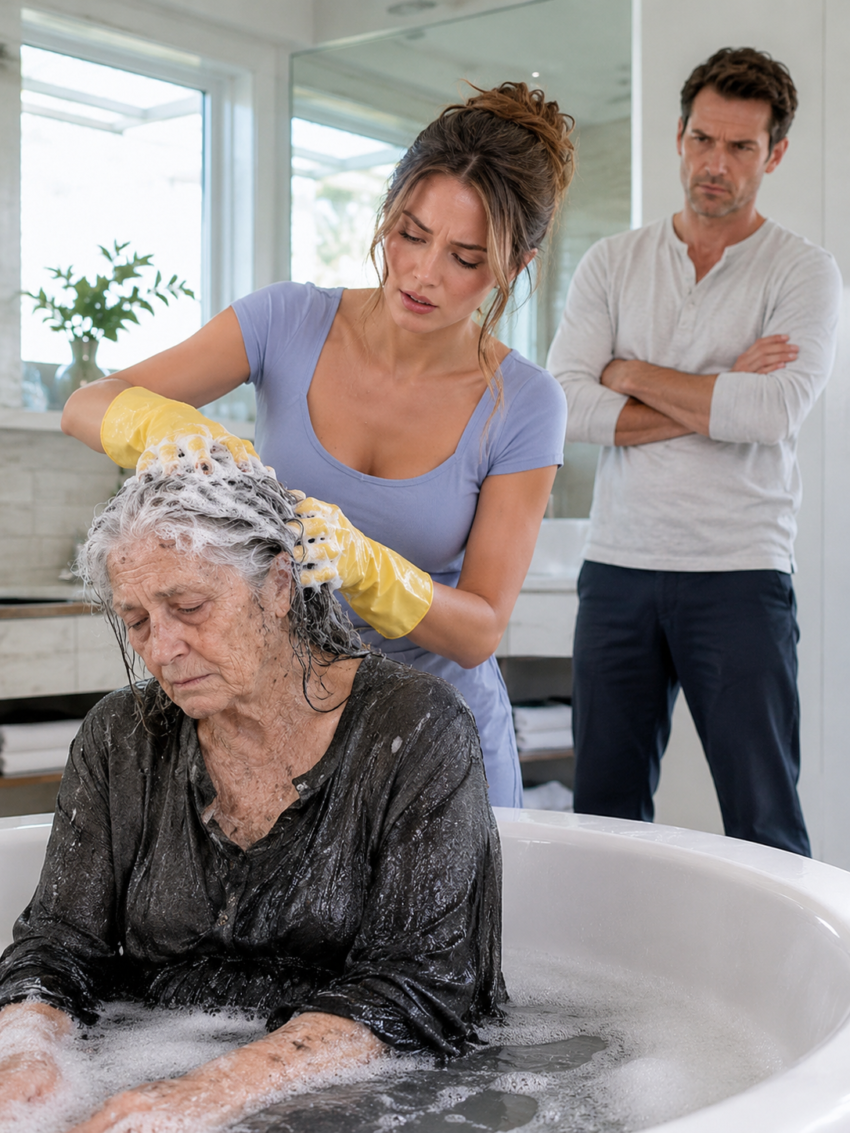
At the back was a pair of thick yellow rubber gloves I used when cleaning with bleach.
I put them on.
Linda noticed.
For half a second, our eyes met in the mirror.
Then she looked away.
“It’s all right.”
I froze.
“What?”
She nodded toward my hands.
“The gloves.”
I said nothing.
“People don’t like touching me.”
I felt my face get hot.
“That’s not why—”
She smiled slightly.
“You don’t have to explain.”
That somehow felt worse.
The Crescent Moon
I helped her remove the coat.
Underneath it, she wore two shirts.
She was much thinner than I expected.
There were old scars on her forearms and bruises in different stages of healing, probably from falls. Nothing dramatic. Just the marks of someone whose body had spent years without much protection.
I turned on the shower.
“Is that temperature okay?”
Linda put her hand under the water.
“That’s nice.”
She said it as if warm water were a gift.
I looked away.
Once she was seated on the bench, I wet a washcloth.
Her hands shook when she tried to wash her hair, so I finally stepped behind her.
I worked shampoo through the gray knots.
Gradually, the water running toward the drain became clearer.
Neither of us spoke.
I cleaned the back of her neck.
Then her left shoulder.
Then I moved to the right.
The washcloth passed over a dark patch.
I assumed it was more dirt.
I rubbed again.
The mark remained.
I stopped.
It was small.
Dark brown.
Curved at the center and pointed at both ends.
A crescent moon.
The washcloth slipped out of my hand.
Linda turned around.
“Are you okay?”
I couldn’t answer.
I had seen that mark hundreds of times.
At the swimming pool.
At the kitchen table when the strap of her nightgown slipped.
On summer afternoons when she wore sleeveless dresses.
My mother had a crescent-shaped birthmark on her right shoulder.
My mother had been missing for almost twenty years.
I stepped backward.
“Stay here.”
Linda looked confused.
“Where would I go?”
I was already running.
I went into our bedroom and dropped to my knees beside the dresser.
My jewelry box was inside the bottom drawer.
I emptied half of it onto the carpet.
Earrings.
Bracelets.
An old watch.
Then I found the silver pendant.
My hands were shaking.
Inside was a tiny photograph.
I was nine years old.
My mother was behind me, her arms around my waist.
She was thirty-eight in that picture.
Dark hair.
Brown eyes.
A wide smile.
Her summer dress had slipped slightly off one shoulder.
And there it was.
The crescent moon.
I heard Daniel behind me.
“Rachel?”
I stood.
“Why did you bring her here?”
His expression changed.
“What happened?”
I held up the pendant.
“Why did you bring that woman here?”
Daniel looked toward the hallway.
Then back at me.
He knew.
Maybe not everything.
But he knew enough.
“Rachel—”
“Tell me.”
He exhaled.
“I noticed something.”
My heart started pounding.
“What?”
“Her wrist.”
I remembered immediately.
When I was six, my mother burned the inside of her left wrist taking a baking sheet from the oven.
The scar was shaped almost like a hook.
I had told Daniel that story years ago.
“You saw her scar?”
“At the kitchen.”
“When?”
“Three weeks ago.”
I stared at him.
“Three weeks?”
“A scar wasn’t enough.”
“So you brought her home without telling me?”
“What was I supposed to say? Rachel, I met a homeless woman who might be the mother you’ve believed was dead for twenty years?”
I couldn’t answer.
Daniel stepped closer.
“I didn’t want to do that to you unless there was something real.”
I looked at the pendant.
Then I went back into the bathroom.
Linda was wrapped in a towel.
I crouched in front of her.
“Look at this.”
I opened the pendant.
She studied the photograph.
“Pretty little girl.”
My throat tightened.
“That’s me.”
She looked at me again.
“Okay.”
I pointed to the woman in the picture.
“Do you recognize her?”
Linda stared.
Five seconds.
Ten.Then she shook her head.
“No.”
I turned the photograph slightly.
“Look at her shoulder.”
She looked.
Then at her own.
Her face became uncertain.
“That’s strange.”
I could barely breathe.
“Your name isn’t just Linda.”
She frowned.
“I don’t know my last name.”
“Parker.”
Nothing.
“Linda Parker.”
She looked frightened.
I removed one yellow glove.
Then the other.
I took her hand with my bare hands.
“My name is Rachel Miller.”
She waited.
“Before I got married, I was Rachel Parker.”
Still nothing.
I heard my own voice break.
“I’m your daughter.”
Linda stared at me.
Then at the photograph.
Then back at me.
“I’m sorry.”
Those were the first words my mother said to me after almost twenty years.
“I don’t remember you.”
A Mother Who Didn’t Know My Name
We did not tell ourselves the birthmark proved everything.
Daniel arranged a medical evaluation.
Aunt Susan drove from Fort Worth the next morning.
The moment she saw Linda, she grabbed the doorframe.
“Oh my God.”
Linda looked frightened.
Susan covered her mouth.
“Linda?”
No response.
My aunt started crying.
She had been twenty-nine when my mother disappeared.
Now she was almost fifty.
She walked closer.
“I’m Susan.”
Linda shook her head.
“I’m sorry.”
Susan looked at me.
That afternoon she showed us an old photograph of herself and my mother.
Linda studied it politely.
Nothing.
Later, DNA testing confirmed what the birthmark had already made difficult to deny.
Linda was my mother.
Knowing that did not magically give her back to me.
Her doctors believed she had severe retrograde memory loss associated with old head trauma and years of psychological stress.
They warned me repeatedly.
Memories could return.
Or they might not.
I treated that warning like a challenge.
I made my mother’s old chicken soup.
She ate two bowls.
“Do you remember this?”
“It’s good.”
“You used to make it.”
She looked apologetic.
“I believe you.”
I played music Aunt Susan said Mom loved.
Nothing.
I brought out Christmas photographs.
School pictures.
My father’s old baseball cap.
Nothing.
One afternoon, I placed a photograph of my father on the table.
Michael Parker.
He was thirty-nine when he died.
Mom picked it up.
She stared at him longer than she had stared at the others.
I leaned forward.
“Do you know him?”
She touched the edge of the photograph.
“No.”
My chest tightened.
Then she added:
“He looks kind.”
I went upstairs.
Daniel found me sitting beside our bed.
“You’re pushing too hard.”
“He’s her husband.”
“I know.”
“She loved him.”
Daniel sat beside me.
“You remember that. She doesn’t.”
I wiped my face.
“I need her to.”
“Why?”
I didn’t answer.
He waited.
Finally, I said it.
“Because she’s the only person alive who knows what happened the day he died.”
Daniel went still.
I had told him my father died in a traffic accident.
I had never told him everything.
I was ten.
I saw my mother across the street.
I ran toward her.
A horn sounded.
My father grabbed me.
Then pavement.
Then screaming.
He died at the hospital.
For twenty-six years, one sentence had stayed in my head.
If I hadn’t run into that street, Dad would still be alive.
After my mother disappeared, nobody could tell me exactly what she had seen.
Now she was sleeping downstairs.
And she couldn’t remember me.
The First Thing She Remembered
Eventually, I stopped testing her.
I stopped placing photographs in front of her.
We developed a routine instead.
Breakfast at eight.
Her medical appointments.
Short walks.
Television after dinner.
One Saturday, I made scrambled eggs.
Mom was sitting across from me.
She watched me pick something out of my breakfast potatoes.
“Still don’t like cilantro?”
My hand stopped.
Daniel looked up from his coffee.
“What?”
Mom frowned.
“What?”
I pushed my plate toward her.
“What did you just say?”
“I asked if you don’t like cilantro.”
“Why?”
She looked confused.
“Because you don’t.”
I stared at her.
I had hated cilantro since childhood.
My mother used to leave it off my food.
“How do you know that?”
She rubbed her forehead.
“I don’t know.”
Daniel slowly put down his mug.
I laughed.
Then I started crying.
Mom looked alarmed.
“Did I say something wrong?”
I reached across the table.
“No.”
I held her hand.
“You remembered something.”
It was tiny.
Not my birthday.
Not my father.
Not the fire.
Cilantro.
But it was hers.
Three weeks later, I took her to Fort Worth.
“Rachie”
Aunt Susan drove us through our old neighborhood.
Most of it had changed.
The convenience store was now a pharmacy.
Our elementary school had a new building.
Our house had burned badly enough that it was eventually demolished. Another family had built there.
Mom stared out the window.
Sometimes she frowned.
Sometimes she shook her head.
Nothing.
Then we reached the intersection where my father died.
I asked Susan to stop.
Mom and I got out.
I hadn’t stood there since I was sixteen.
“Why are we here?”
Mom asked.
I looked across the street.
“Dad died here.”
She turned toward me.
“Michael?”
It was one of the first times she had used his name without prompting.
“Yes.”
We walked slowly along the sidewalk.
I was looking at her instead of the road when someone shouted.
A car had taken the corner too fast.
One wheel jumped the curb.
I froze.
Mom didn’t.
She grabbed my arm and shoved me backward toward a front lawn.
We fell together.
The car hit a street sign several yards away.
For a few seconds, I heard nothing except my own breathing.
Then Mom made a sound.
I turned.
She was staring at me.
“Rachie.”
I stopped breathing.
Nobody called me that.
Nobody except my mother.
“What did you say?”
She reached for my face.
Her fingers shook.“Rachie.”
Her eyes filled with tears.
“My baby.”
I crawled toward her.
“Mom?”
She pulled me against her.
“You were wearing the red sneakers.”
I froze.
“What?”
“That day.”
She was crying now.
“You were wearing those red sneakers your father said cost too much.”
My hands tightened around her.
“Mom, what happened?”
She looked toward the road.
And after twenty-six years, my mother finally told me.
“Your father saved you.”
What Happened to My Father
We went to Susan’s house.
Mom sat at the kitchen table with both hands around a mug of coffee.
I sat opposite her.
“Tell me everything you remember.”
She closed her eyes.
“You saw me across the street.”
I nodded.
“I ran toward you.”
“Yes.”
My stomach tightened.
“So it was my fault.”
Her eyes opened immediately.
“No.”
“Mom—”
“No, Rachel.”
Her voice was stronger than I’d heard it in months.
“The driver ran the light.”
I stared at her.
“Your father saw him before I did.”
She reached across the table.
“Michael ran after you. He pushed you out of the way.”
My eyes burned.
“If I hadn’t crossed—”
“You were ten.”
“But—”
“Rachel.”
I stopped.
“Your father had one second.”
Her fingers closed around mine.
“He chose his daughter.”
I lowered my head.
Mom moved closer.
“Don’t turn the last thing your father did out of love into a punishment he never asked you to carry.”
For twenty-six years, I had remembered my father’s hands pushing me as evidence that I caused his death.
My mother remembered those same hands as evidence of something entirely different.
He had seen the car.
He had known what was coming.
And he had chosen me.
The Fire
Once one memory returned, others began appearing in fragments.
Mom remembered the months after Dad died.
She had barely functioned.
Susan took care of me frequently.
Then came the fire.
I had been staying with Susan that night.
Mom remembered waking to smoke.
She got outside.
Then she remembered something still inside.
A metal box.
It contained our birth certificates, family papers, photographs, Dad’s watch, and a few letters.
She went back.
A gas explosion knocked her unconscious.
When she woke again, she was outside somewhere behind the house.
Disoriented.
Bleeding.
She walked.
A truck driver eventually found her near a highway and took her to a small clinic.
She had no purse.
No identification.
She couldn’t remember her name.
She couldn’t remember Dallas or Fort Worth.
She couldn’t remember Michael.
Worst of all, she couldn’t remember that she had a daughter waiting for her.
After leaving the clinic, she drifted.
Temporary jobs.
Shelters.
Church basements.
Bus stations.
Cheap motel rooms when she had money.
Sidewalks when she didn’t.
Nearly twenty years.
I sat across from her listening.
Then I remembered the yellow gloves.
My mother had spent two decades living as exactly the kind of person I had trained myself not to see.
Carol
More memories returned through ordinary things.
Mom remembered the song she sang when I had a fever.
She remembered I hated peas.
She remembered saving coins in an old coffee can every summer to buy my school shoes.
One afternoon at the community kitchen, she suddenly stopped.
“Carol.”
Daniel turned.
“Carol Jenkins?”
Mom nodded.
Carol had worked cleaning a bus station.
For years, she had quietly helped Mom.
Bread left in a paper bag.
Hot coffee.
A place inside a storage room on freezing nights.
Carol was also the person who eventually told Mom about Daniel’s community kitchen.
We found her still working nearby.
When Mom walked into the break room, Carol stared.
Then she began crying.
Mom hugged her.
“I’m Linda again.”
Carol pulled back.
Mom pointed toward me.
“And this is my daughter.”
Carol covered her mouth.
She refused every offer of money.
So Daniel asked her one question.
“What would actually make your life easier?”
Carol eventually admitted she had always wanted to open a small alterations shop.
She could sew.
She already had customers.
What she didn’t have was equipment or enough savings for a lease.
We helped with both.
Daniel found her first two commercial contracts.
After that, Carol took over.
Mom wouldn’t let me do more.
“She shared what she had with me.”
“That’s why I want to help.”
“Then help her stand. Don’t make her owe you forever.”
I listened.
I was finally learning how.
What Twenty Years Was Worth
I made one more mistake.
I tried to compensate for my mother’s lost years with money.
New clothes.
Jewelry.
Furniture.
A nicer bedroom.
One afternoon she caught me ordering an expensive handbag.
“Rachel, stop.”
“What?”
“Buying me things.”
“You need things.”
“I have things.”
She closed my laptop.
“I don’t need twenty years of luxury because I spent twenty years outside.”
I looked at her.
“Then what do you want from me?”
She considered the question.
“Tomorrow morning?”
“Yes.”
“Breakfast.”
I laughed.
She didn’t.
“I missed your whole life.”
Her hand rested over mine.
“I want to know the woman my little girl became.”
So we had breakfast.
Again and again.
We cooked.
We grocery shopped.
She criticized how I folded towels.
I complained that she used too much salt.
She started calling me Rachie when she wanted something.
Daniel and I eventually funded a program through the community kitchen for older homeless adults who had lost identification or contact with family.
The program helped replace IDs, locate medical records, connect people with healthcare, and search for relatives when appropriate.
We didn’t reunite everyone.
Some people had nobody waiting.
Some didn’t want to go back.
But I stopped assuming that someone sleeping on a bench had always been alone.
A year after Mom’s memory began returning, we went back to Fort Worth.
We stood near the intersection.
This time we stayed well away from the curb.
Mom nudged me.
“I still think about those gloves.”
I groaned.
“Please don’t.”
“They were enormous.”
“I know.”
“You looked like you were about to unclog a sewer.”
I stared at her.
She started laughing.
After a second, I did too.
That memory used to make me ashamed.
Now it belonged to both of us.
That night we returned to Dallas.
Mom washed vegetables at the kitchen sink while I prepared dinner.
Daniel set three plates on the table.
Mom picked up a bunch of cilantro.
She held it over my food.
“Don’t.”
She smiled.
“Still hate it?”
“Apparently you knew that before you knew my name.”
She put the cilantro back.
“A mother remembers important things.”
Under the sink, behind the cleaning supplies, the yellow rubber gloves were still folded where I had left them.
I had thought about throwing them away dozens of times.
I never did.
Because twenty years after losing my mother, the first piece of her that came back to me wasn’t a name, a photograph, or a memory.
It was a crescent moon beneath the dirt—and I only saw it because, for once, I had stopped looking away.