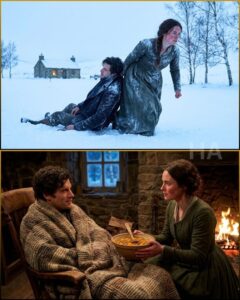
He looked away too late.
The next morning he left.
Nell handed him the blue scarf from the peg by the door, telling herself it was practical. He would need it in the cold. That was all. He accepted it without argument and wrapped it around his neck with the matter-of-fact obedience he had developed toward her practical orders.
At the door he paused, and she watched him choose between several things he might have said and discard all but one.
“Thank you, Nell.”
“Safe drive, Harrison.”
He walked up the road through the bright new snow with the blue scarf at his throat and was half-swallowed by mountain mist before he looked back. She raised a hand once. He did the same.
Then he was gone.
Nell thought that would be the end of it.
It took exactly one trip into town for the mountain to prove her wrong.
Three days later, at Miller’s Market, she was buying flour and dish soap when she heard Mrs. Peabody from the flower stall say, with the gleeful volume of a woman who considered privacy a personal insult, “And apparently the man nearly died on the ridge before some poor maid from up by Silver Pines dragged him into her cabin. Can you imagine? Harrison Winthrop himself.”
Nell turned too quickly. “Who?”
Mrs. Peabody blinked. “Harrison Winthrop. The Winthrops. New York. The old-money billionaires with the foundations and hotels and half the eastern seaboard. Bought Ashford House last year? Gorgeous, tragic man. Fiancée died. Hardly smiles. Makes women act like they’ve lost motor control.”
The soap almost slipped from Nell’s hand.
A billionaire.
Of course.
That explained the watch. The coat. The stillness that came from being looked at too much and known too little.
It also meant she had spent three days telling a man worth more than the county tax base that he sharpened a knife like an apology.
She paid for her things, walked home through air sharp as glass, and told herself she did not care.
She almost believed it until the knock came that afternoon.
A black SUV sat outside her gate like it had wandered into the wrong century. On her porch stood a man in a charcoal overcoat holding an envelope.
“Miss Archer?”
“Yes.”
He handed her the note with the kind of formality that made her feel briefly as if she had opened the door into a stage play.
Inside, the message was short.
I owe you thanks that cannot be outsourced through a driver or a gift basket. If you’re willing, I’d like to see you.
Harrison
No last name. No title. No attempt to turn himself into something larger than the man she had pulled out of the snow.
Nell went inside, found a pen, and wrote across the bottom.
You owe me nothing, but if you insist on being indebted, I drink coffee.
Nell
He came the next afternoon himself.
No driver. No security. Just Harrison, in a dark coat, snow on his boots, standing on her porch like a man who had spent all morning arguing with common sense and lost on purpose.
PART TWO
“You know who I am now,” he said once she had poured the coffee.
Nell sat across from him at her small table. “I do.”
“Does it change anything?”
She considered that seriously, and he seemed to appreciate that she did not rush to soothe him.
“It explains some things,” she said at last. “It doesn’t change the storm.”
He let out a breath. Not quite relief. More like gratitude for being spoken to plainly.
“That is a very simple way of looking at it.”
“I like simple when I can get it.”
He turned the mug between his hands. “I’d like to come back.”
“Why?”
He looked up.
The question was not flirtation. It was Nell in her cleanest form, all straight lines and no lace. He understood that.
“Because,” he said slowly, “I haven’t wanted to be anywhere in particular for a long time. Your cottage is starting to become an exception.”
It was too honest an answer to mock.
Nell should have said no.
She knew that. A woman with her history, her money, her place in the world, and her carefully buried past had no business making exceptions for a man like Harrison Winthrop. Men like him lived in skylines and boardrooms and the kind of grief that got written about in glossy magazines. Men like him did not belong in cottages where the roof complained in wind.
But wisdom and desire had been fighting each other for centuries. Desire was having a very good afternoon.
“You can come back,” she said.
He did.
Six times before February ended.
Always in daylight. Always properly enough that if the town gossiped, it had to work for the details. He came for coffee and stayed for two hours. Sometimes three. Sometimes he brought groceries from town and pretended not to notice she hated accepting help, so he would set them on the counter and begin discussing something else before she could object.
He told her about New York in pieces, never bragging, never performing. He had inherited the Winthrop empire at twenty-eight after his grandfather’s death. He ran a hospitality company, a foundation, and several historic properties because nobody else in his family had the patience for the operational side. Ashford House in Colorado was one of four homes he kept mostly because they were old and complicated and somehow his responsibility. He said responsibility the way some people said prison.
Then one evening, while the fire burned low and the snow tapped softly against the windows, he told her about Elena.
He did not say fiancée first.
He said her name.
That was how Nell knew she still lived somewhere inside him with all her weight.
“Elena Voss,” he said, staring at the steam rising from his mug. “We were supposed to get married in October three years ago. She got sick in September. Everyone thought it was a stubborn flu until it wasn’t.”
Nell waited.
“Sepsis,” he said. “By the time they caught it, she was in organ failure.”
His voice did not crack. That would have been easier to witness. It stayed level, which was worse.
“I keep thinking there was a version of that month where I saw it sooner. Canceled something. Insisted harder. Stayed closer. Done one useful thing before the catastrophe instead of after.”
Nell looked at him for a long moment.
“That’s not how illness works.”
“No,” he said. “It isn’t.”
“But that’s how guilt works.”
His mouth tightened. “Yes.”
The silence that followed was not empty. It had weight. It held two people who knew different versions of surviving by becoming useful.
Nell told him a little more about herself after that.
Her mother, Catherine, had been a seamstress and part-time cleaner in Mason Creek, a mining town twelve miles east. Catherine had died when Nell was twenty. Agnes Doyle had taken her in afterward, then left her the cottage. Since then Nell had cleaned rooms at Silver Pines, sold handmade soaps in town, patched coats, canned peaches, and made a life held together by competence and refusal.
She did not tell him who her father was.
She did not tell him that her mother had whispered the truth from a hospital bed while rain hit the window in hard September sheets.
Edward Archer, she had said. He owned the mountain once. He owned a lot of things. Just not us.
Nell had learned then that the surname Catherine had given her was not quite her father’s name and not quite her mother’s. Archer had been chosen like a thrown stone. Close enough to wound. Different enough to deny him the satisfaction of precision.
Those were the truths Nell kept.
Everything else, she found herself giving freely.
By mid-February Harrison knew what brand of coffee she bought when she had a good month, knew she hated lilies because hospitals smelled like them, knew she wore wool socks to bed even when she denied it, knew the small line that appeared between her brows when she was thinking something through all the way to its bitter edge.
Nell learned he liked silence more than music when he was tired. Learned he read biographies the way other men watched sports. Learned that he had not really laughed in years until she asked whether billionaires got special training in looking exhausted in expensive coats.
One night he reached out and tucked a loose strand of hair behind her ear.
It was barely a touch.
Nell still felt it like a struck match.
“Harrison,” she said, because that was all she trusted herself to say.
His hand fell at once. Not offended. Careful.
“I know,” he said.
And the thing that nearly undid her was that he did know. He knew there were doors inside her that did not open because somebody leaned.
In early March he came to the cottage carrying a tension that made the air around him feel sharpened.
“What happened?” Nell asked before he sat down.
“I have to go back to New York by the end of the month.” He took a breath. “Fundraising season. Board meetings. Half a dozen obligations I’ve already postponed.”
She said nothing.
He looked down at his hands, then back at her. “I don’t want to leave this as it is.”
“How is it?”
“Unfinished.”
The word hung there, simple and dangerous.
He leaned forward. “My aunt, Margaret Finch, runs a literacy initiative in Manhattan. She needs an assistant for the spring. Someone smart enough to manage her calendar, stubborn enough to survive her, and unimpressed enough not to treat my name like weather. I thought of you.”
Nell stared.
“You’re asking me to move to New York.”
“For a season,” he said quickly. “Legitimately. With work. With her, not with me. I’m trying to give this whatever honest chance it deserves.”
Nell’s throat tightened for reasons she disliked.
“You’re talking like there’s a ‘this.’”
His gaze held hers. “There is.”
She should have told him then.
About Edward Archer. About why she had lived three miles from Ashford House for four years and never once gone near it. About how New York society would tear through a woman like her with knives hidden in gloves if it smelled weakness and scandal in the same room.
She should have told him.
Instead she said, “Give me a week.”
She said yes after three days.
The day before they were meant to leave for New York, Harrison sent a message asking if she would come see Ashford House before the season began. The request sat in her chest like a stone.
Still, she went.
Ashford House rose from the Colorado landscape in pale gray stone and long glass, a historic mansion renovated into modern splendor without losing the older bones underneath. It was beautiful in the way great wealth always was when it had time and taste on its side. Nell hated it on sight for the same reason she could not stop looking at it.
Harrison met her at the door himself.
He walked her through rooms full of art, restored woodwork, and quiet money. He showed her the library, the west terrace, the ballroom converted into an event space. Nell listened, nodded, and kept her breathing even.
She was doing very well until the gallery.
The portrait hung at the far end, tall and smug and impossible to ignore.
Edward Archer, oil on canvas, around fifty. Silver hair. Heavy jaw. The look of a man who had spent his whole life believing consequences were for other people. He had her nose. Or rather, she had his. The same stubborn line through the mouth. The same high cheekbones her mother used to look at with something that was not quite anger and not quite pity.
Nell stopped walking.
Everything inside her went very still.
Beside her, Harrison fell silent.
He did not crowd her. He did not speak too soon. He simply stayed there, close enough to steady her if she tipped and respectful enough not to touch.
After a long moment, she said, “He was my father.”
The words sounded calmer than the pulse beating in her throat.
Harrison did not flinch.
“He never claimed us,” she went on. “My mother worked for one of his properties when she was young. He promised things. Men like that always do. Then he left her with a child and a story and the kind of money that vanishes as soon as rent is due.”
She looked at the portrait again.
“I knew his name for years. Never his face.”
When she finally turned, Harrison was watching her with a look so clear it made something in her chest ache.
“I see,” he said.
She gave a hard laugh. “That’s all?”
“No.”
He stepped closer. “I’m also thinking that you walked into this house anyway. And that Edward Archer was almost certainly worse than this painting has the decency to admit.”
A strange, breathless lightness moved through her.
“You’re not reconsidering?”
“Nell,” he said, and his voice changed, deepening into something more stripped of armor than she had ever heard from him, “I am not reconsidering a single thing.”
Later, when they stood in the doorway with March sunlight slanting over the stone steps, he said something else.
“There’s one thing I didn’t tell you.”
Her stomach tightened.
“When I first came to Ashford House in January, I found a box of old papers behind a false panel in the study. Letters. Records. Most of them were financial. A few weren’t.” He held her gaze. “Edward Archer had arranged a private trust years ago for a woman in Mason Creek named Catherine. The payments stopped abruptly after his lawyer died. There was enough in those papers to make me think someone had buried more than bad bookkeeping.”
Nell stared at him.
“You were looking into my mother before you ever met me.”
“I was looking into a wrong,” he said quietly. “I didn’t know you were part of it. The morning of the storm, I was trying to reach a retired groundskeeper in Lower Ashford who might have known where the records ended. I never made it. Then I woke up in your cottage and you handed me water and told me not to be an idiot.”
Nell almost laughed. The timing of the world could be monstrous and absurd in equal measure.
“You should have told me.”
“I wanted certainty before I put another man’s damage in your hands.”
That should have angered her.
Instead, against all better judgment, it moved her.
PART THREE
New York in April was all polished stone, black cars, glass towers, and old names wrapped in new money.
Margaret Finch lived on the Upper East Side in a townhouse that managed to be grand without being cold. She was sixty-five, sharp-eyed, silver-haired, and so gloriously unimpressed by everyone that Nell liked her within six minutes.
“So,” Margaret said over dinner on Nell’s first night, pointing her fork with cheerful menace, “you’re the mountain woman who thawed my nephew out and apparently brought his personality back with circulation.”
Nell almost choked on her water.
Across the table Harrison looked briefly human enough to blush.
Margaret continued, “Excellent. He has been unbearable for years.”
“I can still hear you, Aunt Margaret.”
“Then absorb the feedback.”
That was the beginning of peace.
Nell worked for Margaret by day, handling schedules, donor lists, meeting briefs, and event logistics for the Finch Literacy Initiative. She was good at it, maddeningly so. Systems made sense to her. So did people once you listened longer than they expected. Within two weeks Margaret had stopped pretending Nell was temporary.
Harrison came by the townhouse on Tuesdays and Thursdays under the transparent excuse of discussing the foundation. Sometimes they walked through Central Park afterward. Sometimes they stood at opposite ends of glittering rooms full of old money and looked at each other as if they shared a private language no one else had learned.
That was what frightened Nell.
Not his wealth. Not the city. Not even the scrutiny.
It was the feeling growing between them in plain sight.
At the first major gala of the season, Nell wore deep green silk and borrowed diamonds so understated they probably cost the same as a house. She had prepared for the event the way she prepared for a difficult winter, by studying the terrain. She smiled when appropriate. Listened more than she spoke. Memorized names. Refused to apologize for not being born inside those walls.
At eleven o’clock Harrison found her by a window overlooking the garden.
“How bad is it?” he asked quietly.
“The room smells like expensive flowers and strategic marriages.”
He smiled. “That bad?”
“Worse. I think a woman near the bar just complimented me and threatened me in the same sentence.”
“Which woman?”
Nell tilted her glass very slightly toward a blonde in white silk across the ballroom. She was beautiful in the curated, weaponized way some women were, every gesture polished to suggest softness while hiding steel.
“Her.”
Harrison’s expression cooled by a degree. “Cecilia Vane.”
“Should I know that name?”
“You should avoid it.”
That, of course, guaranteed Nell would meet her within forty-eight hours.
Cecilia greeted her at a luncheon in Tribeca with warm interest so smooth it felt lacquered.
“Miss Archer,” she said, taking Nell’s hand. “I’ve heard so much about you. The woman who saved Harrison Winthrop in a blizzard. How cinematic.”
“He was cold,” Nell said. “I had blankets.”
Cecilia’s smile sharpened invisibly. “And where is your family from?”
“Mason Creek.”
“Your father?”
“Not present.”
“How extraordinary.”
Nell met her eyes. “Less extraordinary than you’d think.”
The conversation remained perfectly pleasant and entirely hostile.
On the ride home Margaret said, “She’s been circling Harrison for two years.”
“I noticed.”
“She is patient, connected, and never attacks directly if she can make the room do it for her.”
Nell looked out at the city sliding past the window. “Let her try.”
That confidence lasted exactly three weeks.
The rumors began as questions. Had anyone actually looked into Miss Archer? Wasn’t it curious that her surname matched the Archer family once tied to Ashford House? Wasn’t it awfully convenient that a maid in a mountain cottage just happened to rescue Harrison during a storm? Such a story. So romantic. So improbable.
It was beautifully done. No single statement solid enough to seize. Just a series of polite little fires.
Nell noticed the changes first in the pauses. The half-second before a greeting. The way a conversation shifted when she approached. The thin layer of social frost that formed when people wanted to appear civilized while deciding whether you were fit to touch their silver.
She gave herself two evenings to feel the sting in private.
Then she told Harrison.
He went still in the way she had learned meant fury, not calm.
“I can shut this down,” he said.
“How?”
“Names. Calls. Lawyers. Public statements.”
“That would feed it.”
He hated that she was right.
Margaret, however, looked almost amused.
“My dear,” she said to Nell the next morning over coffee, “there are two ways to win in society. You either outrank the room or outlast it. Since the second is more interesting, let’s do that.”
“What exactly does that mean?”
“It means,” Margaret said serenely, “I have spent forty years collecting information on people who mistake breeding for immunity. Let me see what Cecilia has been touching.”
What Cecilia had been touching, as it turned out, was rot.
The rot arrived at the Winthrop Foundation’s spring benefit in June.
The event was held in the grand atrium of a museum on Fifth Avenue under a ceiling of glass and light. Donors, trustees, politicians, editors, and old family friends filled the room in sleek black and jewel tones. Nell stood near the main staircase in silver-blue silk, one hand tight around a champagne flute she had no intention of drinking, and told herself the strange tension in the room might be her imagination.
Then Cecilia stepped onto the small stage beside the auction display.
“I wonder,” she said brightly into the microphone, “before we begin, whether Mr. Winthrop would care to clarify a story for the rest of us.”
The room changed.
Conversation dropped in a visible ripple.
Harrison turned before the words had fully landed. Nell saw the precise moment he understood this had been planned.
Cecilia held a folded document between two fingers.
“There has been such charming confusion about Miss Archer,” she continued. “And because transparency matters so much in philanthropic circles, I thought perhaps people ought to know that Miss Archer is not merely a maid with a dramatic rescue story. She is Edward Archer’s illegitimate daughter, and according to this letter, there were financial arrangements once meant for her mother that mysteriously vanished. Which raises such uncomfortable questions about motive, timing, and how one exactly ends up rescuing a billionaire at the perfect moment.”
For one terrible second the room went soundless.
It was the kind of silence that had appetite.
Cecilia turned slightly toward Nell, almost pitying. “Did you really think no one would notice, dear?”
A hot, old shame moved through Nell so suddenly she nearly mistook it for fear.
Then something stranger happened.
It passed.
Perhaps because she was tired. Perhaps because humiliation lost some of its magic once it was dragged into light. Perhaps because she had lived too long under consequences that were never hers to begin with.
She set down her glass.
Then she walked toward the stage.
People moved aside without meaning to.
Cecilia’s expression flickered. That was the first crack.
Nell took the microphone from her with a calm that seemed to alarm half the room.
“Yes,” she said. “Edward Archer was my father.”
The words rang cleanly through the atrium.
“He lied to my mother. Left her. Paid other people to make the problem disappear. I found out who he was when my mother was dying. I never asked him for money. I never met him. I never came to New York to claim a dead man’s guilt as inheritance.”
No one moved.
No one even coughed.
Nell looked directly at Cecilia.
“As for motive, I found Harrison Winthrop half-dead in a blizzard because he got lost on Black Ash Ridge. I dragged him into my cottage because I am not the sort of woman who leaves a man to freeze just because his shoes cost more than my rent.”
A laugh broke somewhere to the left, startled and quickly suppressed.
Cecilia recovered enough to say, “And the letter?”
This time Harrison moved.
He came up beside Nell, not to take the microphone from her, but to stand there in full view of everyone, shoulder to shoulder, making his position unmistakable before he spoke a word.
“The letter,” he said, voice cold as cut glass, “is one page from a file I’ve been investigating since January.”
Cecilia’s face changed.
There it was. The second crack.
Harrison went on. “Edward Archer created a private trust for Catherine Hale and her daughter years ago. The attorney handling it siphoned the money, buried the records, and kept the payments from ever reaching them. My office recovered the documents two months ago. We also recovered evidence that Miss Archer had no knowledge of those records before I told her.”
Murmurs spread through the room like sparks.
Cecilia turned toward him, stunned. “You knew?”
“Yes.”
“How long?”
“Long enough to recognize extortion disguised as etiquette.”
Margaret Finch rose from her table near the front with the majestic calm of a queen attending a messy beheading.
“For those of you who enjoy complete stories rather than fragments,” she said crisply, “the recovered assets have been transferred this afternoon into a new endowment in Catherine Hale’s name. Miss Archer declined to take them personally. Instead, she requested that the funds be used for housing and emergency support for working women in mountain communities across Colorado.”
Now the room really moved.
Shock, admiration, discomfort, curiosity. It passed from face to face like weather.
Nell had not planned to speak again, but something in her rose.
She took the microphone once more.
“My mother spent her life being made smaller by a man who never had to answer for it,” she said. “I won’t build mine by becoming smaller in return. I’m not interested in buying my dignity from a grave. But I am interested in making sure other women don’t get stranded where she was.”
When she finished, the silence held for one suspended heartbeat.
Then someone started clapping.
A trustee. Then Margaret. Then a woman from the arts council. Then half the room.
Cecilia stood very still at the edge of the stage, publicly elegant and privately wrecked.
Nell looked at her one last time and saw the real injury at last.
It was not that her scheme had failed.
It was that she had misjudged her target.
Later, after the benefit had stumbled back into motion without ever fully recovering its old tone, Harrison found Nell alone on a side terrace overlooking the city.
The June air was warm. Traffic glowed below like a restless river.
“You should be furious,” she said without turning.
“I am.”
“At me?”
That made him step closer. “For what?”
“For not telling you she’d gone that far. For thinking I could manage it alone. For standing there in front of three hundred people and turning your foundation gala into a public execution.”
“Nell.”
There was a quiet force in the way he said her name that made her finally look at him.
He had loosened his tie. His composure was intact only in the technical sense. His eyes were too bright. Too open.
“I have spent years,” he said, “surrounded by people who mistake polish for strength. Tonight you were more honest in two minutes than most of this city manages in a decade.”
Something in her throat tightened.
He took one step closer. “Also, for the record, I was already half in love with you in Colorado. Tonight was simply inconveniently persuasive.”
That pulled a laugh out of her, small and helpless and real.
He looked at her as if the sound changed the shape of the air.
“I’m serious,” he said.
“I know.”
“No, Nell. I mean it in the full catastrophic sense.”
The city noise below seemed to fall away.
He reached up and touched her face with a tenderness so careful it hurt.
“I love you,” he said. “I loved you before New York and before tonight and probably from the moment you stood over me in that cottage and talked to me like a badly behaved weather event. I kept thinking I needed the right time, the right calm, the right version of our lives. There isn’t one. There’s just this.”
Nell looked at him for a long moment. At the man who had come to a mountain chasing a buried injustice, frozen nearly to death before he could reach it, then somehow become the one place in the world she no longer had to perform competence as a shield.
“I spent years making a religion out of not needing anyone,” she said quietly. “It felt safe. It also felt lonely enough to sand the bones down.”
His thumb brushed her cheek.
“You don’t have to answer tonight.”
She smiled then, soft and almost aching. “That’s good, because I’m about to answer now.”
He let out a breath that might have been a laugh.
“I love you too,” she said. “Which is rude of me, honestly. I had a whole plan.”
“What was the plan?”
“To remain difficult.”
“How’s that going?”
“Poorly.”
He kissed her there on the terrace above Fifth Avenue with summer heat rising off the city and all of Manhattan glittering like a witness.
It was not a careful kiss.
It was the kind people arrive at only after fear has already lost.
He proposed two weeks later at sunrise in Central Park, standing beside the reservoir while the city was still stretching awake. No photographers. No orchestra. No choreographed surprise. Just Harrison, nervous for the first time she had ever seen, saying with quiet certainty that he knew exactly what kind of world came attached to his name and that he was asking anyway, because every version of the future without her in it now felt misbuilt.
Nell said yes before he finished the second sentence.
The engagement hit the papers by afternoon.
The response was exactly what one might expect from America when handed a love story involving a billionaire heir, a maid from the mountains, a public scandal, and a moral humiliation of the upper class. Half the country called it a fairy tale. The other half called it suspicious. Both halves clicked.
Nell discovered very quickly that scrutiny got boring when it repeated itself.
By September, most of the resistance had burned itself out from lack of oxygen. Harrison never hid her, never softened her edges for company, never introduced her with apology in his tone. Margaret hosted a dinner and seated Nell on her right, which in that world was less etiquette than declaration. The rest of society, which liked certainty more than principle, adjusted.
They were married in October at the little white church in Lower Ashford, ten minutes from the mountain road where Nell had first found him.
That had been her only real demand.
If she was going to marry into wealth grand enough to have its own weather system, then she wanted the people who had known her before all of it to see her do it. She wanted Mrs. Peabody crying in the third pew. She wanted the women from Silver Pines there in borrowed heels. She wanted the town that had watched her carry her own life one practical choice at a time to witness that she was not disappearing into someone else’s story.
The church held eighty people.
One hundred and twelve came anyway.
Harrison, who had faced hostile boards, takeover battles, and Congressional hearings with less visible strain, was unmistakably nervous in the vestibule before the ceremony.
Nell looked at him and said, “You’re standing so still I can hear the panic.”
He laughed, brief and startled.
By the time the doors opened, the panic was gone.
Years later Nell would remember the wedding not as a sequence of vows but as moments. Harrison’s hand tightening around hers when she reached the altar. Sunlight through stained glass. Margaret dabbing at her eyes and denying it was happening. The exact look on Harrison’s face when she said I do, stripped of every layer of practiced calm, nothing guarded left in him at all.
The face of a man who had decided, finally, not to refuse happiness just because grief had once found him first.
She loved him for all of it.
The Catherine Hale Fund launched the following spring.
Nell built it with Margaret and ran it with the same blunt intelligence she brought to everything else. Housing grants. Emergency cash assistance. Job training partnerships with lodges, clinics, libraries, and community colleges across western Colorado. She said yes to practical things and no to ornamental ones. Reporters learned quickly that if they asked her whether she felt vindicated, she would ask whether they had read the budget.
The world, surprisingly, did not end because a maid married a billionaire.
It simply rearranged.
Ashford House became one home among several, but Nell kept the mountain cottage restored and livable, not transformed. She went there when she needed quiet, or memory, or the clean honesty of the life she had built before the Winthrops and galas and headlines. Harrison came with her often enough that the cottage learned him too. He sat at the little table where he had once sharpened a knife badly, drank coffee, and looked around with the private, settled expression he wore only when he was entirely content.
In the third year of their marriage, on an October afternoon the color of copper and old honey, Nell rode up to the cottage alone for an hour of silence.
Their daughter, Maggie Catherine Winthrop, was eleven months old and tyrannical about naps. Harrison had stayed back at Ashford House with the baby and a nanny, insisting Nell take the afternoon.
The cottage was cool when she unlocked it. It smelled faintly of pine resin and old stone. She lit the fire herself because she still preferred to. Then she turned toward the peg by the door and stopped.
The blue scarf was hanging there.
Folded neatly. Returned without note.
For a moment she only stared.
She crossed the room slowly and touched the wool with both hands. Smoke and winter still lived somewhere deep in the fibers. This was the scarf she had wrapped around herself while waiting to see if a stranger would live. The scarf she had sent back into the storm around his throat. The scarf that had disappeared into the machinery of the next three years.
“Harrison,” she said aloud to the empty room, half laughing.
Hoofbeats sounded on the road outside less than a minute later.
Of course.
She opened the door before he reached the gate.
He came through it carrying the baby, who was pink-cheeked, drowsy, and deeply offended by the existence of hats. Harrison looked from Nell to the scarf in her hand and gave her the expression of a man caught in an act of tenderness he had hoped to file quietly away.
“You found it,” he said.
“When?”
“Last fall.” He shifted Maggie higher on his hip. “I brought it back and forgot to mention it.”
“No,” Nell said. “You brought it back and chose not to mention it.”
He smiled without denying it.
“You lent it to a stranger,” he said. “It seemed like something that ought to come home.”
Nell looked at him then. Properly looked.
At the man she had dragged out of the snow. At the billionaire who had turned out to be less interested in being adored than understood. At the husband who paid attention to what mattered and returned things without ceremony. At the father holding their daughter with one large hand braced under her small socked foot as if the whole world had narrowed into exactly where to support her.
Beyond him the mountain stood dark against the October sky. Behind her the fire had begun to catch. In the next room lay the life she had chosen at considerable cost and been paid back for in abundance she had once thought belonged only to other women.
Not because her blood entitled her to it.
Not because Harrison’s name rescued her.
But because she had walked into truth, again and again, and built from there.
She held out the scarf.
“Keep it,” she said. “You nearly died in it. Seems like it belongs to you now.”
He took it, wrapped it around his neck with the same obedient practicality he had worn the first time, and looked at her over Maggie’s soft blond head.
“Once,” he said. “And I had help.”
Nell stepped aside to let them in.
“Extraordinary help,” he added.
“Better,” she said.
He came through the door. The baby immediately reached for the scarf fringe. Harrison laughed. Nell shut out the cold behind them, and the cottage, small and warm and honest, gathered the three of them inside it like a held breath finally released.
The mountain remained where it had always been.
So did the road.
But now, at last, home meant more than one place. It meant the fire, the child, the returned scarf, the man who had once arrived half-frozen and unnamed, and the life that had grown from that impossible morning into something larger and kinder than either of them had known how to ask for.
Exactly enough.
THE END