The room fell silent before I even realized why.
Not because of anything I had said.
Because my phone vibrated across the conference table.
I almost ignored it.
No one interrupted a planning meeting at Fort Bragg unless it mattered.
The screen showed an unknown North Carolina number.
Then a preview video loaded.
Twelve seconds.
I pressed play.
The image shook as if someone had hidden a phone beneath a napkin.
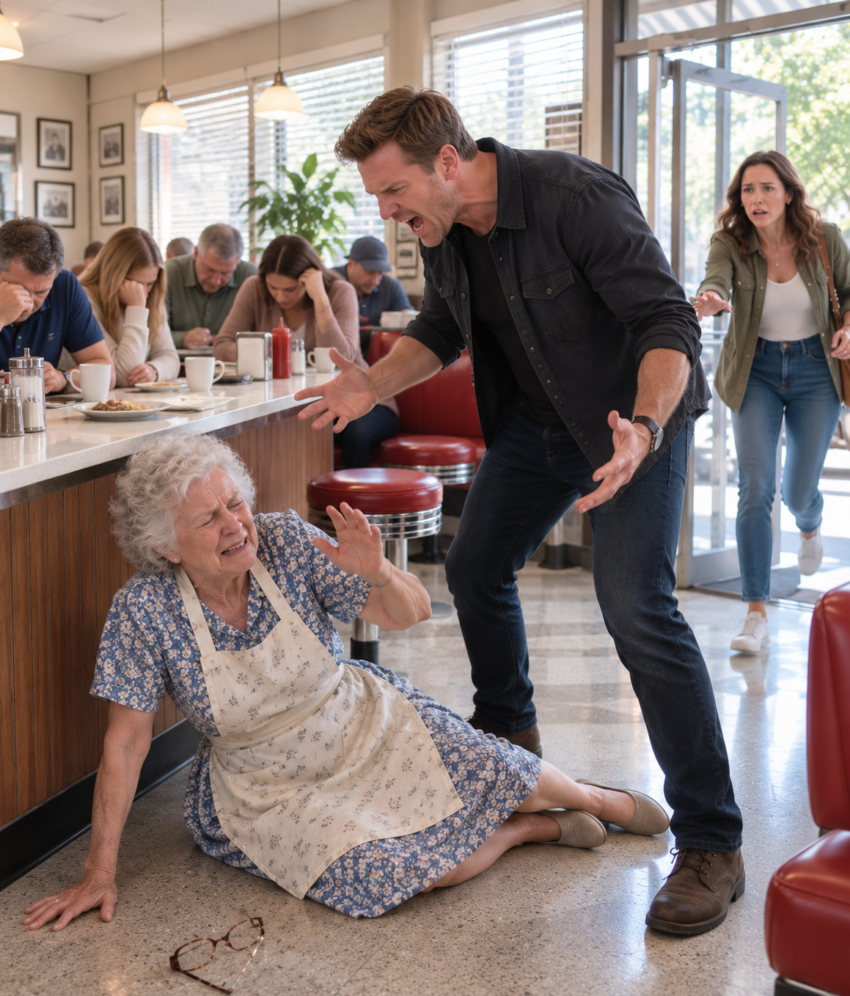
My mother stood behind the counter at Turner’s Family Diner wearing the faded blue apron she’d owned for longer than I could remember.
A man pointed toward her.
She folded her arms.
Even without sound, I knew what she had said.
No.
The man raised his hand.
He slapped her hard enough that she stumbled sideways into the coffee station before collapsing onto the tile floor.
The video ended.
Twelve seconds.
That was all.
I stared at the frozen frame of my mother’s apron crumpled beneath her.
Someone across the table said my name.
“Colonel?”
I looked up.
“Lieutenant Colonel,” another officer corrected automatically.
I hadn’t heard either of them.
I stood.
“Major Ellis, you’ll finish the briefing.”
He looked at my face only once.
“Go.”
No questions.
No speeches.
Just one soldier recognizing another had somewhere more important to be.
The Flight Home Felt Longer Than Any Deployment
I called my mother before I reached the parking lot.
Straight to voicemail.
Again.
Voicemail.
I tried the diner.
No answer.
Then the unknown number called back.
I answered before the first ring finished.
“Who sent that video?”
The voice belonged to a young woman.
Quiet.
Nervous.
“I work at the diner.”
“What’s your name?”
She hesitated.
“Emily.”
“Is my mother alive?”
Silence.
Then—
“Yes.”
Only after hearing that single word did I realize I’d been holding my breath.
“Is she in the hospital?”
“She wouldn’t go.”
That sounded exactly like my mother.
At seventy-five, Evelyn Turner believed ice packs solved almost everything.
“Who hit her?”
Another pause.
Then one sentence.
“Travis Cain.”
The name meant nothing to me.
Not yet.
“Why?”
“Because she wouldn’t sell.”
The line went quiet again.
I slowed beside my truck.
“Sell what?”
“The diner.”
I looked across the parking lot without seeing it.
Turner’s Family Diner wasn’t just a business.
It had been my grandparents’ diner.
My parents kept it alive through recessions, hurricanes, and one devastating kitchen fire when I was twelve.
My father used to joke that the building had survived everything except fashionable wallpaper.
My mother had refused every offer to sell after he died.
She always gave the same answer.
“Your father’s still here.”
She never meant his ashes.
She meant every chair he’d repaired.
Every photograph he hung.
Every coffee mug he’d chipped before refusing to throw it away.
I booked the first commercial flight I could find.
The diner looked smaller than I remembered.
The parking lot wasn’t.
Three pickup trucks sat outside.
Customers were eating as if nothing unusual had happened there less than twenty-four hours earlier.
I pushed open the front door.
The bell above it still made the same soft chime from my childhood.
My mother looked up from behind the register.
A purple bruise darkened one side of her face.
She smiled anyway.
“Nicole.”
I crossed the room before she finished saying my name.
She tried to hug me.
Instead I gently turned her face toward the window.
The bruise reached almost to her jaw.
“You should’ve gone to the hospital.”
“I’m all right.”
“Mom.”
“I’ve had worse.”
I looked around the diner.
People lowered their eyes into their coffee.
Nobody smiled.
Nobody waved.
A man at the counter suddenly became fascinated by his pancakes.
Another woman folded her receipt three different times without looking at us.
Something wasn’t right.
Not just the bruise.
The room.
The silence.
I rested one hand on the old cash register.
“Tell me exactly what happened.”
She wiped the counter with slow circles.
Buying time.
Finally she said,
“He came in after lunch.”
“Who?”
“Travis Cain.”
She nodded toward the front window.
“He said his family wanted this property.”
“And?”
“I said no.”
Nothing else.
I waited.
She kept wiping the same clean spot.
“Mom.”
She sighed.
“Then he hit me.”
Just like that.
No dramatic pause.
No tears.
Just six words.
I looked toward the coffee station.
One ceramic mug had been replaced by a newer one that didn’t match the rest.
Someone had cleaned everything.
Too well.
“Did anyone call the police?”
She nodded.
“Someone did.”
“What happened?”
Her smile disappeared.
“They said I slipped.”
I stared at her.
“Excuse me?”
“The sheriff said there wasn’t enough evidence to prove otherwise.”
I looked around the room again.
Every customer suddenly seemed very interested in finishing breakfast.
Nobody met my eyes.
One elderly couple quietly paid and left without saying goodbye.
The sheriff arrived before I finished my coffee.
Apparently someone had already called him.
He walked inside smiling.
Confident.
Comfortable.
Like this diner belonged to him.
“Mrs. Turner.”
Then he noticed me.
“You must be the daughter.”
I stood.
“Lieutenant Colonel Nicole Turner.”
He extended his hand.
I didn’t take it.
He let it fall naturally, almost practiced.
“I’m Sheriff Dale Mercer.”
“I’d like to see the incident report.”
“Of course.”
He sounded almost cheerful.
“Simple accident.”
I looked directly at him.
“My mother didn’t fall.”
He shrugged lightly.
“That’s not what we were able to determine.”
“There were witnesses.”
“Nobody saw an assault.”
“There are security cameras.”
Another polite smile.
“Unfortunately the system stopped recording earlier that afternoon.”
Everything had an answer.
Prepared.
Convenient.
Too convenient.
I picked up my mother’s chipped coffee mug.
The handle had been glued years ago after Dad dropped it.
He never replaced it because he claimed repaired things lasted longer.
I ran my thumb over the crack.
Then I asked the sheriff one more question.
“Who owns the building next door?”
For the first time since he arrived…
…his smile faded.
The Sheriff Already Had Every Answer
His smile disappeared for less than a second.
Then it came back.
“An empty storage building.”
“Who owns it?”
“Why does that matter?”
“Because if its cameras face this parking lot, they may have recorded what happened.”
He slipped both hands into his pockets.
“There aren’t any cameras.”
I held his gaze.
“You answered that pretty quickly.”
He chuckled.
“Small town. I know every property around here.”
“Good. Then you’ll know exactly where I should start looking.”
For the first time, he didn’t answer immediately.
Instead, he looked toward my mother.
“Mrs. Turner, if your daughter plans to stir people up, she’s going to make this harder on everyone.”
My mother quietly placed a fresh cup of coffee in front of him.
“Coffee’s free today, Sheriff.”
He reached for the mug.
She picked it back up before he could touch it.
“Actually…”
She poured the coffee into the sink.
“…not today.”
The diner became so quiet I could hear the refrigerator compressor humming in the kitchen.
Sheriff Mercer smiled again, but this time it didn’t reach his eyes.
“Have a good afternoon.”
He tipped his hat and walked out.
Only after the patrol car disappeared did anyone inside the diner start talking again.
Not to us.
To each other.
Quietly.
As though nothing had happened.
When lunch ended, I locked the front door.
Mom began wiping tables.
She always cleaned when she didn’t want to talk.
I recognized the routine from childhood.
If she scrubbed the same table three times, something was bothering her.
Today she had already cleaned booth number four twice.
I took the towel from her hand.
“Sit down.”
“Nicole—”
“Sit.”
She did.
Her blue apron still carried a faint brown coffee stain near the pocket.
I remembered spilling that coffee almost fifteen years earlier.
Dad had laughed and told her the stain wasn’t worth fighting.
She’d never replaced the apron.
I sat across from her.
“Who is Travis Cain?”
She looked toward the front windows before answering.
“Wade Cain’s son.”
“Who’s Wade?”
She frowned.
“You really haven’t heard the name?”
I shook my head.
The Army had taken me around the world.
I came home for holidays, funerals, birthdays when I could.
I knew people.
I didn’t know local politics anymore.
Mom folded the dish towel carefully.
“Wade owns Cain Development.”
Still nothing.
“They’ve been buying land around the county for years.”
“Buying?”
She gave me a tired smile.
“Sometimes.”
That single word told me there was more.
“Mom.”
She nodded toward the window.
Across the street stood a row of old brick storefronts.
Half were empty.
The others displayed shiny new signs.
A wine bar.
A boutique hotel office.
An upscale bakery.
None of them had existed five years ago.
“Those buildings belonged to local families.”
“And now?”
“Cain Development.”
One Name Kept Appearing
That afternoon I walked downtown.
Not because I expected someone to talk.
Because I wanted to see.
The old hardware store where Dad used to buy nails had become a luxury furniture showroom.
The family pharmacy was gone.
So was the bookstore.
Even Miller’s Barber Shop had disappeared.
Everything looked newer.
Cleaner.
More expensive.
It also felt strangely empty.
A man sweeping the sidewalk watched me for a moment.
Then looked away.
An elderly woman watering flowers paused when I smiled.
She quickly went back inside.
It wasn’t fear of me.
It was fear of being seen speaking to me.
I stopped outside the old courthouse.
A bronze historical marker stood beside the entrance.
The town proudly celebrated its past.
Yet almost every business across the street had changed owners within a few years.
That wasn’t impossible.
It just wasn’t normal.
I walked into the county recorder’s office.
A young clerk smiled politely.
“Can I help you?”
“I’d like to look up property transfers for Main Street over the last ten years.”
She began typing.
Then stopped.
Her expression changed.
She glanced toward the office behind her.
A middle-aged supervisor stepped out.
“Can I help you instead?”
I repeated my request.
He smiled.
Too politely.
“Those records are temporarily unavailable.”
“Unavailable?”
“Our system is being updated.”“Paper copies?”
“Archived.”
“Can I request them?”
Another smile.
“Not today.”
I thanked him and left.
People who had nothing to hide rarely found three different ways to say no.
Outside, my phone buzzed.
Unknown number.
Again.
I answered immediately.
No one spoke.
I heard traffic.
Then a whisper.
“Don’t go back to the recorder’s office.”
A woman.
Not Emily.
“Who is this?”
“They’ll know you’re asking questions now.”
“Who will?”
Silence.
Then—
“Meet me behind the diner after closing.”
The call ended.
No name.
No explanation.
Just a click.
I looked at the screen.
Blocked number.
Someone wanted to help.
Someone was afraid to be seen doing it.
For the first time since landing in North Carolina, I felt certain about one thing.
The twelve-second video wasn’t the story.
It was only the part someone had managed to save.
The Video Was Never Twelve Seconds Long
That night, I waited behind the diner exactly where the caller had instructed.
A small sedan pulled into the alley with its headlights off.
Emily stepped out first.
Another man climbed out of the passenger seat. He looked close to seventy, wearing an old tweed jacket despite the summer heat.
“Lieutenant Colonel Turner?”
“Nicole is fine.”
He nodded.
“I’m Harold Weiss. I handled legal work for your parents years ago.”
Emily held out a flash drive.
Her hand was shaking.
“The owner told everyone the security system failed.”
She swallowed.
“It didn’t.”
I looked at the drive.
“What is this?”
“The original recording.”
Back inside the diner, I plugged it into my laptop.
The twelve-second clip I’d received was only the beginning.
The full recording lasted almost four minutes.
It showed Travis Cain demanding that my mother sign a purchase agreement.
My mother calmly pushed the papers back across the table.
“I’ve already said no.”
Travis smiled as though she were wasting his afternoon.
“Everybody sells eventually.”
“Not this place.”
He leaned closer.
“You’re seventy-five. How much longer do you think you’ll keep serving coffee?”
My mother folded the contract once and handed it back.
“Long enough to tell you no again.”
The slap came seconds later.
It echoed through the dining room.
Several customers stood up.
No one intervened.
Then came the part missing from my clip.
Travis pointed toward the security camera.
A man wearing a maintenance uniform climbed onto a chair and disconnected it.
Another employee hurried frightened customers toward the exit before police even arrived.
I paused the video.
Nobody spoke.
Finally I looked at Harold.
“How long have you had this?”
“Since that afternoon.”
“Why didn’t you take it to the sheriff?”
He gave a tired smile.
“Because Sheriff Mercer already knew exactly what happened.”
Harold opened an old leather briefcase and removed a worn manila folder.
My father’s handwriting covered the front.
Seeing it stopped me cold.
Dad had been gone for nearly eight years.
I recognized every letter.
Harold slid the folder across the table.
“Your father asked me to keep this if anything ever happened to him.”
Inside were property maps, handwritten notes, newspaper clippings, and one small digital recorder.
Nothing complicated.
Just one clear pattern.
Every family that had refused to sell land to Wade Cain eventually faced inspections, code violations, lawsuits, or sudden financial pressure.
Some finally sold.
Others left town.
Dad had circled one sentence in red ink.
“People don’t leave because they want to. They leave because someone makes staying impossible.”
Harold quietly folded his hands.
“Your father believed someone inside local government was helping Cain Development.”
“Did he prove it?”
He slowly shook his head.
“A week later, he died in what police called a traffic accident.”
No dramatic speech followed.
None was needed.
I looked down at Dad’s recorder.
For years, I’d accepted the official report because Mom had accepted it.
Now I wasn’t sure either of us truly had.
One Phone Call Changed Everything
The next morning, I didn’t go to the sheriff’s office.
I didn’t confront Travis Cain.
I didn’t call the mayor.
I contacted the FBI field office in Charlotte.
Within hours, two agents met Harold and me at the diner.
I handed them exactly three things.
The complete surveillance video.
My father’s folder.
The recorder.
Nothing more.
One agent looked at me.
“Lieutenant Colonel Turner, are you willing to provide a statement?”
“Absolutely.”
After that, the investigation no longer belonged to me.
For the first time since stepping off the plane, I felt something lift from my shoulders.
Justice wasn’t about who shouted the loudest.
It was about putting evidence into the right hands.
Three weeks later, black SUVs rolled into town before sunrise.
Federal agents entered Cain Development’s headquarters.
Others walked into the sheriff’s office carrying search warrants.
By lunchtime, television trucks lined Main Street.
Wade Cain left his office in handcuffs.
Travis followed minutes later.
Sheriff Mercer refused to answer reporters’ questions as agents escorted him into another vehicle.
The mayor resigned before sunset.
No one cheered.
People simply stood on the sidewalks watching years of silence finally come to an end.
That evening my mother unlocked the diner as she always did.
She swept the front porch.
Filled the sugar dispensers.
Started the first pot of coffee.
Routine had always been her way of surviving.
I helped her straighten one of the old family photographs hanging near the register.
It showed my parents opening the diner decades earlier.
Dad wore the same smile I remembered.
Mom reached into a drawer and pulled out her faded blue apron.
The coffee stain was still there.
She slipped it over her shoulders without saying a word.
“You never bought a new one.” I said.
She smiled.
“Your father always said repaired things deserved another chance.”
A week later, federal prosecutors announced that my father’s fatal crash would also be reviewed as part of the broader corruption investigation.
For the first time in years, it felt possible that every unanswered question might finally receive an honest answer.
On reopening day, neighbors filled every booth inside Turner’s Family Diner.
Some had once been too frightened to speak.
Now they stood in line before sunrise.
Mom cut the ribbon herself.
Then she walked behind the counter, adjusted the same old blue apron, picked up a coffee pot, and smiled at the first customer.
I watched from the doorway.
The diner hadn’t survived because anyone rescued it.
It survived because one woman had quietly refused to sell what wasn’t meant to be surrendered.