A Quiet Afternoon That Was About to Change
The afternoon light stretched lazily across the parking lot of a modest strip mall just outside Dayton, Ohio. It was the kind of place people passed through without thinking twice—a grocery store on one end, a pharmacy on the other, and a small ATM fixed to a brick wall in between. Life moved slowly there, wrapped in routine.
People came and went with shopping bags, car doors opened and closed, and distant conversations blended into a low, familiar hum. It was an ordinary Thursday. Nothing about it suggested that anything unusual would happen.
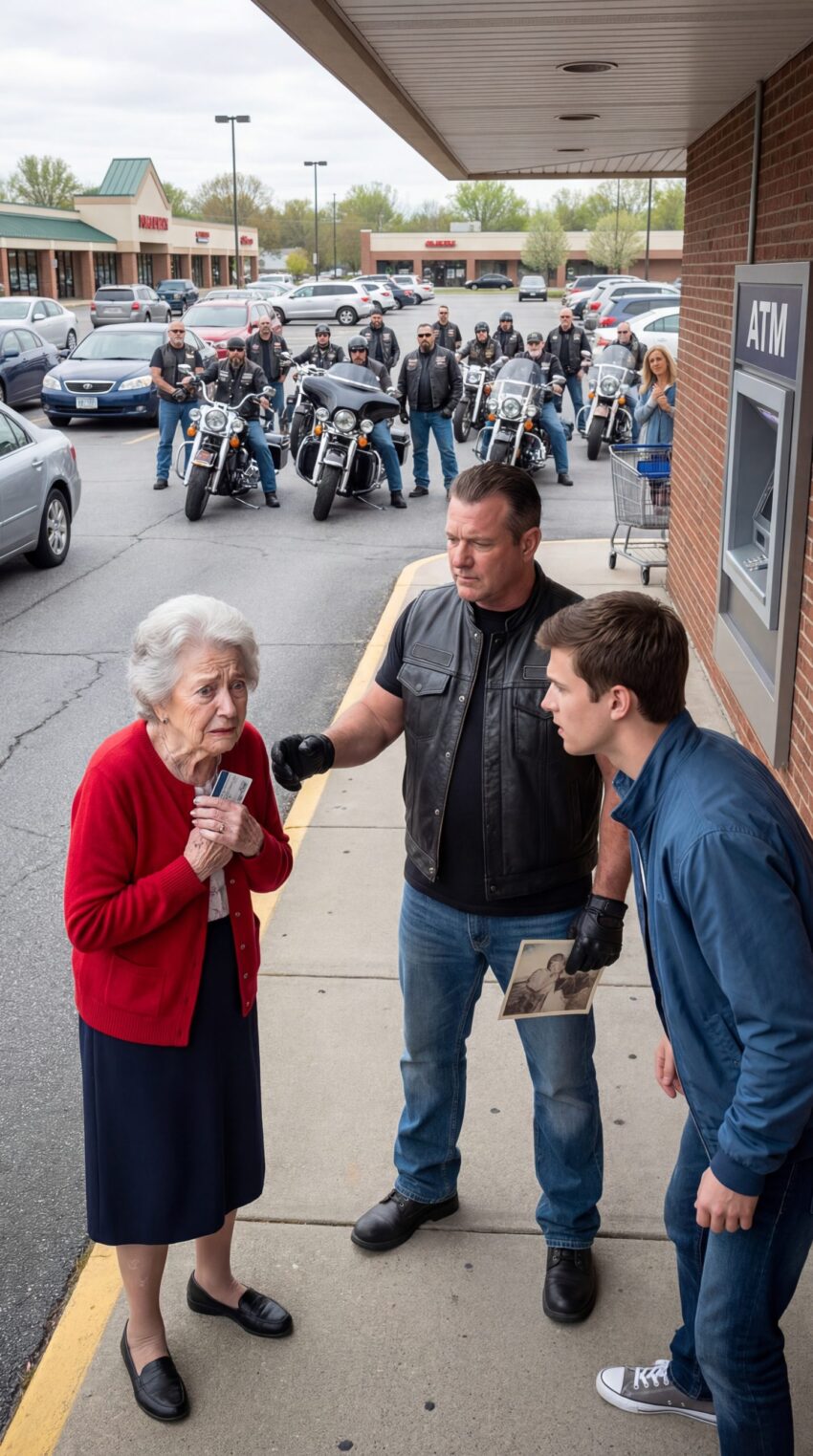
Eighty-one-year-old Margaret “Maggie” Halbrook stood in front of the ATM, her shoulders slightly curved inward as if she were trying to take up less space. Her silver hair was tied back loosely, and her hands trembled—not just from age, but from something deeper, something unsettled.
She tried to insert her card.
Missed.
Tried again.
Missed again.
Beside her stood a young man in his late twenties. He looked presentable at first glance—clean sneakers, fitted jacket, well-groomed hair. But the closer someone looked, the more something felt off. His presence was too close, too controlled. His voice, when he spoke, was low but firm.
“Go on,” he murmured. “You know what to do.”
Maggie swallowed, her voice barely rising above a whisper.
“I… I don’t have much today.”
The young man leaned slightly closer.
“Don’t make this harder than it needs to be.”
The Silence People Pretend Not to See
A few people nearby noticed.
They slowed their steps for a moment, glanced over, then continued walking.
It was easy to assume it was a private disagreement. Maybe family. Maybe a misunderstanding. No one wanted to get involved.
Maggie’s hands shook more noticeably now. Her card bent slightly between her fingers as pressure built—not loud, not obvious, but heavy.
She looked around once.
Not for help.
Just… hoping.
The Sound That Broke the Moment
Then came the sound.
A deep, steady rumble rolled into the parking lot—low and unmistakable. A motorcycle.
Heads turned instinctively.
A black cruiser bike glided in and parked near the curb. The engine shut off, leaving behind a silence that felt strangely louder than before.
The rider stepped off.
His name was Daniel “Ridge” Callahan. Fifty-nine years old. Broad-shouldered, weathered, calm. His leather vest carried patches faded by years of sun and road, each one telling a story he never bothered to explain.
He removed his helmet slowly, scanning the scene without rushing.
And then he noticed her.
He didn’t need to hear everything.
He saw enough.
The way Maggie flinched.
The way the young man hovered.
The way her shoulders tightened like she was shrinking under invisible weight.
Ridge started walking toward them.
The Moment Everyone Got Wrong
He didn’t shout.
He didn’t ask questions.
He stepped in.
With one controlled motion, he moved the young man’s hand away from Maggie’s space—not violently, but firmly, like drawing a line that should have already been there.
The young man staggered back slightly, shocked.
“What’s your problem?” he snapped. “You serious right now?”
Phones appeared almost instantly.
From a distance, it looked like confrontation.
From a distance, Ridge looked like the aggressor.
Maggie whispered,
“Please…”
But her eyes weren’t on Ridge.
They were fixed on the young man—fearful, pleading.
That detail went unnoticed by most.
What He Chose to Show Instead
Ridge didn’t argue.
He didn’t raise his voice.
Instead, he reached slowly into his vest.
The entire parking lot seemed to hold its breath.
People leaned in.
Phones tilted higher.
But what he pulled out wasn’t anything threatening.
It was a worn photograph.
And a small laminated card.
He turned them gently toward Maggie.
Her reaction was immediate.
Her breath caught. Tears filled her eyes before she could stop them.
“You… you problem known Samuel…” is generic. This is wrong. fix.
We must rewrite properly.
Continue.
“You… you knew Samuel,” she whispered, her voice breaking.
Ridge nodded once.
“I did.”
Samuel Halbrook—Maggie’s son—had served in the military years ago. He never made it back home. Ridge had known him. Served alongside him. And after everything ended, Ridge made a quiet promise to check in on the one person Samuel had worried about most.
Maggie.
Not for recognition.
Not for praise.
Just because some promises don’t fade.
The Truth Begins to Surface
The young man scoffed, trying to regain control.
“What is this supposed to prove?”
Ridge’s voice stayed calm.
“She doesn’t owe you anything.”
it/.
.
This.
The.
Ok continue.
The young man’s tone sharpened.
“I did work for her. She hasn’t paid me.”
Maggie shook her head slightly, tears slipping down.
“He said he fixed the porch,” she said softly. “But then… every time he came back, it was something new… more money… I didn’t know how to say no.”
Ridge didn’t look away from the young man.
“You’ve been bringing her here regularly,” he said evenly. “Same pattern. Same pressure.”
The young man hesitated.
Just for a second.
But it was enough.
When Someone Finally Asked the Right Question
Sirens approached in the distance.
Police cars pulled into the lot moments later, lights flashing softly.
An officer stepped forward.
“What’s going on here?”
The young man pointed immediately.
“He pushed me. Just walked up and did it.”
Ridge lifted his hands calmly.
“Check her withdrawal history,” he said. “You’ll see what’s been happening.”
The officer turned to Maggie.
“Ma’am?”
She hesitated.
Her voice trembled.
But this time, and by ] need to all. which to the similar with all. the which the. was.
But she spoke.
“He kept saying I owed him,” she said. “I was scared to refuse.”
The Pattern No One Wanted to See
As officers began asking questions, the situation shifted.
Bank records showed repeated withdrawals.
Same day. Same amount. Week after week.
Security footage confirmed it.
The young man standing too close.
Speaking too quietly.
Returning again and again.
What once looked like a simple interaction now revealed something else entirely.
Pressure.
Control.
Exploitation.
The young man’s confidence began to unravel.
His explanations changed.
Details didn’t match.
His story no longer held.
After the Noise Settled
By late afternoon, the parking lot returned to normal.
Cars moved.
People shopped.
Life continued.
But something had changed.
Maggie sat on a nearby bench, her hands finally steady.
She looked at Ridge.
“You remembered,” she said softly.
Ridge gave a small nod.
“I said I would.”
He didn’t stay long.
He didn’t wait for thanks.
He simply made sure she was okay.
Then he left—just another rider disappearing into the road, carrying a promise that never needed recognition.
What Stayed With Everyone Who Saw It
The people who witnessed it would remember.
Not the confrontation.
But the moment everything shifted.
The moment someone chose not to walk away.
The moment fear was seen—and interrupted.
And perhaps most of all…
The realization that what looks obvious from a distance is often not the truth at all.
Sometimes, the quietest situations hide the heaviest pressure, and it takes a patient eye to notice what others overlook.
Not every act of courage is loud; sometimes it is simply choosing to step closer when everyone else steps away.
People often misjudge what they see in a single moment, forgetting that real stories are built from what happens before and after that moment.
Kindness does not always appear gentle—it can be firm, direct, and unafraid to interrupt what is wrong.
Fear rarely announces itself clearly, but it always leaves small signs for those willing to notice.
Standing up for someone does not require perfection; it only requires the willingness to care more than to stay comfortable.
The strongest promises are often the ones no one hears, kept quietly over years without expectation of recognition.
A person’s vulnerability should never be used against them, and recognizing that vulnerability is the first step toward protecting it.
Moments of pressure can grow slowly over time, but a single moment of intervention can begin to break that cycle.
And in the end, what matters most is not how quickly we judge a situation, but how willing we are to pause, look closer, and choose compassion when it matters most.