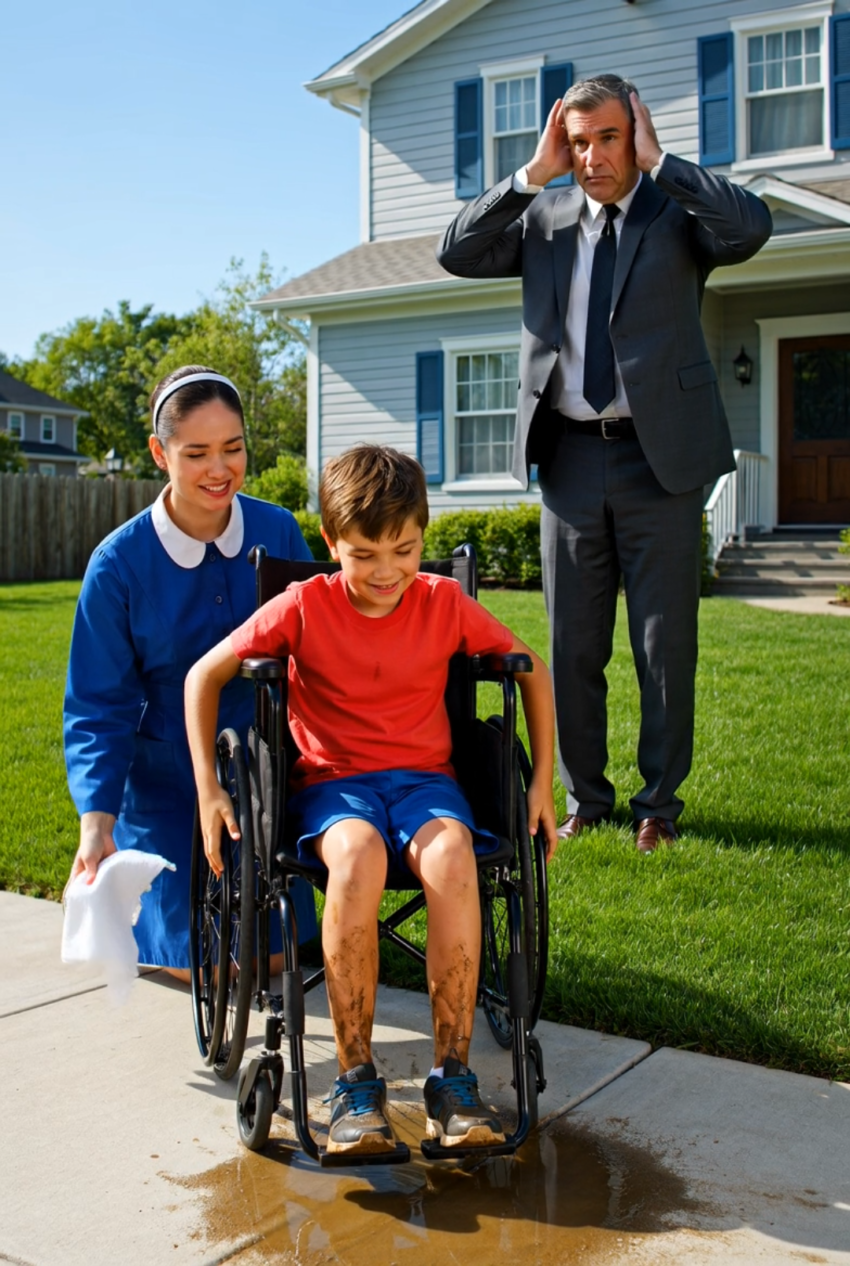
Jonathan Reed was a 45-year-old real estate mogul in Seattle. He had everything: wealth, a hilltop mansion, influence.
But for the past three years, nothing had mattered more than his eight-year-old son, Noah, who lost the use of his legs in a car accident. Since then, Noah had stopped smiling, stopped playing, and barely ate.
Every day, Jonathan watched his son slowly lose the will to live—and felt completely powerless.
One evening, Jonathan left a business meeting earlier than planned and arrived home unexpectedly. As he opened the front door, he heard something he hadn’t heard in months: the bright, carefree laughter of a child.
Following the sound, he stepped into the living room—and froze.
The new housekeeper, Isabella, whom he had hired just two weeks earlier, was kneeling on the floor beside Noah, who was laughing uncontrollably.
“What is going on here?” Jonathan’s voice echoed sharply through the room.
Isabella jumped to her feet, nervously wiping her hands on her navy apron. Her wide hazel eyes reflected fear—but also determination.
“Mr. Reed, I can explain…” she began.
But Noah, still smiling, interrupted.
“Dad, Aunt Bella was teaching me different exercises. Look!”
The blond boy concentrated intensely and managed to move his right foot—just slightly, but more than he had in months.
Jonathan felt his knees weaken.
“That’s impossible,” he whispered.
Isabella took a deep breath to steady herself. She knew it wasn’t part of her job, but seeing Noah so sad reminded her of the techniques her grandmother, Grandma Elena, had used in a small village in New Mexico. Her grandmother had cared for people with similar conditions.
Jonathan grew angry. He accused her of implying that an untrained woman could succeed where the best neurologists in the country had failed.
Tears filled Isabella’s eyes—but she didn’t back down.
“I’m not claiming to know more than the doctors,” she said softly. “I just wanted to help him feel a little better.”
Noah looked at his father, his blue eyes shining with hope.
“Dad, I felt a tingling in my leg,” he said. It was the first time in a long while that he seemed genuinely excited.
Jonathan sent Noah back to his room and asked Isabella to join him privately. Running a hand through his graying hair, he asked if she had children.
When she answered no, he told her she couldn’t possibly understand what it felt like to watch your child slowly lose the desire to live.
Isabella listened quietly.
Then, gently but firmly, she explained that she had grown up watching her grandmother care for people whom city doctors had already given up on.
Her grandmother never claimed to replace medicine. But she believed that sometimes the heart understands what the mind cannot explain.
Isabella described “vital points”—areas of the body that, when gently touched, could awaken dormant energy.
She mentioned a young woman who regained the use of her arms, a man who walked again after losing sensation in his leg, and others whose conditions improved.
Jonathan remained skeptical. He couldn’t risk his son’s health based on stories from a small town.
He decided not to fire her—she was excellent at her job, and Noah clearly trusted her—but demanded she promise never to attempt anything like that again without his permission.
She agreed, sadness filling her eyes.
Later that night, Isabella found Noah crying. He asked why his father wouldn’t let her help him. She explained that his father loved him and was afraid.
Noah admitted that when she touched his legs, it felt like waking up from a long sleep.
With surprising maturity, he understood that his father feared being devastated again if nothing worked.
Isabella whispered that sometimes people just need time to understand.
In the days that followed, Jonathan watched Noah slip back into his old sadness. He barely ate and avoided questions.
Eventually, Noah admitted he was happiest when Isabella sat with him, telling stories about her childhood in the countryside—about farm animals and the medicinal plants her grandmother used.
He said she no longer mentioned exercises, but he kept dreaming about running in his grandmother’s garden.
That confession haunted Jonathan all night.
The next morning, instead of leaving for work, Jonathan stayed in his home office with the door slightly open.
At eight o’clock, Isabella arrived and warmly greeted Noah. He told her he’d had the dream again—the one where he was running.
She knelt beside his wheelchair and gently placed her hand on his arm, saying that dreams often reveal what the heart longs for most.
When he asked if he would ever run, she admitted she didn’t know—but as long as he held onto that dream, there was hope.
Jonathan saw his son smile for the first time in days.
He suddenly understood: Isabella wasn’t just suggesting strange exercises—she was offering hope.
That afternoon, Jonathan asked her to explain her grandmother’s techniques in detail.
Isabella spoke about awakening life energy through gentle touch and emphasized three principles her grandmother always taught: understand the technique, practice it with love, and have the willingness of the person receiving it.
Desperate, Jonathan finally asked if there was any risk.
She replied that her touch was softer than a traditional massage—it couldn’t harm anyone.
After long hesitation, Jonathan agreed to let her help Noah—under strict conditions. She would explain every step beforehand and stop immediately if anything seemed unusual. And no one else could know.
She agreed.
The first official session took place the following week under Jonathan’s close supervision.
Isabella laid a towel on the living room floor and helped Noah lie down. Nervously, she began.
Suddenly, Noah gasped.
“I feel something,” he said. A tingling in his left foot.
Jonathan shot upright in disbelief.
“It’s like someone turned on a light,” Noah said.
As Isabella moved slowly up his legs, the tingling spread. By the end of the session, Noah said he could feel both legs for the first time in three years—and even slightly wiggled his toes.
Jonathan struggled to breathe.
Isabella reminded him this was only the beginning. The body was relearning how to move. It could take months—maybe years.
Even if Noah never fully walked again, she said, at least he would feel more, suffer less, and feel whole again.
Seeing his son radiant with happiness, Jonathan made another decision.
From now on, Isabella would not only manage the house—she would also serve as Noah’s personal therapist, with additional compensation.
She protested, saying she would do it for free.
Jonathan shook his head.
“This isn’t about what you need,” he said. “It’s about what you deserve.”
News of Noah’s progress eventually reached his neurologist, Dr. Michael Harris, who was skeptical but curious.
After observing Noah’s new movements and attending a session, he couldn’t explain what he saw—but he couldn’t deny it either.
He later presented Noah’s case at a medical conference, where Isabella, visibly nervous, shared her story.
Some doctors doubted her. Others were moved.
Her simple honesty—that she couldn’t fully explain why it worked, only that it often did, and that anything helping a child walk again was worth trying—left a lasting impression.
Years later, Noah had grown into a healthy, athletic teenager who volunteered at a rehabilitation center funded by Jonathan and co-designed by Isabella.
The center combined modern therapy with the gentle techniques passed down by Grandma Elena.
With every new patient, Noah would smile and say:
“The most important thing in any treatment? Never lose hope. Aunt Bella taught me that the body can heal when the heart refuses to give up.”
And as Isabella watched him help another child take their first steps, she silently gave thanks for the day a worried father came home early and caught a housekeeper doing ‘strange exercises’ with his son—
Because that moment of doubt had become the beginning of a miracle built on love, courage, and hope.