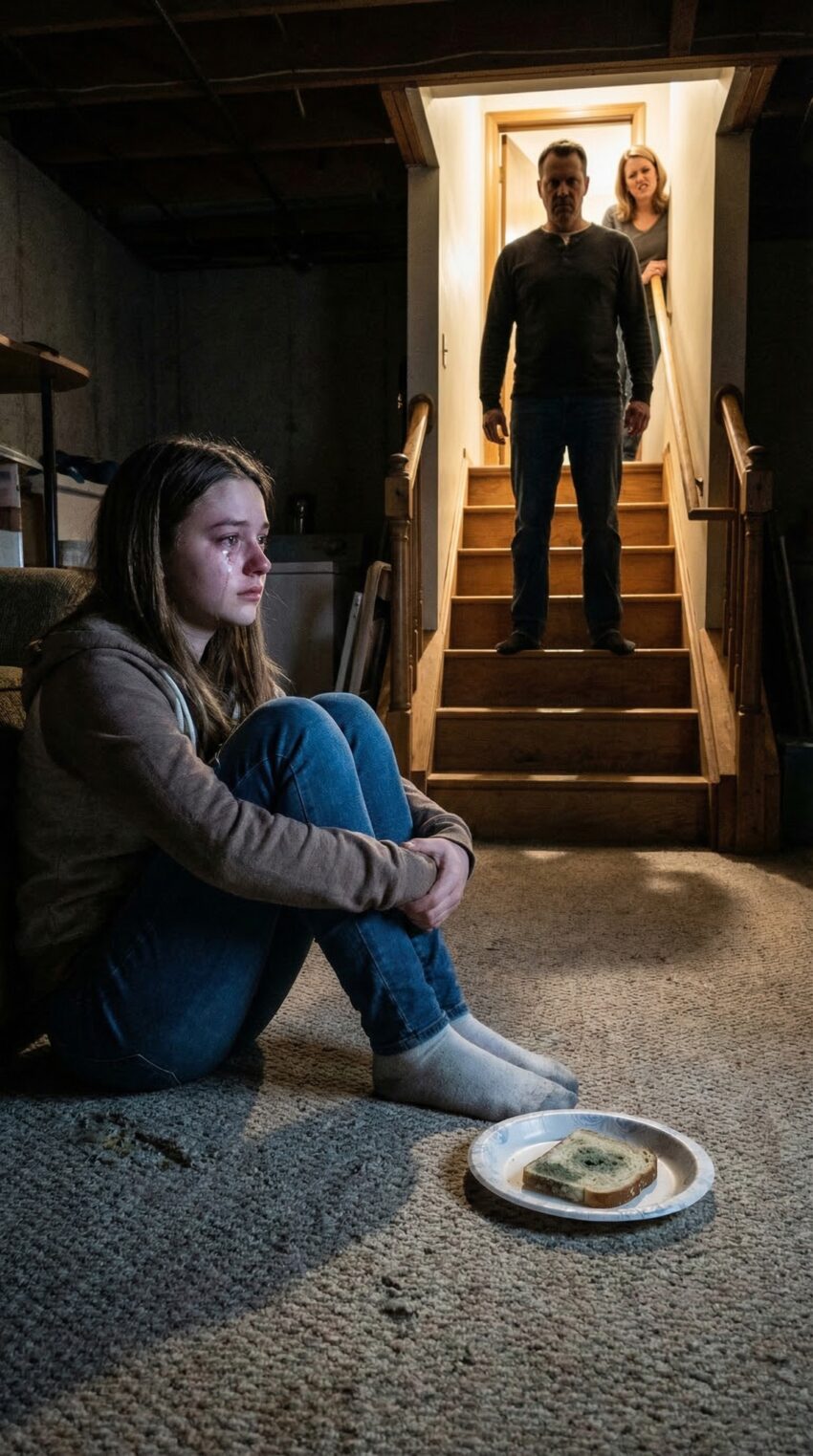
My father chained me in the basement on my sixteenth birthday.
“Mistakes don’t get parties,” he shouted as he snapped the padlock through the metal cuff around my ankle. The chain was short enough that I could sit on the old mattress in the corner or take three steps toward the washing machine, but not much more. The basement smelled like wet concrete, bleach, and the mildew that crept through the cinderblock walls every spring. A single bulb hung overhead, buzzing faintly. I remember staring at it because it was easier than looking at him.
I had made one mistake, if you could even call it that. I had skipped school the week before and lied about where I’d been. I had gone to meet my older cousin Jenna, who was leaving town after a bad divorce, and I knew Dad would never allow it. He found out anyway. In our house, every lie was treated like a crime, every disobedience like betrayal. My father, Randall Mercer, liked rules because rules let him turn his temper into morality.
My mother stood at the top of the basement stairs, arms crossed over her chest, watching like this was just another household chore. Her mouth pinched in that familiar way, half disgust, half boredom.
“You should be grateful,” she said. “Some girls your age get worse.”
Dad laughed once, a sharp ugly sound. “She thinks she’s grown now. Wants freedom? She can sit down here and think about it.”
Then he walked up the stairs and shut the door.
A second later it opened again. My mother tossed down a plate. Two pieces of moldy bread slapped against the concrete beside me.
“Your cake, princess.”
The door slammed. The deadbolt clicked.
For a few minutes, I sat frozen, listening to the footsteps fade overhead. Then the house went quiet except for the furnace kicking on and off. I wrapped both hands around the chain on my ankle and pulled until the cuff bit into my skin. It didn’t budge. Dad had attached it to an iron pipe that ran along the wall. He had thought this through.
I wanted to cry, but crying in that house had always been dangerous. It gave them proof that the punishment was working.
So I counted.
Not minutes at first. Breaths. Then the hum of the bulb. Then the drips from the old utility sink in the corner. Above me, I heard the muffled movement of my parents living their evening as if nothing unusual had happened. Cabinet doors. Television. My father’s heavy steps. My mother laughing at something on a game show.
At seven o’clock, I should have been at dinner with Aunt Denise.
Every year since I turned twelve, she took me out on my birthday—just the two of us. Nothing fancy. Usually burgers, pie, and a bookstore afterward. She was my father’s younger sister, and the only adult in my life who ever looked at me as if I were a person instead of a problem to be managed. She knew enough not to challenge Dad directly unless she had to, but she watched everything. She noticed bruises I explained away. She noticed how I flinched when doors slammed. She noticed that I ate too fast, like I wasn’t sure when food would be allowed again.
At 7:15, she would have texted.
At 7:30, she would have called.
By eight, when I still hadn’t shown up or answered, she would know.
I pulled my knees to my chest and rested my forehead on them, trying to slow the panic crawling through my body. Aunt Denise had once told me, in a whisper outside the grocery store, “If you ever disappear, I will not assume it’s nothing.”
So I counted the hours, knowing she had called CPS the moment I missed our planned dinner.
And for the first time in my life, trapped in that basement with moldy bread at my feet and a chain around my ankle, I believed someone might actually come.
The first night felt endless because I had no clock, only the changing sounds of the house above me.
I knew when my father went to bed because his footsteps always crossed the kitchen in the same heavy rhythm, followed by the scrape of his chair and the slam of the back door while he smoked. I knew when my mother finally came downstairs to switch laundry because she never bothered to look at me. She dumped a basket near the washer, humming to herself, then left again as if I were part of the basement furniture. Once, around what I guessed was midnight, she paused at the foot of the stairs and said, “You brought this on yourself, Tessa.”
I didn’t answer.
That seemed to irritate her more than if I had cried.
The bulb stayed on all night. Sleep came in broken pieces. The mattress was thin and damp-smelling, and every time I drifted off, the chain shifted against the pipe with a metallic scrape that yanked me awake again. By morning, my ankle was raw where the cuff rubbed. My stomach cramped with hunger, but I still couldn’t bring myself to touch the bread.
The next day, Dad came down before leaving for work.
He crouched in front of me, forearms resting on his thighs, wearing the same calm face he used when explaining punishments, like he was a reasonable man forced into difficult choices by an unreasonable daughter.
“You want to know why this is happening?” he asked.
I kept my eyes on the floor.
“Look at me.”
I looked.
“Because shame is the only lesson that sticks.” He pointed toward the stairs. “Out there, people make excuses for kids. They medicate them, coddle them, tell them their feelings matter. In this house, actions have consequences.”
I wanted to tell him I had skipped one day of school, not committed murder. I wanted to ask how locking your daughter in a basement could possibly be called parenting. Instead, I said the one thing that slipped out before I could stop it.
“Aunt Denise is going to come looking for me.”
He smiled.
“No, she isn’t.”
That smile chilled me more than the basement ever could. It meant he had already prepared his story. I imagined him answering the phone the night before, casual and annoyed, saying I had a stomach bug, or that I’d gone to stay with a friend, or that I was grounded and couldn’t talk. He lied easily because adults believed adults, especially fathers with polished shoes and steady jobs and neat front lawns.
After he left, I began testing everything in the basement.
The chain first. The pipe. The bolt on the cuff. Then the radius of movement I had. I could reach the utility sink, the edge of the water heater, a stack of old paint cans, and a shelf lined with tools Dad had forgotten were there. Most were too far back. But by lying flat and stretching my arm until my shoulder burned, I managed to hook a rusted screwdriver with my fingertips and drag it down.
I hid it under the mattress when I heard the back door open that evening.
My mother brought a bowl of canned soup and set it on the floor without a spoon.
“You can still fix this,” she said.
I laughed then, quietly, because the sentence was so absurd I couldn’t help it.
Her eyes narrowed. “What’s funny?”
“The part where you think I did this.”
She slapped me before I saw her move.
Not hard enough to knock me over. Hard enough to make the point. Her wedding ring cut the corner of my lip.
“You always were ungrateful,” she said, and walked upstairs.
I waited until the house settled again, then pulled out the screwdriver and studied the cuff. It was old metal, probably something Dad had once used on the shed. The screw heads were stripped and rusted. I worked at them for what felt like hours, wrists aching, breath fogging faintly in the basement chill. Nothing gave. I tried prying the hinge. I tried jamming the tip into the lock housing. Still nothing.
By the second night, hope had started to turn dangerous.
What if CPS had called and Dad talked his way out of it? What if Aunt Denise had been told I ran away? What if she believed them? What if everyone always did?
Then, sometime the next morning, I heard a car pull into the driveway. Not Dad’s truck. Not Mom’s sedan. Doors opened. Voices. More than one.
A hard knock rattled the front door upstairs.
My whole body went still.
Dad answered. I couldn’t hear the words, only the tone: surprised first, then offended. A woman’s voice answered. Calm. Firm. Another voice, male this time, lower and official.
My pulse slammed so hard it made me dizzy.
Footsteps moved across the kitchen. Fast. Then Dad was at the basement door.
He yanked it open and came halfway down the steps, eyes blazing.
“If you make one sound,” he said in a whisper so vicious it barely sounded human, “you will regret it for the rest of your life.”
Then he turned back toward the kitchen.
For one frozen second, fear won.
I had spent years training myself to survive his moods by staying quiet, staying useful, staying small. Silence had kept me safe before—or at least safer than defiance.
Then I heard the woman upstairs say, “Sir, we need to see your daughter today.”
And something in me broke the right way.
I screamed.
Not words at first. Just sound, ripped raw out of my throat. Then louder, “I’m down here! Basement! I’m in the basement!”
The house exploded into motion.
Dad spun back, but too late. Heavy footsteps pounded overhead. The male voice barked, “Step away from that door!” My father shouted something about discipline and lies and family matters. My mother started crying instantly, the fake kind, the kind she used for church funerals and neighbor gossip.
I screamed again, every word I had never been allowed to say crashing out all at once.
“He chained me up! He chained me in the basement!”
The next ten seconds changed my life.
The basement door flew open so hard it hit the wall.
A uniformed sheriff’s deputy came down first, one hand near his belt, the other reaching toward me. Behind him was a woman in a navy coat with a state badge clipped to her pocket, and behind her—pale, furious, and shaking—was Aunt Denise.
For a second I thought I was imagining her. She had one hand pressed over her mouth, but her eyes locked on me instantly, taking in the chain, the mattress, the split lip, the soup bowl on the floor.
“Oh my God,” she said.
The deputy crouched beside me. “My name is Deputy Collins. You’re safe now. Can you tell me your name?”
“Tessa Mercer.”
He nodded. “Okay, Tessa. Don’t move yet.”
The CPS caseworker, Linda Chavez, was already taking pictures with her phone. The cuff. The pipe. The bread still hard and green-speckled near the wall. The red marks around my ankle. Every detail my parents would later try to call exaggeration.
Upstairs, my father was shouting. “This is discipline! She’s out of control! You people have no right—”
The deputy’s radio crackled. Another officer had apparently arrived outside, because the shouting suddenly cut off and turned into muffled protest.
Aunt Denise came down the last few steps only after Linda touched her arm and said, “Give us one minute.” She looked like she wanted to tear the house apart with her bare hands.
The deputy examined the cuff and frowned. “We’ll need bolt cutters.”
Linda looked at me carefully. “Tessa, has this happened before?”
I swallowed. The truthful answer sat heavy in my throat. Not exactly this. Not a chain. But locked rooms. Missed meals. Bruises from being “grabbed.” Punishments that lasted days. Humiliations disguised as lessons.
“Yes,” I whispered. “Not the chain. But… yes.”
She nodded once, and something in her face changed from concern to certainty.
When the second deputy brought down the bolt cutters, the sound of the metal snapping was so sharp and sudden I flinched. Then the cuff fell away.
I stared at my ankle in disbelief.
Free.
The word didn’t feel real yet. Neither did standing. My legs trembled when Collins helped me up. Aunt Denise wrapped her coat around my shoulders even though it dragged near the floor on me.
“I’ve got you,” she said, voice breaking. “I’ve got you now.”
As they led me upstairs, I saw my parents in the kitchen.
My mother was crying into a tissue, mascara streaking carefully down one cheek. My father had his hands behind his back in handcuffs, still trying to look righteous.
“She’s manipulative,” he said the moment he saw me. “Tessa, tell them the truth. Tell them you forced our hand.”
I stopped walking.
For sixteen years, every room had belonged to him. Every version of events had bent toward his. Every punishment had ended with me apologizing for what he’d done.
Not this time.
“You chained me in the basement,” I said.
My mother let out a soft, offended gasp, like I had embarrassed her at dinner.
“You threw moldy bread at me,” I added, looking directly at her.
Linda wrote something down. Denise squeezed my shoulder.
Dad’s face changed then. He realized, maybe for the first time, that the performance was over. No private correction. No family spin. No chance to rewrite it later over roast chicken and forced smiles. Strangers had seen. Photographs existed. Records would follow.
He looked smaller in handcuffs than I had ever seen him look in my life.
The months after that were ugly, public, and exhausting.
I stayed with Aunt Denise in her townhouse outside Dayton while the case moved forward. A doctor documented the ankle injury, the lip cut, older bruising, and signs of long-term neglect. A forensic interview specialist spoke with me twice. School records showed unexplained absences. Neighbors, once they were asked direct questions by investigators, admitted they had heard yelling for years. One woman remembered seeing me locked outside in freezing weather when I was thirteen. A former teacher testified that I often came to class hungry and exhausted.
My parents were charged—my father more severely, for unlawful restraint, child endangerment, and assault-related offenses, and my mother for neglect and related charges tied to her participation and failure to protect me. Their lawyers tried everything. They said I was rebellious, mentally unstable, dramatic. They called it “an isolated disciplinary mistake.” But evidence has a way of stripping drama out of lies.
The chain did that.
So did the photographs.
So did Aunt Denise, who testified without flinching that she had been documenting concerns for nearly two years because she feared exactly this kind of escalation.
In the end, my father took a plea deal that included prison time and mandatory counseling conditions tied to any future contact with minors. My mother received a lesser but still serious sentence involving jail time, probation, and supervised conditions. Neither outcome was cinematic. No one shouted in the courtroom. No one confessed with tears streaming down their face. Real life was colder than that.
But it was real, and it held.
I moved in permanently with Aunt Denise, who became my legal guardian until I turned eighteen. The first birthday after that, she took me to the same diner we had always planned to go to. She ordered me chocolate cake and asked the waitress to bring sixteen candles plus one extra “for interest.” I laughed so hard I cried in front of strangers, and nobody punished me for it.
The hardest part of freedom was not leaving the basement. It was learning that ordinary kindness was not a trick.
That doors could close without being locked against you.
That food could be given without humiliation attached.
That adults could be angry without becoming cruel.
I finished high school. Later, I studied social work. Ten years after that night, I sat in an office helping teenagers who spoke in the same careful, over-controlled voices I used to have. When they said things like, “It wasn’t that bad,” or, “Maybe I deserved it,” I never rushed them. I just stayed steady and let the truth come when it was ready.
People sometimes ask what happened to my parents, usually in that curious half-whisper reserved for family scandals. The answer is simple. They lost the thing they had used as a shield for years: privacy. Once the world saw what they were inside their own house, everything else followed logically. Court records. Consequences. Distance. Silence.
As for me, I kept one thing from that basement: not the chain, not the hatred, not even the fear.
I kept the count.
The hours I survived.
The minutes between the knock at the door and the moment I chose to scream.
Because that was the real turning point of my life—not the arrest, not the courtroom, not even the day I left that house for good.
It was the second I understood that staying silent would not save me anymore.
And that being heard could.
Part 2: The Girl Who Learned to Speak
Ten years later, I found myself standing in another basement.
But this one didn’t smell like mildew or bleach.
It smelled like fresh paint, coffee, and the faint sweetness of laundry detergent. The walls were a soft cream color, not bare concrete. There were couches instead of a mattress. Lamps instead of a single buzzing bulb.
And there were no chains.
Just a circle of folding chairs.
I adjusted the sleeves of my sweater and looked at the door as it opened slowly. A teenage girl stepped in, shoulders hunched, eyes scanning the room like she was calculating every possible threat.
I recognized that look instantly.
She didn’t trust the quiet.
Didn’t trust the safety.
Didn’t trust me.
Not yet.
“Hi,” I said gently. “You can sit anywhere you like.”
She chose the chair closest to the wall.
Of course she did.
I sat across from her, not too close, not too far. The other counselors moved around the room, preparing materials, but I kept my focus on her.
“What’s your name?” I asked.
She hesitated.
Then, barely audible:
“Lena.”
I nodded. “I’m Tessa.”
Her eyes flicked up at that. Quick. Sharp.
“You work here?” she asked.
“I do.”
She studied me for a moment longer, then crossed her arms tighter.
“They said you… understand stuff like this.”
I almost smiled.
“They were right.”
We didn’t talk about everything that first day.
We talked about small things.
School.
Music.
How annoying it is when people say “it’ll get better” like that’s a magic spell.
She didn’t mention her parents.
I didn’t mention mine.
Not yet.
It took three sessions before she said it.
“They locked me in my room,” she muttered, staring at the floor. “Sometimes for hours. Sometimes… longer.”
I didn’t interrupt.
Didn’t rush.
Didn’t soften it.
I just nodded.
“That shouldn’t have happened to you.”
Her jaw tightened.
“They said it was discipline.”
There it was.
The word.
The same one my father used like a weapon wrapped in logic.
I leaned forward slightly.
“They were wrong.”
Silence stretched between us.
Heavy.
Important.
Then she looked up, eyes glassy but defiant.
“Everyone says that after,” she said. “But when it’s happening… no one comes.”
That hit deeper than she knew.
I took a slow breath.
Then I told her.
Not everything.
Just enough.
“I was locked in a basement once,” I said quietly. “On my birthday.”
Her eyes widened.
“For real?”
“For real.”
“Did anyone come?”
I held her gaze.
“Yes.”
A pause.
Then, softer:
“But only because I stopped staying quiet.”
She didn’t say anything after that.
But something shifted.
You can feel it when it happens—not loud, not dramatic, just… a small crack in the wall someone built to survive.
Months passed.
Lena started sitting closer to the center of the room.
She started talking more.
Laughing, even—quick, surprised bursts like she didn’t expect the sound to come out of her.
One day, she stayed behind after the session.
“I told my caseworker everything,” she said.
I nodded.
“How did it feel?”
“Terrifying,” she admitted.
Then, after a second:
“But also… kind of good.”
I smiled.
“That’s how it starts.”
That night, I went home and stood in my kitchen, staring at nothing for a while.
Not sad.
Not angry.
Just… aware.
Of how far I had come.
Of how that one moment—standing in a dark basement, choosing to scream—had echoed through my entire life.
People think survival is about strength.
About endurance.
About lasting longer than the pain.
But they’re wrong.
Survival changes the moment you decide your voice matters more than your fear.
Sometimes, late at night, I still remember that basement.
The chain.
The silence.
The moment before I screamed.
And I think about all the versions of me that could have stayed quiet.
The one who didn’t believe anyone would come.
The one who thought punishment was love.
The one who thought she deserved it.
None of them survived.
The girl who screamed did.
And now, every time a door opens…
Every time a voice shakes but speaks anyway…
Every time someone chooses not to stay silent—
That moment lives again.
Not as pain.
But as proof.