The Forty-Two Dollars on the Table
The diner on Route 18 always smelled the same in late afternoon. Burnt coffee sat in the air like an old habit, and the faint trace of motor oil drifted in every time the front door opened. Sunlight pushed through the dusty windows in long golden strips, catching the chrome parked outside and turning the row of motorcycles into a line of bright metal shadows.
Most people in Millbrook, Pennsylvania, knew better than to stare at the bikers who gathered there every Thursday.
They were not loud. They did not pick fights. They did not bother anyone.
Still, people kept their distance.
Maybe it was the leather vests. Maybe it was the tattoos. Maybe it was the way years on the road had carved something hard into their faces. Whatever the reason, the booth near the window was always left alone, as if nobody wanted trouble from men who had not asked for any.
That afternoon, seven riders sat there in easy silence, finishing pie, drinking coffee, and watching the light begin to fade over the highway.
Then the front door opened, and the whole room changed.
A small boy stepped inside.
He looked about ten years old, thin in the way children sometimes look when life asks too much of them too early. His backpack hung from one shoulder, and his sneakers were dusty from walking. Behind him came a German Shepherd with three legs, moving with a careful limp that was steady rather than weak. One of the dog’s front legs was gone, replaced by a worn prosthetic brace wrapped in faded green fabric.
The conversations in the diner slowed and then stopped.
The waitress behind the counter froze with a coffee pot in her hand.
A man halfway through a sandwich lowered it without taking a bite.
The boy took a breath like he had spent the whole walk there trying not to lose his nerve. Then he walked straight toward the bikers’ table.
The Boy Who Asked Anyway
At the head of the booth sat a broad-shouldered rider named Wade Brannon. He was fifty-six, with a weathered face, a silver-streaked beard, and the heavy stillness of a man who had seen enough in life to stop pretending he could be surprised by much. He looked up slowly as the boy approached.
The child did not say anything at first. He simply pulled a small stack of folded bills from his pocket and laid them on the table with both hands, carefully, as if they were something precious.
Forty-two dollars.
Mostly ones, softened by time and use.
The boy swallowed hard and looked at Wade, not quite able to hold his gaze for long.
“Please,” he whispered. “Can you hide my dog before the principal takes him?”
Nobody in the diner moved.
Wade looked at the money, then at the boy, then at the dog sitting quietly by his side.
“Son,” he said, his voice low and rough, “you’d better start that over.”
The boy’s fingers trembled. He pressed them against the edge of the table to steady them.
“My principal said dogs aren’t allowed on school property anymore,” he said. “If Sergeant shows up again, they’re going to call animal control.”
The dog sat taller when he heard his name.
Wade’s eyes narrowed slightly. “Why would the dog be on school property in the first place?”
The boy’s face tightened, and for a second it looked like he might lose the fight to keep himself together.
“Because he follows me,” he said softly. “He always follows me.”
One of the other bikers shifted in the booth. Another let out a slow breath through his nose.
Wade leaned forward, resting his forearms on the table. “What’s your name, kid?”
“Eli.”
“Last name?”
“Mercer.”
Wade nodded once. “And your dog is Sergeant.”
The boy glanced down at the Shepherd with something close to apology in his eyes. “Yes, sir.”
The dog’s old collar had turned soft at the edges with age, but one metal tag still hung from it. Another biker, a younger man named Travis, noticed the faded stamping and reached forward just enough to read it.
His expression changed.
“Wade,” he said quietly, “look at this.”
Wade leaned down. The tag read:
K9 UNIT — U.S. MILITARY RETIRED
For a moment, the room seemed to go even quieter than before.
The Dog Who Came Home
Wade looked back at Eli, and something in his face softened, though only a little.
“You’re asking us to hide a military dog?”
Eli nodded quickly. “I saved my lunch money for two months.”
He pushed the forty-two dollars an inch closer as if he thought the extra gesture might help.
Wade did not touch it.
“Who did Sergeant belong to before you?”
Eli looked down. His voice was small now, but steady. “My dad.”
Wade waited.
The boy took another breath. “He was Sergeant’s handler. They served together overseas.”
The words settled over the table with the weight of something sacred.
“Where is your father now?” Wade asked.
Eli’s lips parted, but the first attempt at an answer did not come out. When he tried again, it was barely above a whisper.
“He never made it back.”
The waitress slowly set the coffee pot down on the counter behind her.
No one in the diner spoke.
Wade’s gaze drifted to the dog again. Even with three legs, Sergeant sat with the upright discipline of an animal that had once lived by command, training, and trust. He was old enough to have gray in his muzzle, but his eyes were still alert. He was not restless. He was not afraid. He was simply watching the room the way a good soldier watches a perimeter.
“How’d he lose the leg?” Travis asked.
Eli rubbed the back of his neck. “An explosion.”
One of the older bikers closed his eyes for a second.
Wade slowly reached down, giving the Shepherd time to decide. Sergeant did not flinch when Wade’s hand touched the side of his neck. The big dog only leaned into the scratch behind his ear and let his tail tap the floor once.
“You’re still carrying yourself like you’ve got a job to do,” Wade murmured.
Eli nodded. “He stayed with me after Dad was gone. Mom works two jobs, so when I walk to school, he follows me and waits outside or near the playground. He won’t leave.”
“And the school says he scares people,” Wade said.
“That’s what they keep saying.”
He studied the boy for another long moment. “Who told you to come to us?”
Eli pointed toward the parking lot where the motorcycles gleamed outside the diner window.
“My dad used to say bikers look scary to people who judge fast,” he answered. “But he also said they’re the kind of people you call when nobody else stands up.”
The men at the booth did not speak.
They just looked at one another, and something old seemed to move between them. Not pity. Not performance. Something closer to memory.
Wade picked up the stack of bills and pressed it back into Eli’s hand.
“Keep your money, son.”
Eli’s face fell. “So you can’t help?”
Wade stood.
His chair scraped against the floor loud enough to make two people near the counter jump.
Then he looked down at Eli and Sergeant and said, “I didn’t say that.”
The Riders Make a Decision
The other bikers rose one by one, some finishing the last of their coffee first, some already reaching for their keys.
Eli looked from one face to another, confused by how quickly the room had shifted.
“What are you doing?” he asked.
Wade pulled on his gloves. “Something bigger than hiding a dog.”
“But the principal—”
“Needs to learn the difference between fear and respect,” Wade said.
One of the riders laughed under his breath. Another grabbed cash from his wallet and set it on the table for the pie and coffee. The waitress, who had been quietly listening to everything, waved it away with damp eyes.
“On the house,” she said.
Wade gave her a nod, then crouched so he was eye level with Eli.
“Listen carefully,” he said. “Nobody is taking that dog from you while we’re breathing. Do you understand me?”
Eli’s eyes filled, and he nodded.
“Yes, sir.”
Wade pointed gently at him. “Then tomorrow morning, you walk into school with your head up. And Sergeant walks beside you.”
The boy stared at him. “You mean it?”
Wade’s smile was faint, but real. “More than you know.”
What Eli did not know yet was that one phone call from Wade Brannon traveled farther than most people would expect. By sunset, riders from three nearby counties had heard about a ten-year-old boy, a retired military dog, and a school ready to separate them because adults were too lazy to understand what they were looking at.
By bedtime, nearly thirty motorcycles were committed.
By dawn, the town was about to witness something it would talk about for years.
Morning at Willow Creek Elementary
The next morning at Willow Creek Elementary began like any other school day, at least for the first few minutes.
Parents pulled into the drop-off lane with travel mugs and distracted faces. Teachers carried folders and lunch bags through the front doors. A crossing guard raised her sign as children hurried across the sidewalk with backpacks bouncing against their shoulders.
Then came the sound.
It started low and distant, like thunder too early for the weather.
People paused.
The sound grew louder.
Teachers stopped on the front steps and turned toward the road. A custodian near the gym shaded his eyes. Children pressed themselves to classroom windows.
Then the motorcycles appeared.
First four.
Then eight.
Then more, turning through the entrance in a long, slow line of chrome and leather and controlled power. They did not race. They did not rev to show off. They rolled in with a calm certainty that somehow felt bigger than noise.
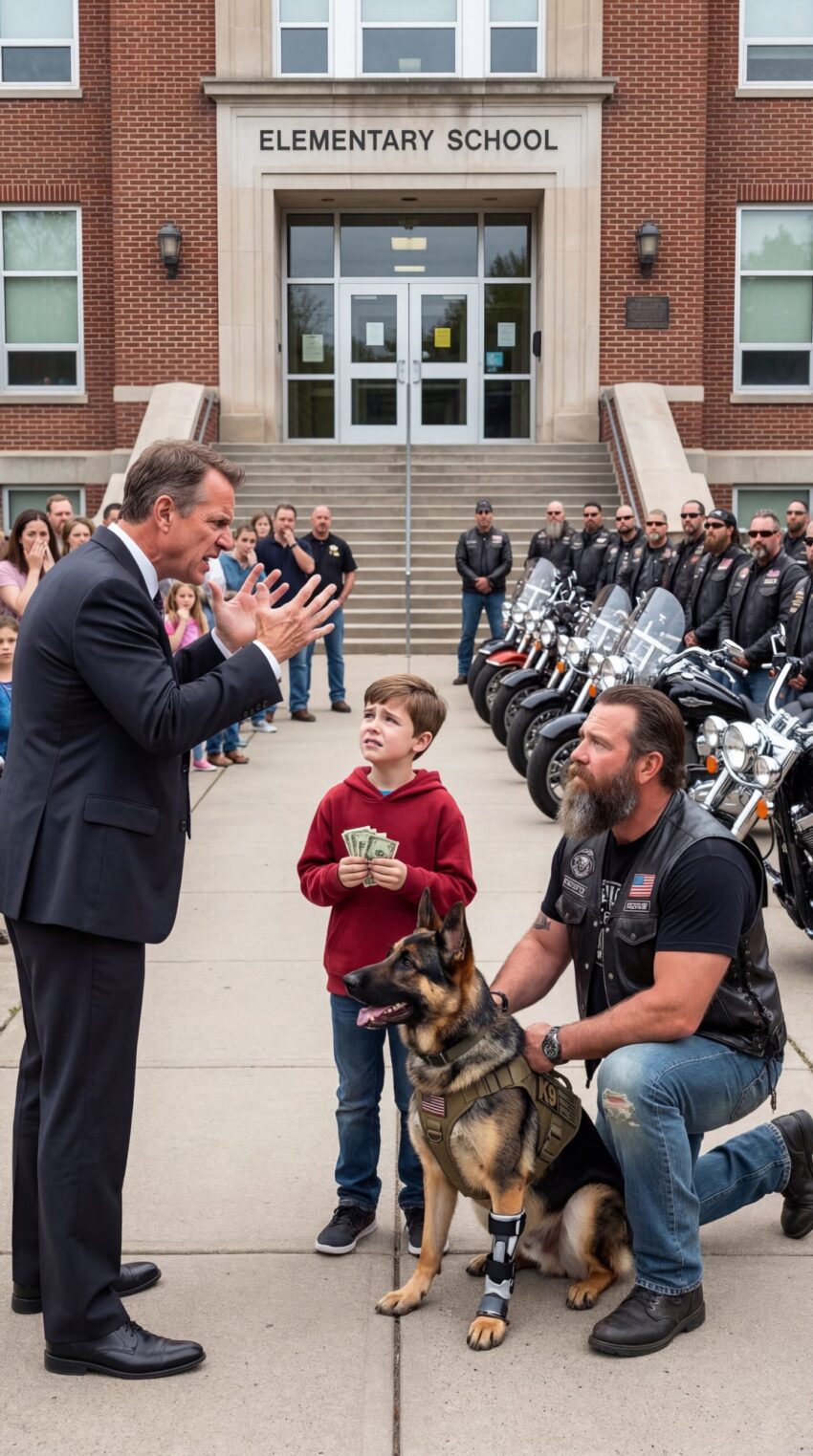
At the center of the school drive stood Principal Roland Pritchard, a rigid man in his late fifties with a narrow tie, a clipped gray haircut, and the permanent expression of someone who believed rules mattered more than the people standing inside them.
His face tightened the moment he saw what was at the front of the procession.
Wade Brannon stepped off his bike.
Beside him stood Eli Mercer.
And sitting with proud, patient dignity at Eli’s side was Sergeant.
The Man Who Thought Policy Was Enough
Principal Pritchard strode forward before anyone else could speak.
“Absolutely not,” he snapped. “I made myself very clear. That animal is not allowed on school grounds.”
Eli stiffened.
Wade rested one hand lightly on the boy’s shoulder, then stepped ahead of him.
“Morning, Principal,” he said.
Pritchard’s eyes moved over the line of riders. “What exactly do you think this is?”
“Support,” Wade answered.
The principal gave a sharp, humorless laugh. “This is a school, not a rally.”
“Good,” Wade said. “Then maybe it’s the right place to teach people something.”
A few parents had gathered nearby now, holding their children’s hands. More teachers were stepping outside. Murmurs spread through the front lawn and parking area in small nervous waves.
Pritchard pointed directly at Sergeant. “That dog frightens students and violates policy.”
Sergeant did not react.
He sat beside Eli, still as stone, his ears forward, his body calm.
Wade looked down at the Shepherd, then back at the principal.
“Do you know what kind of dog this is?”
“A problem,” Pritchard said.
Wade’s voice stayed level. “No, sir. That is a retired military K9. He served in combat zones. He took the damage meant for human beings. He came home missing a leg and still made it his job to get this boy safely to school after the boy’s father died.”
A hush moved through the crowd.
One teacher covered her mouth.
A parent who had looked uneasy moments earlier now stared at Sergeant with completely different eyes.
Pritchard adjusted his tie. “That may be unfortunate, but policy cannot bend for emotion.”
Wade studied him for a second in silence. Then he said, “There’s a difference between bending policy and forgetting your heart.”
Sergeant Changes the Crowd
Before the principal could answer, Sergeant did something simple.
He rose carefully to his feet.
Then he limped forward on three legs and stopped directly in front of Roland Pritchard.
The whole schoolyard held its breath.
Sergeant looked up at the principal, calm and steady.
Then his tail wagged once.
Just once.
No growling. No aggression. No sign of threat.
Only patience.
Only trust.
Something in the moment broke open.
The school counselor was the first to step forward. “He’s not dangerous,” she said.
A third-grade teacher nodded. “He’s gentler than most of the dogs in this town.”
Another parent spoke up. “If that animal got a child here safe every morning, he’s done more for this school than half the adults talking.”
The murmurs turned into voices, and the voices began to align.
“The dog should stay with the boy.”
“You can’t punish loyalty.”
“That’s a service animal in every way that matters.”
The principal looked around and saw what he had not expected to see.
He was alone.
Not physically. The schoolyard was full.
But morally, suddenly and completely, he was standing by himself.
Wade never raised his voice. None of the bikers did. They simply stood in a quiet line behind Eli and Sergeant, present in the way old trees are present, not needing to prove anything.
Finally Pritchard cleared his throat.
“The dog may remain on campus temporarily while the matter is reviewed,” he said stiffly.
Eli blinked. “You mean Sergeant can stay?”
The principal avoided looking directly at him. “For now.”
But the crowd had already understood what Pritchard had not.
The decision had been made.
The School Begins to Change
Sergeant stayed.
And what began as a standoff turned into something no one at Willow Creek Elementary could have predicted.
Within days, children who used to struggle through the school gates were kneeling beside Sergeant on the grass before class, telling him things they did not tell grown-ups. Students who dealt with fear, sadness, and quiet worries found that the old Shepherd listened better than most people ever had. He would sit beside them during recess, accepting small hands on his fur with patient dignity.
Teachers noticed Eli changing too.
The boy who used to keep his shoulders folded inward began smiling again. He spoke more in class. He laughed at lunch. He stopped looking over his shoulder as if the world might take the last good thing he had left.
Veterans from around Millbrook started visiting the school to speak about service, sacrifice, and what it means to come home carrying memories other people cannot see. Some came because they had heard about Sergeant. Some came because they had heard about Eli. Most came because the story reminded them how quickly a community can fail the very things it claims to honor.
Even Principal Pritchard grew quieter.
He never admitted he had been wrong in so many words, but over time his voice softened whenever Sergeant crossed the schoolyard. He stopped referring to the dog as an issue. Then one day he called him by name.
For a town that had once looked at a line of bikers and seen only danger, the lesson landed slowly but deeply.
Appearances had hidden nearly everything that mattered.
A Medal for an Old Soldier
Three months later, the school gym filled with folding chairs, paper decorations, and more people than anyone had expected for a weekday assembly.
A banner hung over the stage:
COMMUNITY HONOR DAY
Parents fanned themselves with programs. Children whispered and pointed toward the front row, where nearly a dozen riders sat in clean jeans and polished boots, looking more uncomfortable under fluorescent lights than they ever had on a highway. Eli sat beside Wade, his hand resting on Sergeant’s neck.
When the principal stepped to the microphone, the room quieted.
Roland Pritchard adjusted the paper in his hands, then looked up.
“Some lessons arrive in ways we do not plan for,” he said. “This year our school was reminded that courage does not always announce itself loudly, and service does not end just because a uniform is gone.”
Eli glanced at Wade, who only gave him a small nod.
Pritchard continued, slower now. “Today we honor Sergeant, a retired military dog whose loyalty to one child reminded this community what devotion looks like.”
The applause began before he finished the sentence.
It rolled across the gym in one long wave.
A ribbon with a silver medal was placed gently around Sergeant’s neck. The old Shepherd sat perfectly still through the whole thing, as if ceremonies were just another assignment to complete with dignity.
Eli was crying openly by then, though he smiled through it.
Wade leaned over and said, “Your dad would be proud of both of you.”
Eli nodded once, unable to answer right away.
When the assembly ended and people drifted outside into the afternoon light, Eli sat on the front steps with Sergeant at his side. The medal rested against the dog’s chest, catching flashes of sun whenever he moved.
Wade stood nearby with his helmet in one hand.
“You know something, kid?” he said.
Eli looked up. “What?”
Wade nodded toward Sergeant. “Heroes don’t always walk on two legs.”
Eli smiled and scratched behind the old dog’s ear.
“I know,” he said softly. “I think some of them just stay when everybody else leaves.”
Wade looked away for a second, blinking at nothing in particular, then put his helmet on.
It was as close to tears as Eli would ever see from him.
What People Should Remember
There are times when the world teaches children to expect disappointment before they are old enough to spell the word, and that is exactly why moments of loyalty matter so much when they finally arrive.
A child should never have to empty his pockets and offer his savings just to protect the last living piece of someone he loved, yet the fact that he was willing to do it tells you how fiercely love can survive even inside a frightened heart.
The people who look intimidating from a distance are not always the ones a town should fear, because sometimes the roughest faces belong to the gentlest defenders and the loudest silence belongs to those who show up when others step back.
A community becomes worthy of its children not when it talks about compassion in assemblies and newsletters, but when it recognizes devotion standing right in front of it and chooses not to break what is already holding a grieving child together.
There is something sacred about an old animal who has already given part of his body in service and still decides, every single morning, that his work is not finished as long as one lonely boy still needs an escort to the school door.
People often say rules keep order, and sometimes they do, but rules without wisdom can become a colder kind of carelessness, the kind that forgets real lives are always more fragile and more important than neat lines in a handbook.
The strongest protection a child can receive does not always come from power or money or status, because sometimes it comes from ordinary loyalty, from strangers who remember their own promises, and from the simple refusal to let kindness be outvoted by convenience.
Grief changes shape when it is shared, and what began as one boy’s private fear became something lighter the moment others decided that his burden belonged to all of them, not because they had to carry it, but because decent people choose to.
The world gets better in very small and stubborn ways whenever someone looks beyond appearances, sees the hidden story in front of them, and answers it not with judgment, but with presence, patience, and moral courage.
And if this story leaves anything behind, let it be this: love is sometimes quiet, heroes are often underestimated, and the souls most worth trusting are often the ones who walk in looking like they owe nobody an explanation at all