The Knock in the Rain
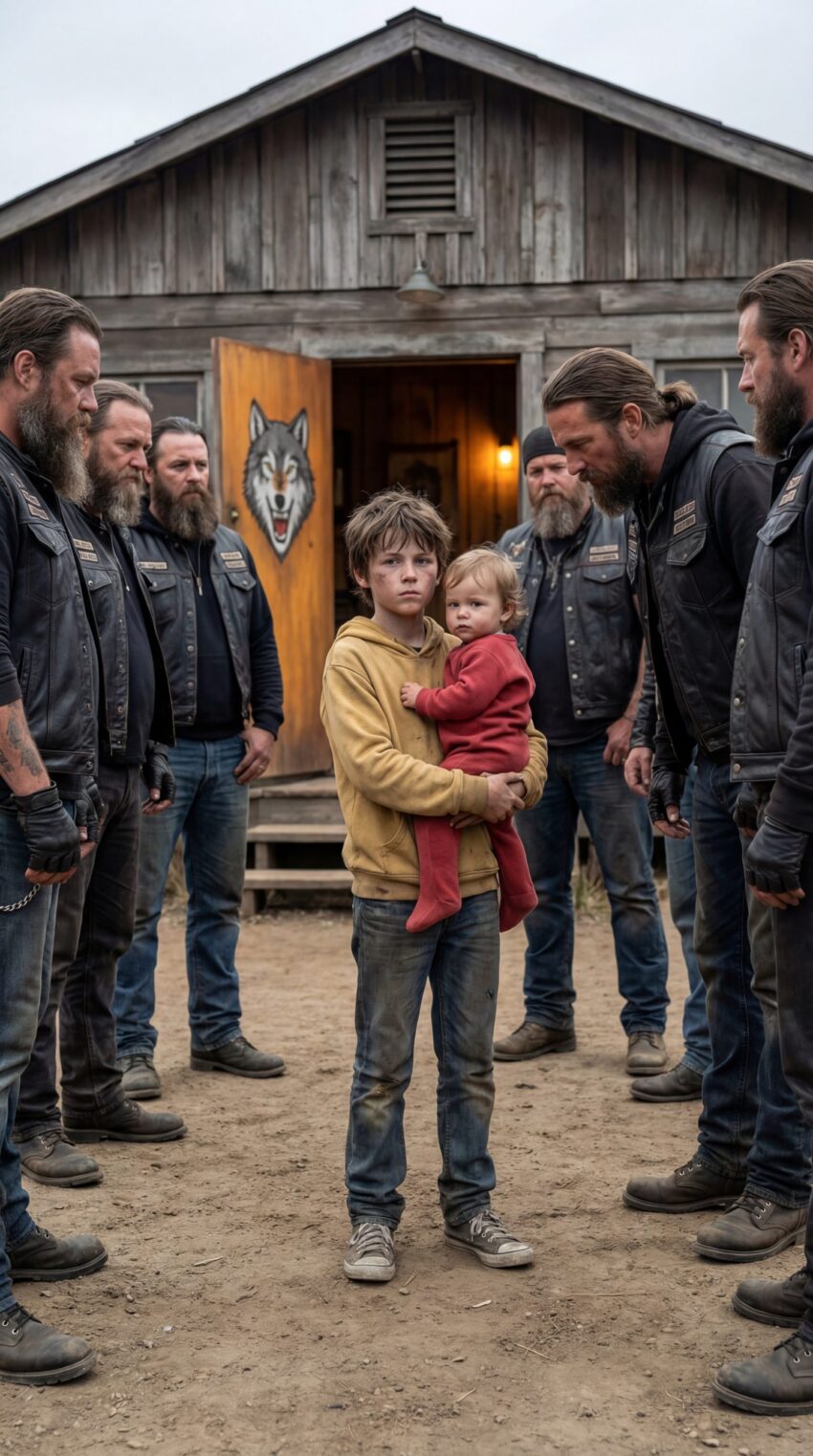
The rain had been falling for hours by the time twelve-year-old Caleb Mercer reached the old clubhouse at the edge of Pine Hollow, Montana. His shoes were soaked through. His jeans clung to his legs. His little sister, Daisy, trembled against his chest beneath a thin borrowed jacket that did almost nothing to keep out the cold.
He stood under the weak porch light with water running down his face and into his eyes, trying to catch his breath. Daisy’s curls were damp against his chin. She was only two years old, too little to understand why her brother had carried her through the dark, too little to understand why home had suddenly become the one place they could no longer stay.
Caleb looked at the painted wolf on the clubhouse door. He had seen the riders around town before. Everyone had. Their motorcycles were loud, their leather cuts were heavy, and people stepped out of their way when they came down Main Street in a group. He did not know whether they were kind men or dangerous men. He only knew that the lights were on, the rain was getting colder, and Daisy had stopped talking twenty minutes ago.
So he lifted his hand and knocked.
Three small knocks.
That was all.
But somehow, in the years that followed, Caleb would remember those three knocks as the sound that divided his life into before and after.
The Door Opens
The door swung open almost at once.
A broad man with a silver beard stood in the frame, one hand still on the handle. He had shoulders like a barn door and tired eyes that sharpened the second he saw the children standing there.
For a brief second, nobody moved.
Then the man looked past Caleb to the empty road, to the rain, to Daisy’s pale face, and stepped aside.
“Get in here, both of you. Now.”
Caleb hesitated only because he had trained himself to hesitate everywhere. He had learned that walking into the wrong room at the wrong time could change everything.
The man seemed to understand that from the look on his face alone.
“You’re safe for this minute,” he said, his voice lower now. “Come inside and let the little one get warm.”
That was enough.
Caleb stepped in, clutching Daisy tighter. The warmth hit him so fast it almost made him dizzy. The place smelled like coffee, engine oil, wet denim, and something cooking in the kitchen. At least a dozen men turned to look. Their conversation stopped. Chairs scraped lightly across the floor. Music played quietly from an old radio near the back, but even that seemed to fade.
No one laughed.
No one asked rude questions.
No one told them to leave.
The bearded man closed the door behind them and said, “Mason, turn that heater up.”
Another man was already moving. A younger rider with tattooed hands dragged two chairs closer to the heating vent in the corner. Someone else disappeared into the kitchen without being asked. A third man came forward with a folded blanket and held it out carefully, as though he understood that sudden movements could scare children more than silence did.
Caleb did not know what to do with such gentleness. He stared at the blanket before taking it.
“Thank you,” he said, because manners were one of the few things his mother had insisted on even when life got hard.
The bearded man nodded once. “I’m Wade.”
“Caleb.”
Wade looked at Daisy, who had buried her face in her brother’s shoulder. “And who’s this?”
“My sister. Daisy.”
Wade’s face changed at that. Not dramatically. Just enough for Caleb to notice.
“All right,” he said. “Let’s take care of Daisy first.”
Warm Milk and Quiet Hands
Everything that happened next felt unreal in the softest possible way.
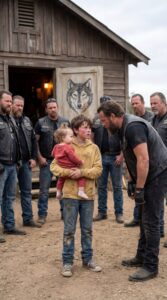
A bowl of soup appeared. Then bread. Then pasta reheated from earlier in the evening. Someone set a mug of warm milk on the table and cooled it with a spoon until it would not burn Daisy’s mouth. Nobody spoke too loudly. Nobody crowded them. The men moved around Caleb and his sister with a strange, almost practiced patience, as if they all understood that frightened children needed room as much as they needed food.
One of the largest men in the room, a rider with a shaved head and a chest like a brick wall, lowered himself onto the floor in front of Daisy. Caleb had seen him when they came in and thought he looked like the kind of man people crossed the street to avoid.
Now that same man crossed his eyes and puffed out his cheeks and made the most ridiculous expression Caleb had ever seen in his life.
Daisy blinked.
Then she laughed.
It was just one small laugh, bright and surprised, but the effect it had on the room was immediate. A few men looked away. Someone cleared his throat. Another rider leaned against the wall and stared down into his coffee like it had suddenly become deeply interesting.
The giant on the floor grinned. “There she is.”
Daisy reached toward him with the easy trust children sometimes gave without explanation.
“Again,” she said.
He made another absurd face, even worse than the first one, and this time she giggled so hard she nearly spilled her milk.
Caleb felt something tight in his chest loosen a little.
Not because the danger was gone. It was not.
Not because everything was fixed. It was not.
But because Daisy was laughing, and for the first time all evening he was not the only person trying to protect that sound.
The Boy Who Waited to Eat
Wade noticed quickly that Caleb had not touched the food in front of him.
The boy sat with Daisy wrapped in the blanket on his lap, helping her sip the milk, making sure her fingers were warming back up, watching the room with the fixed alertness of someone who had spent too long bracing for the next bad moment.
Only after Daisy had eaten half the bread, only after her eyes started to droop with warmth and exhaustion, did Caleb finally lift his fork.
He ate slowly at first, then faster, then slowed down again as though ashamed of how hungry he really was.
Wade had seen a lot of things in his life. He knew the look of hunger when he saw it.
“When’s the last time you ate?” he asked.
Caleb swallowed before answering. “Yesterday morning.”
The room went very still.
Caleb looked down at the table. “I gave Daisy the last crackers this afternoon.”
Wade said nothing for a moment. Then he took Caleb’s plate, walked into the kitchen, and came back with twice as much food.
He set it down gently.
“You don’t need to stretch it here,” he said. “There’s enough.”
Caleb stared at the plate for one long second before nodding.
“Okay,” he whispered.
What Caleb Finally Told Them
Daisy fell asleep in the back room on a bed the riders put together from couch cushions, folded quilts, and a clean flannel blanket that smelled faintly like cedar. A rider named Boone stood at the doorway for a while afterward as if he had appointed himself her guard without saying so.
Then Wade sat across from Caleb at the old wooden table and waited.
He did not push. He did not rush. He just sat with his hands around a mug of cold coffee and gave the boy the rare gift of being allowed to speak in his own time.
At last, Caleb began.
He told Wade about his mother, Elena, who had gotten sick months ago and had been in the hospital for six weeks. He told him how money had run out long before hope did. He told him about his stepfather, Trent Voss, and the way Trent changed when he drank too much.
Caleb did not describe everything in detail. He did not need to. The shape of it was clear enough.
A shove that became a pattern.
Anger that grew easier every week.
A house that taught a child how to read footsteps, tone of voice, and the sound of a cabinet closing too hard.
“I got good at knowing when it was coming,” Caleb said quietly. “I could usually stay out of the way.”
Wade held his gaze but did not interrupt.
Caleb’s hands tightened around each other.
“But Daisy can’t.”
His voice almost broke on that one sentence.
He stared at the table and went on.
“She doesn’t know when to be quiet. She doesn’t know when somebody’s in one of those moods. She just sings, or asks questions, or wants someone to pick her up.”
Wade looked toward the hallway where the little girl slept.
“Tonight?” he asked.
Caleb nodded.
“He had that look.”
“What look?”
Caleb swallowed hard. “The one that means something bad is close.”
Rain tapped against the windows. Somewhere behind them, someone shut off the radio.
“He started toward Daisy’s room,” Caleb said. “So I took her and ran.”
“How far did you walk?”
“A couple miles, I think.”
“In this weather?”
Caleb gave a small shrug that did not belong on any child.
“I didn’t know where else to go.”
Then, after a pause, he added with painful honesty, “I’ve seen your club around town. I never knew if you were the kind of people I should stay away from… or the kind of people I should hope to find.”
Wade let out a long breath.
“And now?”
Caleb looked up. “I think I made the right choice.”
Wade nodded once. Firm. Certain.
“You did.”
The Men in the Back of the Room
Wade stood up and walked to the back of the clubhouse.
He did not raise his voice. He did not make a speech. He did not need to.
Most of the riders had heard enough already. The room had been listening in silence, not out of curiosity but out of concern. By the time Wade reached the other end of the room, half a dozen men were already pulling out phones, keys, and notebooks.
The club was called the Iron Haven Riders. Around Pine Hollow, people knew them as loud men with scarred knuckles, old grief, and engines that rattled windows. What the town did not always understand was that some men become fierce precisely because life taught them early what it means to be unprotected.
A retired deputy who rode with the club on weekends made the first call to a friend still working at the county office. Another man contacted the emergency family services line and made sure a report was started before midnight. A third rider drove to the hospital to check on Elena Mercer and speak with a nurse who could confirm her condition. Two more quietly headed toward the Mercer house to make sure Trent stayed put until proper authorities could handle the situation.
No one complained.
No one asked whether it was their business.
They simply moved.
Boone came back from checking on Daisy and said, “She’s sleeping hard.”
Wade nodded. “Good.”
Caleb sat at the table watching all of this with the stunned expression of someone who had expected at best one safe night and was instead seeing adults build a plan around him.
“Why are you helping us?” he asked softly.
Wade looked at him for a long moment before answering.
“Because somebody should have helped sooner.”
It was not the whole truth, but it was enough for that moment.
The Night Watch
Sometime after midnight, exhaustion finally won.
Caleb fell asleep in the chair where he sat, still in damp clothes, one hand half-curled over the armrest as if even asleep he was prepared to spring up and run. Boone draped another blanket over him without waking him.
The overhead lights were turned off. Only a lamp in the corner remained, casting a gold circle across the room. The clubhouse, loud and ordinary at the start of the night, had gone almost reverently quiet.
Wade stayed awake by the door.
He watched the rain slide down the windows. He thought about a winter from his own childhood that he rarely allowed himself to remember. He thought about one man, long gone now, who had once offered him a hot meal and a place to breathe when he was young and scared and trying hard not to show it.
He thought about how lives can tilt on small mercies.
A chair pulled close to a heater.
A mug of warm milk.
A child being believed the first time he speaks.
On the wall behind him hung the club’s old motto, painted years ago by a brother who had since passed on:
Some roads are meant for shelter, not escape.
Wade looked across the room at Caleb.
“That’s right,” he murmured to himself. “That’s what this place is for.”
Morning in Pine Hollow
Morning arrived gray and thin, with the rain fading into mist over the pines.
Daisy woke first.
She sat up in her little nest of blankets, looked around with sleepy curiosity, and then spotted Caleb across the room. The instant she saw him, all uncertainty vanished. She climbed down and waddled toward a rider sitting at the table drinking coffee.
This was Remy Dalton, a lean man with tattooed arms and a watchband Daisy found immediately fascinating.
She lifted both hands and said, “Up.”
Remy obeyed at once.
A few minutes later, Caleb jerked awake in his chair, disoriented for half a second before memory rushed back into his face.
“Daisy?”
Remy turned so he could see her safely perched on his arm.
“Right here, buddy.”
Caleb exhaled so deeply it seemed to take the rest of the fear with it for just one second. Then he pressed both hands over his face. When he lowered them, his eyes were dry but red.
“What happens now?” he asked.
Wade pulled out the chair across from him and sat down.
“Now, people are coming who know how to help,” he said. “Good people. People whose job is to make sure you and Daisy stay safe and stay together.”
Caleb listened without moving.
“We’ve already started the paperwork,” Wade continued. “We’ve made calls. We’ve got someone checking on your mom. And your stepfather isn’t going to pretend none of this happened.”
Caleb’s voice was barely above a whisper.
“My mom isn’t forgotten?”
Wade leaned forward.
“Not by us.”
That seemed to reach somewhere deep inside the boy. He nodded once, slowly, like someone setting down a weight he had carried too long.
A Promise That Did Not Fade
The following weeks changed everything, though not all at once.
There were interviews, hearings, forms, waiting rooms, long drives, and difficult days when hope felt slower than it should have. Caleb and Daisy were placed in a temporary home in the next town over, but the Iron Haven Riders made certain it was a decent one. A legal aid attorney connected to the club helped guide the process. The retired deputy stayed involved. Wade kept calling the hospital until Elena’s condition began, little by little, to improve.
And the riders did something else, something smaller and somehow just as important.
They showed up.
Twice a week, sometimes more.
They brought groceries. They fixed a secondhand bicycle for Caleb. They taught him how to tighten a chain, check brake lines, and change oil on an old engine that barely ran but made him smile anyway. They visited Daisy with coloring books, stuffed animals, and the kind of steady affection that did not ask children to earn it first.
Daisy renamed Boone Bear and Remy Dragon Man and considered both names final.
No one argued.
When Elena was finally strong enough to leave the hospital and begin piecing her life back together, the club helped her get to appointments and made sure she understood she was not stepping back into the fight alone. Recovery was not simple. Nothing about their story was simple. But for the first time in a long while, the Mercers were no longer standing in the storm by themselves.
None of it appeared in the local paper.
No photos were posted online.
No one chased praise.
It was just a group of men who had been given a choice one rainy night and had made the right one without hesitation.
The Three Knocks That Changed Everything
Years later, people in Pine Hollow would still tell stories about the Iron Haven Riders, and some of those stories would be true while others would be embroidered the way small-town stories often are. But the most important thing that ever happened at that clubhouse was not a fight, a rally, or a run through the mountains.
It was a child standing in the rain with his baby sister and knocking on a door he was not sure would open.
Caleb Mercer had walked through darkness carrying more responsibility than any twelve-year-old should know. He had not come with a plan. He had not come with proof tucked neatly into a folder. He had come with soaked shoes, a frightened little sister, and enough love to keep moving when fear would have stopped most grown men.
The door opened.
Warmth met them.
People listened.
And because of that, the shape of one family’s future shifted.
Sometimes the world misjudges rough hands and loud engines. Sometimes it mistakes scars for cruelty and silence for indifference. But now and then, the safest room in town is hidden behind the door everyone else was too afraid to knock on.
Caleb did knock.
And on the other side of that door, men who had once needed saving themselves recognized bravery when they saw it.
They answered not with speeches, but with soup, blankets, paperwork, phone calls, patience, and the kind of steady protection that keeps its promises long after the storm has passed.
That is how some lives are changed.
Not all at once.
Just enough at first to get through the night.
Then enough more to build a morning.
Sometimes the bravest person in the room is not the loudest adult but the quiet child who keeps walking through wind and rain because someone smaller is depending on him, and that kind of love deserves to be seen, honored, and protected every single time it appears.
A safe place does not always look polished or perfect from the outside, because sometimes the warmest shelter in the world is found in ordinary rooms filled with imperfect people who have simply decided that no frightened child will be turned away from their door.
The people society judges too quickly are often the very ones who understand pain most deeply, and those who have survived hard roads are sometimes the first to recognize another hurting soul and step forward with the exact kindness they once needed themselves.
Real strength is not only found in power, size, or reputation, but in the ability to make space for tenderness, to lower your voice when someone is afraid, to offer food without shame, and to protect innocence without asking for applause.
One act of mercy given at the right time can interrupt years of fear, because a blanket, a warm meal, a patient listener, or a single sentence like “You are safe here” can begin healing wounds that nobody else ever noticed.
Children should never have to become guardians before they have even had the chance to be children, and whenever one small heart has been carrying too much for too long, it is the responsibility of the adults around them to finally say, “You do not have to hold this alone anymore.”
The most meaningful promises are rarely dramatic in the moment they are spoken, because what matters most is not how beautiful the words sound but whether someone stays, returns, follows through, and proves over time that their care was real.
There is a special kind of goodness in those who help quietly, without cameras, without reward, and without needing the world to notice, because love that is sincere does not perform for attention and protection that is honest does not need an audience.
Even when life has taught someone to expect doors to stay shut, there is still hope in the simple truth that somewhere, someone is willing to open one, listen fully, and help carry what has become too heavy for one person alone.
No storm lasts forever, but some nights feel endless while you are inside them, and that is why compassion matters so much, because for the person trembling in the rain, your choice to step forward may become the beginning of the morning they thought would never come.