PART2:
The waitress came over with a mug already in her hand.
“Morning, honey. What can I get you?”
“Black coffee. Two eggs over medium. Wheat toast if you got it.”
“We got bread that claims it’s wheat.”
“That’ll do.”
She looked at my vest folded on the stool beside me.
“Riding far?”
“Far enough.”
“That sounds like a biker answer.”
“It’s the only kind I’ve got.”
She smiled. Her name tag said Brenda.
Brenda poured coffee that looked like it could strip paint and left me alone, which made her excellent at her job.
I was halfway through my eggs when the man came in with the little girl.
I noticed him first because he entered wrong.
Most people come into a diner and look for a seat, or a waitress, or the restroom, or somebody they’re meeting. He came in and looked at every exit. Door. Kitchen pass-through. Hallway to the bathrooms. Front windows. Back emergency door sign glowing red near the pie case.
Then he looked at the people.
Me.
Brenda.
The old trucker in booth three reading a newspaper.
Nobody else.
Then he pushed the little girl ahead of him with one hand on the back of her neck.
That was the first thing that bothered me.
I have three daughters. All grown now. I’ve held little hands crossing streets, carried sleeping girls from trucks into houses, brushed hair out of feverish faces, caught one daughter by the hood of her coat before she stepped off a curb. I know what a father’s hand looks like on a child. I know what worry looks like. What guidance looks like. What impatience looks like when you’re just trying to get food into a kid before they melt down.
That man’s hand was none of those.
It was control.
Not dramatic. Not violent. Not enough that anybody looking casually would have said anything.
But I saw the pressure in his fingers.
I saw how the little girl’s shoulders rose toward her ears.
He put her on the stool right next to mine.
Not one stool over. Not a booth. Not across from him.
Right next to me.
Then he sat on her other side, close enough that his hip touched her stool, one hand still resting at the back of her neck.
She was maybe seven years old.
Small.
Pink jacket zipped wrong, one side higher than the other. No socks. Sneakers dirty and too loose. Her hair was dark and tangled like nobody had brushed it in days. There was a faint bruise near her temple mostly hidden by hair. Her face had that blank look frightened children get when they have learned that showing fear makes things worse.
Brenda came over.
“Morning. What can I get you two?”
The man didn’t ask the girl.
“Coffee. Black. Pancakes for her.”
Brenda looked at the child.
“You want chocolate chips, sweetheart?”
The girl opened her mouth.
The man’s hand tightened.
“Plain,” he said.
The girl shut her mouth.
Brenda’s eyes flicked to his hand.
Not long.
But long enough.
“Plain pancakes,” she said. “Coming up.”
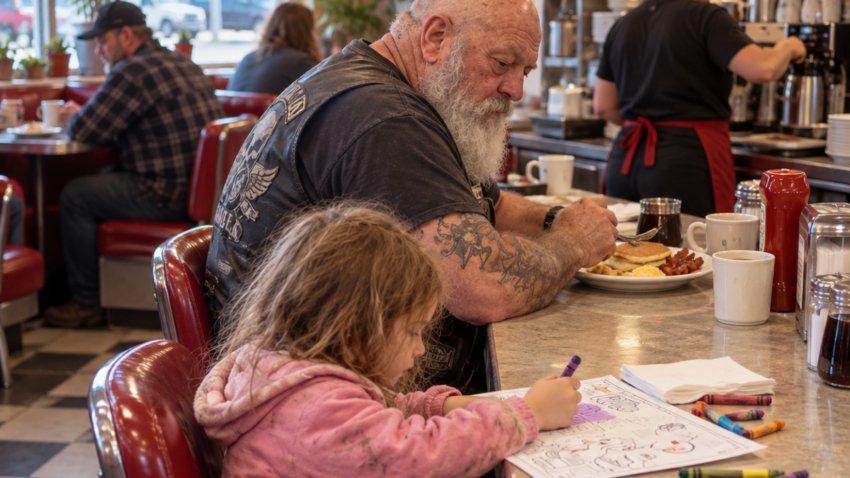
She gave the girl a kids’ menu and a little cup with two crayons in it, one purple and one green.
The girl took the purple crayon.
She did not look at me.
That mattered too.
Children usually look at bikers.
Sometimes they stare. Sometimes they point. Sometimes they whisper to their mothers. Sometimes they grin because chrome and leather and gray beards look like something from a cartoon drawn for grown-ups.
This little girl looked at nothing but the paper in front of her.
She colored in tiny, stiff strokes. Not filling pictures. Just making dark purple lines over the same corner of the menu again and again.
The man’s coffee came.
He drank half of it in one swallow and kept watching the window.
His phone rang.
He glanced at the screen, cursed under his breath, and turned slightly away from the counter.
Not far.
Just enough.
“Yeah,” he said into the phone. “I got her. No, I said I got her.”
The little girl’s crayon stopped moving.
I kept my eyes on my plate.
But every nerve in me had gone awake.
The man lowered his voice.
“No. Not yet. I’m handling it.”
That was when I felt something touch my elbow.
Barely.
Like a moth.
I looked down.
A folded napkin sat beside my coffee cup.
The girl had pushed it across the counter with one finger.
She never turned her head.
The man’s back was still angled away.
I opened the napkin under the edge of the counter.
Purple crayon.
Big shaky letters, the way first graders write when their hands know the words before their spelling does.
The man next to me is not my dad.
My coffee went cold in my hand.
I have been in two wars.
I have had bullets snap near my head, mortars hit close enough to lift dirt into my teeth, a knife held against my ribs outside a bar in Lubbock when I was thirty and too stupid to know fear properly. I have buried brothers, held dying men, watched mothers fold over caskets.
My heart had never pounded like it did in that diner.
I looked at her.
She was staring straight ahead at the pie case. Her purple crayon rested in her hand, but it was shaking so hard it tapped against the counter.
Tap.
Tap.
Tap.
The man was still on the phone.
“No, I’m not stopping again after this,” he said. “I said I’m handling it.”
He ended the call and turned back.
I folded the napkin closed under my palm.
Brenda set down the girl’s pancakes.
“There you go, sweetheart.”
The man threw a twenty on the counter.
“We’re leaving.”
Brenda paused.
“You just ordered.”
“Plans changed.”
The girl flinched.
He stood, grabbed her by the arm, and said, “Let’s go, Emma.”
The flinch was small.
But I saw it.
The name was not hers.
I had maybe thirty seconds before they walked out that door.
No cell signal. I had noticed that when I came in because my phone had been searching since I sat down. One waitress. One old trucker. A cook in the back who looked about nineteen. A man with his hand on a terrified child and something wrong enough that she had risked passing a note to a stranger.
I stood up.
That was when I noticed the purple bleed-through on the napkin.
More writing on the other side.
I flipped it open under the counter.
The second line was smaller, pressed so hard the crayon had torn the paper.
Please hurry. He already took my little brother.
The diner narrowed around me.
Not visually.
Spiritually, maybe.
Everything unnecessary disappeared.
The bad coffee.
The eggs.
The rain-smudged windows.
The country song from the kitchen.
The ache in my knees.
There was only the girl, the man, the door, and the words little brother.
I needed time.
Not much.
Any.
The man was pulling her toward the door.
I did the first thing that came to me.
I knocked my coffee cup off the counter.
It shattered on the tile loud as a gunshot.
Coffee splashed everywhere, including down my own jeans. I jumped back and started cussing like a man who had just lost his wallet and half his dignity.
“Damn it. Damn it. I’m sorry, ma’am. Clumsy old fool.”
Brenda spun around.
The cook poked his head through the pass.
The old trucker looked over his newspaper.
The man froze in the doorway because now everyone in the place was looking in his direction.
That was what I needed.
“I’m sorry,” I said again, loud, making a show of grabbing napkins, patting at my leg, pulling out my wallet. “Let me pay for the cup. I’ll pay for the whole pot if I have to.”
Brenda came around the counter with a towel.
“It’s all right, honey. Just don’t step in it.”
I caught her eye.
Then I slid the napkin across the counter.
Slow.
Flat.
With two fingers.
I tapped it once.
Brenda looked down.
Read it.
Her face went the color of old paper.
To her credit, she did not make a sound.
I mouthed one word.
Police.
Her eyes snapped to mine.
I nodded toward the back.
She turned, walked past the cook, and disappeared through the swinging door like she had only gone for a mop.
The man was watching me now.
The little girl stood beside him, pressed against his hip. His hand had returned to the back of her neck.
“Everything all right over there, friend?” he called.
His voice was friendly.
His eyes weren’t.
“Just old age,” I said. I smiled at him the way you smile at a dog you don’t trust. “Joints go first. Then dignity.”
He didn’t smile.
I looked down at the girl.
“Cute kid. How old’s your daughter?”
He paused half a beat too long.
“Six.”
The little girl’s mouth opened.
His hand tightened.
She closed it.
“Mine are grown now,” I said. “Three of them. Girls grow up fast, don’t they?”
“Yeah.”
He turned for the door.
“We gotta hit the road.”
“Where y’all headed?”
“Oklahoma City.”
The road sign out front said Oklahoma City was behind him, not ahead.
He pushed the door open with his shoulder. The little bell above it rang.
I looked toward the back.
No Brenda.
No sirens.
No time.
So I did the second thing I could think of.
I followed them.
The parking lot had gone brighter with late morning sun, but the air still had a cold edge. A gust of wind pushed dust across the asphalt. The man moved fast, dragging the girl toward the far side.
Toward the white panel van.
No windows in the back.
Oklahoma plates.
First letter scraped off with something sharp.
I felt something old and ugly open inside my chest.
“Hey,” I called out, keeping my voice easy. Country-friendly. Harmless. “Hold on a second.”
He didn’t stop.
“I think your little girl dropped something inside.”
He stopped then.
Did not turn around.
“She didn’t drop anything.”
“Pink mitten,” I said. “Right by the stool. I’ll grab it for you.”
“Mind your business, old man.”
The little girl made a sound.
Not a word.
Just a tiny broken noise.
Like a kitten under a porch.
He opened the back doors of the van.
That was when I saw it.
Inside, on a dirty blue tarp, was a child’s booster seat.
Not hers.
Too small.
Toddler size.
On the floor, half-hidden beneath the tarp, was a red sneaker.
Tiny.
Maybe size seven.
The laces were still tied in a double knot.
The way a mother ties them because little hands get impatient.
The second line of the napkin burned through my mind.
He already took my little brother.
My body made the decision before my brain finished approving it.
I crossed the distance in four strides.
I’m sixty-four years old. My knees are shot. My right shoulder sounds like gravel in a coffee can on damp mornings. I shouldn’t have been able to move that fast.
But I did.
The man heard me coming and turned.
He had a knife out before I reached him.
Short blade.
Fixed.
He had been ready the whole time.
“Back up,” he said. “Back up right now, old man, or I swear to God.”
The girl was between us.
That stopped me.
I lifted both hands slowly.
“All right,” I said. “All right, buddy. I don’t want trouble.”
“Then walk away.”
“I will.”
“Get on your bike and leave.”
“I will. Let me just look at her one time.”
His eyes narrowed.
“What?”
“The little girl. Let me look at her. Then I’ll go. I swear.”
He didn’t understand what I was asking.
He thought I was stalling.
He was right.
Just not for the reason he thought.
I lowered myself into a crouch.
My knees screamed.
I ignored them.
I got eye-level with her.
“Hey, sweetheart,” I said softly. “What’s your real name?”
Her lip trembled.
She looked up at him.
The knife was low by his leg, out of sight of the road. He gave one tiny shake of his head.
“It’s okay,” I said. “You can tell me. I got the napkin. I read it. I know.”
Her eyes filled up.
“Lily,” she whispered.
“Lily,” I repeated. “That’s a beautiful name.”
The man hissed, “Shut up.”
I kept my eyes on her.
“Lily, I need you to do one thing for me. You see that big motorcycle over there? The black one?”
She nodded, barely.
“When I say go, I need you to run to it. Don’t look back. Get down behind the back tire and stay there. Can you do that?”
The man stepped closer.
“I said shut up.”
“Lily,” I said.
Her eyes locked on mine.
“Go.”
She went.
God bless that child, she went.
For three days, she had been controlled, threatened, dragged, renamed, starved, and terrified. But when a stranger in a leather vest told her to run, Lily Garza ran like her life had been waiting for that one word.
The man turned to grab her.
That was his mistake.
I came up out of that crouch with everything I had left.
I was old.
He was younger.
Maybe forty. Strong. Fast. Mean.
But I was a Marine before I was anything else, and some things don’t leave the body even after the body starts charging rent for using them.
I put my shoulder into his ribs and drove him into the open door of the van.
The knife went skittering across the asphalt.
He grunted.
I tried to pin his arm, but he twisted hard and caught me by the throat. We went down on the gravel. My shoulder hit first, and something popped in a way shoulders are not supposed to. Pain flashed white behind my eyes.
I did not let go.
The only thought in my head was back tire.
Get her to the back tire.
Keep him here.
He got on top of me. His fist came down against my cheek. Then my ear. Then the side of my head. The world rang. I tasted blood. Gravel tore into my scalp.
He hit me again.
I clamped one hand around his wrist and the other around his jacket.
All I needed to do was hold him until Brenda got through to someone.
Until the cook came out.
Until the old trucker noticed.
Until God stopped by, if He wasn’t busy.
The man punched me so hard the sky blinked out for a second.
Then I heard the bell above the diner door.
A shout.
Footsteps.
The cook came out holding a cast iron pan.
He was nineteen, maybe twenty. Skinny. Hair net still on. Apron dirty with pancake batter. Face white with fear.
But he kept coming.
The man on top of me turned his head.
The cook swung that pan like he was trying to kill a snake.
It hit the back of the man’s skull with a sound I will hear until I die.
The man went limp on top of me like someone cut his strings.
The cook stood there panting, pan still raised.
“Is she okay?” he gasped. “Is the little girl okay?”
I shoved the man off me.
Everything hurt.
My ribs. My shoulder. My face. My throat.
I rolled onto my hands and knees and crawled toward my Road King.
“Lily,” I called.
Nothing.
“Lily, honey?”
I reached the back tire.
She was there.
Curled tight between the wheel and the saddlebag. Hands over her ears. Eyes squeezed shut. Whole body shaking.
The sight of her alive nearly took what was left of me.
“Lily,” I said. “It’s okay. He can’t get you.”
She didn’t open her eyes.
I did not touch her.
You do not grab a child who has just escaped being grabbed.
I sat down in the gravel beside her, blood dripping onto my vest, and said the only true thing I had.
“You’re safe. You’re safe. You’re safe.”
The first siren came two minutes later.
Longest two minutes of my life.
Brenda must have reached 911 from the office landline. Later I learned she had also locked the front door from the inside after calling, in case the man tried to run back through the diner. She stood in the parking lot now holding a blanket, shaking so badly the fabric fluttered in her hands.
Deputies arrived hard and fast.
Two cruisers, then three.
Guns drawn.
Orders shouted.
They cuffed the man right there while he was still half out of it, one knee in his back, his face pressed into the gravel. I did not feel one bit sorry about it.
Lily still wouldn’t open her eyes.
A deputy approached.
I lifted one bloody hand.
“Slow,” I warned.
He stopped immediately.
Good man.
Brenda came closer with the blanket.
“Can I?” she whispered.
I looked at Lily.
“Sweetheart, Miss Brenda has a blanket. Nobody’s going to touch you unless you say.”
Lily’s eyes opened just a little.
She looked at Brenda.
Then at me.
Her hand came out from under her chin and grabbed two of my fingers.
Hard.
Only then did she nod.
Brenda wrapped the blanket around her without touching more than she had to, tears running down both cheeks.
A sheriff’s lieutenant arrived a few minutes later.
Ramirez.
Mid-forties. Tired eyes. Mustache. The kind of man who looked like he had been born knowing paperwork could not contain evil but still tried.
He crouched near me.
“Sir, you Dale Mercer?”
“Yeah.”
“People call you Preacher?”
“Some do.”
He looked at my face.
“You need medical.”
“She needs it first.”
“She’s getting it.”
He glanced at Lily, then back to me.
“We’ve been looking for this girl since Sunday night.”
“Sunday?”
“Three days. Lily Garza. Taken from her front yard in Las Cruces. Her mother was attacked in the driveway. We thought she might not make it. She woke up this morning and gave us a name.”
My throat closed.
Lily’s fingers tightened around mine.
Ramirez lowered his voice.
“The napkin said something about a brother.”
I nodded.
“She wrote he already took him.”
The lieutenant’s face changed in a way I never want to see on another human being.
He stood immediately and keyed his radio.
“Possible second child victim. We need the girl lucid enough to give location. Get EMS here now. Nobody moves that van until crime scene clears it.”
Then he looked at me.
“Can she talk to you?”
“I don’t know.”
“Try.”
I turned back to Lily.
She was wrapped in the blanket, still holding my fingers like they were a rope tied to shore.
“Honey,” I said softly. “The policeman wants to know about your little brother. Can you tell me where he is?”
Her bottom lip started shaking.
“The motel,” she whispered.
Ramirez crouched on her other side.
“What motel, Lily?”
She pressed closer to me.
“The one with the horse on the sign.”
Ramirez’s eyes sharpened.
“Painted horse? Neon horse? Do you remember?”
“Big horse. Brown. The sign buzzes.”
Ramirez turned to one deputy.
“Mustang Lodge. Six miles east on the frontage road.”
Lily kept talking, words spilling faster now.
“Room eight. Mateo’s in room eight. He tied him to the chair. He said if I was good at the diner, he’d let Mateo have food today.”
She looked up at me then, and her eyes were so old no child should have had them.
“I was good at the diner. Right, mister? I was good. He’ll let Mateo eat now, right?”
I couldn’t answer.
There was no answer that would not hurt her.
So I pulled her gently into my chest, slow enough that she could stop me.
She didn’t.
She folded into me and cried.
I cried too.
I am not ashamed to say it.
Ramirez was already running for his cruiser.
They found Mateo twenty-two minutes later.
Room eight at the Mustang Lodge.
Four years old.
Tied to a chair with phone cord.
Dehydrated.
Broken wrist.
Alive.
Alive.
There are words that deserve their own room.
That one does.
Alive.
They flew Lily and Mateo to Amarillo in the same helicopter. A deputy told me later that Lily held Mateo’s hand the whole flight and kept saying, “A biker helped me. A biker helped me. We’re going home.”
I was in a hospital bed by then too.
Separated shoulder. Two cracked ribs. Concussion. Split eyebrow. Bruised throat. Face swollen enough that when a nurse handed me a mirror, I told her I did not need to see modern art.
Brenda came by before I was discharged.
She stood in the doorway holding her purse with both hands.
“You saved them,” she said.
I shook my head.
“No. Lily did. You called. Marco swung the pan. I just got in the way.”
She cried anyway.
Marco came too, still in his kitchen shoes, hair wet from a nervous shower. He looked embarrassed to be praised.
“You did good, kid,” I told him.
He stared at the floor.
“I thought I killed him.”
“You didn’t.”
“I wanted to.”
“That’s different.”
He looked at me then.
“I was scared.”
“Good.”
His forehead wrinkled.
“Good?”
“Brave doesn’t mean you aren’t scared. It means you come out with the pan anyway.”
He laughed once.
Then cried.
I let him.
Later that night, they brought Elena Garza into my room.
Lily and Mateo’s mother.
She had been transferred from Las Cruces after insisting on being near her children, even though she had stitches in her head and one side shaved where surgeons had relieved bleeding around her skull.
She was maybe thirty. Small. Fierce-looking even in a hospital gown and borrowed sweater. A bruise covered half her face. One eye was swollen. She moved like every step cost more than she had but she paid anyway.
A nurse tried to guide her.
Elena waved her off.
She walked to the side of my bed and stopped.
For a second, she only looked at me.
At the beard.
The bruises.
The sling.
The vest folded on the chair because one of the nurses had cleaned blood off it as best she could.
Then she bent down and put her forehead on my good shoulder.
No words.
Just grief.
Gratitude.
Horror.
Relief.
Everything at once.
I put my good hand lightly on her back and let her cry.
After a while, she whispered, “He took my babies.”
“I know.”
“He came back.”
I waited.
Her voice shook.
“I told him no.”
That was the whole story in four words.
I told him no.
The man’s name was Raymond Kessler. Elena had gone on two dates with him after meeting him through a coworker’s cousin. On the second date, he got angry because she wouldn’t invite him inside. She told him she didn’t want to see him again. He sent messages. Flowers. Apologies. Then insults. Then threats.
She blocked him.
Changed routines.
Told herself she was being paranoid.
On Sunday evening, he came to her house while Lily and Mateo played in the front yard. He hit Elena with something heavy when she stepped outside. The mailman found her in the driveway twenty minutes later, bleeding and unconscious.
For three days, Kessler moved the children across state lines, changing plates, using cash, keeping them quiet with threats.
He called Lily Emma because, according to investigators later, that had been his dead daughter’s name. Whether that was grief, madness, manipulation, or all three, I do not know. I only know Lily flinched every time she heard it.
“He said if I told anyone, Mateo would die,” Lily told detectives.
But she wrote the napkin anyway.
Purple crayon.
Big shaky letters.
A seven-year-old girl with no socks, no phone, no adult she could trust, and a little brother tied to a chair in a motel room wrote the truth down and slid it to a stranger.
People keep calling me a hero.
That child saved herself.
I just read what she wrote.
When Elena finally lifted her head from my shoulder, she wiped her face with both hands.
“Can I ask you something?”
“Anything.”
“Why did she pick you?”
I thought about that.
The vest.
The beard.
The age.
The three daughters.
The way I had been watching because something felt wrong.
“I don’t know,” I said.
Elena nodded.
“She told the nurse you looked like a grandpa.”
That broke something open in me.
I had no grandchildren.
My daughters had their own lives, good lives, busy lives. Two lived far away. One barely spoke to me except on birthdays and holidays because I had not been the kind of father a man should have been when she was small. I loved them. They loved me in the complicated way grown children sometimes love flawed parents from a safe distance.
Grandpa was not a name anybody had given me.
But Lily Garza, scared out of her mind in a truck stop diner, had looked at me and seen something safe enough to risk everything.
“I’ll try to live up to that,” I said.
Elena squeezed my hand.
“You already did.”
The story made the news, though none of us wanted the kind of attention that turns trauma into entertainment. They blurred Lily’s face. Mateo’s too. They showed the diner from the outside, the parking lot, the white van being towed, my motorcycle with crime scene tape fluttering nearby. They called me a retired Marine and biker. They called Marco a quick-thinking cook. They called Brenda alert. They called Lily brave, which she was, though I worried people would forget she was also a child who should never have needed bravery like that.
Kessler survived the cast iron pan.
Unfortunately.
He was charged with kidnapping, attempted murder, assault, unlawful restraint, and a list of other things that looked too small on paper compared to what he had done. Later, investigators connected him to another case in Oklahoma, an attempted abduction the year before that had fallen apart because a grandmother screamed loud enough to wake a neighborhood.
Men like him do not start with the worst thing.
They practice.
That is what I learned.
They test boundaries. Push. Apologize. Return. Escalate. They count on politeness, silence, disbelief, and people not wanting to make a scene.
Lily made a scene with a napkin.
I made one with a coffee cup.
Brenda made one with a phone call.
Marco made one with a pan.
Thank God for scenes.
I went home three days later with my shoulder in a sling, ribs taped, head aching, and strict instructions not to ride for six weeks. I nodded at the doctor like I was going to listen.
My Road King stayed at the diner until one of my brothers rode down to get it. He called me from the parking lot.
“Bike’s fine,” he said.
“That’s more than I can say.”
“Heard you got beat up by a civilian.”
“Tell it that way and I’ll come over there with one arm.”
He laughed.
Then his voice softened.
“You did good, Preacher.”
I closed my eyes.
“Kid did good.”
“Yeah,” he said. “She did.”
Lily called me four days after I got home.
I was in my recliner, half-asleep under a blanket, when my phone rang. Unknown number. I almost let it go to voicemail, then answered because something told me to.
“Mister Preacher?”
Her voice was tiny on the line.
“Hey, sweetheart.”
“My mama says you’re my friend forever now.”
I had to clear my throat.
“Your mama’s right.”
“She says you got hurt.”
“I’m all right.”
“Does your face hurt?”
“Only when I look in a mirror.”
There was a pause.
Then a very small laugh.
It was the best sound I had heard in years.
“I drew you a picture,” she said. “Can I mail it to you?”
“I’d like that more than anything.”
Another pause.
I could hear breathing.
“Mister Preacher?”
“Yeah?”
“I’m sorry I was scared.”
I sat up despite my ribs.
“Honey. Lily. Listen to me. You don’t ever apologize for being scared. Being scared is what your body does when something is wrong. You were brave.”
“I didn’t feel brave.”
“Most brave people don’t while they’re doing the brave thing.”
“I cried.”
“Brave people cry.”
“I gave you the napkin because I didn’t know what else to do.”
“You did exactly right.”
She was quiet.
“You picked me out of a whole diner,” I said. “Do you know how smart that was? How strong?”
“I picked you because you looked like a grandpa.”
I put the phone down for a minute.
Not far.
Just enough to cover my face with my hand.
When I picked it back up, I said, “That’s about the nicest thing anybody ever called me.”
“My grandpa died,” she said.
“I’m sorry.”
“He helped little girls.”
I looked around my living room, at the boots by the door, the old helmet on the shelf, the framed photograph of my wife Denise on the mantel.
“I’ll try,” I said.
The picture arrived a week later.
A white envelope addressed in Elena’s handwriting, but inside was Lily’s drawing.
Stick figures.
A man with a gray beard on a black motorcycle. A little girl on the back. Both smiling. The motorcycle had purple wheels because apparently accuracy has limits when crayons are involved.
At the top, in big purple letters, she had written:
My new best friend.
The napkin was already in my house.
Lieutenant Ramirez had returned it after the initial evidence photographs and processing because the prosecutor said they had what they needed. I expected it to stay in a box somewhere. Instead, Elena asked if I could have it.
So I framed it.
The napkin and the drawing hang side by side now in my kitchen, right above the little table where I drink coffee every morning.
I look at them before I pour the first cup.
Every time.
The first line.
The man next to me is not my dad.
The second.
Please hurry. He already took my little brother.
Then the picture.
My new best friend.
People ask me what I think about most.
It is not the fight.
It is not the knife.
Not the blood, not the pan, not the sirens.
It is where I sat.
I almost took a booth by the window that morning. The sun was coming through in a way that felt good on my shoulders. I almost sat there, facing the parking lot, far enough from the counter that Lily would have been seated somewhere else.
I didn’t.
Because the counter had the better coffee pot.
Because I am particular about coffee.
Because a waitress named Brenda called me honey.
Because a cook named Marco came to work that morning instead of calling in sick.
Because Lily was brave enough to write.
Because I was paying attention.
Because of a thousand ordinary things that could have gone another way.
If I had sat by the window, I don’t know what happens to those two kids.
Actually, I do know what probably happens.
I just don’t want to put the words in my mouth.
A lot of us walk around thinking we need to do something big to matter. Something heroic. Something carved in stone. Something people will stand up and applaud.
Most of the time, mattering looks smaller.
It looks like noticing.
The hand on the wrong neck.
The child with no socks.
The name she flinches at.
The van with no windows.
The silence that does not feel like shyness.
It looks like dropping a coffee cup.
It looks like a waitress walking calmly to the back when her face has gone white.
It looks like a nineteen-year-old cook running into danger with a pan because a little girl might not get another chance.
It looks like making a scene when every polite bone in your body says not to.
Be embarrassed.
Be loud.
Be wrong sometimes.
Apologize when you are.
But if something in you says a child is not safe, do not let comfort talk you out of courage.
Because somewhere there may be a little girl with a purple crayon waiting to see if one adult in the whole world will notice her.
Lily picked me because I looked like a grandpa.
So these days, when I ride, I try to look a little more like what she believed I was.
Not softer, exactly.
Not weaker.
Just more awake.
More willing to let my eyes rest on what feels wrong.
More willing to spill coffee if coffee needs spilling.
A month after the diner, Elena brought Lily and Mateo to see me.
I was mostly healed by then, though my shoulder still hated weather and my ribs complained when I laughed. They pulled into my driveway in a little blue sedan with a dented bumper. Elena got out first, moving slower than a thirty-year-old woman should, but alive. Mateo climbed out next, wrist still in a small cast covered with stickers.
Lily stayed in the backseat for a minute.
I waited on the porch.
No rushing.
No big gestures.
Finally, she stepped out.
Pink jacket again, but clean now. Socks with yellow stars. Hair brushed into two braids. She held a paper bag in both hands like it contained treasure.
Mateo hid behind Elena’s leg and peeked at me.
Lily walked up the porch steps.
“Hi, Mister Preacher.”
“Hi, best friend.”
She smiled.
Just a little.
Then she handed me the bag.
Inside was a purple crayon.
I looked at her.
She shrugged.
“In case somebody else needs one.”
I had to sit down.
She sat beside me.
Mateo slowly climbed the steps and inspected my boots.
“Big,” he said.
“Yours will get there.”
He looked doubtful.
Elena stood at the bottom of the porch, one hand over her mouth, eyes wet.
Lily leaned against my good arm.
Not much.
Just enough.
A child’s trust is not a thing you take lightly after seeing what the wrong adult did with it.
So I sat very still and let her decide how close was safe.
After a while, Mateo asked if my motorcycle was loud.
“Yes,” I said.
“Can it scare bad guys?”
“Sometimes.”
“Can I sit on it?”
Elena started to say no.
Then stopped.
She looked at me.
I nodded.
“Engine off,” she said.
Mateo climbed onto the Road King with my help, grinning so wide his whole face changed. Lily stood beside him, one hand touching the seat but not climbing on.
“You don’t have to,” I told her.
“I know.”
She looked at the bike.
Then at me.
“Maybe next time.”
“Next time works.”
And there was a next time.
That is the part I hold onto.
The story did not freeze those children forever in a parking lot. It kept moving.
Mateo’s cast came off.
Lily started therapy.
Elena went back to work slowly.
Ramirez called occasionally with case updates until the plea deal became official. Kessler would not see daylight for a long time. Not long enough, maybe. But long.
Brenda left the diner six months later and opened a small bakery with her sister. She sends me cinnamon rolls twice a year. Marco became a deputy. He says the pan incident made him realize he did not want to spend his life flipping eggs. I told him law enforcement involved less pancake batter but more paperwork. He said he would risk it.
Lily still writes sometimes.
Mostly postcards.
Purple ink when she can find it.
Dear Mister Preacher,
Mateo lost a tooth. He thinks the tooth fairy is cheap.
Love, Lily.
Dear Mister Preacher,
I rode a pony. It was not as cool as your motorcycle but it was okay.
Love, Lily.
Dear Mister Preacher,
Mama says brave is telling the truth even when your voice shakes. I think she is right.
Love, Lily.
I keep every one.
The last one came with a school photo. Lily in a blue dress, hair brushed, missing one front tooth, eyes still older than they should be but softer now.
On the back she wrote:
To my biker grandpa.
I stared at that longer than a grown man should stare at a school picture.
Then I put it beside the napkin.
Every morning, I look at all of it.
The napkin.
The drawing.
The purple crayon in a little glass jar.
The school photo.
And every morning I thank God I sat at the counter.
Not because I was a hero.
Because I was close enough to be chosen.
Because a little girl was brave enough to ask.
Because someone once told me grandpas help little girls, and for one morning on I-40, with bad coffee cooling beside me and a white van waiting outside, I got to prove her right.