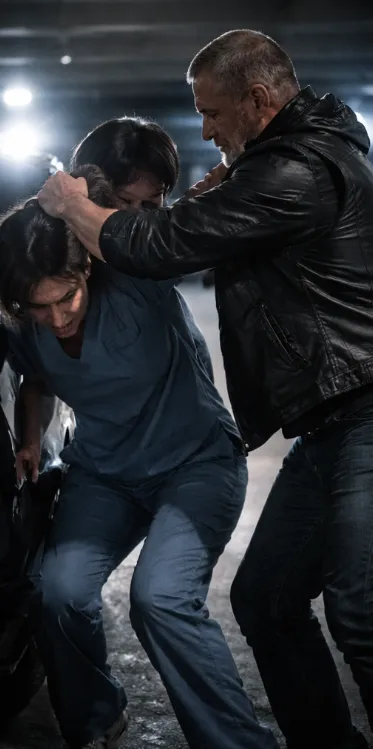
The hand clamped over my mouth came out of nowhere, crushing my scream before it even formed. I felt myself yanked backward, my shoes scraping helplessly across the concrete as he dragged me toward the stairwell, the echo of my own heartbeat louder than anything else in that empty parking garage.
I tried to fight, to twist free, to bite down on his palm, but he was stronger—too strong—and the smell of sweat and oil filled my lungs as panic swallowed me whole.
Then a blinding light cut through the darkness.
The roar of a motorcycle engine tore across the garage, and for a split second, everything froze. My attacker hesitated, his grip faltering just enough for hope to flicker inside my chest.
The biker didn’t shout. He didn’t hesitate. He moved.
In one brutal motion, he ripped the man off me and slammed him against the side of a parked car. Metal groaned under the impact. My attacker stumbled, scrambled, and then ran—disappearing into the shadows as if the darkness itself swallowed him whole.
I collapsed to the ground, shaking so violently I couldn’t feel my hands.
The biker stood over me for a moment, breathing heavily, then slowly crouched down, careful, like I might break if he moved too fast. He shrugged off his leather jacket and draped it around my shoulders without a word.
“You’re safe,” he said quietly.
The words barely registered, but the steadiness in his voice anchored me just enough to breathe again.
He called the police. Called hospital security. Stayed with me while I struggled to answer questions I could barely process. When they asked his name, I learned it—Marcus.
He looked like the kind of man I’d been taught to avoid my whole life. Leather vest patched with symbols I didn’t recognize. Thick gray beard. Knuckles lined with old scars that spoke of a past I couldn’t imagine. But his eyes… his eyes were gentle in a way that didn’t match the rest of him.
And he didn’t leave.
Through the police report, through the hospital exam, through the long, quiet hours where the adrenaline drained out of me and left nothing but trembling exhaustion behind—Marcus stayed.
“You don’t have to stay,” I told him once, then again, my voice thin and unsteady.
“I know,” he said both times.
But he didn’t move.
When my roommate finally arrived hours later, he walked us to her car, scanning every corner of the garage like he was memorizing it. Only when we were safely inside did he step back, give a small nod, and turn away.
I thought that was the end of it.
A stranger stepping in at the right moment. A life intersecting with mine for a few terrifying minutes before disappearing forever.
But the next night, when I came in for my shift, I saw him again.
Marcus sat in the waiting room, his large frame awkwardly folded into a chair that looked like it might collapse under him. His hands rested on his knees, still, patient, as if he had been there for hours.
“What are you doing here?” I asked, unable to keep the surprise from my voice.
“Making sure you get to your car safe.”
“You don’t have to do that.”
“I know.”
When my shift ended, he didn’t walk beside me. He stayed a few steps behind, silent, watchful, like a shadow that refused to let the darkness close in again. He stopped when I reached my car, waited until I locked the doors, until the engine started, until I drove away.
The next night, he was there again.
And the night after that.
For two weeks, Marcus showed up every shift I worked. He never asked for anything. Never tried to get close. Never crossed a line. He simply… stayed.
Other nurses began to notice. They whispered, curious, teasing me gently about my “mysterious biker.”
“Is he your boyfriend?” one of them joked.
I shook my head. “No. He’s just… a friend.”
The word felt strange at first. Too big for someone I barely knew. But as the nights passed, it started to feel true.
On the fifteenth night, I couldn’t hold back anymore.
“Marcus, why are you doing this?” I asked, stepping closer to him than I ever had before. “Why do you keep coming back?”
He stiffened slightly, like I had touched something he wasn’t ready to show. His eyes flickered away, then back again, heavy with something I couldn’t quite name.
“Because I should’ve been here sooner,” he said.
The words hung in the air, confusing, unsettling.
“What do you mean?”
He exhaled slowly, his gaze dropping to the floor.
“Three months ago. Same garage. Different woman.”
My stomach tightened.
“I was visiting someone upstairs when I heard screaming,” he continued. “By the time I got down there… it was too late. The police came. Ambulance took her away. I gave a statement, but I didn’t see who did it.”
A cold chill crept through me, threading its way into my bones.
“The man who attacked me—”
“Same guy,” Marcus said quietly. “I saw his face this time. When I pulled him off you, I recognized him. Same build. Same way of moving.”
My breath caught as the realization slammed into me.
“So you’ve been coming back every night because…”
“Because I wasn’t there in time to stop him the first time.” His voice was low, steady, but there was something raw beneath it. “But I can make sure there isn’t a third.”
I stared at him, at the weight he carried in his eyes, and something inside me broke.
“That wasn’t your fault,” I said softly.
“Maybe,” he replied with a small shrug. “But I’m here now.”
The words should’ve been enough. They should’ve ended the conversation.
But something else lingered.
“The woman… from three months ago,” I asked carefully. “Is she okay?”
Marcus didn’t answer right away. He stood there, silent, his shoulders heavy, as if the truth itself was something difficult to carry.
Then, finally, he spoke.
“She’s in Room 402.”
My heart skipped.
I knew that room. I worked that floor.
Jane Doe. Unidentified. No family. No visitors. A woman kept alive by machines, her body fighting a battle her mind hadn’t yet returned to.
“In a coma,” Marcus added quietly. “Brain injury. She hasn’t woken up since.”
The world tilted beneath me as everything connected.
“You visit her?” I whispered.
“Every day,” he said. “I sit with her. I read to her. Tell her about the weather. About the people passing by. Since she doesn’t have anyone else…” He paused, his voice tightening just slightly. “I figured I owe her that much.”
Tears burned behind my eyes.
The “mystery visitor” the nurses talked about. The one who brought fresh flowers for a woman who couldn’t smell them. The one who sat for hours, speaking softly to someone who couldn’t answer.
It was him.
“I couldn’t save her life,” Marcus continued. “But I can make sure she doesn’t fight for it alone.”
I didn’t realize I was crying until the tears slipped down my face.
“Marcus…” My voice trembled. “It wasn’t your fault.”
He didn’t argue this time. He just nodded slightly.
“But I’m here now,” he repeated.
Two nights later, the police came.
Marcus had remembered more than just a face. He had memorized part of the license plate the attacker fled with that night, repeating it over and over until it etched itself into his mind.
It was enough.
They found him three towns over.
They arrested him.
And this time, there was no escaping.
He confessed to both attacks.
That night, I walked into the parking garage with a strange mix of relief and lingering fear. Marcus was there, leaning against his bike, as if nothing had changed.
“They got him,” I said.
For a moment, he didn’t respond. Then his shoulders dropped, the tension that had lived in him for months finally loosening.
“Good,” he said quietly. “That’s… good.”
“You don’t have to guard me anymore,” I told him.
“I suppose not.” He picked up his helmet. “You take care of yourself, nurse.”
He turned, ready to leave.
“Wait.”
The word came out before I could stop it.
I stepped forward and wrapped my arms around him.
He froze, clearly surprised, then slowly—carefully—patted my back, like he wasn’t sure he deserved the gesture.
“Come inside,” I said. “There’s someone you should meet properly.”
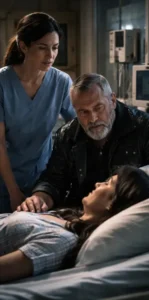
I led him up to the fourth floor, down the quiet hallway, and into Room 402.
But this time, I didn’t let him sit in the corner like a visitor who didn’t belong.
“Talk to her,” I said gently. “She hears you. I know she does.”
Marcus hesitated, then stepped closer, taking the woman’s hand in his large, scarred one.
“Hey,” he murmured. “It’s me. The guy from the garage.” His voice softened. “They got him. He can’t hurt anyone else now. You… you don’t have to be afraid anymore.”
He swallowed hard.
“You can rest. Or you can wake up. But you’re not alone.”
A week later, her fingers twitched in his hand.
A month later, she opened her eyes.
And the first thing she saw… was him.
Marcus wasn’t just a biker anymore. Not to her. Not to me.
He was the man who stayed when he didn’t have to.
The man who carried guilt that wasn’t his.
The man who refused to let darkness win twice.
I still see him sometimes.
He doesn’t stand guard in the parking garage anymore. Instead, he parks his bike out front, grabs a coffee, and heads upstairs—always to the same room, always to the same bedside.
And every time I hear the distant rumble of his motorcycle, I remember something I didn’t understand before.
Heroes don’t always look like heroes.
Sometimes, they look like the people we were taught to fear… and turn out to be the ones who save us anyway.