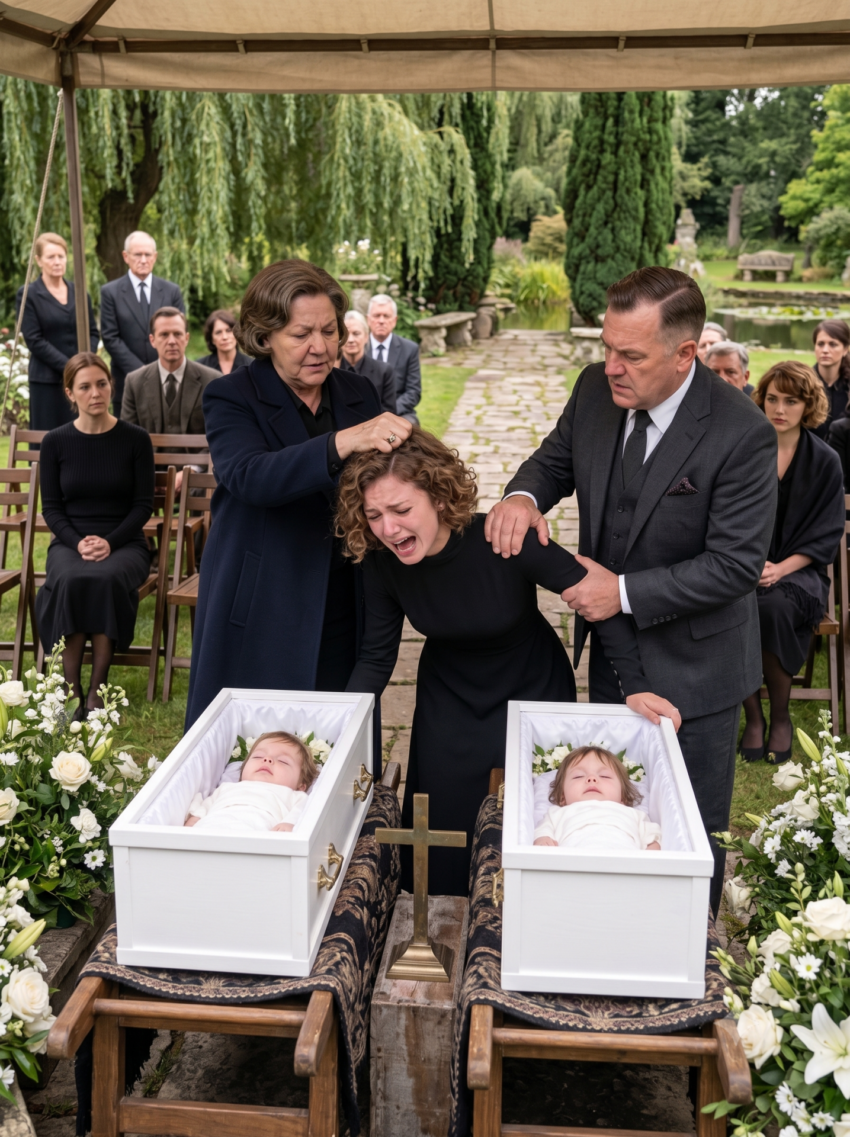
My mother-in-law was standing between the two small white caskets when she looked directly at me and said God had taken my sons because He knew what kind of mother I was.
I had heard plenty from Diane over the eight years I had been married to her son. I had heard that I worked too much, that I held my babies too often, that I spoiled my four-year-old daughter, and that women in her generation had managed three children without complaining.
But I had never heard anything like that.
Not there.
Not with eleven-month-old Caleb and Connor lying six feet away in matching white caskets.
“Diane, stop.”
My voice came out quieter than I expected.
She stared at me.
“Excuse me?”
“I said stop. Please don’t say another word about my boys.”
Her face changed. She stepped toward me so quickly that the folding chair behind her scraped across the church floor.
What happened next lasted only seconds.
Her hand caught the side of my face, someone shouted, and I stumbled into a flower stand beside Caleb’s casket. Before I could straighten myself, my husband, Ryan, grabbed both of my arms from behind.
Not his mother’s.
Mine.
“Laura, enough,” he said into my ear. “Not here.”
I turned my head and looked at him.
“You’re holding me.”
“Because you’re making this worse.”
His mother had just struck me beside our sons’ caskets, and Ryan was telling me to calm down.
Then I heard my daughter’s voice.
Emma had been sitting in the front pew with Pastor Daniel. She slipped down from the bench and walked toward him, clutching the sleeve of her black cardigan.
“Pastor Daniel?”
He bent toward her.
“Yes, sweetheart?”
Emma glanced at her grandmother.
Then she asked the question that changed everything.
“Can I tell Mommy about the stuff Grandma put in the babies’ bottle now?”
Nobody moved.
Ryan’s hands loosened around my arms.
I looked at Emma.
“What bottle?”
She pointed toward Diane.
“The one Grandma made when you were upstairs.”
Diane went pale.
And for the first time since my sons died, I stopped crying.
What Emma Said She Saw
Pastor Daniel immediately moved Emma away from the adults. He didn’t question her or ask her to repeat herself. He simply took her hand and led her toward the church office while one of my sisters followed.
Diane tried to go after them.
I stepped in front of her.
“What did she see?”
“Nothing.”
“Then why are you scared?”
“I am not scared.”
Her voice had gone thin.
Ryan finally moved between us, but he still looked at me as though I was creating a problem he needed to contain.
“Laura, Emma is four. She probably saw Mom making formula.”
“She said your mother put something in it.”
“Kids say things.”
I stared at him.
For years, those three words had taken different forms in our house.
Mom didn’t mean it.
Mom is just old-fashioned.
That’s how Mom talks.
Don’t turn everything into a fight.
Let it go.
Keep the peace.
I had spent most of my marriage keeping a peace that apparently existed only when I stayed quiet.
Diane picked up her purse.
“I’m leaving.”
Pastor Daniel came back into the sanctuary just as she reached the aisle.
“No,” he said.
Diane stopped.
He was normally one of the gentlest people I knew. That afternoon, there was nothing gentle in his expression.
“One of the funeral-home employees has called the police.”
“For what?”
“Until someone understands what that child was talking about, I think everybody should remain here.”
Diane laughed once.
“This is insane.”
Then she walked toward the side exit anyway.
Two funeral-home employees followed her into the parking lot.
The police arrived before she could leave.
I remember standing beside the two white caskets while an officer asked me when Caleb and Connor had last eaten.
That was when the bottle came back to me.
Not Emma’s story.
The actual bottle.
The cloudy plastic bottle I had taken from Connor’s crib the morning we found them.
I had washed almost everything else that day because I couldn’t stand seeing their things where they had left them. But an officer who responded to the house had told me not to touch anything from the nursery until the medical examiner finished the initial review.
So the bottle had been collected.
I looked at the officer.
“You still have it.”
“Have what?”
“One of their bottles. From the nursery.”
His expression sharpened.
“Which child?”
“Connor’s. I think. There was still formula in it.”
That was the first concrete thing I could give them.
And it was enough to turn Emma’s strange little sentence into something they could actually investigate.
The Last Night With My Boys
The night Caleb and Connor died had seemed ordinary until it wasn’t.
They had been fussy from teething, and I was exhausted. Ryan was working late at his family’s insurance office. Diane had stopped by around seven with groceries I hadn’t asked for and immediately began criticizing the laundry on the couch.
I went upstairs to give Emma a bath.
Diane stayed downstairs with the twins.
I remembered that clearly.
What I did not remember was seeing her make their bottles.
When I came back down, both bottles were already sitting on the kitchen counter.
“They were hungry,” she had said.
I hadn’t questioned it.
Why would I?
She was their grandmother.
That sentence would bother me for a long time afterward.
The boys drank, became unusually quiet, and went to sleep early. Diane left around nine.
The next morning, neither baby woke up.
For the first several days, everyone told us sometimes terrible things happen without giving families a reason. There were examinations, questions, medical terms I barely understood and long stretches of waiting.
Then came the funeral.
Then came Emma.
Detective Rachel Bennett met me at the police station that evening. She was in her forties, with a legal pad and a voice so calm that I kept waiting for her to tell me none of this meant anything.
She didn’t.
“We’re not going to interview Emma the way we’re interviewing you,” she explained. “A child specialist will speak with her. We need to be very careful not to put words in her mouth.”
“She saw something.”
“She may have. That’s why we’re going to do this correctly.”
Ryan was sitting beside me.
“My mother would never hurt those boys.”
Detective Bennett looked at him.
“I didn’t say she did.”
“But that’s what everyone is thinking.”
I turned toward him.
“Your daughter said she saw your mother put something in their bottle.”
He rubbed both hands over his face.
“Laura, I know what she said.”
“Then stop explaining it away.”
He lowered his hands.
“I’m trying to understand.”
“No. You’re doing what you always do.”
Detective Bennett looked down at her notes and gave us a moment.
Ryan whispered my name.
I picked up my purse.
“I’m going home with Emma. You should stay somewhere else tonight.”
He stared at me.
“You’re kicking me out?”
“Yes.”
That was the first time in eight years that Ryan asked me to overlook something involving his mother and I simply refused.
He slept at a hotel.
Three days later, Detective Bennett called.
There had been a preliminary finding from the residue inside the bottle.
A sedating substance was present.
I sat at my kitchen table with the phone pressed to my ear while Emma colored beside me.
“What does that mean?”
“It means we have enough to keep investigating.”
“Was it in my sons?”
There was a pause.
“We’re waiting on confirmation from the medical examiner.”
I looked across the kitchen.
One of the twins’ clean bottles was still upside down on the drying rack.
I hadn’t been able to put it away.
“And Diane?”
“We executed a search.”
“Did you find anything?”
Another pause.
“We recovered an item from trash behind her residence. I can’t give you more than that yet.”
But I understood enough.
For the first time since the morning I found my sons, somebody was no longer telling me there might never be an answer.
There was something in the bottle.
And the police had found something behind Diane’s house.
The Comment Under the Funeral Video
I didn’t know anyone had recorded what happened at the funeral until my sister showed me the video.
Someone near the back of the sanctuary had caught the moment Diane came toward me and the seconds afterward when Ryan grabbed my arms. The video ended before Emma spoke, but that didn’t stop it from spreading through local Facebook groups.
I hated it.
People who had never met my sons were arguing about my marriage under a video taken feet from their caskets.
Then Detective Bennett called again.
“Have you seen the comments?”
“I stopped reading them.”
“There’s one I need to ask you about.”
She sent me a screenshot.
The account had no profile picture.
The comment contained one sentence.
Ask the police to check the other babies in that family.
I read it twice.
“What does that mean?”
“That’s what I intend to find out.”
The account disappeared before I could respond.
But Detective Bennett had already saved it.
Over the next few weeks, the investigation widened.
I learned about two incidents I had never heard discussed openly in Ryan’s family.
Years earlier, a relative’s infant had died under circumstances the family still described as unexplained. Another young child had been hospitalized after becoming extremely difficult to wake following an afternoon nap.
Neither incident proved anything about Diane.
Detective Bennett was careful about that.
But Diane had been present both times.
She had offered to watch both children.
And relatives remembered both children being unusually sleepy.
When I told Ryan, he sat at the far end of our couch without speaking.
He had come over to see Emma, and we had been trying to establish a routine where he could spend time with her while I remained nearby.
“Did you know?” I asked.
“Not like that.”
“That wasn’t my question.”
He stared at the floor.
“I knew my cousin’s baby died. I knew about Natalie going to the hospital.”
“Did you know your mother had been watching them?”
His silence answered me.
I stood and picked up the coffee mug in front of him.
“You need to leave.”
“Laura.”
“Not tonight.”
He stood too.
“I didn’t know there was anything to connect.”
“Maybe you didn’t.”
I carried his mug to the sink.
“But every time your mother crossed a line, you trained everyone around you not to look too closely.”
He didn’t argue.
That frightened me more than if he had.
Emma’s Secret Was Never Hers to Keep
Emma began seeing a child therapist twice a week.
For the first month, she asked me almost every night whether Grandma Diane was angry with her.
I always gave her the same answer.
“You are not responsible for a grown-up being angry because you told the truth.”
One evening she was sitting on the bathroom counter while I brushed her hair.
“Grandma said good girls can keep secrets.”
My hand stopped.
“When did she say that?”
“When she gave me the cookie.”
I put the brush down.
“What cookie?”
“The night the babies went sleepy.”
I sat beside her.
I wanted to ask a hundred questions.
I didn’t.
The therapist had taught me not to investigate through my daughter.
“Okay,” I said. “You can tell Ms. Kelly about that tomorrow.”
Emma nodded.
Then she asked, “Are surprises bad too?”
“No. Surprises end. Like a birthday present. Secrets that make you scared are different.”
She thought about that.
“So I can always tell you?”
“Always.”
That became our rule.
Ryan started therapy too.
He moved into a small apartment fifteen minutes away and stopped asking me to speak to his mother’s attorney. For the first time since I had known him, he stopped describing Diane as difficult, intense or misunderstood.
He began calling what she did by its actual name.
Still, that didn’t repair what had happened between us.
One afternoon, after Emma went to my sister’s house, Ryan stood in our kitchen looking at the unused high chairs.
“Do you think there’s any chance for us?”
I folded a dish towel.
“I don’t know.”
“I should have protected you.”
I looked at him.
“You should have believed me before it took this.”
He nodded.
There wasn’t anything else to say.
Then, six weeks after the funeral, Detective Bennett called and asked me to come to the station.
The final laboratory results were back.
The substance found in the bottle was consistent with what had been detected in testing connected to Caleb and Connor’s deaths.
The container recovered from behind Diane’s house contained the same substance.
Diane was charged.
The assault at the funeral was added separately.
I sat in Detective Bennett’s office and stared at the photograph of the bottle inside an evidence bag.
It looked so ordinary.
Cloudy plastic.
Blue measurement marks.
A white cap.
I had washed that kind of bottle hundreds of times.
I had warmed them at two in the morning, packed them into diaper bags and balanced them against my shoulder while carrying one twin in each arm.
Now one of those bottles was evidence.
The Woman Who Left the Comment
Diane was being escorted out after a pretrial hearing when she finally stopped pretending.
Ryan was standing about twenty feet from me in the courthouse hallway. He had attended every hearing but sat separately.
Diane saw him.
She twisted away from the deputy just enough to call his name.
“Ryan!”
He looked up.
“I did it for you!”
The hallway went quiet.
Her attorney immediately told her to stop talking.
She didn’t.
“Those babies were destroying your marriage. She couldn’t handle them. You were miserable.”
Ryan’s face didn’t change.
Diane kept talking.
“I was trying to help you.”
For years, Ryan had always moved toward his mother when she became upset.
That day, he turned around and walked away.
Diane called after him twice.
He never looked back.
I thought that would be the last major surprise.
It wasn’t.
A week later, Detective Bennett asked me whether I knew Diane’s younger sister, Susan.
I had met her maybe six times in eight years. She lived in Indiana and rarely came to family gatherings.
“Why?”
Detective Bennett slid a printed screenshot across the desk.
The Facebook comment.
Ask the police to check the other babies in that family.
“Susan posted it.”
I looked at her.
“Why anonymously?”
“Because she says she’s been afraid of her sister for most of her adult life.”
Susan had contacted police after Diane was charged.
Then she gave them a cardboard storage box she had kept hidden for years.
Inside were old letters, family photographs and one of Diane’s notebooks.
I was not allowed to see everything, but Detective Bennett explained what mattered.
Diane had written about children in the family.
One cried too much.
Another was exhausting his mother.
Another was causing tension between his parents.
The language was cold and practical, as though children were household problems someone needed to solve.
Then there was an old letter.
In it, Diane wrote that sometimes a family needed one person willing to “restore order” when everyone else was too weak to do it.
Susan told investigators she had spent years convincing herself those words meant nothing.
Then she saw the funeral video.
Then she saw my daughter.
And she finally wrote the comment.
When I eventually met Susan outside the courthouse, she could barely look at me.
“I should have said something years ago.”
I didn’t tell her it was okay.
It wasn’t.
But I also knew what fear could make a family call normal.
“You said something now,” I told her.
She nodded and wiped her face.
That was all either of us could manage.
What the Jury Heard
Emma never had to stand in a courtroom and face her grandmother.
Her specialist interview had been conducted under procedures designed for young children, and the case did not depend on her words alone.
There was the bottle.
There were the laboratory results.
There was the container recovered near Diane’s home.
There were witnesses from the funeral.
There was evidence about the last night Diane had been with Caleb and Connor.
And there were Diane’s own statements and records.
The older family incidents were handled carefully. Prosecutors did not pretend every unexplained tragedy from the past could suddenly be blamed on one person.
They didn’t need to.
The case was about my sons.
Caleb and Connor.
After weeks of testimony, Diane was convicted.
When the verdict was read, I expected to feel something enormous.
Relief.
Anger.
Maybe satisfaction.
Instead, I looked at the empty space on the table where the evidence photographs had been displayed and thought about how Connor used to pull Caleb’s socks off in the crib.
A verdict could tell me who was responsible.
It could not give me back a Tuesday morning with two babies throwing cereal onto my kitchen floor.
Outside the courthouse, Ryan asked if we could talk.
We sat on a bench near the parking garage.
For several minutes neither of us spoke.
Then he said, “I know I don’t deserve to ask this right now.”
I waited.
“Is there still a chance for us?”
I looked toward the courthouse doors.
“I think we can both keep going.”
His eyes lifted.
I finished.
“I just don’t think we can keep going together.”
Ryan closed his eyes for a moment, then nodded.
He didn’t bargain with me.
He didn’t mention Emma.
He didn’t tell me his mother had manipulated him.
Three months later, we filed for divorce.
Two Stars
A year after Caleb and Connor died, our lives looked different but not unrecognizable.
Ryan remained part of Emma’s life under boundaries we had worked out carefully. He showed up when he said he would. He attended therapy. He stopped asking me to forgive things on someone else’s schedule.
I appreciated that.
It didn’t change my decision.
One afternoon, Emma brought home a drawing from preschool.
There were three people standing on green grass.
She had drawn herself in the middle, me on one side and Ryan on the other.
Above us were two yellow stars.
She had written the names herself in uneven letters.
CALEB.
CONNOR.
I put the picture on the refrigerator.
On the day the twins would have turned two, Emma and I bought white flowers and drove to the cemetery.
She carried half the flowers because she insisted she was big enough.
When we reached the boys’ grave, she carefully placed her bunch beside mine.
Then she sat in the grass.
“Mommy?”
“Yeah?”
“Do Caleb and Connor know I told?”
I looked down at their names.
There are questions parents want desperately to answer even when they can’t.
So I didn’t lie to her.
“I don’t know, sweetheart.”
Emma picked at a blade of grass.
“I hope they know.”
“Me too.”
She leaned against my arm.
For months, I had thought about the word Diane used with her.
Secret.
As though the truth belonged to the person who demanded silence.
As though a four-year-old child had been given something she was supposed to carry alone.
When we got home, Emma’s drawing was still hanging on the refrigerator. The corners had started curling, so I took it down and slipped it into a simple white frame.
Two parents.
One little girl.
Two stars above them.
I never called what Emma told us a secret again.
It was the truth, and the moment my daughter finally spoke it aloud, our family stopped mistaking silence for peace.