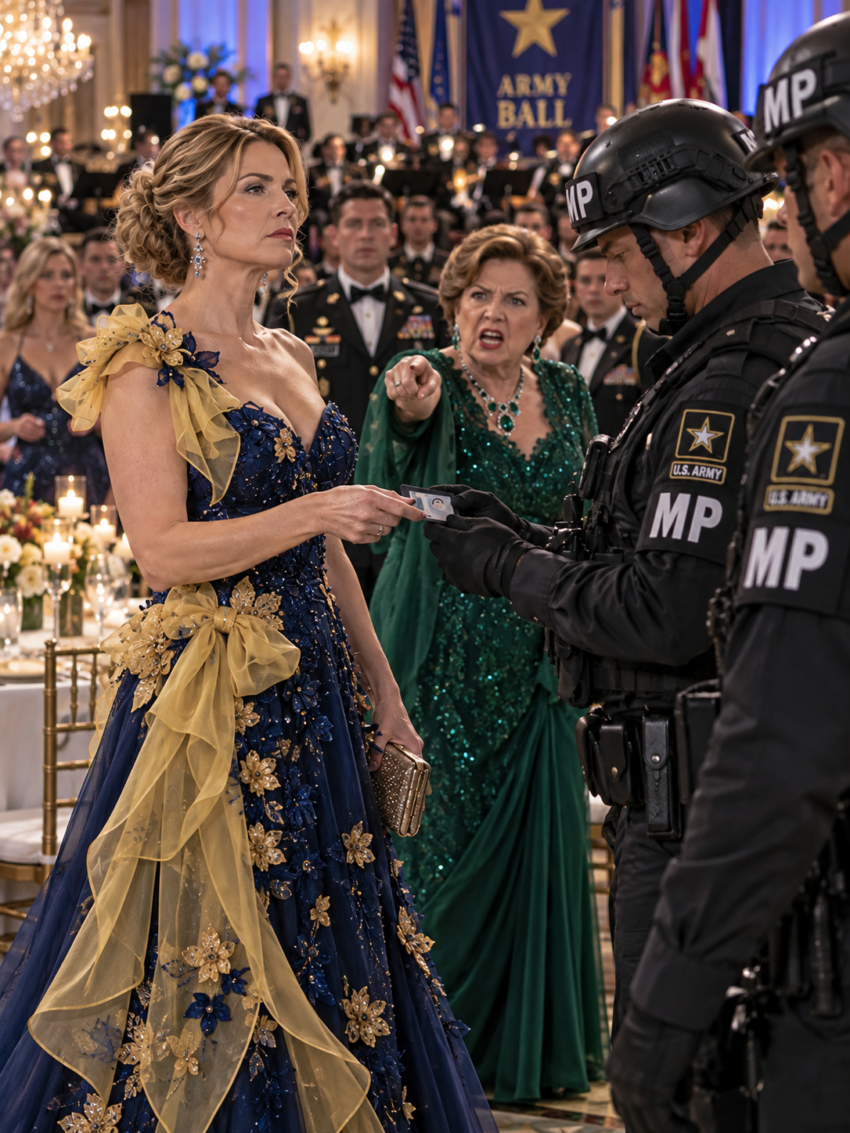
PART 1 — “SHE DOESN’T BELONG HERE”
“Officers and their families paid good money for tonight. We shouldn’t have to pretend some nobody with a desk job belongs at the head tables.”
My mother-in-law said it loudly enough for the people around us to hear.
Then she pointed toward the ballroom doors and looked at the two Military Police officers she’d summoned.
“Please remove her before she embarrasses my son any further.”
The brass quartet stopped halfway through a song.
Chairs scraped across the polished floor as people turned toward us, and suddenly the annual Army formal at Fort Hamilton felt less like a ballroom and more like a hearing.
I was fifty-one years old.
I’d spent twenty-seven years working inside defense and intelligence structures where losing your composure could have consequences far beyond an awkward dinner.
So I didn’t argue with Beatrice.
I opened my evening bag.
Across the room, my husband, Captain Daniel Hayes, stood so quickly that his chair nearly tipped backward.
His face had gone pale.
What bothered me wasn’t that he looked worried.
It was that he didn’t look surprised.
I removed the black credential from my bag and handed it to the senior MP.
Beatrice laughed.
“Oh, please. She carries that thing everywhere because she likes people thinking she’s important.”
The younger MP scanned it.
The device beeped.
He looked at the screen.
Then at me.
His entire posture changed.
He straightened, handed the credential back with both hands, and said quietly:
“Ma’am.”
Beatrice’s smile faltered.
The second MP checked the screen himself.
Then both men came to attention.
“Deputy Director Hayes.”
Nobody laughed.
Beatrice’s pointing hand slowly dropped.
Daniel closed his eyes.
That was when I knew this was not merely his mother humiliating me again.
Something else had happened before we ever entered that ballroom.
SIX YEARS OF “JUST LET HER THINK THAT”
My job had always required discretion.
It had never required me to lie.
For six years, however, Daniel had repeatedly asked me to let his mother believe I held an ordinary administrative position connected to the Department of Defense.
“It’s easier,” he would tell me after family dinners. “Mom turns everything into a competition. If she understands what you actually do, she’ll make every holiday unbearable.”
I believed him.
So when Beatrice introduced me as “Daniel’s office wife—the one who lives behind a computer,” I didn’t correct her.
When she asked whether my government salary could cover my own dress for an officers’ reception, I smiled and changed the subject.
When she told another military spouse that I “basically organize paperwork while Daniel does the real work,” I watched Daniel stare into his wineglass.
Later, in the car, he’d squeeze my hand.
“Thank you for not taking the bait.”
I thought I was protecting our marriage from a difficult woman.
Three hours before the formal, I discovered how thoroughly I’d misunderstood that arrangement.
Daniel and I had checked in at the registration table, where two cream-colored place cards waited.
Mine read:
LAURA HAYES
DEPUTY DIRECTOR
Daniel stared at it.
Then he tore off the narrow strip containing my title.
I actually laughed because the gesture seemed so childish.
“Seriously?”
He lowered his voice.
“Laura, please. Mom will see it and start asking questions.”
“She’s going to be sitting ten feet from people who know me.”
“Then tonight you’re just Laura.”
I looked at the torn strip in his hand.
“Daniel, I’m always just Laura.”
He kissed my cheek.
“Exactly. Thank you.”
I assumed he was protecting my privacy.
Standing in the ballroom now, watching Military Police salute me while my mother-in-law stared at my credential, I remembered that missing strip.
And suddenly it didn’t feel like privacy at all.
THE BLACK CREDENTIAL
Beatrice recovered first.
She pointed at the card.
“That proves nothing. Daniel told me she sometimes lets people think she has more authority than she really does.”
My eyes went directly to my husband.
He looked at his mother.
“Mom.”
One word.
Not a denial.
Not “I never said that.”
Just a warning for her to stop talking.
I slipped the credential between two fingers.
“Daniel, what did you tell her?”
His jaw tightened.
“Not here, Laura.”
“You helped make it here.”
The senior MP glanced between us.
“Ma’am, would you like us to clear the immediate area?”
“No. I want to know who requested that I be removed.”
Beatrice stepped forward before Daniel could speak.
“I did.”
She lifted her chin.
“And I’d do it again. Someone needed to stop you from parading around an Army event pretending you’re equal to people who’ve actually earned their uniforms.”
A colonel near the head table slowly lowered his program.
I looked at Beatrice.
“I never said I was an officer.”
“No. You do something worse. You walk into rooms and let everyone wonder who you are. You stand there with that little black card and expect people to move for you.”
“Beatrice—” Daniel began.
She waved him off.
“I’ve watched her do this for years. She loves making people uncomfortable because nobody knows what she actually does.”
I almost answered.
Instead, I turned to the MP.
“When was the removal request entered?”
He checked his tablet.
“The final request came in tonight, ma’am.”
“Final?”
Daniel’s head lifted.
The MP hesitated.
“There was a prior access advisory attached to your name.”
Something inside me became very still.
“Read it.”
Daniel stepped forward.
“Laura, there’s no reason to turn a family misunderstanding into an official matter.”
I looked at him.
“It became official when Military Police walked over to remove me.”
Colonel Marcus Shaw, who had been seated near the head table, approached us. I knew him professionally, though not well enough to call him a friend.
His expression had changed from social discomfort to professional attention.
“Sergeant, read the advisory exactly as entered.”
The MP looked at me.
I nodded.
He read from the screen.
“Female guest may claim elevated authority. Do not permit presentation of black credential to override removal request.”
I heard someone behind me whisper, “What?”
Beatrice stared at the tablet.
I looked at Daniel.
“You told security not to recognize the credential that verifies who I am?”
“That’s not what I said.”
The MP looked uncomfortable.
“Sir, that’s the language in the entry.”
Colonel Shaw asked the obvious question.
“Who submitted it?”
The sergeant enlarged the record.
His expression changed.
“Captain Hayes.”
The room disappeared around me for half a second.
The sergeant continued.
“Submitted three days ago through his event-sponsor account.”
Beatrice turned toward her son.
“You told me she was bluffing.”
Daniel’s face tightened.
“Mom, stop.”
“You said she carried that card around because she liked people thinking she outranked you.”
A few heads turned.
Daniel looked at her sharply.
Too sharply.
And for the first time in six years, Beatrice ignored the warning in his face.
“DON’T LET HER PULL RANK”
She reached into her evening bag and pulled out her phone.
“You told me what to do this afternoon.”
Daniel took one step toward her.
“Mom, give me the phone.”
Colonel Shaw lifted one hand.
“Captain.”
Daniel stopped.
Beatrice opened their messages and handed the phone to me.
Three messages were enough.
If she starts making a thing out of her title, don’t argue.
Let security handle it.
Don’t let her flash that credential like it settles everything.
I read them twice.
Then I handed the phone back.
“You knew it was valid.”
Daniel rubbed one hand over the back of his neck.
“Of course I knew it was valid.”
“And you told security not to accept it.”
“I was trying to control the situation.”
“What situation?”
His voice dropped.
“My mother finding out.”
“Finding out what?”
“Laura.”
“Say it.”
He looked around the ballroom.
His embarrassment was becoming anger now, but it wasn’t directed at what he’d done.
It was directed at the fact that he could no longer contain it.
“Nobody here needed to know my wife sits above me in that structure.”
The words landed harder than Beatrice’s insult.
She slowly turned toward him.
Daniel immediately tried to pull them back.
“That’s not how I meant it.”
“That’s exactly how you said it.”
“You know what I mean. This environment is competitive. People talk. I didn’t want them assuming my career came through you.”
“Have I ever asked anyone to promote you?”
“No.”
“Have I ever called one of your commanders about your career?”
“No.”
“Have I ever used my position to get you an assignment?”
“No.”
“Then who was making that connection?”
Daniel looked away.
That answer hurt more than if he’d said yes.
Colonel Shaw addressed the sergeant.
“Preserve the access record. No changes until it’s copied and reviewed.”
Daniel raised both hands.
“Colonel, this is a marital issue.”
Shaw’s expression didn’t change.
“Your marriage is not my business. Your use of an event-sponsor account to enter a security advisory you knew contained misleading information is.”
Nobody applauded.
Nobody needed to.
The absence of noise was worse.
Then a woman from the event staff hurried toward us holding a thin folder.
“Colonel Shaw? There’s something else.”
Daniel went completely still.
She looked at me apologetically.
“Mrs. Hayes, three days ago we received a request to replace your original place card. Captain Hayes said your title had been printed in error and instructed us to use only your name.”
I stared at Daniel.
Then I remembered the small cream strip he’d torn away at check-in.
Without thinking, I’d slipped it into my evening bag rather than leaving it on the table.
I reached inside.
There it was.
LAURA HAYES
DEPUTY DIRECTOR
I held it between us.
“Was this protecting my privacy too?”
Daniel didn’t answer.
And that little strip of cardstock changed six years of my marriage.
A coward avoids correcting his mother at dinner.
A coward changes the subject.
A coward asks his wife to ignore an insult because confrontation makes him uncomfortable.
But a coward doesn’t submit paperwork three days in advance.
A coward doesn’t alter a place card.
A coward doesn’t prepare security to distrust his wife’s real credentials before she arrives.
Those were decisions.
Colonel Shaw instructed Daniel to surrender his service phone for review and step away from all event access and protocol responsibilities.
Nobody arrested him.
Nobody handcuffed him.
Nobody publicly stripped him of rank.
He was simply told to leave the ballroom while the record was preserved.
Before he went, he turned toward me.
“Laura, please. This could destroy my career.”
I looked at the cream strip in my hand.
“I didn’t write the advisory.”
“I wasn’t trying to hurt you.”
“You arranged for people to believe I was lying even after I proved I wasn’t.”
His eyes dropped.
“I was trying to control the situation.”
“That required controlling me.”
He had no answer.
When Daniel disappeared through the ballroom doors, Beatrice sat down as if her legs had stopped cooperating.
For the first time that evening, she looked her age.
“I believed him,” she whispered.
I put the place-card strip back into my bag.
“I know.”
“He told me you exaggerated your importance.”
“And you liked that explanation.”
Her eyes filled.
“I was defending my son.”
I looked at the woman who had spent six years asking whether my “little government job” paid enough for dresses, who had laughed about my folders, my desk, my supposedly insignificant work.
“No, Beatrice. You wanted your son to be above me.”
She lowered her eyes.
This time she didn’t argue.
PART2 — THE MISSING TITLE
I stayed at the formal another forty minutes.
That surprised people.
It surprised me too.
Colonel Shaw offered to have someone escort me home, but I declined. I gave him my contact information and said I would submit a written statement through the appropriate channels the next morning.
I didn’t demand punishment.
I didn’t ask anyone to protect Daniel.
And I didn’t use my position to turn his humiliation into something larger.
That mattered to me.
I had just watched my husband use institutional access to solve a personal insecurity. I wasn’t going to answer by doing the same thing.
When I finally returned to our apartment, Daniel wasn’t there.
I put a suitcase on the bed.
He arrived almost an hour later and stopped in the doorway.
“You’re leaving?”
I folded a blouse and placed it beside two pairs of pants.
“Tonight, yes.”
“Laura, don’t do this because of one terrible evening.”
I looked up.
“You did it three days ago.”
He sat on the edge of the bed.
“I can explain.”
“Then explain.”
For nearly a minute, the only sound was the zipper on my toiletry bag.
Finally, he spoke.
“My mother has never understood your work.”
“Because you made sure she didn’t.”
“I never told her you were nobody.”
“You told her enough that she could say it for you.”
He rubbed both hands over his face.
“When we got married, she started asking questions. Who you knew. What level you were at. How much authority you had. She made everything about comparison.”
“She’s been comparing us for six years.”
“Exactly.”
I stopped packing.
“What does that mean?”
Daniel stared at the carpet.
“My career is everything to her. Always has been.”
“I know.”
“And when she realized you were working around senior leadership, she started asking whether you could help me. Whether people would think I was moving up because of you.”
“So instead of telling her I’d never done that, you convinced her I was basically a secretary.”
His mouth tightened.
“I never used that word.”
“You didn’t need to.”
He didn’t deny it.
I placed another blouse in the suitcase.
“What were you expecting tonight?”
“I thought she’d see the title and start bragging, asking questions, telling everyone her daughter-in-law was some powerful official. Then people would look at me and wonder—”
He stopped.
“Wonder what?”
“Whether my career was mine.”
There it was.
Not a complicated conspiracy.
Not some secret professional scandal.
A husband who couldn’t stand the possibility that somebody might look at his wife and then look at him and decide she had gone farther.
“I’ve never taken credit for your career.”
“I know.”
“I’ve never made a call for you.”
“I know.”
“I’ve never opened a door for you.”
“I know.”
“So the person who believed my career diminished yours was you.”
Daniel stood.
“It’s more complicated than that.”
“No. It’s more embarrassing than that.”
He flinched.
“That’s unfair.”
I zipped the suitcase.
“Unfair was telling Military Police that proof of my identity should be treated like part of a lie.”
“I didn’t think my mother would actually have you removed.”
“You told her to call security.”
“I thought they’d pull you aside. You’d show the credential privately, they’d let you back in, and it would be over.”
I stared at him.
“Except you specifically told them not to accept the credential.”
He said nothing.
I waited.
Still nothing.
That silence finally answered the question the entire evening had been circling.
Daniel hadn’t planned a good outcome for me.
He had planned a convenient outcome for himself.
If I protested, I would look dramatic.
If I showed my credential, security had already been warned not to trust it.
If I submitted quietly, Beatrice would remain convinced I was an insignificant wife trying to make herself important.
Every possible version protected him.
I lifted the suitcase from the bed.
“Where are you going?”
“A hotel.”
“Laura, we can fix this.”
“Maybe. But I’m not sleeping here while you explain to me why humiliating me was necessary for your peace.”
His face hardened.
“You’re really leaving your husband over one night?”
I paused at the bedroom door.
“I’m leaving tonight because one night explained six years.”
THE SCREENSHOTS
The next morning, Beatrice sent me three messages.
I ignored the first two until after lunch.
The third contained screenshots.
I hadn’t requested them, but once I saw Daniel’s name, I read them because they directly related to what had happened.
The messages went back months.
Beatrice: Does Laura still do that administrative work?
Daniel: Yeah, basically.
Another conversation:
Beatrice: She doesn’t understand what real pressure is like for an officer.
Daniel had responded with a laughing emoji.
In another, Beatrice asked why I had greeted a general by his first name at a reception.
Daniel wrote:
She knows him through paperwork. Don’t make a whole thing out of it.
I read that sentence three times.
Through paperwork.
I remembered dinners where Beatrice said military wives needed to “understand their husband’s career comes first.”
Daniel would look at me and smile.
I remembered her telling me, “You wouldn’t understand what command responsibility does to a man. Your work stops when you close your laptop.”
Daniel hadn’t corrected her.
In the car afterward, he’d say:
“Thank you for not engaging.”
I had mistaken silence for maturity.
Daniel had been using my silence as construction material.
He’d built an entire version of me inside his family—small enough that he never had to explain why his wife knew people above his chain, why I occasionally disappeared for sensitive meetings, or why senior officials greeted me with professional familiarity.
Beatrice sent one final message.
I was cruel to you. Daniel lied to me, but I wanted to believe him. I know that doesn’t excuse what I did.
I didn’t answer that day.
THE REVIEW
The administrative review began that week.
I submitted a written statement.
No adjectives.
No theories about Daniel’s motives.
No demand that anyone make an example of him.
I documented the call to Military Police, the credential verification, the prior access advisory, the messages Beatrice showed me, and the request to replace my place card.
I also submitted the little cream strip.
The system records did the rest.
Daniel had used his event-sponsor access to create a security note based on information he knew was misleading. He had also requested a change to my place card for personal reasons.
It wasn’t espionage.
It wasn’t some cinematic crime.
That was almost what made it worse.
It was a small misuse of an ordinary institutional tool because a man was embarrassed by his wife’s professional standing.
Daniel was temporarily removed from protocol and access-related responsibilities while the review continued. A promotion he had been expecting was delayed pending the outcome.
I neither helped nor interfered.
When someone asked whether I wanted to make a recommendation regarding consequences, I declined.
What happened to his career could not depend on whether I still loved him.
Two weeks later, Daniel asked to meet.
We chose a coffee shop.
He arrived in civilian clothes and looked as though he hadn’t slept properly.
“My mother isn’t speaking to me.”
I stirred my coffee.
“That’s between you and her.”
“She says I used her.”
“You did.”
He leaned back.
“She treated you badly for years too.”
“Yes.”
“Then why is everything suddenly my fault?”
That question told me more than the apology he’d sent me every night for two weeks.
Daniel still thought blame was something that could be divided until his share became small enough to tolerate.
“Your mother is responsible for what she did. You’re responsible for what you did.”
He stared through the window.
“I’m losing everything.”
“No.”
He looked back at me.
“You’re facing things I used to help you avoid.”
His expression tightened.
“That’s cruel.”
“Cruel was preparing security to call me a liar even if I proved who I was.”
“I’ve apologized.”
“I know.”
“Does that mean nothing?”
“It means you’re sorry.”
I wrapped both hands around my coffee.
“It doesn’t mean the decision disappears.”
We sat quietly for a while.
Then Daniel asked:
“Is there someone else?”
I nearly laughed.
Not because it was funny.
Because he still needed another person to explain why I might decide not to return.
“No.”
His shoulders loosened slightly.
“Then we can work this out.”
“I don’t need another man in order to decide I’ve had enough of this one.”
He looked down.
A month later, I formally began the separation.
BEATRICE
Beatrice contacted me again after that.
This time I agreed to see her.
We met at her house, the same house where she’d spent six years serving me coffee while asking whether I was still at “that little desk job.”
She put the same china cup in front of me.
Neither of us touched our coffee.
“I was horrible to you.”
I waited.
She swallowed.
“And I liked believing Daniel was above you.”
That was the first apology from her that mattered.
Not because it was eloquent.
Because she didn’t hide behind Daniel.
“Why?” I asked.
She looked embarrassed.
“Because I built too much of my identity around my son being exceptional. When he married you, I could tell there were things about your work people respected, and instead of being proud of both of you, I treated it like a threat.”
I said nothing.
“Daniel told me what I wanted to hear.”
She finally looked at me.
“But I wanted to hear it.”
“Yes.”
Her eyes filled.
“I don’t expect you to forgive me.”
“Good.”
She blinked.
“Good?”
“Because forgiveness can’t be another job you hand me so you can feel better.”
She lowered her eyes.
“You’re right.”
It was the first time Beatrice had spoken to me respectfully when there was nobody else around to witness it.
We didn’t hug.
We didn’t promise to rebuild our relationship.
I left twenty minutes later.
That was enough.
THE PLACE CARD
Several months later, Daniel’s administrative review ended with limited but real consequences. He lost certain responsibilities for a period of time, and the promotion he’d expected did not move forward on its original schedule.
His career didn’t collapse.
He wasn’t publicly disgraced across the Army.
There were no headlines.
No dramatic arrest.
There was simply a documented consequence attached to a documented decision.
Our marriage ended more quietly.
One afternoon, while sorting through a box from the apartment, I found the cream strip from the formal.
LAURA HAYES
DEPUTY DIRECTOR
For years, I’d been proud of the fact that I didn’t need people to know my title.
I still was.
But I had finally learned there was a difference between discretion and disappearance.
One is choosing not to announce yourself.
The other is allowing somebody to erase you because your full size makes them uncomfortable.
I put the strip into the top drawer of my desk.
Not framed.
Not displayed.
Just kept.
Months earlier, when those two MPs scanned my black credential and came to attention, everyone in the ballroom seemed to think that was the moment I’d reclaimed my place.
It wasn’t.
The credential had only proved something I’d never doubted.
The more important moment came afterward, when I looked across that ballroom at my husband and stopped helping him explain me away.
I closed the drawer.
The black credential went back into my work bag.
The cream strip stayed exactly where I’d put it.
This time, nobody tore my title off.