The Boy Who Stood in Front of the Engines
Late afternoon settled softly over a small town outside Bartlesville, Oklahoma, the kind of place where Friday nights still belonged to high school football, folding chairs, and families who knew one another by name. The field lights had just begun to glow against the fading sky. Players were walking off the grass with their helmets tucked under their arms, still laughing, still catching their breath, still carrying the easy joy that comes after a hard game finally ends.
It should have been an ordinary ending to an ordinary evening.
Parents were gathering jackets and drink cups. Coaches were calling out reminders about Monday practice. Younger kids were chasing each other near the sideline while the last orange streaks of sunlight fell across the bleachers.
And then the sound arrived.
It started low and far away, almost like thunder rolling across open land. But within seconds, it became sharper, heavier, impossible to ignore. Heads turned toward the gravel road that ran beside the field. Dust lifted into the air. The noise grew louder.
Engines.
Not one.
Not two.
A long line of motorcycles was coming fast down the access road, riding in tight formation, their headlights cutting through the dusty evening air. From a distance, the sight felt overwhelming. Leather vests. Broad shoulders. Large bikes moving in a line that seemed too straight, too focused, too determined.
No one on the field understood why they were coming.
What frightened people most was not just that they were there. It was that they were not slowing down.
The Moment Fear Took Over
Someone near the bleachers stood up so suddenly that their chair tipped backward. A coach dropped his clipboard and shouted, “Get the kids off the field!”
That was all it took.
The calm broke instantly. Parents started calling for their children. A few younger players froze in confusion before older boys grabbed their arms and pulled them toward the sidelines. Conversations disappeared and were replaced by sharp voices, hurried footsteps, and the rising tension that spreads through a crowd when no one knows what is happening.
At the center of that fear stood a boy named Colton Avery.
He was eleven years old, small for his age, wearing a faded number 12 jersey that hung loosely over his shoulders. He had dirt on one knee, sweat drying at his temples, and the kind of face people often overlooked because it was quiet and thoughtful more than loud or attention-seeking.
While everyone else stepped back, Colton stepped forward.
At first, no one seemed to understand what he was doing. His mother, Marissa, was still near the bottom of the bleachers gathering their things. A few parents noticed him walking toward the field and assumed he was trying to find a missing water bottle or a backpack.
But he kept going.
Straight toward the gravel road.
Straight toward the engines.
A man in the crowd shouted, “Somebody stop him!”
Another yelled, “Colton, get back here!”
But the boy did not turn around.
The One Person Who Saw What Others Missed
Earlier, just after the game ended, Colton had dropped his water bottle near the edge of the field. It had rolled farther than he expected, bouncing toward the narrow strip of dirt between the grass and the fence line. When he ran after it, he noticed something strange.
A wire.
Thin.
Tight.
Low to the ground.
It was stretched so carefully across the access path that it almost disappeared into the dust and gravel. If the light had been any dimmer, he might never have seen it. If his bottle had stopped a few feet earlier, he would have walked away without knowing.
But he had seen it.
And when he followed it with his eyes, he noticed it led toward something hidden near the fence.
He did not understand every detail. He did not need to.
He only knew one thing with complete certainty.
If those motorcycles kept coming, they would hit that line.
By the time the engines grew loud enough for everyone else to notice, Colton had already made his decision.
He knew no one would believe him quickly enough.
So he ran.
A Child Against a Wall of Steel
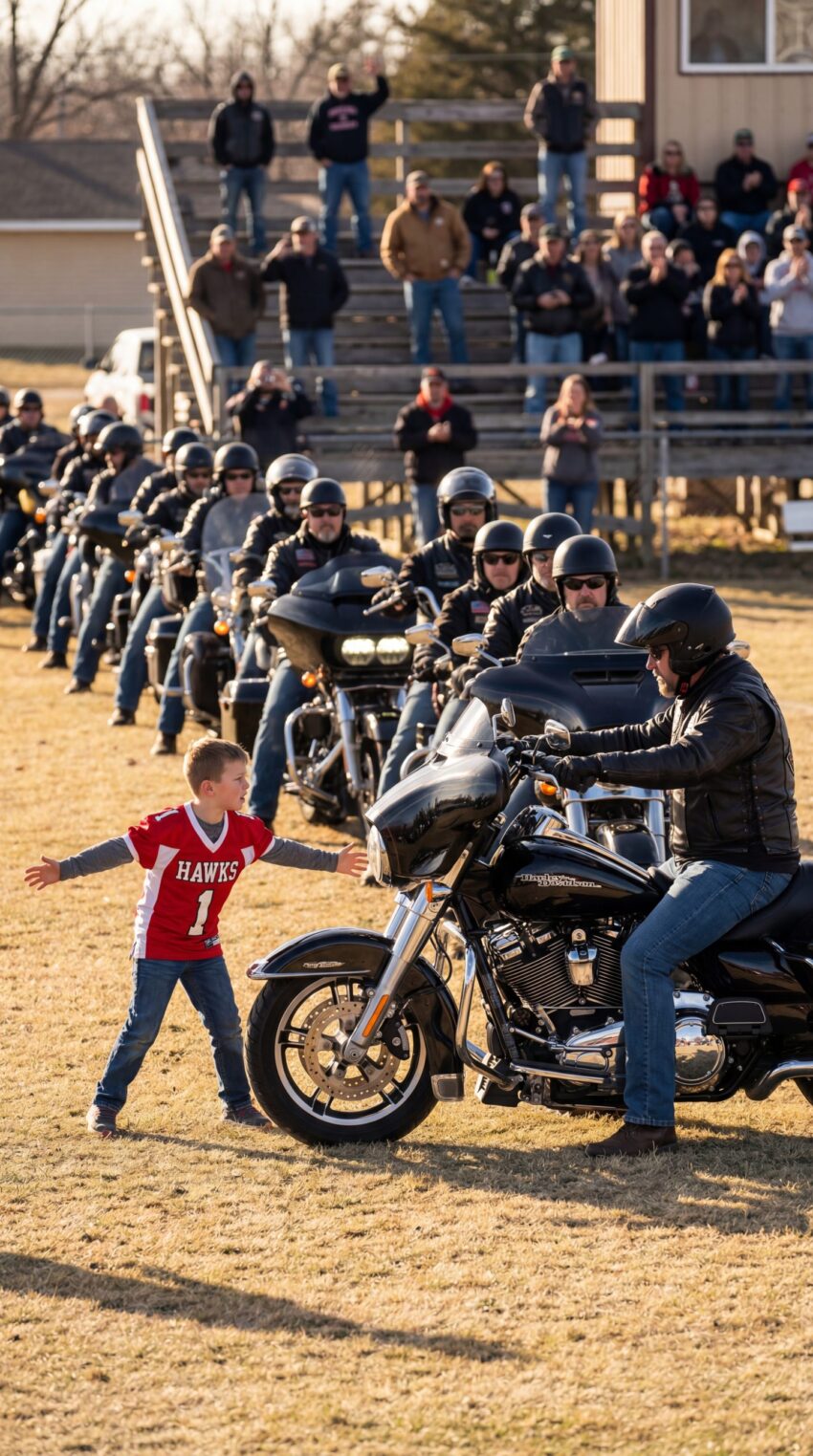
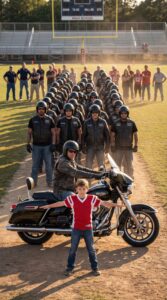
The motorcycles were getting closer now, dust trailing behind them like a storm rolling across the road. Colton reached the edge of the field, stepped directly into their path, and spread his arms wide.
The sight was so shocking that the crowd seemed to lose its voice for half a second.
He looked impossibly small out there. One child in a dusty football jersey facing down a moving line of heavy machines.
Then Marissa saw him.
Her face changed at once. Fear swept through her so visibly that the people beside her later remembered it more clearly than the sound of the engines.
She dropped everything in her hands and ran.
“Colton!” she cried. “Move, baby, move!”
But he did not move.
He planted his feet harder.
The motorcycles kept coming.
From the bleachers, it looked unbearable. The lead rider was enormous, easily over six feet tall even seated on the bike, with thick arms, a sleeveless leather vest, weathered gloves, and a posture that made him seem even larger than he was. Dark glasses hid his eyes. His expression could not be read from a distance.
To the people watching, it appeared there was no chance he could stop in time.
One parent covered her mouth.
A coach sprinted forward, but he was too far away.
Someone shouted, “Kid, get out of the way!”
Colton lifted his chin and screamed with all the strength in his chest, “Stop! Don’t come any closer!”
His voice cracked, but it carried.
Not because it was loud enough to overpower engines.
Because it held something stronger than fear.
Urgency.
The Last Second
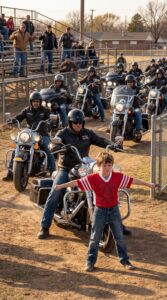
The distance between the boy and the lead bike disappeared with terrifying speed.
Ten feet.
Five.
Three.
Still, Colton did not step aside.
For a heartbeat, the entire field seemed suspended in one impossible moment. No one breathed. No one blinked. It felt as though the whole town had been pulled into a single second that refused to move forward.
Then Colton shouted again, louder this time.
“There’s something on the ground!”
The lead rider’s posture changed.
It was subtle, but real. He leaned slightly, narrowed his focus, and for the first time looked not only at the child in front of him, but beyond him.
Then his hand hit the brake.
The front tire locked with a harsh screech. Gravel spat into the air. Dust burst outward. The motorcycle stopped less than a foot from Colton’s knees.
Behind him, the rest of the riders reacted instantly. One by one, they braked in a disciplined chain, each bike halting with remarkable control. No one lost balance. No one crashed. The line tightened, shifted, and settled into stillness.
Silence rushed over the field so suddenly it felt louder than the engines had.
Colton remained where he was, arms still out, chest heaving.
Marissa stumbled to a stop several yards away, tears already running down her face.
The Man Behind the Helmet
The lead rider cut his engine and slowly removed his helmet.
He was in his late forties, with a lined face, close-cropped dark hair touched with gray, and eyes that looked tired in the way only life can make them tired. There was no wildness in his expression. No cruelty. Only focus.
He looked directly at Colton and asked, “What did you say?”
Now that the engines were quiet, the boy’s voice sounded younger.
“There’s something there,” he said, pointing with a shaking hand. “Right by the line. I saw it earlier.”
The rider followed his finger.
He stepped off the motorcycle and moved carefully toward the patch of dirt ahead of his front tire. Another biker, broader and younger, approached from behind him.
“You see it?” the second man asked.
The lead rider crouched low, studying the ground. Then his jaw tightened.
“Yeah,” he said quietly. “I see it.”
He straightened and turned toward the field.
“Everybody back,” he said. His voice was calm, but it carried weight. “Now.”
This time, no one hesitated.
The Truth Hidden in the Dust
Parents pulled children behind them. Coaches guided players farther from the road. Officers had not yet arrived, but the seriousness in the rider’s face was enough to change the whole atmosphere.
Marissa reached Colton then and grabbed him by the shoulders, looking him over as if she needed proof he was still standing there.
“What were you thinking?” she whispered through tears.
Colton swallowed hard. “I didn’t know how else to stop them.”
She pulled him against her chest, trembling too hard to answer.
Meanwhile, the lead rider followed the thin wire with his eyes toward the fence line. Tucked near the base of the fence was a small concealed object no one in the crowd had noticed before.
He looked at the other biker and said, “Call it in.”
The man nodded and reached for his phone.
A coach, pale and breathless, stepped closer but kept his distance. “What is it?” he asked.
The lead rider did not offer a dramatic answer. He simply said, “Something that shouldn’t be here.”
That was enough.
Within minutes, police vehicles arrived with lights flashing across the darkening field. Officers moved quickly, clearing the area wider than before. One officer crouched near the line, examined it carefully, then followed it toward the object by the fence.
He stood up and spoke into his radio in a low voice.
Whatever he said changed the mood immediately.
This was no misunderstanding. No prank. No harmless debris.
It was a real threat.
Why the Boy Ran Forward
An officer approached Colton after the area had been secured and asked gently, “How did you notice it?”
Colton looked down at his dusty cleats. “My bottle rolled over there,” he said. “I went to pick it up, and I saw the wire in the dirt.”
The officer glanced toward the fence again, then back at the boy.
“And when you saw the bikes coming, you ran in front of them?”
Colton nodded.
“I thought if I yelled from far away, nobody would hear me.”
There was no pride in the way he said it. No attempt to sound brave. He said it like a simple fact, the way children sometimes say the most remarkable things without understanding how remarkable they are.
The lead rider had been listening from a few steps away. He came closer, his helmet hanging at his side.
For a moment, he just looked at the boy.
Then he said, “You did the right thing.”
Colton blinked up at him.
The man added, “And you probably saved a lot of people tonight.”
The Kind of Men No One Expected
As the investigation continued, townspeople began to see the riders differently than they had only twenty minutes earlier.
They had arrived in formation because they had been invited to stop by after a charity ride passing through the county. A local booster had arranged for them to meet one of the coaches and make a donation to the school equipment fund. They had not come looking for trouble. They had come because someone had asked for support.
No one on the field had known that when they first heard the engines.
Fear had filled in the blanks before truth had the chance.
The lead rider introduced himself to the officers as Wade Holloway. He gave his statement clearly and without performance. The other men stood quietly behind him, no swagger, no boasting, no demand for attention. They understood how close the evening had come to turning into something awful, and that understanding softened the entire scene.
One of the younger bikers crouched near Colton and offered him a sealed bottle of water.
“You okay, little man?” he asked.
Colton nodded, though his hands still shook.
The biker smiled faintly and said, “You’re tougher than most grown folks I know.”
Marissa let out a watery breath that sounded half like a laugh and half like a cry. “Please don’t encourage him,” she said.
That drew the first gentle ripple of relieved laughter anyone had heard since the motorcycles appeared.
When the Field Grew Quiet Again
The sky turned darker. The stadium lights cast long pale beams across the empty grass. Police tape moved softly in the evening wind. Families lingered longer than they needed to, as though no one quite knew how to leave a place after seeing how quickly an ordinary night could shift.
Colton sat on the bottom row of the bleachers wrapped in his mother’s jacket. His jersey was still dusty. His sneakers were still untied. Now that the danger had passed, he looked exactly like what he was—an exhausted little boy who had made one impossible choice in the few seconds that mattered.
Marissa sat beside him, holding his hand so tightly he did not even try to pull away.
After a while, she asked quietly, “Were you scared?”
He stared out at the field before answering.
“Yeah,” he said. “I was really scared.”
She brushed his hair back from his forehead. “Then why did you stay there?”
Colton thought for a moment.
“Because if I moved,” he said softly, “they wouldn’t know.”
Marissa closed her eyes, and for a second she could not speak.
Down by the road, the motorcycles were starting up again. One by one, the riders prepared to leave.
Wade looked back toward the bleachers before putting on his helmet. He lifted a hand once in a small gesture meant only for the boy.
Colton raised his own hand in return.
No more words were needed.
Then the bikers rode away in the same disciplined line in which they had arrived, disappearing beyond the gravel road as the field returned to silence.
But it was not the same silence as before.
It was heavier.
More thoughtful.
The kind of silence people carry home with them.
Because everyone there understood something they had not understood an hour earlier: courage does not always look loud, and wisdom does not always come from the biggest person in the room.
Sometimes the first one to see danger is the smallest one standing closest to it.
And sometimes one child, with shaking hands and a breaking voice, can stop an entire night from becoming a tragedy.
What People Remembered Afterward
In the days that followed, people told the story in many ways.
Some talked about the thunder of the engines.
Some talked about the dust rising over the access road.
Some talked about how close the front tire came to Colton’s legs before it stopped.
But the detail that stayed with most of them was simpler than that.
It was the image of a boy spreading his arms wide as if his small body could hold back a force much larger than himself.
And somehow, in the moment that mattered, it did.
Not because he was stronger.
Not because he was fearless.
But because he paid attention when others were distracted, and because he acted when no one else yet understood the risk.
People often think bravery belongs to the powerful, the older, the trained, the ones who look ready.
That night in Bartlesville, bravery wore a dusty jersey, untied cleats, and the nervous voice of a child who loved strangers enough to warn them.
And that is why people never forgot it.
Real courage is not the absence of fear, but the decision to step forward even while your heart is pounding, because you know staying silent may cost someone else more than it costs you.
We should never underestimate quiet children, because many of them notice what distracted adults miss, and sometimes their awareness becomes the very thing that protects an entire room, a family, or a community.
The world often teaches us to trust appearances, yet one evening can remind us that the people we fear may be kind, and the smallest person among us may carry the clearest sense of what is right.
Attention is a form of love, because when we truly pay attention to the world, to people, and to the signs around us, we are far more capable of preventing pain before it reaches those who do not even know they are in danger.
A child who chooses to protect others should never have to carry that burden alone, which is why every brave young heart deserves adults who will listen quickly, believe sincerely, and stand beside them with tenderness afterward.
What saved that night was not noise, size, or power, but the simple human choice to look closer, speak up, and trust the warning that came from someone others might have ignored.
There are moments in life when doing the right thing feels lonely, frightening, and almost impossible, yet those are often the exact moments that define a person’s character more clearly than years of easy comfort ever could.
We become a safer world for one another when we stop dismissing people based on age, appearance, or first impressions, and begin meeting one another with patience, humility, and a willingness to understand before we judge.
The most unforgettable acts of goodness are often not grand or polished, but raw and immediate, born in seconds when someone decides another life matters more than their own comfort.
Long after the engines fade, the dust settles, and the field grows empty again, what remains is the truth that one brave choice, made by one ordinary person at the right time, can echo through countless lives in ways no one will ever fully measure