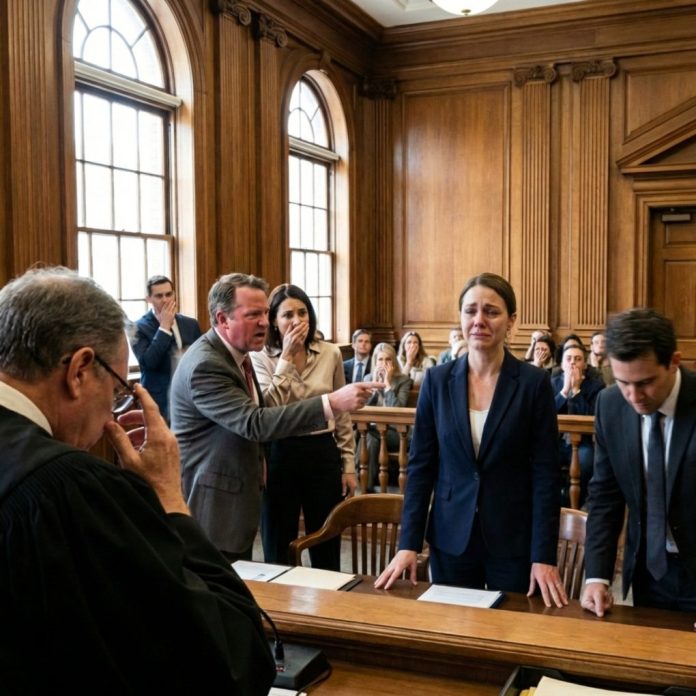
I represented myself in court. My husband and his mistress laughed, “You’re too poor to hire a lawyer. Pathetic.”
Everyone agreed… until the judge asked his lawyer, “You really don’t know who she is?”
My husband’s jaw dropped.
We were in a family courtroom in Cook County, Illinois, the kind with beige walls, a state seal above the bench, and a quiet hum of people waiting to have their lives turned into case numbers. I sat alone at the petitioner’s table with a thin accordion folder, a legal pad, and a pen I’d chewed through twice.
My name is Camille Ross, I’m thirty-six, and I looked exactly like what they wanted the room to believe: a broke wife with no attorney and no leverage.
Across the aisle, my husband Ethan Ross sat with his lawyer and his girlfriend—Mara Keene—who wore a cream blazer and a smug smile like she’d already won. Mara wasn’t technically supposed to be at counsel table, but she’d squeezed in anyway, whispering and laughing, acting like the courtroom was a theater and I was the joke.
Ethan leaned back and said loud enough for people nearby to hear, “She’s representing herself because she can’t afford a lawyer.”
Mara giggled. “Pathetic.”
Their attorney, Mr. Shaw, didn’t correct them. He smirked at his notes like confidence was a service he billed by the hour.
The bailiff called our case. We stood. The judge—Hon. Lillian Cho—looked down at the file, then looked at me.
“Ms. Ross,” she said, “you’re appearing pro se today?”
“Yes, Your Honor,” I replied, steady. “By choice.”
Ethan snorted softly.
Mara leaned toward him and whispered, “She thinks she’s in a TV show.”
Judge Cho’s eyes flicked toward the sound, then back to her paperwork.
“Mr. Shaw,” the judge said, “your appearance for Mr. Ross is noted.”
“Yes, Your Honor,” Shaw replied smoothly. “We’re seeking a straightforward dissolution. My client requests primary custody and exclusive use of the marital home.”
My chest stayed calm even as my stomach tightened. Exclusive use meant they planned to move Mara into my home while calling it “stability for the children.”
Ethan’s lips curled. “She’ll sign once she realizes she can’t fight,” he muttered.
I didn’t react. I only opened my folder and placed a single page on top, like a bookmark.
Judge Cho turned back to me. “Ms. Ross, do you understand the risks of self-representation?”
“Yes,” I said. “I also understand the risks of being underestimated.”
That earned me the slightest pause—an assessing look.
The judge glanced down at my file again, then asked, almost conversationally, “Ms. Ross… do you still maintain your license in good standing?”
The room changed temperature.
Mr. Shaw blinked. “Your Honor?”
Ethan’s head snapped toward me. “License?”
Judge Cho didn’t look at Ethan. She looked directly at his attorney.
“You really don’t know who she is?” she asked.
Mr. Shaw’s smirk vanished.
And Ethan’s jaw dropped so hard Mara’s laughter died mid-breath.
Because they hadn’t been laughing at a poor woman without a lawyer.
They’d been laughing at someone who knew the law better than they did—
and had chosen to stand alone anyway.
Mr. Shaw’s expression tightened as if he were trying to rewind the last thirty seconds.
“Your Honor,” he said carefully, “my understanding is Ms. Ross is appearing without counsel.”
Judge Cho’s voice stayed neutral, but sharp. “That doesn’t answer my question,” she said. “Do you know who she is?”
I didn’t interrupt. I didn’t introduce myself with drama. I let the judge speak, because credibility is louder when it comes from the bench.
“Ms. Ross clerked for the Seventh Circuit,” Judge Cho continued, eyes on Shaw. “She’s also published on evidentiary standards in domestic violence proceedings.”
A murmur ran through the gallery—quick, suppressed.
Ethan’s face went pale in layers. Mara looked at him, confused, then back at me, suddenly uncertain what she’d walked into.
I kept my posture steady and said, simply, “I’m an attorney, Your Honor. I’m not representing myself because I can’t afford counsel. I’m representing myself because I prepared this case and I want the court to hear it directly.”
Ethan found his voice, panicked. “That’s not fair—she didn’t tell anyone—”
Judge Cho lifted a hand. “Mr. Ross, you’ve had ample notice of her filings,” she said. “You chose to treat her as unserious.”
Mr. Shaw tried to regain ground. “Even so, Your Honor, the issues are custody and property. My client’s position remains—”
“Then let’s discuss evidence,” Judge Cho said, flipping open the file. “Because the first thing I’m seeing is Ms. Ross’s motion for emergency temporary orders, with attached exhibits.”
Shaw blinked. “Exhibits?”
I slid my folder forward in a neat stack: screenshots, bank statements, daycare emails, a timeline, and—most importantly—certified copies of police reports I hadn’t publicized. I’d learned the hard way that abusers thrive on noise. Evidence thrives on silence.
Judge Cho looked at Exhibit A. Her face stayed composed, but her eyes sharpened.
“Mr. Shaw,” she said, “your client is seeking primary custody. Yet Ms. Ross has submitted documentation of an active investigation regarding financial coercion and unauthorized transfers.”
Ethan’s head jerked. “What transfers?”
I didn’t look at him. I looked at the judge. “Your Honor, while I was hospitalized last spring, Mr. Ross moved $62,000 from our joint savings into an account solely in his name,” I said. “He then used those funds for travel and gifts. I have the statements and the merchant receipts.”
Mara’s mouth opened. “Ethan—”
Judge Cho continued reading. “And Exhibit C appears to be a sworn statement from the daycare director.”
“Yes,” I said. “Confirming Mr. Ross attempted to remove our children early using a forged authorization letter. The daycare refused and documented it.”
Shaw’s voice turned defensive. “Your Honor, these are allegations—”
Judge Cho cut him off. “They’re supported by documentation,” she said. “If you want to challenge them, you’ll do so with evidence, not attitude.”
Ethan’s hands trembled on the table. Mara leaned away from him, as if distance could protect her.
Judge Cho turned to me again. “Ms. Ross, are you requesting supervised visitation pending hearing?”
“Yes, Your Honor,” I said. “And exclusive use of the marital home, because I can demonstrate Mr. Ross has already attempted to move Ms. Keene into that residence.”
Mara’s cheeks flushed. “That’s not—”
“Ms. Keene,” Judge Cho said sharply, “you are not a party to this case. You will remain silent.”
Mara went rigid.
Ethan stared at me like he was seeing my face for the first time.
Not as a wife he could bully.
As an opponent who came prepared.
And the truth was simple: they’d laughed because they assumed poverty.
What they missed was the quiet weapon of someone who knows procedure—and knows how to wait.
Judge Cho set her pen down and looked directly at Ethan.
“Mr. Ross,” she said, “your request for primary custody is denied at this time.”
Ethan’s face twitched. “What?”
“Given the exhibits presented,” she continued, “the court is ordering temporary primary placement with Ms. Ross, and supervised visitation for you until the evidentiary hearing.”
Mr. Shaw opened his mouth, but the judge was already moving.
“Exclusive use of the marital home to Ms. Ross,” she said. “Mr. Ross will vacate within seventy-two hours. Any attempt to remove property outside the agreed inventory will be considered contempt.”
Mara’s hand flew to her mouth. Ethan’s head snapped toward her, panic written all over him.
Judge Cho wasn’t finished.
“Additionally,” she said, “I’m ordering a temporary financial restraining order: no new debts, no asset transfers, and immediate disclosure of all accounts opened in the last eighteen months.”
Ethan’s voice rose. “She’s manipulating this! She’s—she’s doing lawyer tricks!”
Judge Cho’s gaze hardened. “What you call ‘tricks’ is called ‘evidence,’ Mr. Ross. And what you did in this courtroom—mocking a self-represented litigant—shows poor judgment at best.”
She turned to Mr. Shaw. “Counsel, I strongly recommend you advise your client to take the next hearing seriously.”
Mr. Shaw nodded stiffly, suddenly sober.
When the judge called the next case, the courtroom noise returned like someone turned the volume back up. People stood, shuffled, whispered. But my world stayed quiet for a moment.
Ethan stared at me as if he’d expected me to crumble, not to hold my ground.
Mara’s smugness was gone. She didn’t look like a winner anymore. She looked like someone who’d just realized she’d attached herself to a sinking ship.
As we gathered our papers, Ethan hissed under his breath, “So you were just pretending to be powerless.”
I met his eyes, calm. “No,” I said. “I was surviving you.”
Outside the courtroom, the hallway felt brighter. My hands shook—not from fear, but from release. I’d spent years being talked over, minimized, treated as if the loudest voice was automatically the truth.
It isn’t.
The lesson I learned—and the one I wish every woman walking into a room full of smug people could carry—is this:
Being alone at the table doesn’t mean you’re losing.
Sometimes it means you stopped paying for someone else’s performance.
I represented myself because I knew what my husband was counting on: intimidation, shame, the assumption that I’d be too embarrassed to stand up without a lawyer beside me.
Instead, I brought what actually wins in court:
Preparation. Documentation. Discipline.
And the final irony—the part that still makes me breathe out a small laugh when I think about it—is that they called me “too poor” to hire a lawyer…
…while sitting across from someone who could have taught their lawyer how to do his job.
That day, I didn’t just win temporary orders.
I reclaimed my name—
not as Ethan’s wife, not as Mara’s target, not as the “pathetic” woman they wanted on display.
As myself.