The Knock in the Rain
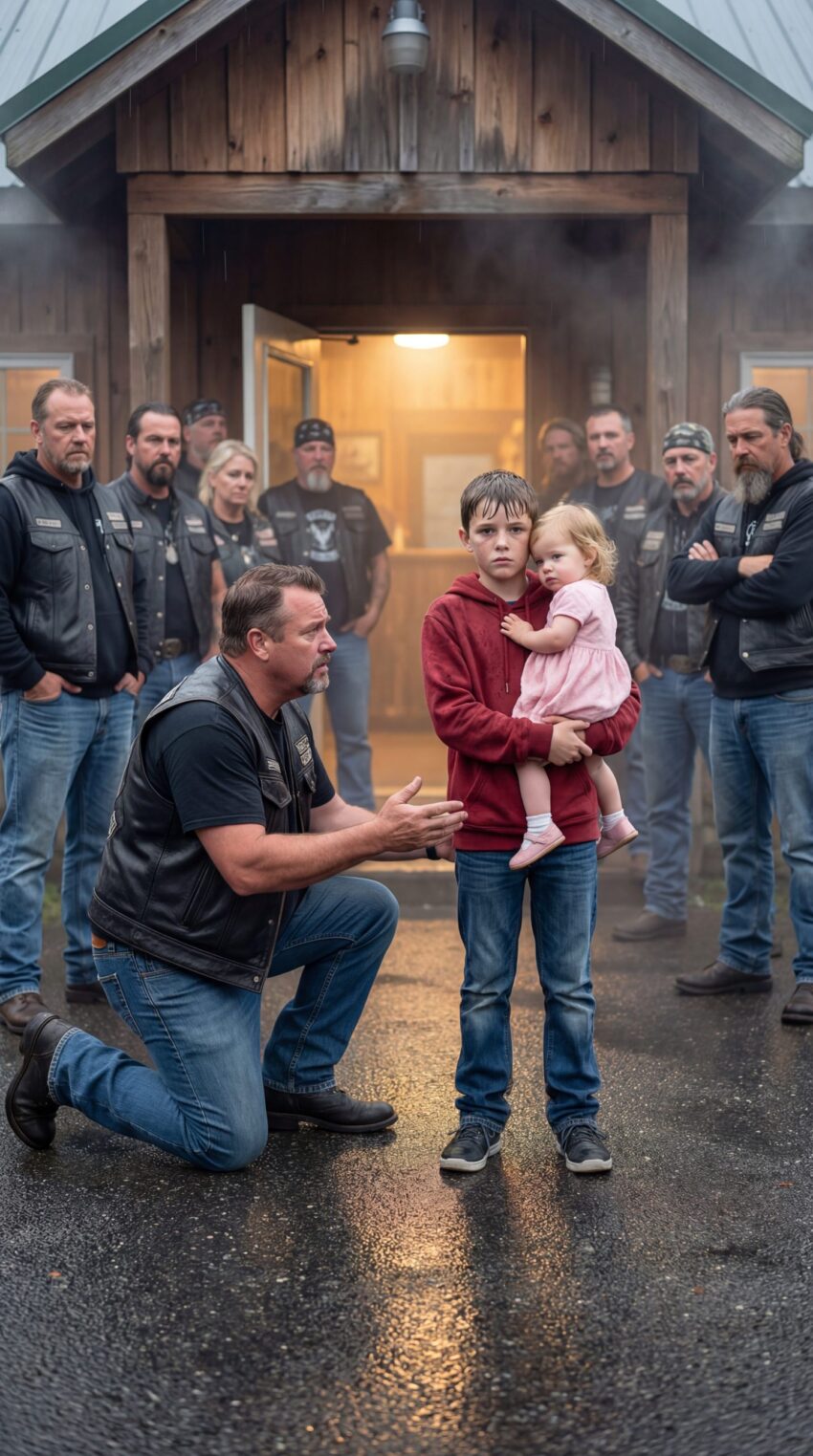
By the time the children reached the clubhouse, the November rain had already soaked through everything they had. The older child stood in the doorway with water dripping from his hair, his thin shoulders trembling from cold and strain, while the little girl in his arms clung to him so tightly it looked like she was trying to disappear into his chest.
Inside, the room had been loud only a moment earlier. Men had been talking over each other, boots scraping the floor, a ballgame humming on the television in the corner. But the second the door opened and everyone saw a twelve-year-old boy standing there with a toddler in his arms, the entire place went still.
No one rushed them. No one raised a voice. A few of the men looked at each other first, as if they all understood at once that this was one of those moments a person remembered for the rest of his life.
The boy swallowed hard before speaking.
“Please don’t send us away.”
His voice was rough from cold and fear, but he did not let it break.
“I just need somewhere warm for my sister. Just for tonight. I’ll leave in the morning if you want.”
The man nearest the door was broad-shouldered, gray at the temples, with a weathered face and the kind of steady eyes that made people tell the truth without meaning to. His name was Huck Darnell, and everyone in Briar Glen knew he was the one the Iron Vale Riders listened to when something mattered.
He looked first at the boy, then at the baby girl whose tiny shoes were missing and whose socks were soaked through.
“You’re not leaving tonight,” Huck said. “Come inside.”
Warmth Returns Slowly
Two men pulled chairs near the heating vent without being asked. Someone from the back room disappeared into the kitchen. Within minutes, the sharp smell of rain and wet denim began to give way to the softer, steadier smell of soup warming on the stove and milk heating in a pan.
The boy stepped in carefully, like he still expected someone to change their mind. He was small for twelve, but his face had the strained look of someone who had been carrying more than a child ever should. The little girl on his hip, barely two years old, buried her face against his neck and whimpered once, then went quiet again.
A plate was set on the table. Bread. Leftover pasta. A bowl of chicken soup. Another man, a giant with red hair and hands like shovel blades, sat down cross-legged on the floor in front of the toddler and made the most ridiculous face anyone in the room had probably ever seen him make.
His name was Coby Vance, though the men all called him Brick.
The little girl blinked. Then her mouth twitched. Then, suddenly, she let out a tiny laugh.
That sound changed something in the room.
It was such a small laugh, so light and unexpected in a place full of leather jackets, engine grease, and rough voices, that several of the men had to look away for a second. There was something about hearing a toddler laugh after arriving like that, half frozen and shaking in the rain, that reached straight under every scar a man had ever tried to hide.
Across the room, Rooster Kane leaned against the kitchen doorway with his arms folded over his chest. He was usually the loudest man in any room, but he had not said ten words since the children came in.
He was watching the boy.
Or more specifically, watching the fact that the boy had been given food first and still had not touched a bite of it.
Instead, he sat in a chair with the toddler on his lap, lifting the warm mug carefully to her mouth and waiting each time she swallowed before offering her more. He checked her fingers to see if the color had returned. He tucked the blanket around her knees. He rubbed her back every few seconds without even seeming to realize he was doing it.
Only when the little girl had eaten. Only when her eyes were heavy with warmth and safety. Only when Brick carried her to a pile of cushions in the back room and laid her down gently. Only then did the boy finally reach for the fork.
He ate slowly at first, then faster, but still with the strange care of someone trying not to finish too quickly.
Rooster stepped forward.
“When did you last eat?”
The boy thought about it honestly.
“Yesterday morning.”
He looked down at the table when he said it.
“I gave Maisie the last crackers this afternoon.”
Rooster turned without a word, went back to the kitchen, and returned with another bowl filled to the rim.
A Boy Who Learned Too Much
Later, after the little girl was sleeping in the back room on a bed made from couch cushions and folded blankets, Huck sat across from the boy at the long table and waited.
The room had gone quieter now. The rain still tapped against the windows, but inside the clubhouse, the lamps were low and steady. A few men sat nearby pretending not to listen, though every one of them was listening.
Huck rested his forearms on the table.
“Tell me your name.”
The boy hesitated, not because he did not want to answer, but because he looked like someone who had learned to weigh every word before letting it go.
“Owen Sutter.”
“And your sister?”
“Maisie.”
Huck nodded once.
“All right, Owen. Tell me what happened.”
At first the boy spoke in short, careful pieces. Then the story began to come out the way truth often does when a person is finally somewhere safe enough to say it.
Three years earlier, his mother, Laurel, had gotten sick. She had been in and out of the hospital ever since. The bills piled up. The stress grew heavier. Then came Trent Bell, Laurel’s boyfriend at the time, who had seemed helpful in the beginning. He fixed things around the house. Drove Laurel to appointments. Brought groceries when money got tight.
Then he moved in.
Then he started drinking harder.
Then the house changed.
Owen did not use dramatic words. He said everything plainly, almost quietly, which somehow made it worse to hear. He explained how he had learned to read Trent’s moods before Trent even opened his mouth. He knew the difference between the sound of boots crossing the kitchen when things were normal and the sound of boots crossing the kitchen when they were not. He knew what it meant when Trent’s voice dropped low and flat instead of rising. He knew when to keep Maisie in her room and when to distract her with made-up games and songs.
“I could usually stay out of his way,” Owen said.
He stared at his hands as he spoke.
“I got good at it.”
Then he swallowed.
“But Maisie’s too little. She doesn’t understand when the house changes.”
His voice tightened for the first time.
“She just wants to follow people. She laughs. She asks questions. She doesn’t know when she’s supposed to be quiet.”
No one at the table moved.
Owen went on. That afternoon had been worse than usual. Trent had been drinking since before noon. Laurel was still at St. Catherine’s Medical Center, too weak most days to understand everything going on back home. Owen had seen the look in Trent’s face, the one that meant trouble was already on its way. Then he had seen Trent start walking toward Maisie’s room.
So Owen did the only thing he could think to do.
He grabbed his sister, wrapped her in a blanket, and ran.
“I didn’t know where I was going,” he admitted. “I just knew I couldn’t stay.”
He and Maisie had walked in the rain for nearly two hours. He had passed closed stores, a gas station, and a church with no lights on. Then, from the road, he saw the glow from the Iron Vale Riders clubhouse.
He had seen the bikers around town before. Heard people talk. Heard the whispers people liked to repeat when they wanted to feel better than somebody else.
Owen lifted his eyes and looked directly at Huck.
“I didn’t know if you were good men or bad men.”
He drew in a breath.
“But I was out of choices.”
Huck held the boy’s gaze for a long moment.
“You made the right choice.”
Something shifted in Owen’s face then, not relief exactly, but the first sign that he might believe he did not have to carry the whole night by himself anymore.
The Men in the Room
There are moments when people decide what kind of men they are, and most of those moments happen quietly.
No speeches were made in that clubhouse. No one pounded a fist on the table. No one talked about honor or brotherhood or doing the right thing, because none of that needed to be said aloud.
The men had all heard enough.
Calls began going out almost immediately, calm and organized. Amos Grier, a retired deputy who rode with the club on weekends, contacted someone he trusted at the county sheriff’s office. Another man called emergency social services and made sure a formal report was opened before dawn. Two more riders headed to St. Catherine’s to check on Laurel Sutter and make sure there was a number on file if her condition changed overnight.
Just after two in the morning, a pair of brothers rode past the Sutter house and parked half a block away where they could watch without drawing attention. Trent Bell’s truck was in the driveway. Lights were still on inside. They stayed there until first light, not to play hero, but to make sure nothing slipped through the dark before the proper people arrived.
Back in the clubhouse, Owen finally fell asleep in a chair near the wall, still wearing clothes that had only half dried, one hand resting near the armrest as if even in sleep he expected to have to move fast if someone called for him.
A blanket appeared over his shoulders.
No one claimed credit for it.
Someone shut off the television. Someone else dimmed the overhead lights and left only a lamp burning in the corner. The clubhouse, which had begun the night smelling like coffee, oil, and wet leather, now felt almost like a church after service had ended.
Huck sat near the door with a mug of coffee that had long gone cold and listened to the rain soften against the windows.
He thought about his own childhood more than he liked to. He thought about a winter years ago when he had been close to Owen’s age and one decent adult had stepped in at exactly the moment when his life could have bent the wrong way for good.
People in town had called that man dangerous too.
They had been wrong about him.
Huck looked across the room at the sleeping boy and then toward the back room where the little girl was curled under a blanket, safe for the first time in who knew how long.
The club had a saying painted small above the workshop door, old enough that the paint had begun to fade.
Not every wolf runs after the weak. Some run beside them.
Huck stared at the words for a long time.
Then he looked back at the children and thought, yes, this is exactly what that means.
Morning After the Storm
Morning came in slowly, gray and misty, with the rain thinning into a pale veil over the hills beyond Briar Glen.
Maisie woke first.
For a moment she sat on the blanket nest in the back room, blinking at the unfamiliar walls. Then she spotted her brother asleep across the room and seemed to decide that as long as Owen was nearby, the world had not ended after all.
She toddled out into the main room in oversized socks and walked straight to Leon Pike, who was sitting at the table with a mug of coffee and a newspaper he was not really reading.
She lifted her arms without a shred of doubt.
Leon, covered in tattoos and built like a fence post hammered into the earth, picked her up immediately.
Maisie poked at the ink on his forearm with deep concentration.
“Dragon,” she announced.
Leon glanced at the dark curls and wings winding around his skin and smiled.
“Close enough.”
Owen woke around seven.
The first thing on his face was confusion. The second was panic.
He sat up so fast the chair legs scraped the floor.
Huck, already watching, nodded toward Leon.
“She’s right there.”
Owen looked over and saw Maisie safe in Leon’s arms, busy playing with the man’s watchband as if she had known him all year.
The breath that left Owen then seemed to come from somewhere deep and sore inside him. He covered his face with both hands for just a second. When he lowered them, his eyes were red around the edges, but dry.
He looked at Huck.
“What happens now?”
Huck pulled out the chair across from him and sat down.
“Now, some good people are coming,” he said. “People whose job is to make sure you and your sister stay safe and stay together.”
Owen did not speak.
Huck continued carefully.
“We’ve already started the process. Trent Bell won’t get to pretend none of this happened. And there are people looking at every option for you and Maisie, the right options, not the easy ones.”
The boy’s shoulders stayed tight.
“And my mom?”
“We have people with her,” Huck said. “She has not been forgotten.”
Something in Owen’s posture loosened then, just a little. Not peace. Not yet. But maybe something a person could survive long enough to reach peace someday.
The Weeks That Followed
The story did not end when the rain stopped.
In the weeks that followed, the Iron Vale Riders became a quiet, steady presence around the Sutter children’s lives. They did not take over. They did not make a performance of caring. They simply showed up again and again in the places where showing up mattered.
They attended hearings. They gave written statements. Amos helped explain the process whenever the system became confusing or cold. A local attorney named Dana Whitlock, who had known Huck’s family for years, offered legal help at no cost and made sure Laurel’s case was not buried under paperwork and delay.
When Laurel slowly began recovering enough to understand what had happened, two of the riders drove her to appointments and sat with her through meetings she was too overwhelmed to face alone. When Owen and Maisie were placed temporarily with a foster family in the next town over, Huck and the others made sure it was a home where both children were safe, together, and treated with kindness.
Then they kept visiting.
Twice a week at first. Sometimes more.
Rooster taught Owen how to patch a bicycle tire properly instead of the fast sloppy way kids usually do it. Brick showed him how to check engine oil and hand a wrench the right way. Leon, who rarely talked much, spent an entire Saturday helping Owen rebuild an old chain on a battered bike somebody had donated.
That was the first time most of them saw the boy smile without caution in it.
As for Maisie, she decided almost immediately that Brick and Leon belonged to her forever. She renamed Brick “Bear,” refused to be corrected, and began waving at every motorcycle she saw as if she personally knew all riders in the state of West Virginia.
None of this made the local news. There were no photographs. No speeches. No public praise.
That was never the point.
The point was that a boy had knocked on a door in the rain without knowing what waited on the other side, and the people who answered had chosen to be the kind of adults children remember when they grow up and decide whether the world is mostly cruel or mostly kind.
Owen Sutter had walked two miles through cold November rain carrying his little sister and the full weight of keeping her safe. He had reached a building many people in town only knew how to judge from the outside.
But rough doors do not always open into rough hearts.
Sometimes they open into warmth. Sometimes they open into soup on the stove, dry blankets, and men who understand more about protection than the world ever gave them credit for.
And sometimes the people others are quickest to fear turn out to be the ones standing quietly between innocent children and the worst parts of the dark.
A Door Still Open
Years from now, Owen would probably not remember every word spoken that night. He might forget who set the bowl in front of him first or which rider laid the extra blanket over his shoulders after he fell asleep.
But he would remember the feeling.
He would remember what it was like to knock while rainwater ran down his sleeves and fear sat so hard in his chest he could barely breathe. He would remember the door opening. He would remember one steady voice saying he and his sister were not going back out into the cold.
He would remember that, for one long terrible stretch of his young life, love looked like staying alert, staying quiet, reading the room, and keeping his baby sister warm with his own body.
Then, all at once, love began to look like something larger.
A table with enough food on it.
A warm room.
A child finally allowed to sleep.
A group of men deciding, without hesitation, that the burden would not belong to one exhausted boy anymore.
And that is how some lives begin to turn.
Not with miracles exactly, but with ordinary mercy offered by people willing to stand still and mean it.
Some roads are easy and bright, and some are walked barefoot through rain with a toddler in your arms and no certainty at all. The ones that matter most are often the ones taken because there is no other decent choice.
Owen took that road.
The door opened.
And everyone on both sides of it left changed.
Messages to Carry Forward
Some children become brave long before they were ever meant to, and when that happens, they do not need to be admired from a distance nearly as much as they need safe adults to step close, believe them, and help carry what has been crushing them in silence.
The strongest kind of protection is not always loud or dramatic, because sometimes it looks like a warm meal, a careful question, a phone call made at the right hour, and a steady promise repeated often enough that a frightened child finally starts to believe it.
You can learn almost everything worth knowing about a person by watching how they respond when someone small, tired, and scared arrives with nothing to offer except trust, because that is the moment character stops being a performance and becomes a choice.
There are people who spend their lives being judged by the way they look, the way they dress, or the noise of their engines, and yet they still choose gentleness when gentleness is needed most, which says more about their hearts than appearances ever could.
No child should have to memorize the moods of a home just to survive the evening, and every time an adult notices that kind of burden and decides to help, the world becomes a little less cruel and a little more worthy of the children growing up inside it.
Real courage is often painfully quiet, because it can sound like a boy knocking on an unfamiliar door, a little girl laughing for the first time all day, or a worn-out mother trusting that someone decent will stand beside her until she can stand again on her own.
The right kind of help does more than solve one emergency, because it stays long enough to prove that kindness was never temporary, and that consistency is one of the deepest forms of love a hurting family can receive.
Whenever a child risks everything to protect someone smaller than themselves, the adults nearby should understand that they are looking at both heartbreak and greatness at once, and they should answer it not with pity alone but with action, respect, and care.
Some of the warmest rooms in this world are hidden behind doors people were taught to fear, and some of the safest hands belong to those who know exactly what it means to go through life misread, underestimated, or judged before they ever speak.
If this story leaves anything behind, let it be the reminder that somewhere, even on the coldest night, there must always remain at least one open door, one honest light, and one group of people willing to say to the frightened and the weary, with their whole hearts, you are safe here now.