The Night We Couldn’t Calm Our Daughter
I am not proud of the night I nearly called hospital security on a man who was only trying to help my child.
My name is Marcus Hale. My wife, Nora, and I had welcomed our daughter, Ava, just three months earlier in a small hospital outside Columbus, Ohio. She was tiny, pink, and louder than any human being her size had a right to be. From the moment we brought her home, our world rearranged itself around her cries.
Ava had colic. Not the mild kind people talk about casually. The kind that stretches from early evening until well past midnight. The kind that makes you pace grooves into your hardwood floors and question whether you are doing anything right. We tried everything—swaddling techniques from parenting blogs, white noise machines, warm baths, special bottles designed to reduce air. Nothing seemed to work.
Sleep became something theoretical. Nora and I moved through our days like foggy versions of ourselves, surviving on coffee and stubborn love.
Then one Tuesday night, Ava felt warmer than usual. At first, I told myself it was just from crying so hard. But when I checked her temperature, the number blinked back at me: 102 degrees.
My heart dropped.
Nora looked at me, her face pale. “That’s too high,” she whispered.
Within minutes we were in the car, Ava strapped into her seat, still crying in that sharp, desperate way that makes your chest ache. The streetlights blurred past as I drove faster than I should have, one hand gripping the steering wheel, the other reaching back to touch her tiny foot as if I could somehow transfer calm through my fingers.
“It’s okay, sweetheart,” Nora kept saying softly. “We’re going to help you.”
I wasn’t sure whether she was reassuring Ava or herself.
The Waiting Room
The emergency room at Riverside Medical Center felt too bright for midnight. Fluorescent lights hummed overhead. The air smelled like antiseptic and exhaustion. A television in the corner played muted late-night news while a handful of people sat slumped in stiff chairs.
We checked in at the front desk. The nurse took Ava’s temperature again and nodded calmly, which only made me more anxious.
“We’ll call you as soon as we can,” she said.
So we waited.
Ava’s cries echoed off the tiled floor. Heads turned. A woman across from us sighed audibly. I felt heat creep up my neck, a mix of embarrassment and fear. Nora rocked back and forth, her arms trembling from fatigue.
“I can’t get her to settle,” she said, her voice cracking.
I tried pacing with Ava in my arms. I tried bouncing her gently. I tried humming. Nothing worked. Her face turned red, her tiny fists clenched tight against her chest.
I felt useless.
The Man in Leather
That was when I noticed him.
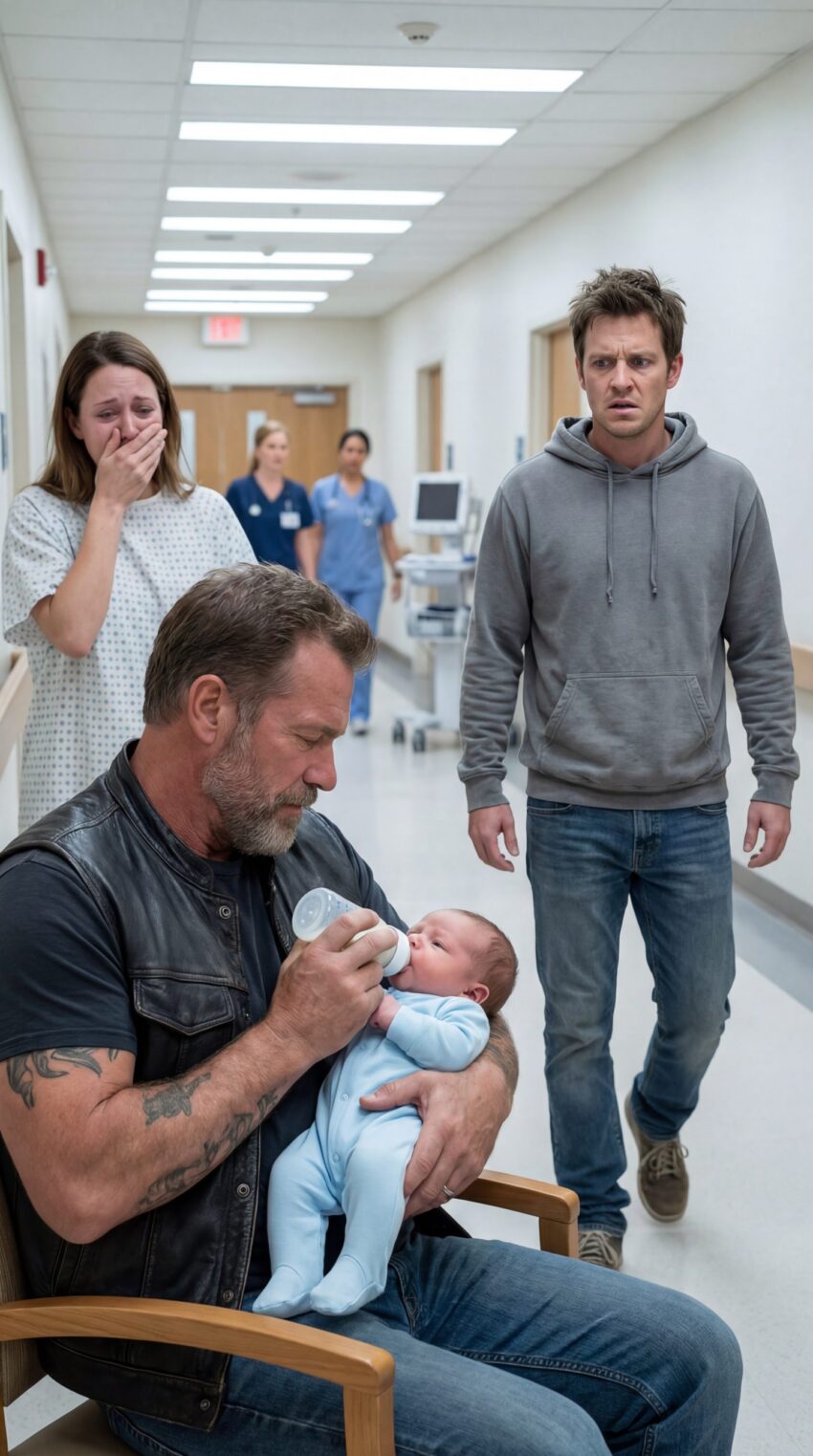
He had been sitting two rows down, leaning forward with his elbows on his knees. He wore a worn leather vest over a dark T-shirt, heavy boots planted firmly on the floor. Tattoos covered both of his forearms. His beard was streaked with gray, and there was something solid about him, like he took up more space than the average person.
He stood slowly and walked a few steps closer.
My instincts tightened immediately.
He didn’t invade our space. He didn’t reach out. He just listened to Ava’s cry for a moment.
Then he said in a low, steady voice, “That sounds like colic. I remember that cry.”
I moved without thinking, stepping slightly in front of Nora.
“We’ve got it,” I replied, sharper than I intended.
He lifted his hands slightly in a gesture of peace. “Sorry. Didn’t mean to intrude.”
He returned to his seat without another word.
But my pulse was racing. In less than five seconds, I had judged him. Leather vest. Tattoos. Late at night in an ER. My mind filled in the rest of the story without evidence.
Still, I kept watching him out of the corner of my eye.
Desperation
Ava’s crying intensified. It was no longer just noise; it felt like it vibrated through my bones. Nora’s shoulders shook as she tried to soothe her.
“Marcus, I don’t know what to do,” she said, tears spilling over.
I looked at my daughter, her small body stiff with discomfort, and something inside me cracked. Pride didn’t matter anymore. Appearances didn’t matter. Only Ava did.
I turned back toward the man.
“Hey,” I began, swallowing hard. “I’m sorry about before.”
He nodded gently, as if he had been expecting that.
“You’re tired,” he said. “And scared. I get it.”
He introduced himself as Grant Turner. He told us he had four children—grown now, scattered across different states. He chuckled softly.
“I’ve walked more living room floors at three in the morning than I can count,” he said.
Nora looked at me, silently asking a question.
Every instinct in my body resisted the idea of handing my daughter to a stranger. But every attempt we had made had failed.
Very carefully, I extended Ava toward him.
The Quiet Miracle
Grant took her with surprising gentleness. His large hands supported her head and back with practiced ease. He tucked her against his chest, holding her securely but not tightly.
He began to sway.
It wasn’t dramatic. Just a slow side-to-side motion, steady as breathing. Then he hummed. The sound was low and slightly off-key, almost like the idle of a distant engine. It vibrated softly through his chest.
Within seconds, Ava’s cries softened.
Within a minute, they turned into hiccups.
Within three minutes, she was asleep.
Completely asleep.
Her tiny fist rested against the leather of his vest. Her mouth hung slightly open, her breathing even and deep.
Nora burst into tears, covering her face.
I stood there stunned.
“Babies feel tension before they understand words,” Grant said quietly. “Sometimes they just need someone who isn’t afraid.”
He handed Ava back to me with care, as if she were made of glass.
I held her close, hardly daring to move.
His Own Worry
We learned that Grant was there because a close friend from his motorcycle club had been brought in after a serious accident. His friend was in surgery upstairs.
Even with his own fear sitting heavy on his shoulders, he had chosen to step into ours.
A nurse finally called our name. The doctor examined Ava and reassured us that she likely had a mild virus layered on top of her colic. Her fever was already coming down.
We were sent home with instructions and reassurance.
When we walked back into the waiting room, Grant was gone.
The nurse at the desk smiled softly.
“His friend made it through surgery,” she said. “He left once he knew.”
The Longest Four Hours
That night, Ava slept for four straight hours.
It might not sound like much, but for us, it felt like a gift from heaven.
Nora and I lay awake in the dim light of the baby monitor, listening to the silence.
“He didn’t look like what I expected,” Nora said quietly.
Neither did I.
I kept replaying the moment I stepped in front of him, ready to protect my daughter from someone who had only intended to help.
Looking Beyond Appearances
A few weeks later, once Ava’s colic began to ease, Nora searched online for Grant’s motorcycle club. We found their page. They organized toy drives for foster children. They hosted fundraisers for injured riders. They collected food for struggling families.
The photos surprised me. Big men in leather vests holding toddlers on their shoulders. Smiles that reached their eyes.
We decided to visit during one of their charity events.
The Warehouse Full of Laughter
The club’s warehouse sat on the edge of town. Country music played from an old speaker. Folding tables were covered in wrapping paper and tape dispensers. Men with broad shoulders and rough hands argued playfully over who was better at wrapping gifts.
Grant spotted us immediately.
His face broke into a wide grin when he saw Ava in Nora’s arms.
He approached slowly, crouching slightly so he wouldn’t overwhelm her.
“Hey there, little one,” he said softly.
Ava stared at him for a second, then reached out.
I laughed. “She remembers you.”
He shrugged. “Guess I made an impression.”
I took a deep breath.
“I almost called security on you that night,” I admitted.
He chuckled.
“You were protecting your kid. That’s your job.”
I shook my head. “I was protecting her from the wrong person.”
He looked at Ava, then back at me.
“You were exhausted. And you still chose to trust when it mattered. That’s what counts.”
We stayed and wrapped presents. No one treated us like outsiders. No one mentioned the hospital again. It was just people helping people.
Three Years Later
Ava is three now.
She runs without hesitation into Grant’s arms whenever she sees him. She calls him “Uncle Grant,” and he pretends to groan when she demands piggyback rides.
Every time I watch her laugh with him, I think about that night in the ER. About how close I came to letting fear turn into suspicion.
Grant didn’t arrive in a pressed suit or with polished words. He came in boots and leather, carrying his own worry, and still found room to steady a stranger’s child.
That night changed more than my daughter’s sleep pattern.
It changed me.
It reminded me that exhaustion can distort our judgment, that fear can paint strangers in darker colors than they deserve, and that sometimes the people who look the toughest carry the gentlest hearts.
It taught me that humility begins the moment we admit we might be wrong about someone, and that trust often requires courage when we feel least capable of giving it.
It showed me that kindness does not announce itself with fanfare, but arrives quietly, hums softly, and leaves before asking for recognition.
It proved that being a good father is not about never feeling afraid, but about choosing connection over pride when your child needs help.
It revealed that communities are built not by appearances but by actions repeated over time.
It reminded me that the world is far more layered than first impressions allow, and that wisdom sometimes comes dressed in leather and steel-toed boots.
It encouraged me to pause before judging, to breathe before reacting, and to remember that everyone carries a story we cannot see at first glance.
It strengthened my belief that compassion shared between strangers can ripple outward in ways we may never fully measure.
And it left me with a quiet promise to teach my daughter, as she grows, that courage is not loud, kindness is not always polished, and the safest hands are sometimes the ones we almost turn away from.