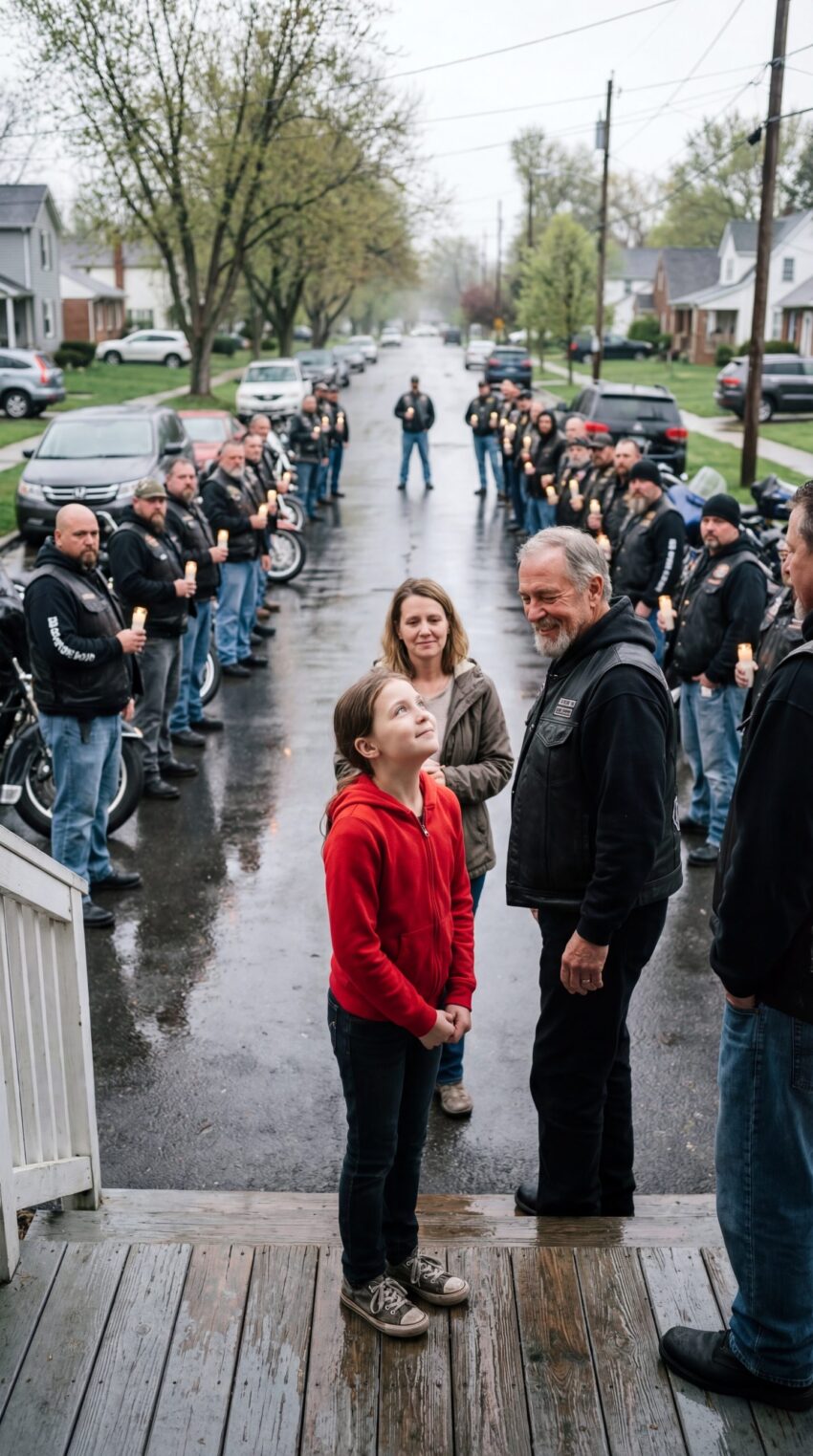
The Night the Street Forgot How to Judge
On a cold, rain-soaked evening in late November, the quiet suburban street of Briarwood Lane in Overland Park, Kansas, followed its usual rhythm—until it didn’t.
Porch lights flickered on one by one as dusk settled in. Rain tapped steadily against windows, and the familiar hum of everyday life drifted through the neighborhood. It was the kind of street where people waved politely but rarely stepped beyond small talk, where routines mattered more than questions.
But at exactly 7:11 p.m., something shifted.
The small blue-gray house at the end of the block had been unusually silent for days. No television sounds. No laughter. No signs of life beyond a single dim light upstairs.
Three nights earlier, a police car had pulled up quietly in front of that house. No sirens. No urgency. Just two officers walking slowly to the front door, hats in hand.
Inside that house now lived eight-year-old Lila Carter.
Her father, Everett Carter—known among his friends as “Iron Everett”—had passed away unexpectedly after collapsing at a construction site. He had been a welder, a devoted father, and a longtime member of a local motorcycle club. He was the kind of man who fixed broken gates without being asked and showed up early to every school play, no matter how long his workday had been.
Now, the house he once filled with warmth felt too quiet.
The First Engine in the Rain
At 7:18 p.m., Mrs. Donnelly, who lived across the street, noticed the first motorcycle.
It didn’t roar.
It didn’t demand attention.
It simply turned the corner and parked neatly along the curb, its engine shutting off with a soft, controlled hum.
She frowned, pulling her curtain slightly aside.
Then another motorcycle appeared.
And another.
A Line That Didn’t Move
By 7:25 p.m., nearly three dozen motorcycles lined both sides of Briarwood Lane.
Their headlights were off.
Their chrome surfaces dulled under the rain.
One by one, the riders stepped off.
They were broad-shouldered, dressed in dark leather vests soaked through by the steady drizzle. Boots met the pavement with quiet certainty. No one spoke loudly. No one laughed.
Instead, they formed a line along the sidewalk in front of Lila’s house.
Not tightly packed.
Not chaotic.
Just present.
Across the street, curtains shifted.
Doors cracked open.
Phones appeared in hands.
“Something’s not right,” one neighbor whispered.
“I’m calling the police,” another said, already dialing.
But the riders didn’t react.
They stood still.
Hands visible.
Heads slightly lowered.
Rain slid from their jackets and dripped onto the pavement beneath them.
Inside the Quiet House
Upstairs, Lila sat on her bedroom floor, hugging a stuffed rabbit that had lost one of its button eyes years ago.
Her aunt, Rebecca Sloan, had been staying with her since the news came. She spoke gently about arrangements, about visitors, about what the next day might bring.
But Lila wasn’t really listening.
Her world had shrunk into something small and confusing.
When she heard the faint sound of engines outside, she stood slowly and walked toward the window.
Peeking through the curtain, she saw them.
A long line of figures standing in the rain.
She didn’t feel fear.
She felt something she didn’t yet have a word for.
When Authority Meets Silence
At 7:37 p.m., two patrol cars rolled onto the street, tires hissing softly against the wet asphalt.
Officers stepped out, scanning the line carefully.
One of them approached a tall man near the center. He looked to be in his early sixties, with a weathered face and calm, steady eyes. His gray beard was damp from the rain.
“Evening,” the officer said. “Can you tell me what’s going on here?”
The man removed his gloves slowly before answering.
“We’re not here to cause trouble, officer.”
The officer glanced down the street.
The bikes were properly parked.
No engines revving.
No raised voices.
Still, something about the silence made it feel heavier than noise.
Rebecca opened the front door and stepped onto the porch, pulling her sweater tightly around her.
Her voice trembled despite her effort to stay firm.
“What do you want?”
The man turned toward her but didn’t step closer.
“We’re here for Everett.”
The words landed gently—but carried weight.
Rebecca stiffened.
“You’re not taking anything from this house.”
A quiet ripple moved through the line of riders—not anger, just something deeply felt.
The officer raised a hand slightly.
“Let’s keep this calm.”
Standing for Something No One Could See
A few minutes later, Sergeant Daniel Reeves arrived. Known for his calm judgment, he took in the scene before speaking.
“You’ve made your presence known,” he said evenly. “Now explain it.”
The bearded man nodded once.
“We’re standing watch.”
“From what?” the sergeant asked.
The man glanced briefly at the surrounding houses.
At the phones.
At the whispers.
Then he answered.
“From anything that might make this harder for her.”
The answer lingered.
Not aggressive.
Not defensive.
Just honest.
He reached slowly into his vest pocket. Several officers tensed slightly.
But he only pulled out his phone, typed a short message, and put it away.
“Just letting the others know we’re here,” he added.
More Than Just a Gathering
At 8:13 p.m., a low rumble echoed from the end of the street.
Five more motorcycles appeared, followed by two pickup trucks with hazard lights blinking softly.
They parked carefully.
Engines shut off one by one.
From the trucks stepped a few women dressed in dark coats. One carried a folded American flag encased in clear plastic. Another held a small wooden box.
A man approached Sergeant Reeves.
“Evening, sir. We’re here for the watch.”
The sergeant studied him.
“For Everett Carter?” he asked.
The man nodded.
The original rider spoke again, his voice softer now.
“He rode with us for almost twenty years. Never missed a charity ride. Never missed showing up when a kid needed support.”
He looked toward the faint light in the upstairs window.
“His little girl’s in there.”
Light in the Rain
The wooden box was opened carefully.
Inside were small battery-powered candles.
No banners.
No speeches.
No attention-seeking gestures.
Just quiet light.
Each rider took one, holding it steady in their hands as the rain continued to fall.
The glow spread gently along the sidewalk, small points of warmth against the cold night.
Sergeant Reeves watched closely.
There was no threat here.
Only purpose.
The bearded man stepped forward slowly, making sure every movement was clear.
He knelt near the walkway and placed a candle gently on the ground.
Then he stepped back into line.
The Moment That Changed Everything
At 8:26 p.m., the front door opened wider.
Lila stepped out onto the porch.
She wore an oversized sweatshirt, her small hands gripping the sleeves. Her bare feet pressed against the cool wood.
Rebecca stood just behind her, uncertain but no longer afraid.
The riders didn’t move.
The bearded man removed his helmet completely, holding it at his side.
“Evening, sweetheart,” he said gently.
Lila looked at the line of faces.
Rain falling.
Candles glowing.
“Are you my dad’s friends?” she asked.
The man nodded.
“Yes, ma’am.”
The word carried quiet respect.
No one laughed.
No one recorded.
One of the women stepped forward and placed the folded flag carefully at the bottom of the steps.
“This is for tomorrow,” she said softly.
Lila looked down at the candles.
Then back at the man.
Her voice was small, but clear.
“Why are you all standing in the rain?”
The answer came without hesitation.
“So you don’t have to feel alone tonight.”
Everything seemed to pause.
The rain softened.
The whispers stopped.
Across the street, curtains slowly fell back into place.
Sergeant Reeves removed his cap.
Mrs. Donnelly lowered her phone.
Something shifted—not outside, but inside everyone watching.
A Quiet Goodbye
At 8:41 p.m., without commands or signals, the riders began turning off their candles one by one.
The bearded man gave Lila a small nod.
“We’ll see you tomorrow.”
Engines started gently.
No roaring.
No showing off.
Just a low, steady hum.
The motorcycles pulled away in calm formation, their red taillights fading into the rainy distance.
By 8:48 p.m., Briarwood Lane returned to silence.
But it wasn’t the same silence as before.
It was softer.
Warmer.
More understanding.
Inside the house, Lila placed her candle on the windowsill, watching its glow reflect faintly against the glass.
The grief was still there.
But the emptiness wasn’t as heavy.
Because sometimes strength doesn’t need to be loud to be real, and sometimes the people who look the most intimidating are the ones who carry the quietest kindness, and sometimes showing up without asking for attention is the purest form of love, and sometimes a child doesn’t need answers as much as she needs presence, and sometimes respect is expressed not in words but in patience, and sometimes community reveals itself not during celebrations but in moments of loss, and sometimes protection comes not from force but from standing still with purpose, and sometimes people realize too late that they judged a moment before understanding it, and sometimes a single question from a child can change how an entire street sees the world, and sometimes even on the coldest nights, a few small lights are enough to remind someone that they are not alone.