The Afternoon Outside First Harbor Bank
By 4:17 on a gray Thursday in late October, the parking lot outside First Harbor Bank in Cedar Ridge, Pennsylvania, had already emptied into that tired end-of-day quiet that settles over small American towns. The sun was low but hidden behind clouds, and the air carried the kind of cold that made people hurry from one building to another with their shoulders raised and their hands deep in their pockets.
Inside a silver sedan parked near the side curb, a little girl named Callie Wren had reached the dangerous stage of waiting where every second felt longer than the one before it. She was seven years old, wearing a pink cardigan over a white dress with tiny strawberry prints, and the hem of the dress was marked with a faint stain from the fruit punch she had spilled at lunch. Her shoes tapped the back of the passenger seat. Her fingers drummed against the juice box in her lap. She had already counted the ceiling lights in the bank lobby through the windshield three times.
Then she saw him.
He came through the bank’s glass doors like a man who had gone inside carrying the last little bit of strength he had and had left without any of it.
He was tall and broad through the shoulders, wearing an old black leather jacket that had gone soft and faded with age. The kind of jacket that had seen years of weather, miles of highway, and more than a few hard seasons. In one hand, he held a stack of papers folded so tightly they looked as if they might tear. He did not slam the door. He did not turn back. He did not raise his voice.
He just crossed the parking lot in slow, dragging steps toward a dark motorcycle parked beneath a flickering lamp.
When he reached it, he sat down heavily, leaned forward, and covered his face with both hands.
A second later, his shoulders shook.
Callie went still.
She had seen adults cry before, but usually in a way adults thought children could not understand. Quietly in kitchens. In bathrooms with the door half closed. In cars after phone calls they said were nothing important. But this was different. There was something so large and lonely about the man bent over on that motorcycle that it did not make sense to her. Grown men that big were not supposed to look like they were falling apart in the middle of a bank parking lot.
Without really thinking it through, she unbuckled her seat belt.
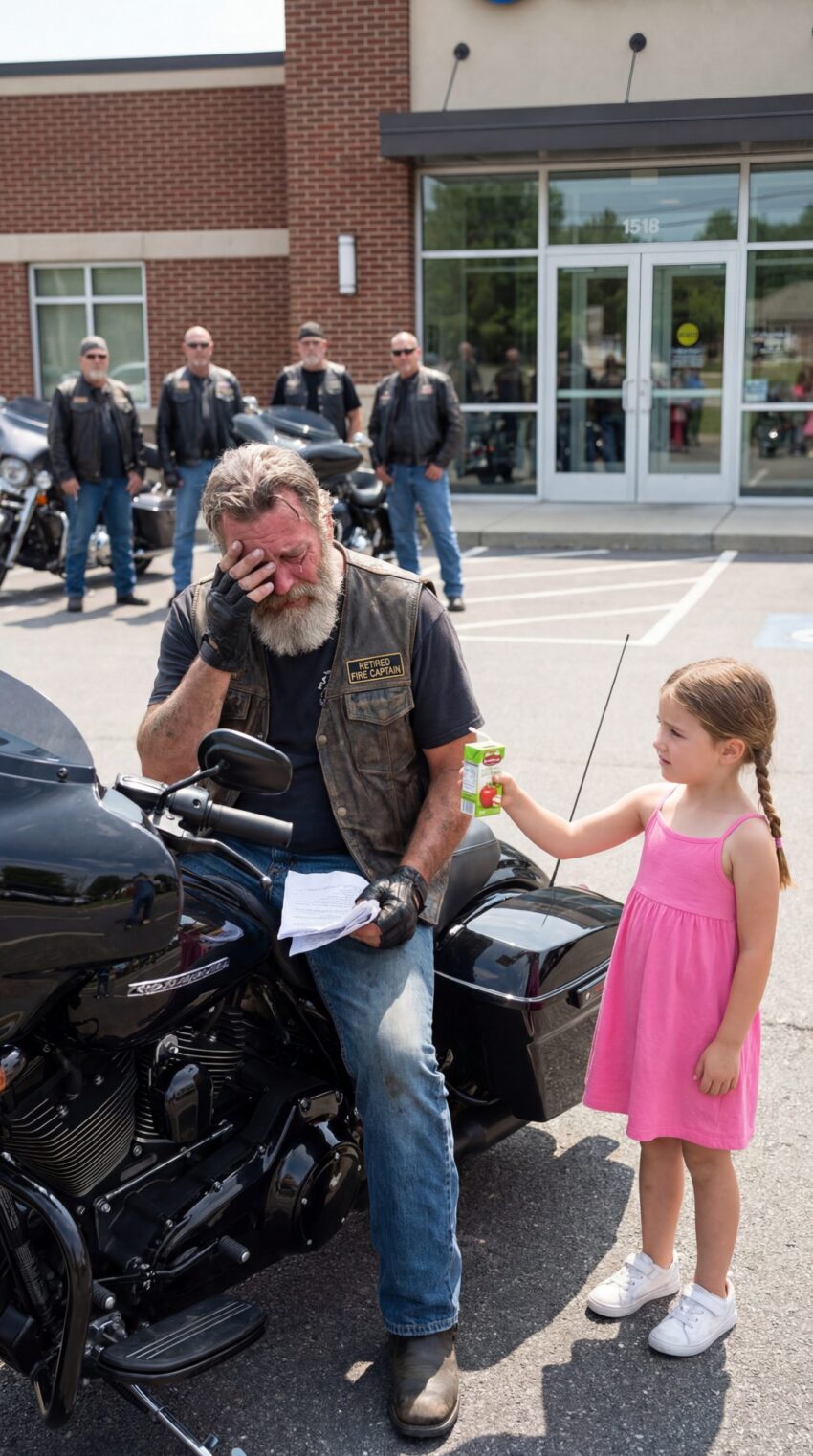
She moved carefully, the way children do when they know they are breaking a rule but believe they are doing it for a reason that matters. She pushed open the car door as softly as she could, slipped out, and started walking toward him with her apple juice box clutched in one hand.
A Child Who Had Not Yet Learned to Look Away
Callie came to a stop beside the motorcycle and looked up at the man.
From this close, he seemed even bigger. His beard was streaked with silver. His face was roughened by sun and years. His boots were worn at the toes, and there was a simple patch stitched onto the front of his leather vest beneath the jacket. One patch read Retired Fire Captain. Another carried a nickname in small letters: Mason.
She reached out and touched the edge of his vest with two fingers, gently, like someone touching the sleeve of a grandfather in church.
“Sir?” she said softly. “Are you okay?”
The man looked up fast, startled, as if he had forgotten the rest of the world still existed.
His eyes were red. Not from anger. Not from drink. From the effort of holding too much inside for too long.
He wiped his face quickly with the heel of his hand, embarrassed to have been seen.
“I’m all right, sweetheart,” he said in a voice that was low and uneven. “You should get back to your mom.”
Callie studied him with the direct honesty that only children manage.
“But you’re crying,” she said. “My teacher says crying is allowed when your heart hurts.”
For one brief second, the corner of his mouth twitched like he might smile. But the expression never fully came.
“Your teacher sounds smarter than most people,” he murmured.
Callie looked toward the bank door and then back at the papers in his hand.
“Did somebody in there make your heart hurt?”
The question was so plain, so innocent, that he let out one broken breath that almost sounded like a laugh.
If only it had been that simple.
Still, after a moment, he nodded.
“Something like that.”
Callie held out the apple juice.
“This helps me when I’m sad,” she told him. “It’s apple. It’s the best kind.”
That almost undid him.
His throat moved as he swallowed. For the first time since he had come out of the bank, someone had offered him something without suspicion, paperwork, explanation, or judgment. Just simple kindness in a cardboard box with a straw attached.
He took the juice carefully, like it was something far more valuable than it was.
“Thank you,” he said.
Callie glanced at the motorcycle.
“My grandpa had one too,” she said. “His was blue, but yours looks stronger.”
The man nodded slowly.
“Your grandpa must’ve been a good one.”
Her face changed a little then. Not dramatically. Just enough.
“He was,” she said. “He isn’t here anymore.”
The man lowered his eyes.
That landed somewhere deep.
“I’m sorry,” he said quietly.
Callie noticed the folded papers again.
“Did they say no to you?”
He hesitated.
Then, because he was too tired to pretend and because children sometimes make honesty feel safer than adults do, he answered.
“My wife passed a few days ago,” he said. “I came to get money from my account so I could take care of what needed taking care of. They kept saying something was flagged, or incomplete, or under review. They looked at me like I was trying to trick them.”
Callie frowned so hard her eyebrows nearly touched.
“That’s mean.”
He did not correct her.
She turned at once toward the bank.
“I’m going to get my mom.”
He lifted his hand, startled.
“No, honey, you don’t need to—”
But she was already running, pigtails bouncing behind her, sneakers slapping the pavement with determination.
Mason Rourke sat very still on the motorcycle and watched her go.
A few minutes earlier, he had felt invisible. Or worse than invisible. He had felt reduced. Shrunk down into a problem sitting across from a desk under fluorescent lights.
Now a little girl was marching into a bank like a tiny witness for the defense.
The Woman Who Knew the Sound of Injustice
Inside the bank, Callie found her mother near the customer service counter.
Her mother, Nora Ellison, was still in her work clothes: a fitted charcoal suit, a cream blouse, and low heels that suggested she had been on her feet longer than she wanted to admit. She was a litigation attorney from downtown Cedar Ridge, and by that point in the day she had the practiced expression of a woman who had answered too many emails, taken too many calls, and had very little patience left for nonsense.
Callie tugged urgently at her sleeve.
“Mom.”
Nora looked down.
“Callie? Why are you out of the car?”
Callie spoke in one breath.
“There’s a grandpa outside on a motorcycle and he’s crying because they were mean to him and his wife died and he needs his own money and they made him feel bad.”
The air around them changed.
The woman at the next station stopped typing. A man waiting in line looked up. Somewhere behind the desk, a manager’s office door opened an inch and then paused.
Nora’s face sharpened.
“Slow down,” she said, though her voice had already cooled into that dangerous calm Callie knew well. “What exactly happened?”
Callie pointed toward the front windows.
“He came out of here. He has papers. He said they wouldn’t help him. He’s outside crying on his motorcycle.”
That was all Nora needed.
There are certain words that turn a tired mother back into something fierce. There are certain stories that strip away every layer of social politeness and leave only principle behind.
This was one of them.
“Show me,” Nora said.
Callie grabbed her hand and pulled.
Outside, Mason was still sitting on the motorcycle, though now he looked more composed, as if he had spent the last few minutes trying to gather himself back together before the world came near him again.
Nora took him in quickly. The worn jacket. The documents. The patch. The strain in his face. The raw, stunned emptiness that follows grief when bureaucracy meets it at the door.
“Sir?” Nora called gently. “My daughter says you may have been given a hard time in there.”
Mason looked from her to the child and back again.
“It’s nothing,” he said automatically. “I’ll figure it out.”
Nora had spent enough years in courtrooms to recognize a man who had been talked over so much he had started trying to disappear.
“May I see the papers?” she asked.
He hesitated, but only for a second. Then he handed them over.
She scanned the documents fast. Death certificate request forms. Account statements. Funeral home estimate. Identification. Authorization records. Everything looked untidy in the way grief makes paperwork untidy, but not suspicious. Not dishonest. Just human.
Nora’s jaw tightened.
“There is no reason you should have been treated disrespectfully over this,” she said.
Mason gave a short, tired shrug.
“The teller said the account needed further review. The manager talked to me like I was trying to pull something. Kept looking at my clothes. My bike. Me.”
Nora handed the papers back.
“Stay here,” she said. “Callie, you stay with Mr. Rourke.”
Callie nodded solemnly, as if she had just been given official assignment.
Nora turned and walked back into the bank.
She did not rush. She did not stomp. She did not make a scene at the door. But she moved with the controlled force of someone who already knew she was right.
The Difference Between a Mistake and a Humiliation

From outside, Mason could not hear every word through the glass, but he could hear enough.
Nora’s voice rose only slightly, yet it carried.
“I want the branch manager.”
Then a few minutes later:
“No, this does not wait until tomorrow.”
And then, sharper still:
“A grieving customer should not have to prove his dignity to walk through your front door.”
People in the lobby began turning their heads. A few customers stepped aside. One young man near the ATM lifted his phone, not in the cheap, hungry way people chase embarrassment, but in the instinctive way modern people reach for evidence when fairness is on the line.
Outside, Callie climbed onto the passenger seat behind Mason with his permission and began swinging her legs lightly.
“My mom gets like this when something isn’t fair,” she told him.
Mason let out the first real laugh he had managed all day, quiet though it was.
“Does she?”
“Yes,” Callie said. “You’re probably okay now.”
He stared at the bank door.
He wanted to believe that. He really did.
But grief had taught him that “okay” was not a place people returned to just because someone meant well.
A long twenty minutes later, the glass doors opened again.
Nora came out first.
Behind her was a man in a navy tie and an expression that had gone pale around the edges. He looked like someone who had spent the last several minutes realizing that procedure and cruelty are not always the same thing, but they can look identical to the person receiving them.
He approached Mason cautiously.
“Mr. Rourke,” he said. “I owe you an apology. There was a misunderstanding in how your case was handled. If you would come back inside, we can resolve the matter immediately.”
Mason looked at him for a long moment.
Then he looked down at Callie, whose small face was set with serious expectation.
Then he looked back at the manager.
“No,” he said.
The man blinked.
“I’m sorry?”
Mason’s voice stayed low. That made it stronger.
“I said no. I’m not going back in there.”
The manager shifted uncomfortably.
“Sir, we can take care of everything right away.”
Mason nodded once.
“Maybe you can. But you already showed me how easy it was for your people to look at me and decide what kind of man I must be. I came in to access my own money so I could lay my wife to rest. You made me feel like I had to defend the fact that I belonged in your building.”
Silence fell between them.
Not an empty silence. The kind that forces people to hear what they would rather explain away.
“You embarrassed me,” Mason went on. “And when somebody is already trying to stand upright through the worst week of his life, that matters.”
The manager opened his mouth, then closed it again.
And then, from the back seat of the motorcycle, Callie spoke in the clear, matter-of-fact tone of a child reciting a classroom rule.
“If you hurt somebody in front of everyone, you say sorry in front of everyone.”
All of the adults turned toward her.
For half a second, even Nora had to hide a smile.
Then she straightened.
“My daughter is right,” she said.
An Apology That Could Not Be Whispered Away
It happened exactly the way it should have happened.
The manager went back inside. A few moments later, he stood in the middle of the lobby under bright lights and in front of customers, tellers, and staff and delivered the most uncomfortable public apology of his professional life.
He admitted that Mr. Mason Rourke had not been treated with the respect he deserved. He stated clearly that the matter had been handled poorly. He said the bank would correct it immediately and review how customers were being received and assisted.
Through the window, Mason could see mouths go still, eyes lower, shoulders shift.
No grand speech can erase humiliation. No polished sentence can undo a moment when a person is made to feel smaller than his grief.
But sometimes hearing the truth spoken aloud in public is the first small board laid across a broken bridge.
This time, when the manager came back out, Mason finally agreed to complete the transaction, though only with Nora beside him.
He walked in slowly. Not bowed. Not hardened. Just steady.
Callie waited by the window and watched him disappear into the lobby. She pressed both hands against the glass as if willing the room to behave itself.
When he came out fifteen minutes later, the papers were neatly organized, the withdrawal had been completed, and the check folder in his hand looked impossibly thin compared to everything it represented.
He thanked Nora first.
Then he looked at Callie.
“I won’t forget what you did for me today,” he said.
She shrugged with the careless grace of children who do brave things before they understand the size of them.
“You looked like you needed somebody,” she replied.
He bent slightly and, after asking permission with his eyes and receiving it from Nora, gently hugged her.
It was not a long hug.
But it was the kind that says more than most conversations ever do.
The House That Felt Too Quiet
That night, Mason returned to a house that no longer sounded like home.
His wife, Elaina, had been gone only four days, and already the silence had changed shape. It lived in the kitchen where she used to hum while making coffee. It sat in the hallway where her slippers no longer waited crookedly by the door. It stood by the coat rack where her scarf still hung, one end brushing the wall like it might move if he looked long enough.
On the mantel were framed photographs that hurt in different ways.
Elaina on the back of the motorcycle with both arms around his waist, laughing into the wind.
Elaina in the garden with dirt on her jeans and sunlight in her hair.
Elaina at a summer cookout, leaning sideways into the camera with the expression of a woman who loved being alive.
Mason lowered himself into his recliner and stared at the room until memory started pressing in from every corner.
He had spent thirty-one years running toward emergencies as a firefighter. He had stood in smoke, heat, chaos, and heartbreak. He had lifted beams, carried strangers, steadied shaking hands, and made terrible phone calls no one should ever have to make.
But this was different.
This was paperwork.
This was loss dressed in office language.
This was being asked for one more form when all he had left was exhaustion.
He pulled out his phone and called one of the oldest friends he had.
Darren Pike answered on the second ring.
“Tell me why your voice sounds like that,” Darren said.
Mason told him.
Not every detail. He did not need to. Men who have known each other long enough learn how to hear the whole story through the broken pieces.
There was a pause on the line, and then Darren exhaled hard.
“They did that to you today?”
“Yeah.”
“After everything?”
Mason looked at the framed photo of Elaina by the lamp.
“Yeah.”
Darren’s voice dropped lower.
“You’re not sitting in that house thinking you’re alone in this, are you?”
Mason did not answer quickly enough.
That was answer enough.
The Story That Refused to Stay Small
By morning, the story had moved farther than Mason intended.
Not because he had spread it. He had not.
But Darren told his sister. His sister told a retired paramedic she worked with. The paramedic had once volunteered with a widow’s support fund and told two others. Someone else found a short video clip online of a little girl’s voice near a bank door saying, “They made a grandpa cry.” Another person recognized Mason from his fire department years. Another recognized Nora from a county hearing. By lunch, the thing had grown legs.
People did not repeat the story because they loved outrage.
They repeated it because something in it felt familiar.
A tired man trying to do one impossible thing after another after losing the person who steadied his life.
A child who still believed sadness deserved an answer.
A woman who refused to let procedure hide poor treatment.
By afternoon, old friends were calling. Former firefighters. Riders from weekend charity runs. Neighbors. A woman whose attic Mason had once helped save from a lightning fire. A man whose father Mason had comforted after a house collapse twenty years ago. One after another, voices came through the phone saying some version of the same thing.
We remember who you are.
That mattered.
Because grief has a way of narrowing the world until a person begins to think pain is the only true thing left in it.
But kindness widens it again.
Not all at once. Not completely. Still, enough to let some air back in.
What a Little Girl Had Really Changed
A week later, after Elaina’s service had been held and the casseroles had stopped arriving and the evenings had started stretching longer again, Mason received an envelope in the mail.
Inside was a crayon drawing.
It showed a black motorcycle, a small girl with yellow hair that looked nothing like Callie’s real brown pigtails, and a very large man with a square smile standing under a bright blue sky. Above them, in uneven letters, was written:
Thank you for not leaving.
Tucked behind the drawing was a note from Nora.
She wrote that Callie had asked about him every day since the bank parking lot. She wrote that children rarely forget the first time they see an adult choose dignity over anger. She wrote that she hoped he was being given room to grieve in peace. And at the bottom, she added one final line.
Some people are helped by being rescued. Others are helped by being seen. I think that day you gave my daughter something too.
Mason read the note twice.
Then he sat in the quiet house and let himself cry again.
Not the same kind of crying as before.
Not the kind that comes from being stripped raw in public.
This kind came from the shock of discovering that even now, after loss had hollowed out so much of his life, the world could still send tenderness to his door.
He placed the drawing on the mantel beside Elaina’s photo.
And for the first time since she had been gone, the room did not feel quite as empty.
A Small Voice in a Hard World
People often imagine life changes because of grand speeches, official decisions, or dramatic turning points no one can miss.
But sometimes a day turns because a child notices what everyone else has trained themselves not to notice.
A man on a motorcycle covering his face.
A grief too heavy to hide.
A wrong done politely enough that other adults might have walked past it.
Callie Wren did not walk past it.
She saw pain and responded the only way she knew how: by walking toward it with an apple juice box and a question honest enough to break through pride.
That did not bring Elaina back. It did not erase the cruelty of being judged in a moment of need. It did not magically repair everything broken in Mason Rourke’s life.
But it changed the shape of that afternoon.
It interrupted humiliation with humanity.
It reminded a grieving man that he had not vanished from the moral eyesight of the world.
And it proved something many people forget once they grow older and more careful:
Sometimes the clearest voice in the room belongs to the smallest person willing to tell the truth.
Those who watched the story later talked about the bank manager, the public apology, the legal pressure, and the clip that spread from phone to phone.
But that was not the real center of what happened.
The real center was a little girl who saw a stranger hurting and decided that mattered.
And because she decided that, everyone around her was forced to remember it too.
Sometimes the world does not need louder people, smarter systems, or more polished explanations nearly as much as it needs human beings who are still brave enough to stop, notice another person’s pain, and refuse to treat suffering like background noise.
A child’s kindness can do what formal power often fails to do, because innocence has a way of cutting through pride, status, appearance, and excuses until only the truth remains standing in the middle of the room.
Grief is already heavy enough without making people carry suspicion, judgment, and humiliation on top of it, which is why the smallest act of patience or respect can become unforgettable to someone who is barely managing to hold themselves together.
There are moments when helping someone does not require money, authority, or a perfect plan, but only the willingness to say, “I see what is happening, and I am not going to pretend it is acceptable.”
Many adults spend years learning how to protect themselves by looking away, but children sometimes remind us that compassion begins the moment we choose to step closer instead of stepping around what feels uncomfortable.
Dignity matters most when a person is at their weakest, because that is when they are most likely to remember forever who treated them like a burden and who treated them like a human being.
A public apology cannot erase a wound, but honest accountability can still matter deeply, because truth spoken aloud has a way of giving back a small piece of the respect that was taken away.
The people who leave the deepest mark on our lives are not always the ones who arrive with power or importance, but often the ones who offer a simple kindness at the exact moment we were starting to believe no kindness was coming.
Even in a world that can feel rushed, cold, and overly suspicious, goodness still survives in ordinary places like parking lots, waiting rooms, sidewalks, and front seats of cars whenever someone decides another person’s pain is worth answering.
If there is one thing worth carrying forward from this story, it is this: never underestimate what can happen when courage wears a small voice, kindness comes without permission, and one human heart refuses to let another break alone.