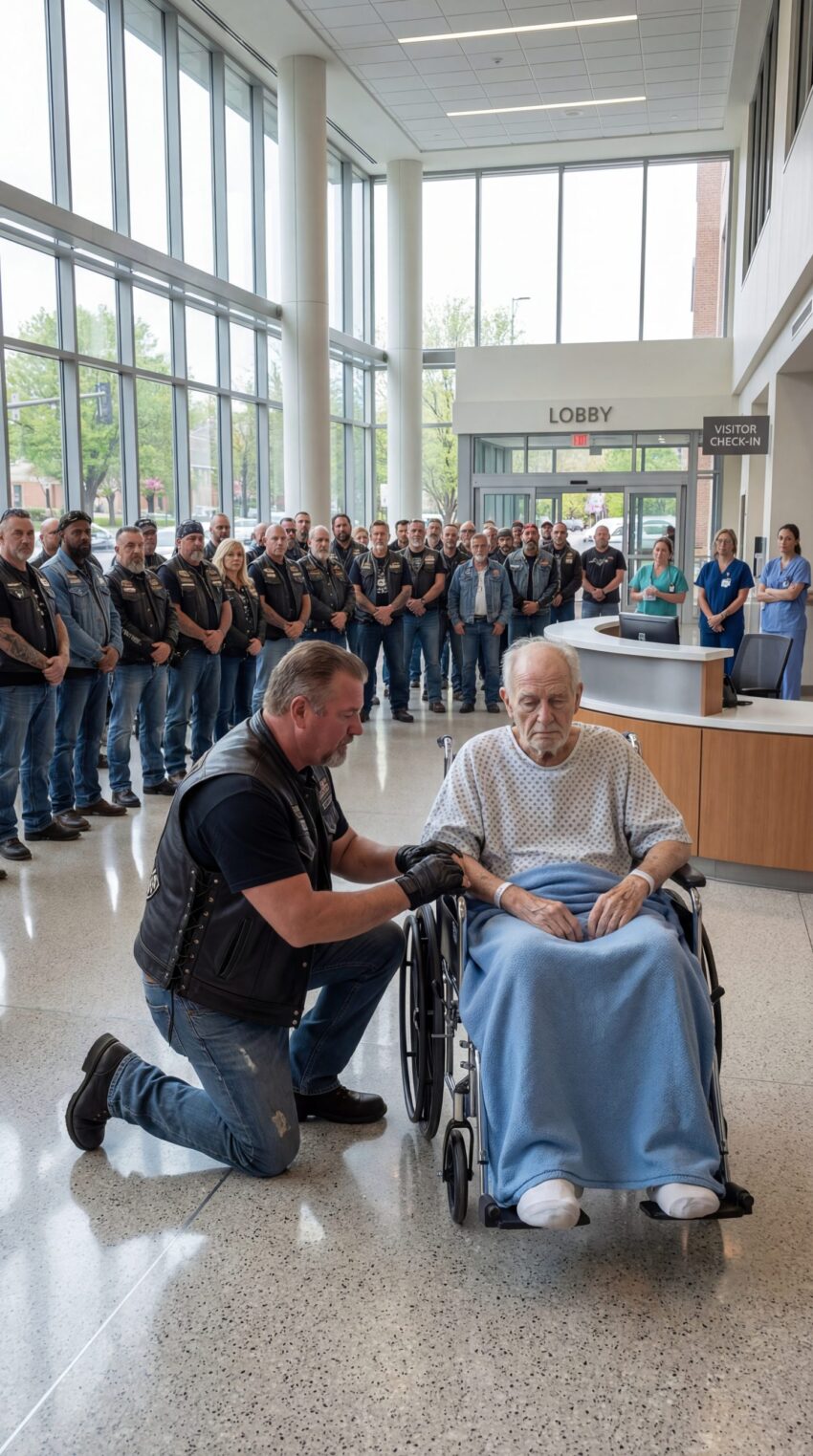
The Morning the Windows Began to Shake
On most mornings, Cedar Hollow Residence in northern Ohio felt like a place where time had stopped asking questions.
The halls were always clean. The medication carts always moved on schedule. The television in the common room always hummed low enough to blend into the walls. Even the sunlight that came through the tall front windows seemed careful, as if it had learned not to disturb anyone too much.
Marlene Whitaker had worked there for nearly eight years, and that was long enough to understand that not all quiet meant peace. Some quiet came from comfort. Some came from routine. But another kind settled over places where people had slowly stopped expecting anything from life.
That was the kind Cedar Hollow carried most days.
Marlene was organizing morning medications when she felt a faint vibration under her shoes. At first, she assumed one of the delivery trucks had pulled into the back lot. Then the glass in the cabinet doors gave a soft rattle. A second later, the windows at the nurses’ station trembled.
She lifted her head.
The sound came low at first, almost like distant weather. Then it deepened into something unmistakable. Engines. Not a few. A wave of them. A rolling, layered growl that moved across the parking lot with such force that every conversation in the building seemed to break at once.
An aide paused with a stack of towels in her arms. A resident sitting near the television turned down the volume. Two orderlies looked toward the entrance. Someone near the front desk whispered, “What on earth is that?”
Marlene already knew one thing for certain.
Whatever was happening, it had not come there by accident.
Forty Riders and One Question
When she stepped into the lobby, the front doors were already framing the sight that would later live in everyone’s memory like a scene from a film.
Motorcycles filled the front lot in clean rows, almost unnervingly orderly. Chrome flashed in the pale morning sun. Leather vests, denim, worn boots, weathered faces. Men and women. Young riders, older riders, broad-shouldered riders with gray at their temples, and lean riders with eyes that seemed to take in everything at once.
There were forty of them, maybe a few more.
They killed their engines nearly together, and the silence that followed felt heavier than the noise.
At the front of the group stood a tall man in his sixties with a silver beard and a stillness that pulled attention without effort. He did not swagger. He did not raise his voice. He simply walked toward the automatic doors as if he had already made peace with whatever waited on the other side.
The receptionist stood up too fast and nearly knocked over her chair.
“Sir, this is a private care facility,” she said, trying to sound firmer than she looked. “You can’t just come in like this.”
The man removed his gloves and tucked them into his belt.
“We’re not here to cause trouble,” he said evenly. “We’re here for Warren Talbot.”
The name moved through Marlene like a small electric shock.
Warren Talbot was ninety years old. Most people in the building spoke about him as if he were difficult, confused, or stuck in stories that no longer belonged to the real world. He told anyone who would listen that he had once ridden with men who crossed states to protect one another. He talked about old highways, roadside garages, winter charity runs, and a motorcycle club he helped build from almost nothing in the late 1960s.
The administrators called it fixation.
Marlene called it memory.
The Man in Room 214
Warren had lived at Cedar Hollow for almost three years.
He was not easy in the way facilities liked people to be. He asked too many questions. He noticed when his hearing aid batteries were late getting changed. He wanted fresh air instead of television. He disliked being spoken to as if he were a child. And when his daughter visited once every few months with polite impatience on her face, he became quieter for days afterward.
He often sat by the same second-floor window in his wheelchair, looking out over the long stretch of cracked pavement near the hedges as though he expected something important to arrive there one day.
Marlene had brought him soup, adjusted his blankets, listened to stories no one else had time for, and once helped him search half his room for an old photograph that had slipped behind a drawer. In that photograph, Warren had stood beside a line of motorcycles, younger and stronger, one hand on the shoulder of a laughing man in a denim jacket. There had been pride in his face then, but more than that, there had been belonging.
That was what Marlene recognized every time he talked about his old brothers.
He was not reaching for fantasy.
He was reaching for home.
The facility director, Cynthia Vale, came striding into the lobby with the sharp expression she wore whenever control began slipping out of her hands.
“What is going on here?” she demanded.
The silver-bearded rider turned to face her. “We asked a simple question. Where is Warren Talbot?”
Cynthia folded her arms. “Mr. Talbot is under supervised care. He is not available for whatever this is.”
A few riders behind the man exchanged looks, but none of them moved forward.
Marlene felt her pulse in her throat.
Cynthia continued, “His medical condition makes him vulnerable to confusion, and I will not allow a group of strangers to upset him.”
That was when Marlene made the choice that changed the rest of her life.
“Room 214,” she said quietly.
The lobby froze.
Cynthia turned so fast her badge swung against her blazer. “Excuse me?”
Marlene held her gaze. “Second floor. End of the east hall.”
The director’s face hardened. “You are completely out of line.”
Marlene surprised herself with how steady her voice sounded next.
“Maybe,” she said. “But I’m done pretending no one remembers who he is.”
The Walk Down the Hall
The riders moved through the building without chaos, without shouting, without the kind of energy the staff had feared. Their boots sounded firm against the tile, but there was restraint in every step.
Residents cracked open their doors. Some leaned out with walkers. Others watched from their beds with wide, curious eyes. One old man in the hallway pressed a hand to his chest and whispered, “I haven’t heard that sound in years.”
Marlene led them to the elevator, then up to the second floor. The silver-bearded man stood beside her the whole ride, saying nothing for a moment. Up close, she noticed a small patch stitched above his pocket with the name ELI.
When the elevator doors opened, he asked softly, “You’ve been taking care of him?”
“As much as they let me,” Marlene answered.
He nodded once. “Then thank you.”
She did not know why those two words nearly broke her.
At the far end of the east hall, Room 214 waited with its familiar half-open door and its faded wreath still hanging from winter, though spring had already begun outside.
Eli stopped before entering.
For the first time, something shifted in his face. Not fear, exactly. Something older. Something closer to grief held in check for too many years.
He looked at Marlene.
“Does he still talk about us?”
She swallowed. “Every week.”
Eli lowered his eyes for one brief second, then pushed the door open.
The Face He Never Forgot
Warren Talbot sat by the window with a blanket over his knees, his thin shoulders curved inward, his hands resting quietly in his lap. The morning light touched the lines in his face and the silver in his hair. Without his hearing aids in place, he looked even farther from the world around him, as if sound itself had stopped visiting regularly.
For one aching moment, nobody spoke.
Then Eli crossed the room, pulled a chair close, and lowered himself until he was eye level with the old man.
His voice, when it came, was nothing like the powerful tone he had used in the lobby.
It was gentle. Almost reverent.
“Road Captain,” he said. “It’s Eli Mercer.”
Warren blinked once.
Eli smiled through eyes that had already gone wet.
“You taught me how to keep a bike upright on rain-slick pavement outside Evansburg in 1974,” he continued. “You told me panic makes the road smaller. You remember that?”
The old man stared at him for another heartbeat, then another.
His fingers twitched.
Marlene watched the confusion leave his face in pieces, like fog lifting from a field when morning finally warms it.
“Eli?” Warren whispered.
The room changed.
Not dramatically. Not loudly. But completely.
Eli let out a broken breath that sounded half laugh, half sob. He reached forward and took Warren’s shaking hand in both of his.
“Yeah, old man,” he said, smiling now through tears he no longer bothered to hide. “It’s me.”
Warren’s mouth trembled. His eyes moved past Eli to the riders gathering behind him in the doorway, and something in his posture rose from deep inside him.
“You came,” he said.
A woman near the back, wearing a worn brown vest and a braid down one shoulder, covered her mouth and started crying.
“Of course we came,” Eli answered. “We should’ve come sooner.”
The Vest in the Drawer
Cynthia arrived with two security guards just as the room had begun filling with quiet emotion.
“This visit is over,” she snapped. “Mr. Talbot is not competent to make decisions in this state.”
Warren turned toward her, and the softness that had filled his face moments earlier hardened into something proud and unmistakably alert.
Still, Cynthia pressed on.
“He has episodes,” she said to the riders. “He tells stories that are not grounded in reality, and none of you should be encouraging this.”
Marlene felt anger rise so sharply that it steadied her.
She crossed to Warren’s dresser, pulled open the bottom drawer, and reached beneath a folded stack of thermal shirts. She had seen it there once before, hidden carefully under ordinary things.
When she lifted it out, the room went still.
It was an old leather vest, worn smooth at the seams, darkened by age, lined inside with repairs made by hand. On the back was the faded original insignia of the club Warren had helped found decades earlier.
Marlene carried it over and laid it across his shoulders.
The effect was immediate.
Warren straightened in his chair as if memory had a spine of its own. His chin lifted. His hands settled over the leather with familiarity so deep it needed no explanation.
The riders in the doorway lowered their heads.
Cynthia’s expression faltered.
Eli stood and turned toward her.
“That look right there,” he said, his voice quiet but iron-steady, “is not confusion.”
One of the riders stepped into the room then, a neatly dressed man in a dark vest with reading glasses clipped to his collar. Instead of a nickname patch, his vest carried a single word over the chest pocket.
COUNSEL.
He removed a folder from inside his jacket.
“My name is Grant Holloway,” he said. “I am an attorney, and before anyone here says another word about what Mr. Talbot can or cannot do, I suggest we discuss what authority this facility actually has over a resident who has repeatedly stated he wishes to leave.”
The security guards looked suddenly less certain about why they had come.
A Voice the Whole Building Could Hear
Cynthia tried to recover the ground she had lost.
“His daughter holds power of attorney,” she said sharply. “That gives the family legal standing in medical matters.”
Grant nodded. “Medical matters, yes. Ownership of his life, no.”
Warren looked from one face to another, and when he spoke, he spoke clearly.
“I said I wanted out months ago.”
Marlene closed her eyes for a second.
He had said it many times. In different words, on different days. Sometimes calmly. Sometimes bitterly. Once while staring through the window at rain.
Nobody had wanted to hear him because hearing him would have required action.
Now the hallway behind them was filling. Residents had gathered outside the room. Staff members stood farther back, pretending not to listen.
An older woman from Room 210 lifted her voice from the doorway.
“He always knew exactly what he was saying,” she called out. “They just didn’t like it.”
Another resident added, “He told me every Friday those bikers would come someday.”
A third voice followed, thin but firm. “Looks like he was right.”
Something invisible shifted in the building then. Not policy. Not paperwork. Something human. The balance of who got believed.
Cynthia saw it too.
For the first time since she entered the room, she had no immediate answer.
The Motorcycle Waiting Outside
It turned out Eli and the others had not come empty-handed.
In the lower parking lot, covered beneath a weatherproof canvas, waited Warren’s old motorcycle, restored with painful care over the past year by riders who had passed photographs, stories, and spare parts between states to bring it back as close as possible to the machine he once loved.
It was a 1961 Harley Duo-Glide in deep black with cream pinstriping, polished enough to catch the whole sky in its tank.
When Marlene first saw it, she pressed a hand to her mouth.
Warren was brought downstairs slowly, wrapped against the spring wind. Residents lined the front walkway in sweaters and blankets, some seated in wheelchairs, some leaning on canes, all of them watching with the alert stillness of people who understood they were seeing something rare.
A local police officer had arrived by then after reports of a large biker presence at the facility, but he stopped short when he took in the scene. This was not disorder. This was witness.
Eli knelt beside Warren’s chair.
“You don’t have to do a thing that hurts,” he said. “Even just sitting beside it is enough.”
Warren looked at the bike for a long moment.
Then he smiled, slow and astonished, like a man seeing an old version of himself walk out of the past.
“I’d like to sit on her,” he said.
It took four riders and all the care in the world, but they lifted him gently and settled him onto the seat.
The moment his hands closed around the handlebars, the years seemed to fold.
His shoulders broadened. His back straightened. The corners of his mouth rose. He was still a frail old man, still tired, still carrying the weight of time in his body, but no one there could miss what had returned to his face.
Recognition. Dignity. Joy.
Someone in the crowd began to clap. Then another. Then nearly everyone.
Warren looked toward the officer and spoke with a clarity that carried across the lot.
“Nobody is taking me anywhere,” he said. “I am going because I choose to.”
The officer gave one small nod.
That was enough.
The Family That Arrived Too Late
They stopped first at a roadside diner outside Millersport, the kind of place with a long counter, hot coffee, and pie in a glass case near the register. The riders took booths and stools, filling the space with leather, laughter, and the sort of careful protectiveness that made strangers instinctively lower their voices around them.
Warren sat at the head of a pushed-together row of tables, bundled in a clean wool coat someone had brought for him. Marlene sat nearby because, to everyone’s mild amusement and deep approval, she had quit Cedar Hollow in practice before Cynthia could finish threatening her on paper.
She had no plan for what came next.
For the first time in years, that uncertainty did not frighten her.
It felt honest.
They had barely received their coffee when Warren’s daughter and son arrived.
His daughter, Teresa, came in first, brisk and angry, with Warren’s son, Douglas, two steps behind her carrying outrage like it had been prepared on the drive over.
“This is unbelievable,” Teresa said. “You people had no right to interfere.”
The diner went silent except for the hiss from the grill.
Grant Holloway placed a folder on the table and slid it forward.
“Actually,” he said, “what we interfered with was neglect.”
Douglas stared at the papers. “He belongs in care.”
Warren looked at him for a very long moment before speaking.
“A father belongs where he is treated like a person,” he said quietly. “You had every chance.”
Teresa’s expression shifted, not into guilt, but into frustration at being cornered by truth.
“We were trying to protect assets,” she said, then seemed to realize too late what she had admitted.
Warren gave a tired smile with no warmth in it at all.
“That’s the first honest sentence you’ve spoken to me in years.”
No one at the table moved.
Grant opened the folder.
Inside were revised legal documents Warren had been discussing with outside counsel for months through letters Cynthia had apparently never known about, helped along by an old family friend of the club who had recognized the situation for what it was.
Trusts. Transfers. Directives. All clean. All lawful. All devastating to the children who had mistaken distance for advantage.
“Mr. Talbot’s estate will no longer pass in the manner you expected,” Grant said.
Douglas looked furious. Teresa looked stunned. Warren only looked relieved.
“My home, what remains of my savings, and the land up near Ash Creek,” he said, “will go to a foundation for aging veterans, retired riders, and forgotten men who need somewhere decent to land.”
He rested one weathered hand over his coffee cup.
“No more forgotten rooms,” he added.
What Home Meant in the End
Warren did not have years after that day.
He did, however, have months filled with more life than the previous three years had given him.
The riders found a small accessible cottage on church-owned land outside Ash Creek, close enough to town for nurses and supplies, far enough out for open sky and the sound of evening wind through the trees. Volunteers took turns staying with him. Marlene, after one week of pretending she was only helping temporarily, accepted a permanent role coordinating his care.
He laughed more there.
He told stories without being corrected.
He sat on the porch while motorcycles rolled up the gravel drive on warm afternoons, each visit another reminder that promises made in youth sometimes sleep for a long time before waking again.
When his strength allowed it, Eli read aloud old route journals and club notes. When it did not, they simply sat together in companionable silence that felt nothing like the silence Cedar Hollow had known.
One evening near sunset, Warren said to Marlene, “I thought the world had already finished with me.”
She adjusted the blanket over his knees and smiled.
“Looks like it hadn’t,” she said.
He smiled back. “No. Looks like I still had people riding my direction.”
He passed in his sleep near the end of autumn with the bedroom window cracked just enough to let in cool air and the distant sound of engines arriving one by one along the gravel road.
He was not alone.
At his farewell, motorcycles lined both shoulders of the county highway for nearly a mile. Veterans stood beside riders. Nurses stood beside mechanics. Men who had known him for fifty years stood beside young riders who had only heard his story months earlier but came anyway because respect, once understood, asks to be carried forward.
When the formation pulled out, one place near the front remained open.
No one filled it.
No one needed to explain why.
Because blood may begin a family, but loyalty is what proves one.
Because being remembered is one of the deepest kinds of mercy.
Because sometimes the people who arrive late are still the right people, as long as they come with love and do not leave again.
Because dignity can return to a life in one brave morning when somebody finally says, This person still matters.
Because the world often calls people difficult when what it really means is inconveniently honest.
Because growing old should never mean becoming invisible.
Because friendship built in truth can outlast distance, silence, pride, and the long damage of time.
Because one act of courage from a nurse, a friend, or a stranger can break open a system that depends on everyone staying quiet.
Because home is not always the place written on your records, but the place where your voice is heard without being reduced.
Because the strongest love is not always loud, yet when it finally arrives, everyone in the room can feel the ground change beneath them.
Because no one should spend their final chapter wondering whether they were forgotten, especially when somewhere out there, hearts still remember the road back