A young widowed veterinarian was fired for secretly saving a wounded military dog, a choice her boss condemned. But he had no idea that his harsh decision would backfire and ultimately cost him far more than he ever expected.
If you had asked me, years ago, what kind of person breaks their own life on purpose, I would have given you a very clean, very logical answer—someone reckless, someone naïve, someone who mistakes impulse for courage. Back then, before everything that happened, before the morning I watched my entire career unravel in front of a room full of strangers, I would never have imagined that person might look exactly like me, standing in scrubs that hadn’t been washed in two days, holding a trembling credit card over a machine that would decide whether a dog lived or died.
My name is Nora Callahan, and for a long time, I thought I understood the limits of responsibility. I was a veterinarian, yes, but I was also a mother, a widow, and a woman who had learned—sometimes the hard way—that compassion without boundaries can ruin you. Life had already taken more from me than I’d ever expected to lose, and I had built what little stability I had left with careful, deliberate choices. I worked at a corporate veterinary clinic not because I believed in it, but because it paid reliably, and reliability is a luxury when you’re raising a child alone. My son, Theo, was thirteen then, right at that age where he pretended not to need me but still left his bedroom door slightly open at night, as if some part of him wasn’t quite ready to face the dark alone.
That morning started like so many others—gray, damp, and heavy with the kind of drizzle that never quite becomes rain but still manages to soak through your clothes if you stand in it long enough. I remember thinking, as I unlocked the clinic doors and stepped inside, that the air smelled faintly of antiseptic and burnt coffee, a combination that had somehow become comforting over time. There’s a strange kind of rhythm to veterinary work, even in a corporate setting. Animals don’t care about your policies or your quotas; they arrive in pain, in fear, in need, and you respond. Or at least, that’s how it’s supposed to work.
By mid-morning, the waiting room had filled up with the usual mix of routine appointments and minor emergencies. A limping terrier, a coughing tabby, a nervous golden retriever who refused to sit still. Nothing out of the ordinary—until the doors burst open.
The boy came in first, soaked to the bone, dragging a rusted red wagon behind him with both hands. He couldn’t have been older than ten, maybe eleven at most, and his face was streaked with rain and tears in a way that made it hard to tell where one ended and the other began. Inside the wagon lay a German Shepherd, large and once clearly powerful, now reduced to a trembling, broken form. His breathing was shallow, uneven, and one of his hind legs—God, I still remember the angle—was twisted in a way no limb should ever be.
“Please,” the boy gasped, his voice cracking under the weight of panic. “Please help him.”
Everything else in the room seemed to fall away.
I dropped what I was doing and moved toward them, kneeling beside the wagon without hesitation. The dog’s eyes flickered toward me, clouded with pain but still alert, still aware. There’s a look animals give you in moments like that—a quiet, unspoken trust that feels almost unbearable.
“What’s his name?” I asked, keeping my voice as steady as I could.
“Ranger,” the boy said, choking on the word. “He—he saved me.”
That was when I noticed the skid marks on the boy’s shoes, the faint smear of blood on his sleeve, the way his hands wouldn’t stop shaking.
Before I could ask anything else, a voice cut sharply across the room.
“Don’t touch that animal until we’ve verified payment.”
I didn’t have to turn around to know who it was.
Victor Hale.
Regional director, corporate enforcer, the kind of man who wore expensive suits like armor and treated compassion as a liability. He had a way of appearing exactly when you didn’t want him to, as if he had a sixth sense for moments that might cost the company money.
“Victor,” I said, rising to my feet slowly, “this dog needs immediate surgery. He’s bleeding internally, and that leg—”
“—will be addressed,” he interrupted, his tone cold and precise, “once the appropriate financial arrangements are made.”
The boy, whose name I would later learn was Caleb, scrambled to his feet and rushed to the front desk. With fumbling hands, he emptied the contents of his pockets onto the counter—coins, crumpled bills, even what looked like a handful of arcade tokens.
“This is all I have,” he said, his voice breaking completely now. “My dad’s deployed. Ranger’s all I’ve got. Please, I’ll pay the rest later, I swear.”
Victor didn’t even look at him.
“The deposit for a procedure of this magnitude is three thousand dollars,” he said, as if reciting from a script. “Upfront.”
I felt something inside me tighten.
“He’s a military service dog,” I said, stepping closer. “You can’t just—”
“I can, and I will,” Victor replied, finally turning his gaze toward me. “And if you proceed without authorization, Dr. Callahan, you will be terminated immediately. Do I make myself clear?”
The room had gone completely silent.
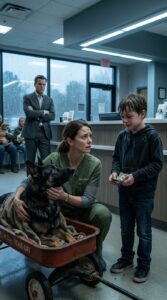
In the corner, an older man in a worn denim jacket sat quietly with a small white dog in his lap, watching everything unfold with an expression I couldn’t quite read. At the time, he seemed like just another client. I barely registered him.
My attention was fixed on the boy.
Caleb had dropped to his knees beside the wagon again, pressing his forehead against Ranger’s side, whispering apologies over and over as if saying them enough times might somehow undo what had happened.
And Ranger—despite the pain, despite everything—lifted his head just enough to lick the boy’s hand.
That was the moment everything changed.
Because in that small, fragile exchange, I saw something that had nothing to do with policy or procedure or profit margins. I saw loyalty. Sacrifice. A bond that didn’t ask for permission to exist.
And I knew, with a clarity that left no room for doubt, that I was about to destroy my own life.
I walked behind the reception desk, ignoring the way Victor’s eyes followed me, sharp and calculating. My hands moved almost on their own as I logged into the system, pulled up the billing interface, and reached into my pocket for the one card I had sworn never to use unless there was absolutely no other option.
It was meant for Theo.
For rent, for clothes, for emergencies that involved my own child.
My fingers hovered over the keypad for a fraction of a second, just long enough for doubt to whisper its objections. But then I thought of Ranger’s eyes, of Caleb’s trembling voice, and the hesitation disappeared.
I swiped the card.
The machine beeped.
Approved.
Three thousand dollars.
Gone.
A strange, steady calm settled over me then, the kind that comes when a decision has already been made and there’s no point in second-guessing it.
“Prep the operating room,” I said to the nearest technician, my voice firm now, almost detached. “We’re going in immediately.”
“Nora,” Victor snapped, his composure cracking for the first time, “you just signed your own termination.”
“Then I hope you enjoy the paperwork,” I replied without looking at him.
The surgery lasted nearly six hours.
Time, in those moments, becomes something fluid, stretching and compressing in ways that don’t quite make sense. There’s only the work—the precise, meticulous process of repairing what’s been broken, of holding a life together with skill and stubborn determination.
Ranger’s injuries were severe. Internal bleeding, multiple fractures, extensive tissue damage. At several points, I wasn’t sure we were going to make it.
But we did.
When the final stitch was placed and his vitals stabilized, I stepped back, exhaustion hitting me all at once like a physical force. My hands were shaking, my back ached, and my vision blurred at the edges, but he was alive.
That was enough.
When I walked back into the waiting room, the early morning light was just beginning to filter through the windows. Caleb was curled up on a chair, asleep, his head resting awkwardly against the armrest.
I didn’t wake him.
I just stood there for a moment, letting the quiet settle around me, letting myself believe—if only briefly—that maybe, just maybe, things would be okay.
I should have known better.
The doors slammed open with a force that made everyone in the room jump.
Victor strode in, a printed report clutched in his hand, his face flushed with barely contained rage.
“What did you think you were doing?” he demanded, his voice echoing off the walls.
I didn’t answer immediately.
Not because I didn’t have one, but because I knew it wouldn’t matter.
“I saved a life,” I said finally.
“You violated company policy,” he shot back. “You used clinic resources without authorization, and you expect—what? Gratitude?”
“I paid for the procedure myself,” I said, holding his gaze. “The company didn’t lose a cent.”
“That’s not the point,” he snapped. “The point is control. If we let employees make decisions based on emotion, we lose the structure that keeps this business profitable.”
There it was.
Not care. Not ethics.
Profit.
The room was full now, clients watching, whispering, their expressions shifting from curiosity to discomfort to something closer to disbelief.
Victor turned, raising his voice just enough to ensure everyone could hear.
“Let this be a lesson,” he said. “Compassion does not override policy. And insubordination—no matter how well-intentioned—has consequences.”
He looked back at me, his expression hard as stone.
“You’re fired.”
The words landed, but they didn’t hit as hard as I expected.
Maybe because I had already known.
Maybe because, in some quiet corner of my mind, I had accepted the cost the moment I swiped that card.
I nodded once, set my stethoscope on the counter, and walked out.
No argument.
No scene.
Just… done.
The week that followed was, without exaggeration, one of the worst of my life.
Applications went unanswered. Calls weren’t returned. And when I did manage to get through to someone, the tone shifted the moment my name was recognized.
Victor had done exactly what he threatened.
Blacklisted.
Eviction notices began appearing like clockwork, each one a reminder that good intentions don’t pay rent. Theo tried to be strong, tried to pretend he wasn’t scared, but I could see it in the way he lingered near me, in the way he asked questions he didn’t really want answers to.
I had gambled everything.
And I was losing.
What I didn’t know—what I couldn’t have known—was that someone had been watching.
The older man in the denim jacket.
The one I barely noticed.
He had seen everything.
And more importantly, he had recorded it.
The video spread faster than anything I had ever seen.
By the time I realized what was happening, it was already everywhere—my face, Victor’s voice, the entire confrontation laid bare for the world to judge.
The reaction was immediate.
Explosive.
People were angry—not in the quiet, polite way, but in a loud, collective outrage that refused to be ignored. Calls flooded the clinic. Appointments were canceled. Reviews plummeted.
And then, something unexpected happened.
People started reaching out to me.
Messages. Emails. Donations.
Support, in a volume so overwhelming it was almost impossible to process.
The turning point came three days later.
I was sitting on the floor of my apartment, surrounded by half-packed boxes, when I heard a noise outside—voices, movement, something unusual enough to pull me to the window.
What I saw made me freeze.
A crowd.
Dozens of people gathered on the street, cameras, signs, something that felt more like a rally than anything I could make sense of.
And at the front of it—
Caleb.
Standing beside Ranger, who, despite the bandages and the careful way he held himself, looked stronger than I had ever seen him.
When I stepped outside, the applause hit me like a wave.
Ranger moved first, limping forward with determination, pressing himself against me with a soft, familiar weight that brought tears to my eyes before I could stop them.
Behind him, the older man stepped forward.
“My name is Arthur Bennett,” he said, his voice calm but carrying easily over the crowd. “And I believe you’re exactly the person we’ve been looking for.”
What followed felt less like a conversation and more like the beginning of something entirely new.
A foundation.
A hospital.
A place where no one would be turned away.
And an offer that would change everything.
Lesson of the Story:
Doing the right thing rarely comes at a convenient time, and it almost never guarantees immediate reward. In fact, it often demands sacrifice, risk, and a willingness to stand alone when it matters most. But integrity has a way of revealing itself, especially when witnessed by others, and kindness—genuine, selfless kindness—creates ripples that extend far beyond what we can see. When you choose compassion over fear, even when it costs you everything, you may lose your footing for a while, but you won’t lose your direction—and sometimes, that’s what leads you exactly where you were meant to be.