The Girl by the Highway
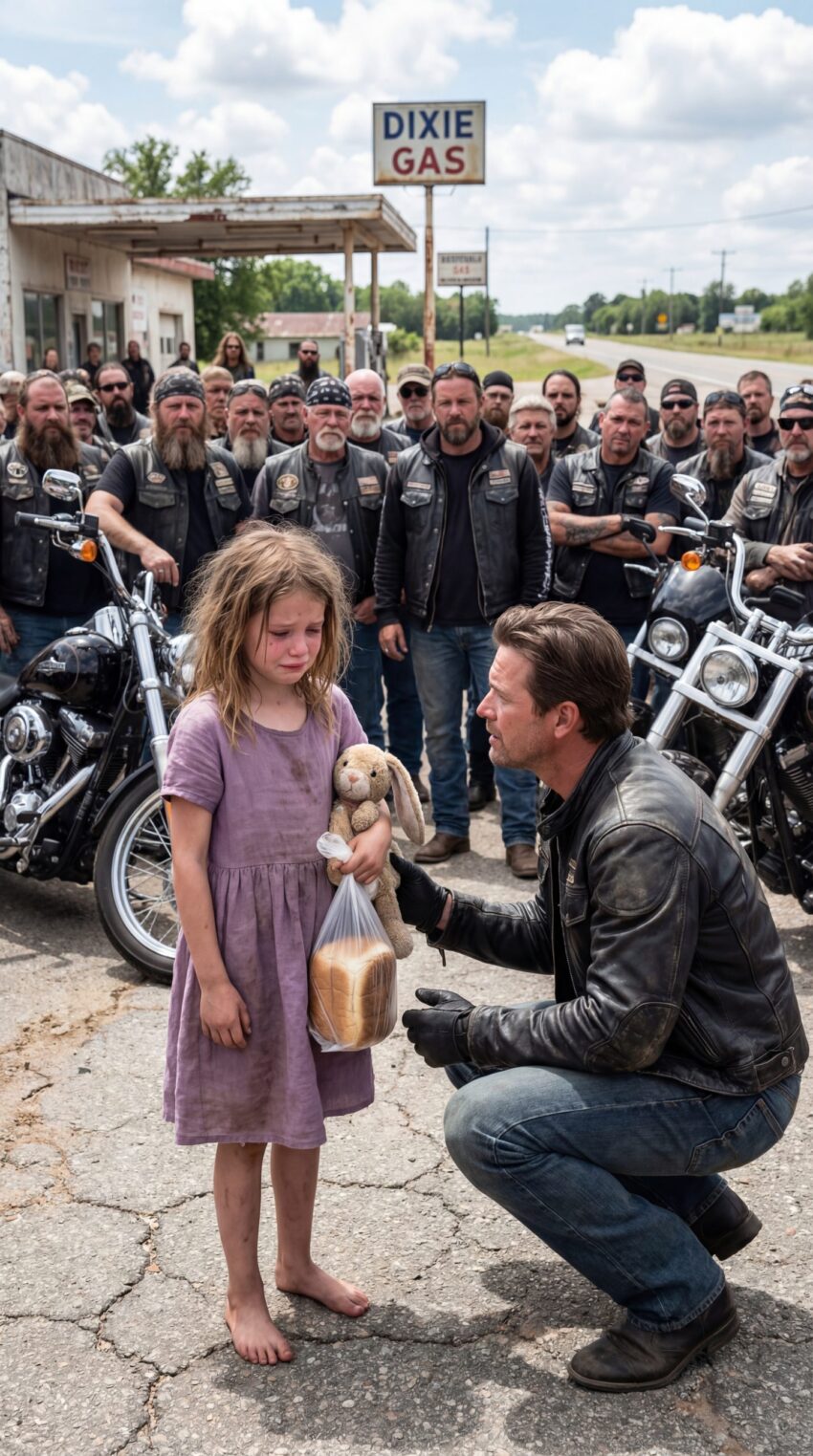
The heat above Route 82 shimmered like a mirage, turning the afternoon air over the old gas station into something restless and unsteady. The station sat outside Elk River, Missouri, with two faded pumps, a crooked awning, and a broken neon sign that had not fully worked in years. Most travelers stopped only long enough to fill a tank, grab a drink, and move on.
Seven-year-old Brielle Sutton stood near the ice machine with bare feet on hot concrete and a worn stuffed bunny tucked against her chest. One of the bunny’s button eyes had been replaced with black thread. Its ears were soft from years of being held. Brielle pressed it close as if it could do the job of a parent, a home, or a promise.
Earlier that morning, her mother had told her to wait by the station door. A man named Wade had been in the driver’s seat, tapping the steering wheel and complaining under his breath. Her mother had looked exhausted in the way adults sometimes did when life had taken too much from them and left them with no patience for anyone smaller than themselves.
Brielle had asked the same question she always asked.
“Are we going home now?”
Her mother had not answered right away. Then she had looked at Brielle, not with hatred exactly, but with the tired emptiness that frightened a child even more.
“Just stand still for once,” she had said. “Please don’t make this harder.”
Brielle had obeyed. She always tried to obey. She had learned that when grown-ups were upset, being quiet felt safer than asking for comfort.
Then the car door shut. The engine started. When Brielle reached for the handle, it was locked.
“Mom?” she had called.
The window rolled down only halfway.
“Wait here,” her mother said.
“For how long?”
There had been a pause, long enough for hope to grow and then begin to shake.
“Just wait,” her mother answered.
Then Wade had muttered something sharp, and the car pulled away before Brielle understood that nobody was coming back in the next minute, or the next hour, or maybe at all.
By midafternoon, she had stopped crying. She was too thirsty for that. Too tired. Too confused to know which hurt mattered most.
She stood there under the broken sign, trying to be good in case goodness still counted for something.
The Sound of Engines
The first motorcycle came into view as a low growl in the distance. Then another. Then many more.
A long formation of riders moved down the highway in steady rhythm, leather vests dark against the white glare of the road. Chrome flashed under the sun. The sound rolled across the station lot like distant thunder. At the front rode a broad-shouldered man in his forties with a trimmed beard touched by gray and a patch on his back that read Road Captain.
His name was Nolan Mercer.
Nolan had spent enough years on the road to notice what others missed. He noticed broken taillights, bad weather building over flat country, the way a man looked before he started trouble, and the way a child looked when she had been left alone too long.
Brielle did not wave. She did not cry out. That was what made him pull back on the throttle.
She was standing too still.
He lifted a hand, signaling the group to slow. The riders behind him adjusted instantly, the formation peeling off the highway and into the gas station with practiced ease. Engines quieted one by one until the lot fell into a silence so sudden it almost felt sacred.
The station clerk stepped out from behind the counter and stared.
Nolan killed his engine, removed his helmet, and looked at the little girl again. Dust on her feet. Wrinkled clothes. A stuffed bunny held so tightly it looked like part of her body. Eyes too old for her age.
He walked toward her slowly and crouched a few feet away.
“Hey there,” he said, softening his voice without thinking about it. “You all right out here?”
Brielle looked at him, then at the line of bikes behind him, then back down at the ground.
He waited. He did not rush her. Fear had its own clock.
“What’s your name?” he asked.
Her voice was almost a whisper.
“Brielle.”
“That’s a beautiful name.”
She said nothing.
Nolan glanced at the stuffed bunny. “What about your friend there?”
She looked down at it. “Mopsy.”
“Mopsy looks brave.”
A tiny shift crossed her face, not a smile but something close.
Then she said the sentence that changed the entire afternoon.
“My mama said nobody keeps loving trouble forever.”
The words were quiet. Calm. Memorized.
Behind Nolan, several riders went completely still.
A woman rider named Raina Cole closed her eyes for one second and inhaled sharply. A giant of a man called Big Eli looked toward the road as if he might somehow chase down the car even now. Another rider muttered a curse under his breath, though not at Brielle.
Nolan kept his face steady.
“That should never have been said to you,” he replied.
Brielle shrugged the way children do when pain has become ordinary.
“Did your mom leave?”
She nodded.
“Did she say when she’d come back?”
“She said to wait.”
Nolan swallowed hard. “How long have you been here?”
The station clerk stepped forward before Brielle could answer. His name tag said HANK.
“Since before I opened,” Hank said quietly. “I thought somebody was around back. Then she told me her mama was coming. I called once this morning, but I should’ve called again.”
Nolan gave a short nod. “Call now.”
Hank was already pulling out his phone.
A Circle of Protection
Within minutes, the riders moved from concern to action without creating chaos. Someone brought bottled water. Someone else came back from inside with crackers, applesauce, and a small chocolate bar. Raina shrugged off a clean flannel shirt and asked Brielle if she could wrap it around her shoulders.
Brielle nodded.
Nolan stayed close enough for her to see him every time she looked up. That seemed to matter.
He pointed toward the water bottle. “Can I set this here for you?”
She nodded again.
“You don’t have to talk fast,” he told her. “You can take your time.”
Brielle drank as if she was trying not to look thirsty. That hurt almost as much as the words she had spoken.
The motorcycles were now parked in a loose arc around the station. Not threatening. Not loud. Just present. A shield built out of engines, leather, and people who had decided that leaving was no longer an option.
A patrol car arrived first, then a second. A county social worker followed not long after, a tired-looking woman with kind eyes named Denise Hollowell. She crouched near Brielle and introduced herself gently.
“Hi, sweetheart. I’m Denise. I’m here to help you, okay?”
Brielle’s gaze moved first to Nolan.
He gave her a small nod. “You can talk to her.”
So Brielle did.
She gave her name. Her age. Her mother’s first and last name. The name Wade. A vague description of the car. When Denise asked whether Brielle had anyone else in her family, the child hesitated.
“I used to have Grandma Faye,” she said. “But Mom said we weren’t supposed to go there anymore.”
Denise wrote that down fast.
The officers worked their phones. The station clerk repeated what he had seen. Raina fixed Brielle’s ponytail with gentle fingers. Big Eli sat on the curb a little distance away and pretended not to be crying when Brielle finally took a bite of the chocolate bar.
At one point Nolan looked down and said, “You’re doing really well.”
Brielle blinked at him. “I’m trying not to be hard.”
For a second, he had to look away.
A Promise in the Evening Light
By sunset, Denise had found an emergency foster placement in Mill Creek, a small town about forty minutes away. The foster parents had experience, a clean home, and room ready for a child on short notice.
When Denise explained it, Brielle listened with grave attention.
“Will my mom be there?” she asked.
Denise did not lie. “No, honey.”
Brielle lowered her eyes to Mopsy.
It was time to leave.
Denise opened the car door. Brielle took a few steps, then stopped. She turned and looked at the riders, all of them standing in the soft gold light of evening, helmets off, faces open and aching.
Her voice came out so quietly that the whole lot leaned toward her.
“Will you all forget me?”
Raina covered her mouth. Big Eli turned fully away. Hank the station clerk muttered, “Lord help us.”
Nolan crossed the distance in seconds and dropped to one knee in front of Brielle.
“Look at me,” he said.
She did.
He pulled a small, weathered patch from the inner pocket of his vest. It was not his club patch, only an old memorial ride patch he had carried for years, edges worn by weather and miles.
He placed it carefully in her hand.
“You keep this,” he told her. “And anytime life tries to tell you that you don’t matter, you remember today. We stopped, didn’t we?”
Brielle closed her fingers around it.
“Yes.”
“That means something,” Nolan said. “We don’t disappear easy.”
For the first time that day, the child smiled. Small. Trembling. Real.
When Denise finally guided her into the back seat, the riders stayed exactly where they were until the door closed.
Then Nolan stood and gave one nod.
Engines roared to life all at once.
Not wild. Not angry. Ceremonial.
Denise’s sedan pulled onto the road, and more than a hundred riders followed behind in a long, respectful escort that stretched across the evening like a promise made visible.
Inside the car, Brielle held the patch in one hand and Mopsy in the other. For the first time since morning, she did not look like a child waiting to be left. She looked like someone carrying proof.
The Child Who Kept Asking
The video hit social media before midnight.
A waitress from the diner across the road had recorded the motorcycle escort leaving the station. By morning, everyone in three counties seemed to have seen it. Comments poured in. Donations started arriving at the county office. Reporters called nonstop.
Nolan ignored all of it.
The next morning, Denise called the bike shop where he worked.
“She’s safe,” Denise said when he answered.
That was the first thing he needed to hear.
“She slept through the night,” Denise added. “But this morning she asked if the bikers knew where she was.”
Nolan leaned against the workbench and closed his eyes for a second.
“She asked that?”
“Yes,” Denise said. “So I’m asking something of you. No publicity. No grand gesture. Just consistency. If you meant what you told her, prove it quietly.”
“I meant it,” Nolan replied.
Later that afternoon, a small supervised visit was arranged in the backyard of the foster home. Brielle waited on the steps in clean clothes and new sneakers that made her look suddenly more like a child and less like a survivor.
The moment she saw Nolan, Raina, and Big Eli come through the gate, her whole face changed.
“You came.”
Nolan crouched automatically. “Told you we would.”
This time she ran to him, arms going around his neck before he had time to prepare for it. He hugged her back with extreme care, as if trust were the most fragile thing he had ever held.
They spent the next hour drawing with sidewalk chalk, fixing Mopsy’s torn ear, and letting Brielle press the horn button on Big Eli’s parked bike, which made her laugh so suddenly that everyone around her froze and then smiled.
When it was time to leave, her fear returned in a rush.
“When will you come back?” she asked.
“Sunday,” Nolan answered.
“What if it rains?”
Big Eli spoke up, his deep voice gentle. “Then we come in trucks.”
That earned another smile.
Finding Grandma Faye
Denise kept digging through records until she found Faye Holloway in a modest apartment in Ashton Bend. Faye was sixty-nine, lived alone, and had never stopped keeping Brielle’s old coloring books in a basket by the couch.
When Denise and Nolan told her what had happened, Faye sat down so suddenly that the kitchen chair scraped hard across the floor.
“My granddaughter?” she whispered.
She had not seen Brielle in nearly three years. Her daughter had cut contact after too many arguments, too many unstable men, too many excuses wrapped in anger. Faye had looked, called, written, and prayed, but every number had changed and every trail had gone cold.
Now she pressed both hands over her mouth and cried without making a sound.
“I would have taken her in one minute,” she said. “One minute.”
A home study was arranged. Background checks were done. The apartment was small but spotless. Nolan and the others repaired a loose handrail, replaced a broken lamp, and built a narrow white bookshelf for the room Faye was preparing.
They did it without speeches.
Faye watched them work and finally looked at Nolan with wet eyes.
“You loved a child once too, didn’t you?”
He paused, a screwdriver still in his hand.
Years earlier, he had lost his daughter, Hadley, after an illness that had hollowed out his marriage and changed the direction of his life. He did not talk about her often, but grief had a way of recognizing itself.
“Yes,” he said quietly.
Faye nodded as if that explained everything.
When Brielle saw her grandmother again at the visitation center, she hesitated only for one shattered second. Then Faye opened her arms and said, “Baby girl.”
That was enough.
Brielle ran across the room and slammed into her grandmother so hard that both of them nearly lost balance. Faye dropped to her knees and held her as if she were holding back every lost day with the strength of both arms.
“Mom said you didn’t want me,” Brielle cried into her shoulder.
Faye pulled back just enough to look into her face.
“That was never true,” she said, tears running freely now. “I have loved you every day.”
Brielle stared at her. “Every day?”
“Every single one.”
Nolan turned away then, because some reunions were too private to witness head-on.
The Room That Changed Everything
The kinship placement was approved within days.
When Brielle moved into Faye’s apartment, the riders showed up with bins of clothes, books, art supplies, and a new bedspread covered in small wildflowers. Raina hung pale blue curtains. Big Eli carried boxes as if they weighed nothing. Nolan put together the little white bookshelf and tightened each screw twice, just to give his hands something to do.
When the room was finished, Brielle stood at the doorway and looked inside in total silence.
The bed was made. Mopsy sat on the pillow. Her books were lined up neatly. The patch Nolan had given her was framed in a small shadow box above the dresser.
“This is mine?” she asked.
Faye smiled through tears. “All of it.”
Brielle stepped into the room like she was entering a church.
“Nobody ever made me a room before,” she whispered.
The sentence landed like a weight in every chest.
Nolan turned back to the bookshelf and adjusted a shelf that did not need adjusting.
From that day forward, the bikers kept their word the only way that mattered: through repetition. School pickup when Faye’s hip hurt. A backpack before second grade started. A birthday cake in October. Phone calls. Check-ins. Quiet visits. Presence without pressure.
They became part of the structure holding Brielle up while her heart relearned what safety felt like.
The Day She Finally Believed It
Healing did not happen all at once. Brielle still had bad dreams. She still asked too many times if plans were really staying the same. She still tested love by expecting it to vanish.
But little by little, the fear loosened.
She laughed more easily. She slept longer. She brought home spelling tests with gold stars. She told Big Eli his music sounded ancient and told Nolan that Mopsy probably deserved a motorcycle helmet too.
On her eighth birthday, more than a hundred riders rolled into Ashton Bend with ribbons tied to their handlebars and gifts strapped to their bikes. Neighbors came outside. Children cheered. Faye stood on the porch laughing and crying at the same time.
Nolan handed Brielle a small leather journal with her name embossed on the front.
Inside the first page, he had written one sentence:
You were never the problem.
Brielle read it once. Then again. Then she looked up at him with eyes so full that he had to clear his throat before speaking.
“Is this true?” she asked.
“Completely true,” he answered.
She hugged the journal to her chest, then said the words everyone there would remember.
“I think I believe it now.”
And maybe that was the real turning point. Not the rescue. Not the escort. Not even the homecoming.
It was the moment a child stopped repeating a cruel lie and began making room for a better truth.
Years later, people would still tell the story in different ways. Some said it was about a little girl at a gas station and the bikers who stopped. Some said it was about a grandmother who never stopped loving from a distance. Some said it was about the kind of kindness that shows up not once, but over and over until trust has roots.
All of that was true.
But the deepest truth was simpler.
A child had been told she was too difficult to keep loving.
Then life answered back with people who stayed.
And that changed everything.
Some children do not need perfect words as much as they need steady people who keep showing up until fear no longer gets the final say.
Sometimes the most powerful kind of love is not dramatic at all, but faithful, patient, and willing to return again and again without asking for applause.
A safe home does more than give a child a bed to sleep in, because it gives that child permission to rest, to laugh, to grow, and to imagine a future without bracing for loss.
The adults who choose tenderness in hard moments often have no idea how deeply their consistency can shape the heart of a child who has been waiting for proof.
Pain can leave marks, but it does not get to decide a person’s whole identity when healing hands, honest care, and lasting presence keep speaking a stronger message.
Found family is still family, and sometimes the people who protect your heart most fiercely are the ones who arrived by choice rather than by blood.
Children remember the sentences spoken over them, which is why kindness, reassurance, and truth should be given generously and repeated often.
Second chances do not always come through the people who first broke your trust, but they can still arrive through others who help rebuild your sense of worth.
There is quiet dignity in the people who step in without turning someone else’s pain into a performance, because real compassion is often most beautiful when it is steady and humble.
The world becomes softer and safer every time one hurting child meets even one adult who refuses to look away.
And sometimes hope does not come quietly at all, because sometimes it arrives with engines, worn leather, scarred hands, and a promise strong enough to drown out an old lie forever.