The Day a Stitched Doll Changed a Silent Home
The first time Nathaniel Grant truly noticed the doll, his thoughts did not drift to quarterly reports, acquisition meetings, or the relentless schedule that usually consumed him from dawn to midnight.
What stopped him cold was something far smaller.
It was the uneven stitching—tiny, careful threads crossing a faded cotton dress, each one placed with deliberate patience. The seams did not hide the wear. They honored it. It looked as if someone had lovingly repaired what the world had already dismissed as disposable.
Nathaniel stood in the living room of his home in Ridgefield, New York, a space so meticulously maintained it resembled the pages of an interior design magazine. The walnut floors gleamed under late-morning sunlight. Bookshelves stood in symmetrical perfection. Fresh white lilies—delivered every Friday without fail—rested in crystal vases. The faint scent of citrus polish lingered in the air.
Everything was polished. Balanced. Complete.
And yet, something in the room felt unfinished

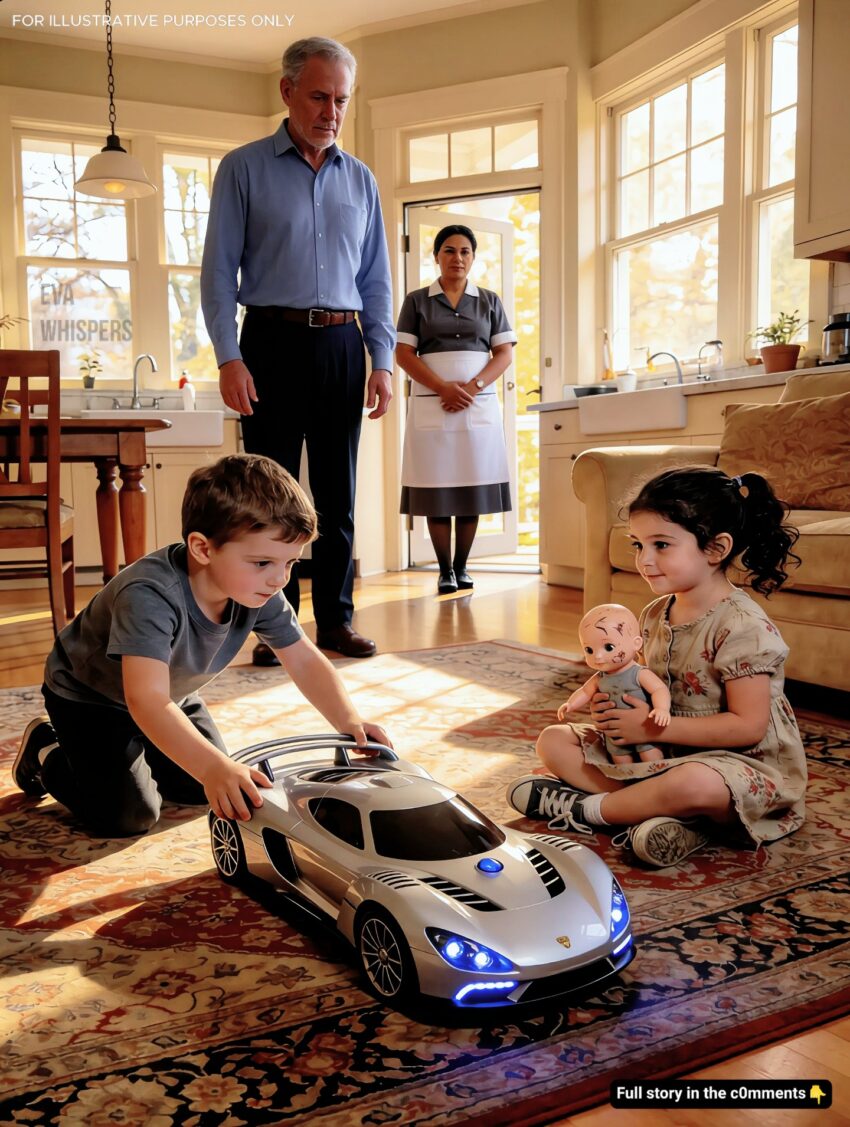
Near the wide bay window, his three-year-old son, Ethan, knelt on the Persian rug, pushing a sleek silver race car in precise loops. The toy’s glossy surface flashed in the light; soft electronic chimes rang every time he pressed a button. Tiny blue lights blinked with mechanical cheerfulness.
Across from him sat a little girl Nathaniel had only noticed in passing before.
She held a small plastic doll tightly against her chest.
The doll’s painted face was scratched. One arm moved stiffly. Its dress had clearly been hand-sewn from a piece of old floral fabric that matched nothing in the room. The girl’s sneakers were worn thin at the toes, and her dark curls were tied back with a stretched elastic band.
But her smile—calm, steady, unguarded—held a quiet brightness.
The contrast pressed unexpectedly against Nathaniel’s chest.
“Dad, look!” Ethan called out proudly. “It goes super fast!”
The silver car zipped across the rug, skimming dangerously close to the doll.
Nathaniel instinctively held his breath.
The girl did not flinch. She simply drew the doll closer—not out of fear, but with careful tenderness, as though protecting something precious.
Nathaniel stood motionless.
He was a man who negotiated multi-million-dollar contracts in minutes, who made decisions others hesitated over for months. And yet now he found himself unable to move, pinned in place by a question rising quietly inside him.
A question he could no longer ignore.
A Question Long Overdue
“Isabella,” he said at last, turning toward the kitchen doorway, “how long have you been working here?”
Isabella Morales, who had been standing quietly near the entrance, straightened as if summoned before a judge. She had tried to remain invisible, her hands folded tightly over her apron, watching carefully to ensure her daughter did not disturb anything.
“Almost three years, Mr. Grant,” she answered softly. “Since before Ethan was born.”
Almost three years.
Nearly three years of arriving before sunrise. Preparing meals. Cleaning rooms she would never sit in. Caring for a child she clearly adored.
And Nathaniel realized, with an uncomfortable tightening in his stomach, that he barely knew more than her name.
He glanced again at the little girl.
“And your daughter,” he continued gently, “does she come with you often?”
Isabella hesitated.
“Not at first,” she admitted. “I used to leave her with a neighbor, but she moved away last year. Mrs. Davenport said it was fine if I brought her—as long as she stayed quiet.”
Mrs. Davenport, the estate manager, had made that decision without ever informing him.
The realization stung.
In his own home, other people seemed to understand reality better than he did.
“You never mentioned it,” he said quietly.
Isabella lowered her eyes.
“I didn’t want to trouble you,” she replied. “You have more important things to worry about than my problems.”
The words landed heavily.
More important things.

Two Childhoods Sharing One Room
Ethan suddenly abandoned his race car and leaned toward the doll with open curiosity.
“Why is it broken?” he asked.
The little girl glanced first at her mother, then at Nathaniel, silently seeking permission.
Isabella gave a small nod.
“You can answer, sweetheart.”
The girl lifted the doll slightly, her expression serious.
“She’s not broken,” she said. “She’s tired.”
Ethan blinked. “Tired?”
“My mom says when something lives a long time without enough kindness, it starts to look worn on the outside,” the girl explained carefully. “But inside, it still has a lot of love.”
Nathaniel’s throat tightened unexpectedly.
He looked at the gleaming race car, then at the stitched doll, and understood that what he was witnessing was not simply a difference in toys.
It was the quiet meeting of two entirely different childhoods.
He lowered himself to their level.
“May I see her?” he asked gently.
The girl hesitated, then carefully placed the doll in his hands as though entrusting him with treasure.
He examined it closely. The stitching was uneven but strong. The small hand had been reattached with painstaking effort. Nothing about it was careless.
“Who fixed her?” he asked.
The girl’s chin lifted proudly.
“My mom. She found her and said everyone deserves another chance.”
Isabella turned slightly away, embarrassed.
Seeing the Woman Behind the Uniform
Nathaniel stood slowly, still holding the doll before returning it.
“You did this?” he asked.
“I did what I could,” Isabella replied evenly. “She wanted a doll. I couldn’t afford a new one.”
The vast living room suddenly felt cavernous.
“How much do you earn here?” Nathaniel asked quietly.
Isabella stiffened.
“Minimum wage,” she answered. “What the law requires.”
He swallowed hard.
He had spent more than her weekly pay on a single bottle of wine.
“And your hours?”
“Seven in the morning until seven in the evening,” she said. “Sometimes later.”
Twelve hours a day.
Six days a week.
The numbers echoed sharply in his mind.
“Where do you live?”
“A small rented room,” she answered. “It’s enough for the two of us. There’s a park nearby.”
Nathaniel closed his eyes briefly.
He imagined her daughter falling asleep clutching that worn doll, while Isabella prepared for another exhausting day before sunrise.
When he opened his eyes, Isabella was watching him anxiously.
“Did I do something wrong?” she asked.
He shook his head slowly.
“No,” he said quietly. “I did.”

A Decision That Changed the House
Nathaniel sat down on the sofa and gestured for her to sit as well. She hesitated before perching at the edge, as though crossing an invisible line.
“I want to understand your life,” he said. “Not just the part that exists inside this house.”
Isabella exhaled softly.
“There isn’t much to tell,” she said. “We wake up early. We come here. We work. We go home.”
But when he gently asked more—about her childhood, her family, her daughter’s father—she answered honestly. There was no self-pity in her voice. Only fatigue. Only resilience.
With each sentence, Nathaniel became more aware of how narrow his own world had become.
Finally, he spoke.
“Things are going to change.”
Isabella’s face drained of color.
“Are you letting me go?”
“No,” he replied firmly. “I’m correcting something.”
He outlined it simply: increased pay, shorter hours, full weekends off, paid leave.
She stared at him.
“I don’t deserve that,” she whispered.
“You deserve more than that,” he answered.
When Comfort Is Challenged
The front door opened.
His wife, Margaret, entered with composed elegance, her expression cooling as she surveyed the scene.
“What’s happening?” she asked.
Nathaniel explained calmly.
Her disapproval was immediate.
“You made this decision without discussing it with me.”
“I didn’t need to,” he said.
For the first time, he recognized the widening space between them—not born of anger, but of values quietly diverging over years.
What followed was not shouting.
It was revelation.
When Margaret finally left the room, the silence that followed felt strangely peaceful.
For illustrative purposes only
A Different Kind of Evening
That night, Nathaniel did something he had not done in years.
He ate dinner in the kitchen.
The food was simple—rice, roasted chicken, warm vegetables—but it tasted richer than any catered meal he had attended in months.
He bathed Ethan. He listened to Lucia’s soft laughter. He watched the children fall asleep side by side—Ethan’s hand loosely holding Lucia’s, Lucia’s arm wrapped protectively around her stitched doll.
For the first time in years, his home felt inhabited.
Not impressive.
Alive.
Building Something Real
In the months that followed, change unfolded through quiet decisions.
Isabella moved into a small but sunlit apartment. Lucia received her own bed, her own shelf of books, her own corner of the world.
The doll was never discarded.
It remained—respected.
Ethan and Lucia began attending the same preschool. Nathaniel adjusted his schedule. Meetings were declined. Evenings were protected.
Margaret drifted further away, her absence no longer wounding.
One stormy evening, when thunder rolled across Ridgefield and the power flickered out, the four of them gathered in the living room by candlelight.
Nathaniel told a story about a magical doll that repaired hearts instead of seams.
The children fell asleep to the rhythm of rain.
Isabella remained awake, overwhelmed by the quiet transformation taking place around her.
“You’re a good father,” she said softly.
“I’m learning,” Nathaniel replied. “Because of you.”
The Richest Man in the Room
Two years later, on a peaceful Sunday morning, Nathaniel sat on the floor building towers from wooden blocks with Ethan and Lucia, now nearly six.
Isabella entered the room, her hand resting gently over her growing belly.
She was smiling.
The stitched doll now rested under a small glass case on a bookshelf.
“Why is she up there?” Ethan asked.
Nathaniel wrapped his arm around Isabella.
“So we remember,” he said. “That love repairs what money never can.”
And in that ordinary room—filled with sunlight, laughter, and quiet anticipation—Nathaniel understood something with perfect clarity:
Wealth had nothing to do with what he possessed.
It had everything to do with who stood beside him.
For the first time in his life, he felt complete.