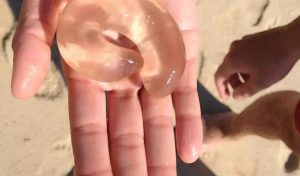
The translucent, jelly-like mass began to change. Not suddenly, not dramatically, but slowly, almost imperceptibly—as if it were waking up. Its surface quivered faintly, and inside, something shifted. The tiny dark dots we had assumed were harmless air bubbles moved and arranged themselves into an unsettlingly regular pattern. A chill ran through my fingers.
“Do you see that too?” I whispered, even though the beach around us was completely empty.
We stepped back instinctively. My heart was pounding as if we had just narrowly avoided something dangerous. For a brief moment, I wanted to walk away and pretend we had never found it. But curiosity won.
We crouched down in the sand and observed the object without touching it. And that was when the realization slowly set in: this was not an ordinary remnant washed up by the sea.
It wasn’t debris.
It wasn’t a torn fragment.
And it certainly wasn’t harmless.
It was whole.
And worse still—it didn’t seem lifeless.
I immediately messaged a friend who had studied marine biology. I sent her a photo with a short note: “We found this on the beach. Do you know what it is?”
The reply came almost instantly:
“Where are you? Stay away from it. Don’t touch it again.”
My stomach tightened.
When she called, her voice was unusually tense. She explained that it was neither a jellyfish nor seaweed. What we had likely encountered was a cluster of eggs belonging to a marine predator—a rare and potentially dangerous species that normally wouldn’t appear so close to shore.
These clear, gelatinous structures act as natural incubators. Inside them, dozens—sometimes hundreds—of embryos develop. At a certain stage, they become sensitive to heat, movement, and contact with saltwater.
That explained why the mass had reacted the moment we put it back into the sea.
But that wasn’t the most disturbing part.
She went on to say that similar discoveries have been reported more frequently in recent years, even in areas where such species had never been seen before. Rising ocean temperatures, disrupted ecosystems, and the disappearance of natural predators are forcing unfamiliar forms of life closer to the coastline—and closer to people.
“If that membrane had ruptured while you were holding it,” she said quietly, “the consequences could have been very serious.”
I hesitated before asking what she meant. When I finally did, I wished I hadn’t.
Some marine organisms release toxins even at the embryonic stage. Others can trigger severe allergic reactions, chemical burns, or intense skin irritation. And all of this can happen without a bite or sting—just from direct contact.
We stood there in silence, staring at the nearly beautiful, translucent mass that half an hour earlier had seemed like nothing more than a curious object left behind by the tide. Now we understood that we had been holding something that was never meant to be touched by humans.
Using a stick, we carefully pushed it back into the water and moved as far away as we could. Even later, after washing my hands several times, I couldn’t shake the strange sensation on my skin—like the memory of the touch refused to fade.
Once home, I started researching. And the more I read, the deeper the unease grew. All over the world, people are finding similar gelatinous formations on beaches, mistaking them for jellyfish, trash, or even toys. They pick them up, take photos, let children play with them…
Then come the pain, the swelling, the emergency room visits. In some cases, lasting damage.
The most deceptive thing of all is how harmless these objects look. They’re clear, glossy, almost artistic. Nothing about them signals danger.
Since that day, I see the ocean differently. It’s no longer just a place of beauty and calm—it’s a living, shifting world that’s changing faster than we realize.
So if you ever come across something strange on the beach—something jelly-like, translucent, even fascinating—don’t touch it. Don’t test it. Don’t take the risk.
Because sometimes, behind an innocent appearance, there’s a reality that sends a cold shiver down your spine. And we learned that lesson far too close for comfort.