The Woman Who Wouldn’t Move
The sun in Phoenix doesn’t warm you so much as it presses down on you, especially along the wide roads where heat rises off the asphalt in a shimmering layer that makes the city look like it’s breathing through clenched teeth, and if you live day to day the way I did, you learn to read those waves like weather, because they tell you when people will roll their windows up faster, when drivers will get impatient, and when a kid selling candy at a stoplight needs to be twice as quick and ten times more careful.
My name is Rory Kincaid, and I was sixteen then, although my shoulders already felt older than that, because there’s a kind of tired that comes from hustling under a burning sky while adults look right through you as if you’re a smudge on the glass of their lives, something they can’t quite clean off, and you learn early that being unseen is its own kind of punishment.
My corner was near a bus stop on a noisy stretch of road where the air always smelled like exhaust and fried food and hot rubber, and where the rhythm of my day was ruled by the light: red meant sprint, smile, offer, negotiate; green meant leap back before a lifted truck rolled forward like it didn’t care whether I existed. I sold whatever I could carry in a battered plastic tub, mostly candy bars, gum, bottled water that I’d kept cold in a foam cooler, and when the day went well I’d go home with enough to keep my little apartment’s lights on and my mom’s worry from swallowing her whole.
On a Monday, in the middle of all that usual chaos, I noticed her.
She sat on the bus bench like she’d been planted there by some patient hand, not slumped the way people sit when they’re exhausted, not fidgeting like someone waiting for a ride, but upright and still, wrapped in a faded shawl that looked like it had once been bright enough to announce itself from across the street, and now held the dull gray of street dust as if the city had slowly painted her into its background.
She stayed there through the first day, and at first I told myself the ordinary story because ordinary stories are easier to hold: she was waiting for someone, a son, a daughter, a neighbor who promised they’d be back in ten minutes and got stuck. When the afternoon stretched into evening and she still hadn’t moved, I told myself a second story: maybe she’d gotten confused, maybe she was tired, maybe someone would notice and step in.
On Tuesday morning, when I dragged my cooler back to the corner and saw her in the same place with the same posture and the same faraway gaze, something in me tightened, because Phoenix isn’t gentle, and the night air cools down just enough to trick you into thinking it’s kind before it snaps back into heat the next day, and I could see the grime on her shawl had thickened like a second layer of cloth.
People noticed her, sure, but noticing isn’t the same thing as caring, and I watched the reactions like I watched traffic: a woman in gym clothes steered her kid away, a man with a headset laughed into his phone and glanced at the bench like it was a piece of trash someone forgot to pick up, and the bus drivers kept their faces forward the way people do when they’ve decided a problem belongs to someone else.
A schoolgirl in a neat uniform tugged her mother’s sleeve and asked, curious and soft the way kids can be before they learn the world’s rules.
“Mom, why is that lady sitting there?”
Her mother didn’t slow down, didn’t even look properly, just tightened her grip and kept walking like kindness was something you could catch.
“Don’t stare, honey. Keep moving.”
By Wednesday afternoon, the quiet anger in me had turned into something sharper, because I knew what it felt like to be treated like part of the sidewalk, and I hated the idea that we’d all agreed this woman could just stay there until she faded away, as if the city could erase people the way it erased chalk in the rain.
I crossed the street during a long red light, stepping between cars and ignoring the irritated honks because my nerves were already buzzing, and I stopped in front of her, close enough to see the details that made her feel less like a rumor and more like a person.
Her lips were cracked from dryness, her hands were folded in her lap with a strange, stubborn grace, and her sandals didn’t match, one dark and one pale, like she’d gotten dressed in a hurry or someone had dressed her without paying attention. What got me, though, was her face, because it carried the worn-down look of someone who’d been through too much, but underneath it was a kind of dignity that didn’t ask permission.
I crouched a little, trying to keep my voice respectful, the way my mom raised me, even when money was tight and patience was thinner than the walls in our apartment.
“Ma’am, are you okay? Do you need water?”
Her head turned slowly, as if her neck had forgotten how to move, and her eyes found me with a focus that startled me, because for a moment she looked fully awake, fully present, as if I’d pulled her out of deep water.
“Water would be lovely,” she said, and her voice was rough like paper, but calm.
I handed her a bottle from my cooler, and she held it like it was something precious instead of something most people didn’t think twice about.
“Thank you,” she murmured, and then, like the smallest confession, “I forgot my way home.”
I didn’t know what to say to that, because there are problems you can solve with a few dollars, and then there are problems that sit in your chest like a stone. I tried anyway.
“Do you know your name?”
Her mouth twitched, like the question pulled at something that was almost within reach.
“Elowen,” she said, and after a breath, “Elowen Hartnell.”
The name didn’t sound like the names on my block, but it didn’t sound fake either, and the way she said it held the memory of being someone people used to stand up for.
“Do you remember anything else? A street, a gate, a color, anything at all?”
Her eyes slipped past me again, chasing something invisible on the far side of the road.
“A gate,” she whispered. “Black. Tall. And the street… the street is quiet.”
Quiet street, black gate, in Phoenix, where half the neighborhoods had tall fences and everyone wanted privacy, especially the folks with money. It wasn’t much, but it was more than nothing, and my frustration swelled, not at her, but at the fact that nobody else had bothered to ask.
When my last candy bar sold and the light turned green again, I walked home with that woman’s voice stuck in my head the way a song gets stuck, repeating whether you want it to or not.
My mom, Marisol, was in our kitchen when I pushed the door open, and the kitchen was really just a corner of the living room with a small stove and a table that wobbled if you leaned your elbow wrong, but she made it feel like a home anyway, because she had a way of folding love into the ordinary.
She didn’t look up right away, because she was chopping vegetables for dinner, her shoulders rounded with fatigue that never fully left her.
“Ma,” I said, too quickly, because once I started I didn’t know how to stop, “there’s an older lady at the bus stop, and she’s been there for days.”
My mom’s knife paused, and the silence that followed wasn’t peace, it was her weighing whether this was the kind of trouble that reached out and grabbed you.
“At your corner?” she asked.
“Yeah,” I said. “I gave her water. She said she forgot how to get home.”
My mom finally looked up, and her eyes sharpened the way they did when she was scared but trying not to show it.
“Rory, you can’t just get involved with every stranger you see,” she said, and there was fear in it, not cruelty, because fear is what you wrap around your kid when you don’t have money to wrap around them instead.
“She’s not dangerous,” I insisted. “She’s just… lost.”
My mom exhaled hard through her nose, the kind of sound that meant she was trying to keep her temper from turning into something louder.
“Lost people have families, and families can be messy,” she warned. “And the world loves blaming the wrong person.”
I knew she meant me, the kid with the cheap sneakers and the candy tub, the easy suspect, and I hated how right she was.
Still, I couldn’t shake the image of Elowen sitting there while everyone stepped around her like she was a crack in the pavement.
“I’m going back,” I said, grabbing my empty tub, because leaving gave me something to do with my hands.
My mom stood so fast her chair scraped.
“Rory—where are you going?”
“To get her somewhere safe,” I said, and I tried to sound confident even though my heart was hammering.
My mom’s face tightened, like she wanted to grab me and keep me in the apartment forever, but she also knew you can’t hold a teenager still without breaking something inside them.
“Be careful,” she said finally, softer now, because love always comes back around. “And don’t sign anything, don’t accept anything, and don’t let anyone make you the story.”
I nodded, and then I ran, because if I walked, I might talk myself out of it.
A One-Wheel “Limo”
By the time I got back to the bus stop, the sun had started sliding down and the light had turned a dusty gold that made everything look both beautiful and tired at the same time. Elowen was still there, as if she’d never moved a muscle since I’d left, and seeing that made my chest ache in a way I didn’t have a name for.
I crossed the road, weaving between cars, and stopped in front of her again.
“Ma’am,” I said, keeping my voice gentle, “you still remember the black gate?”
She lifted her head, slow but deliberate.
“Yes,” she said, and for the first time I heard something firm in her tone, like a thread of herself had returned. “It’s mine.”
That should’ve sounded strange, considering the state she was in, but the way she said it didn’t leave room for doubt.
I looked around, feeling ridiculous because what was my plan, really, to wander the city with a lost woman and a vague description, but then my eyes landed on something near a construction guy packing up down the block: an old wheelbarrow, rusted at the edges, the kind that squeaks just from being looked at.
The man, Duke, wasn’t actually my uncle, but everybody on the corner called him that because he’d been there forever, and he had a way of acting annoyed while still doing things that helped.
I jogged over, raising my hands like I was about to negotiate an international treaty.
“Unc Duke,” I called, “I need a favor.”
He squinted at me, the way older guys do when they’ve seen a hundred kids make a hundred dumb choices.
“A favor costs,” he said.
“I’ll owe you,” I promised. “I just need to borrow the wheelbarrow for a bit.”
He followed my gaze to Elowen on the bench, and his eyebrows rose like they were trying to leave his forehead.
“For her?”
“To get her home,” I said, and I heard how crazy it sounded, but I kept going anyway. “She’s been sitting there for days.”
Duke stared for a long moment, then sighed the way people sigh when they’ve decided not to be heartless today.
“Bring it back,” he said. “And don’t wreck it.”
I rolled the wheelbarrow over, the wheel complaining with every turn, and when I stopped in front of Elowen, I tried to lighten the moment because fear gets smaller when you laugh at it.
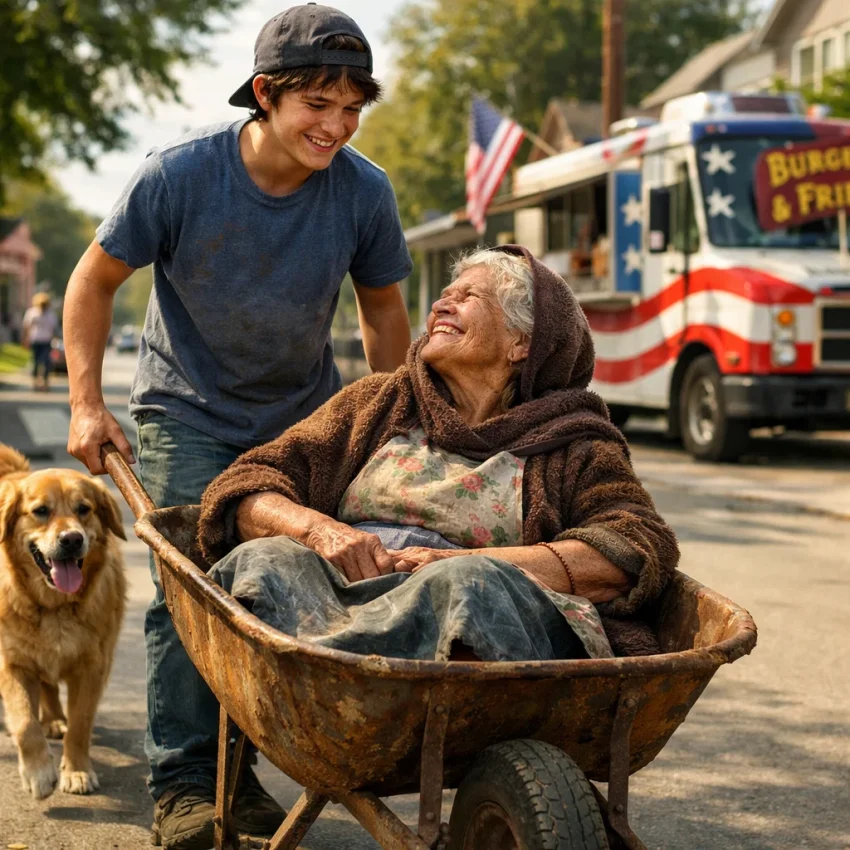
“Your ride is here,” I told her, and I spread my arms as if presenting something luxurious. “It’s a one-wheel limo. No seatbelts, but the service is excellent.”
She looked at the wheelbarrow, then at me, and for the first time her face cracked open with something like real amusement.
“You’re serious,” she said, and there was disbelief in it, but also warmth.
“I’m serious,” I replied. “If you can tell me when things feel familiar, we’ll find that gate.”
Her eyes studied me, searching for mockery, and when she didn’t find it, she nodded.
“All right,” she said. “Let’s go.”
I helped her carefully, because she felt lighter than she looked, like a person made fragile by time and hunger and too many nights outside. Once she was settled, her shawl tucked so it wouldn’t catch on the metal, I lifted the handles and started pushing.
The city changed by degrees as we moved, the way it always does when you climb out of the parts where everything is loud and crowded and into the parts where the streets widen, the yards get greener, and the air smells less like survival and more like lawn sprinklers.
I was sweating within minutes, my arms burning, but Elowen sat upright like a queen in a strange little carriage, and every so often she’d close her eyes as if listening for her own memory to catch up.
“How’s the ride?” I asked, breathing hard.
“Surprisingly smooth,” she said dryly. “Your ‘limo’ has character.”
I laughed, and the sound made something in my chest loosen.
“We also offer music,” I told her. “I can hum anything you want.”
She made a small sound that was almost a chuckle.
“Hum something you like,” she said, and her tone made it feel like she was giving me permission to exist.
So I hummed an old song my mom used to play while she cleaned, something slow and familiar, and for a few blocks we weren’t a broke kid and a lost woman, we were just two people moving through a city that didn’t care whether we made it or not.
Then, as we turned onto a street lined with tall trees and neatly trimmed hedges, her hand lifted slightly.
“Wait,” she whispered. “This… this is right.”
I slowed, watching her face, and I saw it there, a flicker of recognition that sharpened her eyes.
“One more,” she said. “Just one more turn.”
We turned, and the world shifted like a curtain pulling back.
At the end of the street stood a gate that looked like it belonged to a different life entirely, black metal tall enough to make you feel small, with ornate details that caught the last light of the day, and beyond it, glimpses of a property that didn’t just say “money,” it said “distance,” the kind of distance that keeps ordinary people out.
Elowen lifted a trembling finger.
“That’s it,” she said, and her voice held a quiet certainty. “That is my home.”
I stopped so suddenly the wheelbarrow squeaked in protest, and my mouth went dry.
“This?” I asked, because my brain couldn’t catch up. “You live here?”
She didn’t answer the way someone trying to convince you would, she just stared at the gate like she’d found the end of a long, exhausting story.
“Knock,” she said.
The Gate That Opened Like Thunder
The gate had a small intercom panel and a camera, and I stood there with my sweaty hands and my cheap shirt and the wheelbarrow behind me like a punchline no one asked for.
I pressed the button.
A tinny voice crackled through.
“Yes?”
I swallowed.
“I’m here with Ms. Hartnell,” I said carefully. “She… she needed help getting home.”
There was a pause long enough for my heartbeat to feel loud.
“We don’t buy anything,” the voice snapped. “Leave.”
Before I could say anything else, Elowen spoke from the wheelbarrow, and her voice, though rough, carried a command that felt practiced.
“Darryl,” she called. “Open the gate.”
Silence, and then a sharp intake of breath from the speaker, like someone had just seen a ghost in daylight.
“Ma’am?” the voice said, suddenly unsteady. “Is that… is that you?”
The next moment, the gate mechanism hummed, low and powerful, and the black metal began to swing inward with slow authority, as if the property itself had decided to recognize her.
A security guard rushed out, big man, clean uniform, eyes wide with panic and relief.
“Ms. Hartnell,” he blurted, and his voice broke on her name, “we’ve been looking everywhere.”
Behind him, the main house seemed to erupt into motion, and people poured out like someone had kicked an ant hill: staff in neat clothes, drivers, gardeners, and then, a cluster of well-dressed relatives moving fast with faces that didn’t all match the words they were about to say.
A woman in silk-loungewear hurried forward, her hair perfect despite the speed, her hands already reaching out dramatically.
“Mom!” she cried. “Oh my God, you’re here!”
A man in an expensive-looking suit followed, eyes scanning Elowen the way someone scans an investment they thought they’d lost.
“We were so worried,” he said, but his tone didn’t land right, like the line had been rehearsed.
They crowded in, their perfume mixing with the clean scent of watered grass, and I stood there gripping the wheelbarrow handles, suddenly aware of how dirty I must look in their world.
Elowen didn’t melt into their arms, didn’t cry with relief, didn’t do any of the things people expect an older woman to do when she’s “rescued.” She just sat there, tired and watchful, her gaze moving across their faces like she was measuring something invisible.
Then she turned her head and found me.
“Rory,” she said, clear enough that every person there went silent.
My throat tightened, because hearing my name in that place felt unreal.
“Yes, ma’am?” I answered.
Elowen’s eyes held mine steadily.
“You bring me inside,” she said. “Not them.”
A ripple of discomfort moved through the group, and the man in the suit frowned as if I’d tracked mud onto his ego.
“Ms. Hartnell, we have a chair inside,” he argued quickly. “We can—”
Elowen cut him off with a small lift of her hand.
“Rory,” she repeated, and the way she said it ended the discussion.
So I pushed the wheelbarrow forward, into the property, along a driveway that felt like it belonged in a movie, past manicured gardens and stonework so clean it looked staged, and the whole time I could feel eyes on my back, judging, calculating, resenting.
Inside the front entry, the air was cool and smelled faintly of polished wood, and the floor shone so much I could see the reflection of my scuffed sneakers, which made me want to disappear on the spot.
I rolled forward anyway, because stopping would’ve felt like admitting I didn’t belong, and Elowen had already decided I did.
When I reached a wide sitting room with high ceilings and soft furniture that looked too expensive to sit on, I stopped carefully.
“Here we are,” I said, trying to sound normal.
I helped her down gently, and as she settled into a cushioned chair, her shoulders sagged with the kind of relief that only comes when your body finally believes it’s safe.
Elowen looked up at me.
“What is your full name?” she asked, as if she needed to anchor it.
“Rory Kincaid,” I said. “Just Rory is fine.”
She nodded slowly, recording it somewhere inside herself.
“Rory,” she murmured, and then, softer, “thank you.”
I shrugged, embarrassed, because praise always felt too big for me.
“It wasn’t a big deal,” I lied, because I knew it had been.
Elowen’s gaze sharpened, and for a brief moment the tiredness lifted enough to show steel underneath.
“Come back in the morning,” she said.
I blinked.
“For what?”
Her mouth curved slightly.
“I want to offer you something better than a thank-you,” she replied. “I want to offer you work.”
My Mother’s Fear And My First Suit
I walked home that night with my mind spinning so hard it felt like my thoughts were going to fly out of my head and scatter across the street, because what did “work” mean inside a place like that, and why would a woman with a gate like a fortress want anything from a kid who sold candy at a stoplight.
Sleep didn’t come easily, and when it did, it was thin and restless, full of flashes: the black gate opening, the relatives’ eyes, Elowen saying my name like it mattered.
Before sunrise, I was up, scrubbing myself clean, trying to make my one decent shirt look less like it belonged to a thrift rack, and when I couldn’t find an iron because we didn’t have one, I heated the back of a metal spoon over the stove and pressed the wrinkles out the way my mom had taught me when we were trying to look “presentable” for school meetings and job interviews.
My mom watched me from the doorway, worry carved into her face.
“You’re really going back,” she said, not as a question but as resignation.
“I have to,” I told her. “She asked me to.”
My mom stepped closer, adjusting my collar like she was trying to protect me by fixing the details.
“Just remember,” she said, low, “people with money can make problems feel like your fault even when they aren’t.”
I nodded, and I kissed her cheek, because I needed her blessing even if she didn’t fully agree.
When I reached the gate, I stood outside like a kid on the first day of school, trying to hold my shoulders straight.
A different kind of silence lived on that street, the kind that comes from privacy and distance, and it made my own breathing feel loud.
The intercom clicked.
“State your business,” a voice said.
“My name is Rory,” I replied. “Ms. Hartnell told me to come this morning.”
There was a pause, and then a smaller pedestrian door opened.
A woman stepped out, mid-thirties maybe, immaculate hair, fitted dress, and a face that carried polite contempt like it was part of her makeup.
“You’re the wheelbarrow boy,” she said, not bothering to hide the insult inside the words.
I held my temper down where it belonged, because my mom’s warning rang in my head.
“My name is Rory,” I repeated.
She looked me over like she was estimating my worth.
“Vivienne Sloane,” she said. “I handle Ms. Hartnell’s schedule and the house’s administration.”
Her smile didn’t touch her eyes.
“Before you step inside,” she continued, “understand that this home contains valuables you couldn’t replace in ten lifetimes, so if anything is touched, broken, or misplaced, the consequences will not be negotiable.”
I swallowed, because the threat was clear without being loud.
“I’m not here to steal,” I said evenly. “I’m here because Ms. Hartnell asked.”
Vivienne tilted her head like she found my confidence annoying.
“We’ll see,” she murmured, and she stepped aside.
Inside, she led me through hallways that smelled like clean money, past framed photographs of Elowen with important-looking people, and out to a back terrace where morning light fell across a garden so perfectly kept it didn’t look real.
Elowen sat in a white rocking chair, a cup of tea in her hand, her hair neatly arranged, her clothes clean and elegant, and the transformation from the woman on the bench was so dramatic that for a second I wondered if I’d imagined the whole thing.
But when she saw me, her face warmed.
“Rory,” she said, and the relief in my chest surprised me, because I hadn’t realized how much I needed her to remember.
“Good morning, ma’am,” I said, careful and respectful.
Elowen waved me closer.
“Sit,” she told me. “You’re already on time, which I appreciate.”
I perched on the edge of a chair like I might break it.
Vivienne hovered for half a second, then excused herself with a look that promised she’d be watching from a distance.
Elowen leaned forward, studying me the way she had at the bus stop, as if she could see something under my skin.
“Do you know what I’m offering?” she asked.
I shook my head.
“No, ma’am,” I admitted. “I just… I didn’t want to leave you out there.”
Elowen’s mouth curved gently.
“And that is why I’m offering you something,” she said. “I want you here, working with me.”
I blinked.
“Doing what?”
Her eyes held mine, steady.
“As my assistant,” she replied. “Not a driver, not a gardener, not a temporary helper, but someone close enough to tell me the truth when I’m tired, and patient enough to help me keep my days in order.”
My brain stumbled.
“I’m not trained,” I said, because it felt like the only honest response. “I’m not… I don’t have fancy skills.”
Elowen lifted her cup slightly, as if making a quiet toast to my refusal to pretend.
“I’m not hiring a résumé,” she said. “I’m hiring character.”
I didn’t know what to do with that, so I just sat there, hands clasped, trying not to show how hard my heart was beating.
Elowen continued, calm and matter-of-fact.
“You’ll be paid,” she said. “Fairly. You’ll eat here. You’ll have a place to rest when days run long.”
I stared.
“How much?” I asked, because the question felt unreal, but my life had taught me money mattered.
Elowen named a monthly amount that sounded like a different universe, and my throat tightened so hard I almost couldn’t breathe.
I managed, barely, to speak.
“That’s… that’s a lot,” I said.
Elowen’s gaze didn’t flinch.
“You will earn it,” she replied. “And you will use it well, because you don’t seem like someone who wastes what he had to fight for.”
The Tests Hidden In Plain Sight
The first weeks were like learning a new language while everyone around you pretended it was simple.
I learned where Elowen kept her notes, how she liked her tea, which appointments she actually cared about, and which ones she tolerated out of obligation, and I learned quickly that her mind wasn’t always consistent, because some days she was sharp enough to correct a financial document with a glance, and other days she’d ask me where the kitchen was in her own house.
The staff reacted to me in layers.
The cooks were kind, because kindness recognizes itself, and the gardeners nodded at me like I belonged to the world of work even if I didn’t belong to the world of wealth. Vivienne, though, watched me like I was a stain she couldn’t scrub off, and when she spoke to me, her tone always suggested she was waiting for me to slip.
One afternoon, she cornered me in Elowen’s office when Elowen was resting.
Her heels clicked on the polished floor, and she closed the door with a softness that made my skin tighten.
“You’ve made yourself useful,” she said, and the compliment sounded like an insult in her mouth.
“I’m doing my job,” I replied carefully.
Vivienne stepped closer, lowering her voice like we were sharing a secret.
“You know Ms. Hartnell isn’t always… consistent,” she said. “She forgets things. She leaves paperwork out. Sometimes she even signs things without reading.”
I didn’t answer, because anything I said felt like a trap.
Vivienne’s smile sharpened.
“If you find documents,” she continued, “anything financial, anything sensitive, bring it to me.”
My chest went cold.
“Why?” I asked.
Vivienne’s eyes flicked over me, landing on my shoes, my cheap watch, the parts of me she thought proved I could be bought.
“Because you could benefit,” she said smoothly. “And because this house needs ‘responsible’ people making sure nothing ends up in the wrong hands.”
Her meaning was clear, and it wasn’t responsibility she cared about.
I held her gaze and forced my face into something neutral, because anger would only feed her.
“I’ll keep an eye out,” I said, which was true in a way she wouldn’t understand.
Vivienne looked satisfied, as if she’d just placed a hook and felt it catch.
“Good,” she said. “I knew you’d be sensible.”
After she left, her perfume lingering like a warning, I stood there for a long moment and wondered if my mom had been right, if this was the part where I became the story people told about the kid who got too close to money and paid for it.
Then the “accidents” started.
A thick envelope of cash on a hallway table, just sitting there like someone had dropped it and forgotten, and I stared at it so long my eyes hurt, because my mind immediately calculated what it could fix in my life: the leaky ceiling, the overdue bills, the groceries my mom pretended weren’t running low.
My fingers hovered over the edge of the envelope.
Then I saw Elowen’s face in my mind, not the polished one from the terrace, but the one on the bench, proud even when she had nothing, and I felt sick at the idea of betraying that.
I picked up the envelope and carried it straight to her.
Elowen was reading by a window, and when I held it out, she glanced at it with a calm that felt almost too calm.
“You left this out,” I said. “I figured you’d want it somewhere safer.”
Elowen nodded.
“Thank you,” she said simply. “Put it on the desk.”
No praise, no surprise, just a quiet acceptance that made me feel oddly unsettled.
Then it happened again, and again, each time with something that felt too tempting to be a real mistake: a folder left open with sensitive papers visible, a small jewelry box sitting unattended, a checkbook left on a side table as if inviting the wrong kind of attention.
Every time, I returned what I found, locked what needed locking, and said as little as possible, because I didn’t want to sound like I was asking for applause.
Finally, one evening, Elowen called me into her office.
She sat behind her desk with a notebook open, her posture straight, her eyes clear in a way that made the room feel sharper.
“Sit down, Rory,” she said.
I sat, heart pounding, because I couldn’t tell whether this was a reward or a dismissal.
Elowen watched me for a moment.
“Before all of this,” she asked quietly, “what did you want to become?”
The question hit me so hard I couldn’t answer right away, because nobody had asked me that in years, and the truth felt fragile, like something I’d hidden away to keep it from being laughed at.
I stared at my hands, then forced the words out.
“A lawyer,” I admitted. “I wanted to be a lawyer.”
Elowen’s eyebrows rose.
“Why?”
I swallowed.
“Because people get pushed around,” I said, and my voice thickened. “Because the truth doesn’t protect you unless someone stands up for it, and where I’m from, nobody stands up for kids like me.”
Elowen didn’t interrupt, didn’t pity me, just listened like my words mattered.
“And what stopped you?” she asked.
I let out a small breath that felt like surrender.
“Money,” I said. “And time. We always needed groceries more than textbooks.”
Elowen nodded slowly, then wrote something in her notebook.
“All right,” she said. “You can go.”
I left confused, half expecting something dramatic to happen and nothing did, at least not that day.
A week later, a man in a modest suit arrived at the gate carrying a stack of books so tall it looked like it might topple.
He introduced himself politely to the security guard, and when I came down, he smiled at me as if we already had an agreement.
“You’re Rory Kincaid?” he asked.
“Yes, sir,” I said, still holding a broom because I’d been cleaning the terrace.
He extended a hand.
“My name is Professor Malcolm Greer,” he said. “Ms. Hartnell hired me to tutor you.”
My lungs forgot how to work for a second.
“Tutor me?” I echoed.
Professor Greer nodded, shifting the books in his arms.
“Three times a week,” he said. “Writing, history, and introductory legal reasoning.”
I turned toward the house like I might run straight through the wall.
Elowen sat inside with a newspaper, calm as ever, and when I blurted out what was happening, she looked up with the mild impatience of someone who didn’t understand why I was surprised.
“You said you wanted to be a lawyer,” she replied. “So we’re beginning.”
I could feel tears building, the humiliating kind you can’t control.
“Why would you do this?” I asked, voice breaking. “I’m just your assistant.”
Elowen set her paper down and walked closer, slower than she used to, but still steady.
She placed a hand on my shoulder, light but firm.
“Because I’ve watched you,” she said. “I left things out on purpose. I watched what you did when no one was clapping.”
My stomach dropped.
“Those were tests?”
Elowen’s mouth curved in a small, knowing smile.
“Yes,” she said. “And you passed.”
The Family That Smelled Opportunity
If Elowen’s house had been a calm lake on the surface, it was because the storms were circling beneath it.
The first real crack came when a man named Gideon Wexler arrived unannounced, walking through the front door like he owned the air in the room.
He was Elowen’s brother-in-law, her late husband’s brother, and even before I heard his name, I felt what he was from the way the staff stiffened, from the way voices dropped, from the way the whole house seemed to brace itself.
I wasn’t in the sitting room when he entered; I was near the side hall, and I stayed back on instinct, because some people carry trouble like a scent.
Through a partially open door, I heard his voice, loud, cutting, used to being obeyed.
“So this is what you’ve become,” Gideon snapped, and his words landed heavy on the air. “Collecting strays?”
Elowen’s voice, when it came, was quieter, and somehow that made it more dangerous.
“You’re in my home, Gideon,” she said. “Lower your voice.”
Gideon laughed, and it wasn’t warm.
“Your home,” he repeated. “You mean the home my brother built a life in, the home you’re now handing to a teenager from the street?”
My hands clenched at my sides, heat rushing up my neck, but I stayed still, because I wasn’t sure stepping in would help or make me the weapon he wanted to swing.
Gideon’s voice rose.
“I want him out,” he demanded. “Today.”
Elowen’s reply came like a blade sliding out of a sheath.
“No,” she said.
There was a pause, and I imagined Gideon standing there, stunned that a woman he’d probably dismissed as fragile wasn’t bending.
Then he pressed harder, the way bullies do when they hit resistance.
“Everyone knows you’re not steady,” he said. “Everyone knows you forget things, that you get confused. You need supervision.”
Elowen’s chair creaked, and I pictured her shifting, calm in a way that made my throat ache with admiration.
“I don’t need you,” she said. “I need honesty, and you’ve never offered me that.”
Gideon snarled something under his breath, then struck with the oldest weapon in the world: shame.
“You’re embarrassing the family,” he said, and I could hear the smugness in it, as if he believed the word “family” gave him power. “You’re going to make us a joke.”
Elowen let a silence stretch out long enough to make him uncomfortable, and when she finally spoke, her voice was level.
“You don’t have a family,” she told him. “You have an appetite.”
Something crashed lightly, not broken, but knocked aside, and Gideon’s anger spiked.
“This isn’t over,” he warned.
Elowen’s answer was almost bored.
“No,” she agreed. “It isn’t.”
After he left, the house stayed tense, and I moved through my tasks as if the air had thickened, because I could feel the shift, the way predators move when they smell a weak spot.
Two days later, Elowen looked at me across the breakfast table, her expression calm but intent.
“We’re hosting a family meeting,” she said.
I nearly dropped my spoon.
“Why?” I asked.
Elowen’s smile was small and sharp.
“Because they think I’m frightened,” she replied. “And I want them comfortable enough to show me exactly who they are.”
The Announcement No One Expected
The day of the meeting, the driveway filled with luxury vehicles and people who wore wealth the way some people wear perfume, heavy and obvious.
Relatives arrived with bright smiles that didn’t reach their eyes, carrying small gifts that felt like props, and they settled into Elowen’s main sitting room as if they were already dividing the furniture in their minds.
Gideon came last, confident, broad-shouldered, wearing a suit that looked expensive enough to silence people, and he sat with his legs spread as if claiming territory.
I stayed near the edge of the room, dressed in my neatest clothes, holding Elowen’s folder and water bottle the way she liked, feeling every stare like a fingertip pushing at my skin.
When Elowen entered, leaning on a cane, the room quieted, not out of respect so much as anticipation, and she moved slowly but deliberately, taking her seat like a judge taking the bench.
Beside her stood a man I didn’t recognize, older, serious, carrying a briefcase with the quiet authority of someone who had seen families tear themselves apart over paperwork.
Elowen lifted a hand toward him.
“This is Mr. Halvorsen,” she said. “He is here to read a legal designation.”
The relatives leaned forward as one, hunger showing in their faces.
Gideon’s mouth twitched, satisfied, as if he’d already won.
Mr. Halvorsen opened his folder, cleared his throat, and began.
“Ms. Elowen Hartnell has asked that this statement be made in the presence of witnesses,” he said, “regarding the management of her personal assets and business interests should she become unable to make decisions on her own.”
A hush settled like a blanket.
Mr. Halvorsen continued, slow and precise.
“The designated individual will hold legal authority to act on Ms. Hartnell’s behalf within the limits of the documented trust and accompanying directives.”
Gideon’s smile widened.
Then Mr. Halvorsen looked down at the page and delivered the line that cracked the room open.
“The designated individual is Rory Kincaid.”
For a heartbeat, the silence was so complete it felt like the whole house was holding its breath.
Then the room exploded.
A woman sprang up, voice high and outraged.
“Who is he?”
Another relative pointed at me like I’d spilled something on the carpet.
“That boy?”
Gideon’s chair scraped the floor as he stood, fury rising so fast his face flushed.
“This is insanity,” he snapped. “You can’t be serious.”
Elowen raised her hand, and the gesture alone cut through the noise the way a gavel does.
“Sit,” she said, and her voice didn’t need to be loud to be obeyed.
Gideon hesitated, then stayed standing, stubborn.
Elowen looked at him the way you look at a person who has finally shown you the truth you suspected.
“You’re angry,” she said, calm, “because you thought you were next in line.”
Gideon scoffed.
“I’m angry because you’re being manipulated,” he insisted. “Because you’re not thinking clearly.”
Elowen’s eyes narrowed, just slightly.
“I am thinking more clearly than I have in years,” she replied. “And I’m finally tired of pretending your concern is love.”
Voices rose again, accusations flying, but Elowen didn’t flinch.
She turned her head toward the security team.
“Please escort everyone out,” she said, as if requesting a simple errand.
The relatives protested, threatened lawsuits, shouted about “family” and “tradition,” and Gideon’s voice cut above them all, sharp with humiliation.
“You’ll regret this,” he hissed, staring at me like I was a disease.
Elowen didn’t even look at him.
“I regret wasting years on people who only loved my name,” she said.
The guards guided them out, and the black gate closed again with a finality that made my knees feel weak.
When the house finally fell quiet, I sat on the edge of the couch like my body had forgotten how to stand.
Tears rose, not from joy, but from fear, because being handed something that big didn’t feel like winning, it felt like stepping onto a bridge that might collapse under you.
I turned to Elowen.
“Why me?” I asked, voice shaking. “I’m not your family.”
Elowen looked at me for a long moment, and in that look I saw exhaustion, wisdom, and something close to tenderness.
“Family is behavior,” she said softly. “Not paperwork and not blood.”
She reached out and took my hand, her fingers cool, her grip steady.
“You didn’t help me because you wanted anything,” she continued. “You helped me because you saw me.”
My throat tightened so hard it hurt.
“I don’t know how to do any of this,” I admitted.
Elowen squeezed my hand once.
“Then we’ll learn,” she said. “And you’ll become the man you told me you wanted to be.”
The Fog That Came And The Promise I Made
For a while, life inside the gate softened.
My tutoring became routine, my college preparation turned into real applications, and Elowen seemed lighter, as if throwing the hungry relatives out had cleared the air in her lungs.
My mom began visiting on Sundays, nervous at first, then gradually more comfortable as Elowen treated her with a respect my mom wasn’t used to receiving from people in that world.
My younger siblings wandered the garden wide-eyed, and Elowen would sit with them under the shade and tell stories that made them laugh, stories that didn’t need money to be charming.
But time has its own plans, and slowly, quietly, Elowen began to slip.
At first it was small things, like calling me by the wrong name for a second and then laughing it off, or misplacing her glasses and insisting someone had “borrowed” them when they were perched on top of her head.
Then came mornings when she sweetened her tea with salt and didn’t notice, and afternoons when she stared out a window for an hour as if waiting for a memory to come home.
One day, she looked at me across the breakfast table, brow furrowed with concern.
“Are you going to your job today?” she asked. “You’ll be late.”
My stomach dropped.
“What job, ma’am?” I asked gently.
She blinked, confused.
“The garage,” she said. “Didn’t you say you fix cars?”
I felt something break inside me, slow and quiet.
“I’m in college,” I reminded her, keeping my voice soft. “I’m studying law.”
Elowen’s face shifted, uncertainty washing over it like a wave.
“Oh,” she said faintly. “I thought… I thought I imagined that.”
I excused myself and went into the service bathroom and cried silently with my forehead against the cool wall, because none of the money in that house could buy back a moment once it slipped away.
When I came back out, I sat beside her with a book, because I didn’t know what else to do except stay.
Elowen glanced at me, uncertain.
“Hello,” she said politely, as if we’d just met.
My throat tightened, but I took her hand anyway, the way I’d done so many times.
“Hi, ma’am,” I said gently. “It’s Rory. I’m here.”
Sometimes she recognized me, sometimes she didn’t, and I learned to stop measuring love by recognition, because love can live deeper than memory, and when she didn’t know my name, she still relaxed when I spoke, still softened when I sat close, still held my hand like it meant something.
I rearranged my life around her needs, studied late at night, skipped parties, skipped anything that felt optional, because she had once pulled me out of a life that felt like an endless red light, and I couldn’t abandon her now just because her mind was tired.
Every night before she slept, I repeated the same promise, not because she always understood it, but because I needed it to exist in the air.
“Rest,” I told her softly. “I’m here. I’m not leaving.”
The Black Gown And The Moment She Found Me
Graduation came faster than I expected, because time speeds up when you’re busy trying to hold two lives together, and on the morning I put on the black gown, my hands trembled so much I had to sit down and breathe through it.
Elowen couldn’t come.
The nurse said it was too much stimulation, too much movement, too many unfamiliar faces, and I nodded because I understood, but inside I felt a hollow ache, because I had pictured her in the front row, chin lifted, clapping like she owned the room.
My mom and siblings were there, beaming, loud with pride, and I smiled for photos and shook hands and accepted congratulations, but the moment the ceremony ended, I left the celebration behind like a coat I didn’t need.
I drove straight back to the house.
When I reached Elowen’s room, the light was low and warm, the air scented with lavender, and she lay small under the blankets, her face peaceful but distant, as if she was listening to a world none of us could hear.
The nurse met me at the door.
“It hasn’t been a clear day,” she warned softly. “She’s been confused.”
I nodded, throat tight.
“Can we have a moment?” I asked.
The nurse slipped out, closing the door quietly.
I stepped closer to the bed, holding my diploma folder like it was fragile.
“Ma’am,” I whispered.
Elowen’s eyes moved toward me slowly.
“Yes?” she said faintly. “Are you the doctor?”
The question hit like a bruise, but I forced a gentle smile, because I refused to let this moment become tragedy.
“No,” I said softly. “It’s me. Look.”
I stepped back, straightened my gown, placed my cap on my head carefully, and then I moved closer again, kneeling by the bed so my face was level with hers.
I took her hand, pressed it against my cheek, and breathed through the shaking in my chest.
“It’s Rory,” I told her. “I graduated. I’m a lawyer now. We did it.”
Elowen stared at the gown, at the cap, at my face, searching through the fog for something that fit, and for a long second I thought she wouldn’t find anything at all.
Then her eyes filled with tears, bright and sudden, and she squeezed my hand with a strength that startled me.
“My love,” she whispered, and her voice sounded younger for a heartbeat. “You see him? You see our boy?”
I froze, understanding in a rush that she wasn’t seeing me as Rory in that moment, but she was seeing what she needed to see, what her heart had carried for years, and correcting her would’ve been cruelty dressed as truth.
So I swallowed my own name and stepped into the shape of her meaning.
“Yes,” I said gently, voice trembling. “He did it. You helped him do it.”
Elowen’s breath hitched with emotion.
“I knew it,” she murmured. “I knew God didn’t forget me.”
Her fingers softened around mine, and her face eased into a smile that looked like peace, the kind of peace you see on someone who finally believes they are not alone.
I stayed there, kneeling, my gown pooling on the floor, tears sliding down my face without sound, because I understood that recognition isn’t always about names, and love doesn’t always follow the rules our brains set for it.
Elowen’s eyes drifted closed, still smiling, still holding my hand, and I stayed until her breathing turned slow and even, until the room felt like it was holding its own quiet prayer.
The Legacy That Was Never About Money
Years passed, and I grew into the life Elowen had shoved open for me with the force of her stubborn belief.
I built a small law practice, then a larger one, and every time I stood in a courtroom, I felt the echo of the bus bench, the heat, the way a person can be ignored until someone decides they won’t allow it.
Elowen’s mind continued to fade in and out, some days bright enough to tease me, other days lost enough to ask politely who I was, and I answered the same way every time, because repetition became my kind of faith.
“It’s Rory,” I’d say softly. “I’m here.”
When she asked if she had a child, I gave her the truth that mattered, even when her mind couldn’t hold it for long.
“Yes,” I’d tell her, smiling. “A good one.”
And she’d relax, satisfied, because some truths don’t need details, they just need warmth.
After she eventually slipped into a quieter state, the house changed again, not into emptiness, but into purpose.
Elowen had built legal walls around her decisions long before her mind grew tired, and when Gideon and Vivienne tried to claw their way back in, the paperwork held, the witnesses held, and the recordings of Elowen’s clear, firm choices held, because she had known exactly what kind of people they were and planned accordingly.
I didn’t turn the trust into a private kingdom.
I turned it into a tool, because Elowen’s real gift had never been the house or the gate or the money, it had been the idea that someone could be seen into a better life.
I funded tutoring programs for kids who worked after school, scholarships for teenagers who were one bad month away from dropping out, and legal clinics that treated ordinary people like they deserved dignity, because I remembered how it felt to be treated like a problem that could be ignored.
Once a month, I drove to the corner where I used to sell candy, parked a few blocks away, and walked to the bus bench that started it all.
The bench had been repainted since then, and the city had changed the nearby stores, but the heat still rose off the road the same way, and people still hurried past each other like they were the only ones in the world.
I’d sit for a while, watching, waiting, not for Elowen to return, but for the reminder of what she taught me.
Then I’d stand, buy everything a kid had in their hands, and offer a card with my office number, not as charity, but as an invitation.
“If you ever want something different,” I’d tell them quietly, “call me.”
Some laughed like it was a joke, because hope can feel like a scam when you’ve never had room for it, but some took the card carefully and tucked it away like it was a secret.
And every time that happened, I felt Elowen’s hand on my shoulder the way it had been in her office, firm(all) and warm(all), as if she were reminding me again that family is behavior, and dignity is something you give as much as something you keep