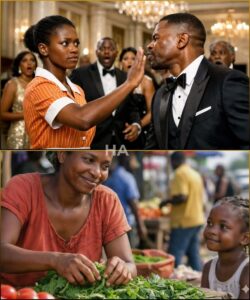
The slap sounded wrong in a room built for polite applause.
Not loud exactly, not in the way explosions are loud, but sharp, final, the kind of sound that makes even chandeliers feel exposed. It cracked through the grand hall of the Meridian Crown Hotel and left a small, stunned silence hanging in the air like a held breath.
Joy Sheruo’s hand hovered a moment after impact, her palm tingling. Her faded maid’s uniform suddenly felt like a costume everyone had agreed to laugh at, until now.
David Chibu, the billionaire, the man whose name bent conversations around him, stared at her as if she had written her signature across his face.
A ribbon of blood shone at the corner of his mouth. His eyes were wide, urgent. Not furious.
Pleading.
For one stunned second, the entire room stopped pretending.
Then came the noise.
“Get her!” someone shouted.
“Arrest her!”
Security surged forward, shoes scuffing marble. Phones rose like metal flowers blooming in panic. A woman in pearls gasped so hard it became a performance.
Joy didn’t scream. She didn’t run. She didn’t even lift her hands to protect herself.
Because she wasn’t looking at the guests.
She was watching David’s breathing.
Or rather, what was happening to it.
His shoulders pitched. His jaw clenched as if he were trying to swallow the whole world back into order. His knees buckled. The microphone at the podium squealed, a startled animal.
David Chibu, the most powerful man in the room, collapsed face-first onto the marble floor.
The hall went silent again, but this time it was a different silence. A hungry one.
Joy felt security grip her arms, wrenching them behind her. Pain shot up her shoulders, bright and clean, but it was nothing compared to the terror in her chest.
Because David wasn’t moving.
And everyone else was waiting.
Waiting for permission.
Waiting for someone important enough to touch him first.
Joy’s throat tightened around a memory so old it still tasted like dust and charcoal smoke.
“Move,” she said hoarsely, not to the guards, not to the guests, but to the air itself. “Please. Move.”
Before we go deeper: where are you watching from right now, and what time is it there?
Because some stories don’t just pass through you. They sit down in your ribcage and refuse to leave.
If stories of courage, injustice, and unexpected humanity move you, consider subscribing. This one is going to stay with you.
Joy had learned early that silence could be a kind of shelter.
She grew up on the edge of Nairobi, where corrugated rooftops rattled when the wind got playful, and the scent of charcoal clung to clothes like a second skin. Her mother, Ruth, sold vegetables from a roadside stall. Her hands were always in motion, sorting tomatoes, counting small notes, wiping sweat from her brow. Her smile tried to be brave, but Joy could see tiredness living behind it, quiet and permanent.
Her father, Joseph, used to come home from construction sites with dust in his hair and stories that ended halfway, as if hope was a sentence he didn’t trust enough to finish.
When Joy was thirteen, Ruth collapsed behind the stall.
At first, people said the sun was too strong. Someone waved a plastic fan in her face. Someone else shouted for space like that alone could fix what was broken. And still nobody touched her. Nobody wanted to be the one to decide. Nobody wanted the blame.
By the time an ambulance finally came, Ruth’s lips had turned pale. Joy arrived in time to hear the siren fading into the distance, not getting louder.
Her mother died that night of a heart condition no one knew she had.
The doctors said earlier intervention might have saved her.
Joy never forgave the word might.
It followed her through her teenage years like a shadow that learned to whisper. Might have. Might still. Might never.
After Ruth’s death, Joseph unraveled slowly, then all at once.
Work dried up. Drinking began. Nights grew louder. Joy learned to stretch meals with water and patience. She learned to smile when landlords knocked, to hide her school uniform so her father wouldn’t sell it.
At sixteen, she stopped going to school.
No dramatic goodbye. No crying in the doorway. Just a quiet understanding that education was a luxury their grief could no longer afford.
She cleaned offices at night. Then she found work as a hotel maid, a place where the floors gleamed like polished lies, and people walked across them as if gravity owed them gratitude.
The Meridian Crown was a monument to wealth. Crystal lights. Marble everywhere. Bathrooms bigger than Joy’s childhood home. Sheets that cost more than her monthly wage.
The rules were simple.
Eyes down. Voice low. Presence invisible.
If you made a mistake, you didn’t apologize. You disappeared.
Joy did her work like a ghost with a mop. Guests snapped their fingers when they wanted something. Managers spoke at her instead of to her. Some people smiled politely, but their eyes slid over her face like it wasn’t worth storing.
She accepted it all with the calm of someone who had lived through worse.
But at night, in the single room she shared with Joseph, Joy’s mind returned to her mother’s last moments. The circle of hesitant bodies. The fear that wore the mask of “caution.” The waiting.
Joy began to read everything she could about medical emergencies. Old pamphlets from clinics. Articles on her phone when allowed. She wasn’t trained. She wasn’t certified.
But she learned the signs.
Shortness of breath. Sudden dizziness. The way sweat could be a warning. The way a body tried to speak before it gave up and went quiet.
Knowledge became her quiet rebellion.
At work, Joy noticed things others missed. A guest leaning too heavily on the wall. A woman’s hands shaking as she signed a bill. She didn’t interfere unless asked. She knew unsolicited concern could be punished.
Still, she watched.
Her only real friend at the hotel was Hale Lima Musa, a soft-spoken woman with kind eyes and a laugh that startled people who underestimated her.
Hale Lima had been at the Meridian Crown long enough to understand the invisible hierarchy as if it were printed on the walls.
“This place,” she warned Joy more than once, “does not reward good intentions. Only obedience.”
Joy would nod. She understood.
And yet something inside her resisted the idea that obedience was the highest virtue a human could offer.
On the morning of the gala, Joy woke before dawn.
Joseph slept on the thin mattress, an empty bottle on the floor beside him like a confession. Joy draped a blanket over him out of habit, the same habit her mother had once used to cover Joy’s shoulders at night.
At the hotel, the air buzzed with rehearsed anxiety. Important guests were arriving, the kind of people whose names appeared in newspapers and whose presence demanded perfection. Billionaires. Politicians. Investors. The sort of people who didn’t ask if you were tired. They assumed you weren’t allowed to be.
Joy was assigned to the upper floors, then unexpectedly redirected to the main hall.
“It’s an honor,” a supervisor said, but his voice carried a warning instead of pride.
Joy’s stomach tightened with unease she couldn’t name.
Then she saw him.
David Chibu entered the hall like the room belonged to him by birthright. Tall, tailored, effortless. People made space without being asked. Conversations softened. Laughter changed shape into something careful.
Power walked beside him like a bodyguard.
Joy had seen men like him before on billboards, in magazines, in the way poor neighborhoods talked about “those people” with a mixture of anger and awe. David Chibu was a story told in numbers: net worth estimates, market expansions, glossy interviews praising his discipline.
But Joy didn’t see the numbers.
She saw the cracks.
A slight delay before he answered a question. The brief clenching of his hand at his side. A shallow breath swallowed quickly when he thought no one was watching.
It reminded her of Ruth at the stall, insisting she was fine while her body quietly negotiated with death.
Joy tried to dismiss it. This was not her place. She was a maid. She didn’t have permission to notice powerful men.
But as the hours passed and the gala preparations intensified, her concern grew teeth.
David snapped at a server for a trivial mistake. Joy didn’t flinch at the anger. She flinched at the way his voice wavered beneath control, as if his body was running out of fuel.
At one point, she caught his reflection in a mirror.
For half a second, his composure slipped. His eyes looked distant, unfocused, like he’d stepped briefly out of his own life.
Then it was gone, replaced by iron control.
Joy felt urgency rise in her chest like a tide.
She considered telling someone.
Then she remembered the stall, the crowd, the waiting.
She remembered arriving too late.
David Chibu’s relationship with control had started long before wealth.
He was born outside Lusaka, in a township where hunger was common and expectations were small. His mother, Miriam, sold secondhand clothes in an open market and taught him to count money before she taught him to read. Preparation, she called it. Survival first, dreaming later.
His father left early. No dramatic goodbye. Just an absence that never corrected itself.
David grew up with a single belief that hardened into law: if anything was going to change, it would be because he forced it to.
Scholarships. Long nights. Ruthless discipline. He carried resentment toward weakness, especially his own.
Then one afternoon, the illusion shattered.
Miriam collapsed in the market.
David was nineteen, home for the holidays, when he heard someone shout his name. He ran through stalls and bodies, heart pounding until he saw her lying on the ground.
People stood around in a loose circle. Whispering. Watching.
No one touched her.
“She might be important,” someone said, as if importance was the only permission slip for compassion.
“We should wait,” said another.
David dropped to his knees, begging strangers to help.
Fear ruled the moment. Fear of doing the wrong thing. Fear of responsibility. Fear of consequences.
By the time the ambulance arrived, Miriam was gone.
The doctors later said immediate intervention might have saved her.
That sentence became a splinter under David’s skin.
From that day, he vowed two things: he would never be powerless again, and he would never let anyone see him weak.
As his business empire grew, so did the walls around him. Vulnerability was replaced with authority. Rest became a rumor. Slowing down was something other men did, men without ambition.
When doctors warned him about his heart, genetic risk worsened by stress, David listened politely and ignored them.
Medication was taken irregularly. Appointments postponed. Symptoms managed like inconvenient employees.
He told himself he understood risk better than anyone.
What he didn’t admit, even to himself, was how deeply terrified he was of dying the way his mother had: exposed, helpless, waiting for permission to be saved.
The gala was meant to be controlled.
David arrived on time. The hall was flawless. Marble floors. Soft music. Cameras angled for the best story.
He approved. Details mattered.
Yet beneath his suit and practiced calm, his body was rebelling. Pressure in his chest, familiar but sharper tonight. He adjusted his posture, slowed his breathing.
Control, he reminded himself, wasn’t optional.
A server brushed him accidentally. David snapped. The irritation surprised even him.
Across the room, Joy noticed.
David didn’t see her at first. He rarely saw uniforms as human beings. But something about her gaze, steady and unafraid, registered like a pinprick under his skin.
It annoyed him. He looked away.
As the evening progressed, the pressure worsened. He ignored it the way he ignored warnings, by pretending they were beneath him. Someone offered whiskey. He drank it despite knowing better.
Alcohol smoothed discomfort and sharpened his confidence. It reminded him who he was supposed to be.
Later, Joy approached to adjust a setting near his table.
“Sir,” she said softly, “are you all right?”
The question hit him like accusation.
“I’m fine,” he said curtly, sharper than necessary.
Joy hesitated, then stepped back.
David watched her retreat with a flicker of unease. Why did concern irritate him so much?
Because it sounded like pity. And pity, to David, was an insult.
Then he saw Joy speak to management, discreetly gesturing in his direction.
A thin smile of dismissal from the hotel manager.
Anger rose in David, clean and cold.
How dare she speak about him? How dare a maid assume she knew anything about his body, his limits, his life?
He confronted her publicly, voice precise enough to cut glass.
“This is a professional environment,” he said, ensuring others could hear. “If you can’t tell the difference between imagination and reality, you shouldn’t be here.”
Joy’s cheeks burned. She absorbed the humiliation without flinching.
For a moment, David thought he saw something flicker in her eyes. Not fear. Not anger.
Recognition.
It unsettled him.
He turned away, satisfied he’d restored order.
But his body had other plans.
When David stepped onto the stage to speak, applause rose like obedient weather. Cameras flashed. He gripped the podium, smiled.
His words came slower than usual. His tongue felt thick.
The room tilted.
David tightened his grip and forced his voice steady.
Control. Always control.
Near the edge of the hall, Joy stood with her heart hammering. She watched the sheen of sweat at his temple, the shallow breath, the small tremor in his hand.
She thought of Ruth.
She thought of might.
Joy looked toward the manager again.
“Sir,” she murmured. “Please. I think he needs help.”
The manager’s eyes flashed with irritation. “Not now.”
“I’ve seen these signs,” Joy insisted, voice tightening. “He’s struggling.”
The manager leaned close, voice low and threatening in its practicality. “Do you know who he is? Do you want to lose your job tonight?”
Joy stepped back, cheeks burning. Eyes were on her. Curious. Judgmental.
She returned to her duties, swallowing the rising panic.
Onstage, David saw the exchange. The implication tasted like humiliation.
He pushed through the speech faster, skipping lines, forcing applause to cover the wobble in his voice.
Then the pressure in his chest spiked.
His vision narrowed. The hall became too bright, too loud, too far away.
He stepped down from the podium and tried to wave off concern.
His legs trembled.
Joy saw it.
Time stretched.
She watched people hesitate again. Investors in expensive suits, hands frozen mid-motion. Security scanning for threats, missing the one happening inside a man’s chest.
Everyone was waiting for permission.
Joy felt something inside her snap into place, not rage, not bravado.
Memory.
She slipped past security, heart pounding louder than the music.
“Stop her!” someone shouted.
Joy reached David as his knees buckled. He looked down at her, confusion and anger fighting in his eyes.
“What are you doing?” he demanded, voice unsteady.
Joy didn’t answer. She raised her hand.
For a fraction of a second, every future balanced on the edge of choice.
Then she struck.
The sound cracked through the hall.
David’s head snapped to the side.
And for a heartbeat, his eyes focused, startled into clarity.
Then his body collapsed.
Security dragged Joy away. She didn’t resist.
Her eyes stayed on David’s still form, on the unnatural quiet of his chest.
The hotel manager shouted orders. Someone finally called an ambulance.
People knelt beside David, fumbling, uncertain, afraid to be responsible.
Joy’s stomach twisted with bitter irony.
In the security office, fluorescent lights turned everything harsh.
“You understand the gravity of this?” the manager demanded. “You struck one of the most powerful men in the country.”
Joy’s voice was trembling but clear. “I understand he was dying.”
“You are not a doctor.”
“No,” Joy agreed. “But I’ve seen this before.”
He stared at her, incredulous. “That doesn’t give you the right.”
Joy looked up. “Would it have been better if I did nothing?”
The question hung in the room, heavy and unanswered.
Police arrived. Procedures followed. Statements recorded. Joy was escorted out as cameras flashed.
By morning, the story was everywhere.
HOTEL MAID ATTACKS BILLIONAIRE AT GALA.
VIOLENCE ERUPTS AT ELITE EVENT.
People filled comment sections with certainty and cruelty.
She looks unstable.
This is what happens when boundaries disappear.
Make an example of her.
No one asked why.
They only asked: how dare she?
At home, Joseph watched the footage with shaking hands. He turned off the television and sat on the edge of the bed like someone waiting for the roof to collapse.
“They will destroy you,” he whispered.
Joy stared at the wall. “I couldn’t watch it happen again.”
Joseph’s silence broke him open. He hadn’t said her mother’s name in years, but it lived in the room with them anyway.
At the hospital, David Chibu lay motionless in the ICU.
Machines beeped steadily, cold and loyal.
Dr. Emmanuel Kofi Agumen, a senior physician with decades of experience, studied the timeline carefully. The collapse had been sudden, but not complete. There was a brief neurological response before full cardiac failure.
“That window,” he murmured to his team, “is unusual.”
A nurse hesitated. “There was… an incident. At the hotel.”
“What kind of incident?”
“A woman struck him,” the nurse said cautiously.
Dr. Agumen went quiet.
When security footage arrived, he watched it twice.
Then again.
The slap. The sudden jolt. David’s eyes widening, body stiffening, then collapsing.
“That impact,” Dr. Agumen said slowly, “triggered a stress response. Brief, but it may have delayed full shutdown.”
A junior doctor frowned. “Are you saying the slap saved him?”
“I’m saying,” Dr. Agumen replied carefully, “without it, he may not have made it to this bed alive.”
Truth moved cautiously in cases like this. Especially when power was involved.
But biology did not care who owned the building.
Three days later, David’s eyes opened.
Not dramatically, not like movies. Just a slow return to awareness, fingers tightening faintly, breath growing steadier.
David blinked at the ceiling, pain and confusion knitting his face.
“You’re in the hospital,” Dr. Agumen told him. “You’ve had a cardiac event.”
David swallowed, memory arriving in fragments: lights, podium, dizziness, then…
The slap.
His brow furrowed.
“Who was the woman?” he rasped.
“The maid,” Dr. Agumen said gently. “Joy Sheruo.”
David closed his eyes, and for the first time in years, something like fear slid into him. Not fear of dying.
Fear of repeating history.
“What happened to her?” he asked.
“She was detained. Under investigation. Public opinion hasn’t been kind.”
David’s heart rate spiked, not from stress, but from recognition. His mother. The market. The crowd waiting. The might.
“Find her,” he said, voice gaining strength. “I want to speak to her.”
His advisers urged caution. Lawyers warned about optics. Public relations teams suggested waiting.
David stared at them, the old word ringing in his head.
Wait.
“No,” he said quietly. “We will not wait.”
When Joy received the message that David wanted to see her, her stomach turned into water.
She arrived at the hospital escorted through corridors where staff avoided her eyes, as if shame could be contagious.
Outside David’s room, Dr. Agumen met her.
“You’re brave,” he said softly.
Joy shook her head. “I was desperate.”
“Sometimes,” he replied, “they look the same.”
Inside, David lay thinner, paler, stripped of his aura.
For a long moment they stared at each other, the air full of what neither knew how to say.
Then David tried to sit up.
“Don’t,” Joy blurted instinctively, stepping forward.
David’s lips twitched. “Still watching out for me.”
Joy stopped, suddenly aware of her place again, of the invisible line between them.
“I owe you an apology,” David said.
Joy’s breath caught.
“For humiliating you,” he continued. “For not listening. For thinking my power made me untouchable.”
Joy swallowed hard. “I didn’t want to be brave,” she whispered. “I just didn’t want to be too late again.”
David’s eyes softened. “You weren’t.”
The words cracked something open inside Joy. Tears rose, unwanted and unstoppable. She turned her face away, ashamed of the release.
David didn’t look away.
Outside the room, the machinery of power shifted.
A press conference was scheduled for noon.
The hospital lobby was a storm of cameras and microphones. Reporters rehearsed questions with sharpened voices.
David walked to the podium slowly, supported by Dr. Agumen, wearing a simple suit without any of his usual armor.
The room hushed, not because David demanded it, but because the world was hungry for what he would say.
“I won’t speak for long,” David began, voice steady but softer than people remembered.
“A few days ago, I collapsed at a public event. In the moments before that, I was warned quietly, respectfully, by a hotel employee named Joy Sheruo.”
Murmurs spread.
“I ignored her. I dismissed her concern. I humiliated her.”
Keys clacked. Cameras flashed faster.
“When my condition worsened seconds later, Joy intervened. Her action, misunderstood by many, triggered a response that delayed full cardiac arrest long enough for emergency care to reach me.”
He nodded toward Dr. Agumen.
“The medical report confirms this. Without that intervention, I would likely not be here today.”
The room shifted, as if reality had moved its furniture.
“Joy Sheruo did not assault me,” David said clearly. “She saved my life.”
Silence followed, heavy and stunned.
Then the world exhaled in chaos.
“Are the charges being dropped?”
“Yes,” David replied without hesitation. “Immediately.”
“What about the hotel’s responsibility?”
David’s gaze sharpened. “Institutions often reward silence over courage. That must change.”
Upstairs, Joy watched the press conference on a small television, her hands shaking. Joseph’s hand found hers, trembling too.
For the first time in days, he exhaled like someone allowed to breathe again.
Vindication did not erase consequence.
When Joy returned to the hotel for a formal meeting, the lobby looked the same but felt like a different planet.
Management apologized. Compensation offered. Her job reinstated.
Joy listened, then said calmly, “I won’t be returning to my old position.”
The manager blinked. “Why?”
“Because this wasn’t about me,” Joy said. “It was about a system that teaches everyone here to ignore danger if it’s noticed by the wrong person.”
She didn’t ask for a promotion.
She asked for training. Protocols. Clear permission for staff to speak up when someone’s life was at risk, regardless of role.
Some executives shifted uncomfortably.
But the story had become too large to fold back into silence.
David created a fund for emergency response education in public spaces, especially for workers without formal authority. Training programs launched not just for CPR, but for recognizing danger and acting while summoning help.
Joy insisted she not be used as a mascot.
“I don’t want to be remembered for the slap,” she told David later in a quiet meeting at a community center.
David nodded. “Then what do you want?”
Joy thought for a moment. “I want people to know caring doesn’t require permission.”
David’s eyes held hers, no longer defensive. “Then we want the same thing.”
Joseph changed too, slowly, awkwardly, like a man learning to walk with a different spine. He stopped drinking. He cooked again. He began to show up in small ways, not with speeches, but with presence.
“You look lighter,” he told Joy one evening.
Joy smiled softly. “I feel anchored.”
Joy volunteered at a local clinic, then enrolled in formal emergency care training. The coursework was hard, but it was the first exhaustion she welcomed. It felt like turning pain into preparation.
One afternoon, a young boy collapsed in the clinic waiting area. Panic rippled through the room.
Joy didn’t freeze.
She checked breathing, positioned him, spoke calmly, directed someone to call for advanced support. When the medical team arrived, the boy was stable.
The mother clutched Joy’s hands, sobbing. “Thank you,” she whispered. “Thank you for not waiting.”
Joy felt something settle in her chest.
Not pride.
Confirmation.
News never reached the media, and Joy was grateful. This was how it should be. Lives saved without spectacle. Humanity acting without an audience.
Months later, a national guideline was released quietly: in emergencies, any staff member who reasonably perceives imminent danger may initiate intervention while summoning medical assistance without fear of disciplinary action. Mandatory training to follow.
Joy read it twice and set it down.
Joseph looked at her. “Is that good?”
Joy nodded slowly. “It’s enough.”
Across the city, David stood on his balcony one evening and watched the lights flicker on. His heart still required care. His limits were still real.
But fear no longer dictated his pace.
He sent Joy a short message: They listened.
Joy replied: We spoke.
And somewhere in Nairobi, a cleaner stepped forward when someone collapsed. A guard called for help without waiting. A receptionist broke protocol to save a life.
No headlines. No applause.
Just breath continuing.
Joy understood then that the true climax had never been her hand against David’s face.
It had been her refusal to return to silence once the noise faded.