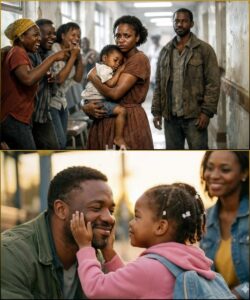
Before we begin: Where are you watching from, and what time is it there right now? If stories of justice, healing, and quiet courage speak to you, subscribe and stay with us. ✨
Isatu Dio learned to read a room the way other people read the weather.
A shift in temperature. A glance that lasted half a second too long. A laugh that didn’t belong to joy.
You didn’t need a forecast when you’d lived long enough as the kind of woman the city treated like background noise. A woman with cleaning gloves that never fit. A woman whose name people said wrong, if they said it at all. A woman who pushed a cart through factory corridors and made other people’s messes disappear.
Invisibility was a skill. She’d mastered it the way you master carrying water without spilling: by learning exactly how much to hold, and exactly how little to ask.
But the morning Amara’s breathing changed, invisibility stopped being a strategy and became a sentence.
It began before sunrise, when the industrial zone still slept under the gray weight of night. Isatu was standing over the thin mattress in their one-room place, listening to her daughter breathe.
Sometimes Amara’s chest rose and fell like a soft tide. On those days, Isatu could pretend the world had a little mercy.
Other days, Amara’s breathing rattled, thin and urgent, like air scraping through a too-narrow door.
This was one of those days.
Amara’s eyes fluttered open, glassy. Her tiny fingers gripped Isatu’s sleeve with a strength that didn’t match her body.
“Mama,” she whispered, the word barely a thread.
Then her chest hitched. A wheeze. A pause that lasted too long.
Isatu’s heartbeat turned into a drum. She scooped her child up, pressing her cheek to Amara’s forehead, feeling heat and fear at once.
“Breathe, baby,” Isatu murmured, steadying her voice the way you steady a tray when someone bumps you. “Just like we practiced.”
She reached for the inhaler Ibrahim had given them, the one he carried like a secret. She shook it with shaking hands, pressed it gently, counted—one, two—
Amara sucked air like it was being rationed.
The inhaler helped, but not enough.
Isatu didn’t even stop to tie her headscarf neatly. She wrapped Amara in the warmest cloth they owned, grabbed the small bag with documents and coins and medicine, and stepped outside into a city that had already decided it was too busy to notice one child.
Halfway to the main road, she saw Ibrahim Mensah.
He was waiting near the bus stop like he always did, just beyond the market stalls, slightly apart from the men who begged loudly. His clothes were worn but clean. Dust sat at the elbows of his jacket. His shoes were cracked, but his posture was… wrong for the story people told about him.
Not proud. Not arrogant.
Just unshaken.
He looked up, and his eyes went straight to Amara.
“She’s worse,” Isatu said, and hated how small her voice sounded.
Ibrahim was already moving. Not frantic, not panicked—focused. Like a man stepping into a task he’d rehearsed in his head a thousand times.
He touched Amara’s cheek with the back of his fingers, checking color, checking sweat, checking what mattered.
“We go now,” he said.
“To the clinic?” Isatu asked, though she already knew.
“The hospital,” Ibrahim replied. “And if they delay us, we don’t argue. We move.”
He said it like delay was a choice the world might try, and like he had already decided it would fail.
Isatu didn’t ask how. She didn’t have breath to spare.
They flagged down a car—really, Ibrahim did. He stepped into the road and raised one hand, not pleading, not performing desperation. The driver braked hard, as if stopping had suddenly become the safest option.
Inside the car, Isatu held Amara upright, counting breaths. Ibrahim watched Amara’s chest like he could translate every rise and fall into a plan.
When the hospital came into view, Isatu’s hope lifted and then immediately bruised. Hope had learned not to get comfortable.
The entrance was crowded. The public hospital corridor hummed with the kind of noise that swallowed individuals whole: arguments at the pharmacy window, babies crying, shoes squeaking on disinfected tile, a television mounted too high playing something cheerful that belonged to another planet.
And then—there it was.
The look.
They laughed before they looked at the child.
Isatu stood at the triage window with Amara’s limp little body against her chest. Amara’s breathing rattled thin and urgent, her lips slightly pale, her eyes unfocused like she was staring through the ceiling into somewhere else.
Isatu spoke carefully. Respectfully. She had learned that tone mattered more than truth in places like this.
“Please,” she said. “My daughter can’t breathe. She needs oxygen.”
The nurse behind the glass glanced at the paperwork, then at Isatu’s clothes, then—almost automatically—at Ibrahim.
His jacket. The dust on his sleeves. The fact that he didn’t look like money.
The nurse’s mouth tightened.
“Payment first,” she said, already turning to call the next number.
Isatu’s throat closed. “Please,” she tried again. “She’s three—”
Behind her, someone scoffed. “Why bring a beggar here?”
Another voice, a whisper sharpened into entertainment: “Charity mistakes don’t get priority.”
A security guard stepped closer, not to help, but to redirect. His body angled between Ibrahim and the door like Ibrahim was a contamination risk.
“Sir,” the guard said, using the voice people use when they want compliance, not conversation, “you need to step back.”
Isatu felt heat rise up her neck. Not anger yet. Shame first. Shame always arrived first, fast and practiced, like the world’s hand on her shoulder pushing her down into the place it preferred her.
She tried to explain again, softer, smaller, as if shrinking might earn mercy.
But Amara whimpered. A thin sound. Like a question.
And the doors stayed closed.
Outside, the city hummed unbothered. Cars honked. People bought fruit. Somewhere, someone laughed at a joke that didn’t cost anyone breath.
No one in that corridor knew that the man they were pushing away owned the ground beneath their feet.
And when the truth surfaced, it would leave no one untouched.
They got turned away the first time.
Not officially, not with a stamp. Just with a shrug. A hand wave. A slow erasure.
Isatu left the triage window carrying her child like a fragile argument the world refused to hear. She felt eyes on her back. Felt whispers crawl over her skin.
Ibrahim walked beside her, silent.
Outside, she leaned against the wall and fought the panic that wanted to eat her from the inside. She fumbled in her bag, counting the coins she already knew wouldn’t be enough.
“I’m sorry,” she whispered to Amara, pressing her lips to her hair. “I’m trying, baby. I’m trying.”
Ibrahim’s voice came low, near her ear. “Wait.”
She looked up, confused.
He reached out to a man passing by, asked politely for a phone. The man hesitated—then handed it over, as if something in Ibrahim’s calm made refusal feel inappropriate.
Ibrahim stepped aside, dialed, spoke quietly.
Isatu couldn’t hear the words. Only the tone: controlled, precise, the tone of someone who didn’t need to prove he mattered.
When he returned, his face hadn’t changed. But his stillness carried a different gravity now, like a lock had clicked open somewhere unseen.
“They’ll take her,” he said.
Isatu stared at him. “What did you say?”
“I asked for help,” he replied. “That’s all.”
Inside, everything moved as if someone had flipped a switch.
A nurse rushed over. A stretcher appeared. Oxygen. A doctor, suddenly present, suddenly urgent.
Amara was taken from Isatu’s arms, a mask placed over her face, her cries fading into a soft, terrifying quiet.
Isatu stood frozen, empty-handed, her arms still shaped like they were holding her child.
Ibrahim guided her to a chair, his hand steady on her shoulder.
“Breathe,” he said. “Stay with me.”
And Isatu did, because she had no other choice.
Hours later, a doctor came out with tired eyes and honest posture.
“She’s stable for now,” the doctor said. “But this condition needs consistent treatment. Monitoring. This can’t keep happening like this.”
Isatu nodded. “I understand.”
The doctor hesitated. “It’s expensive.”
Isatu’s mouth went dry. “I’ll find a way.”
The doctor’s gaze flicked to Ibrahim. “You’re the father?”
Ibrahim’s answer came without hesitation.
“Yes.”
Then, in a voice that wasn’t loud but somehow filled the space, he said, “Prepare whatever you need.”
He stepped away to make a call. Not borrowed this time.
Isatu watched him like she was watching a stranger wearing a familiar face.
Because this was different.
The staff’s posture changed around him. The little extra politeness. The sudden attentiveness. The way people began to listen before he finished speaking.
When he returned, the doctor’s demeanor had softened into something like respect.
“We’re transferring her,” the doctor said. “To a private pediatric wing.”
Isatu blinked. “Private?”
“Yes,” the doctor replied. “Follow me.”
They passed through doors Isatu had never gone through. Cleaner halls. Quieter air. Machines that hummed like careful guardians instead of clanging like warnings.
Amara lay asleep in a crisp bed, oxygen steady, her face peaceful for the first time in hours.
Isatu sat beside her and cried silently, the tears falling without drama, just gravity.
When the room quieted, Isatu turned to Ibrahim.
“You did this,” she said.
It wasn’t accusation. It was recognition.
Ibrahim nodded once. “I made a call.”
“To who?” Isatu asked, though she already felt the answer coming like thunder you sense in your bones before the sky admits it.
He hesitated, then met her gaze without hiding.
“People who owe me,” he said carefully.
Isatu’s heart pounded. “Why would anyone owe you anything?”
Ibrahim looked at Amara, then back at Isatu.
“Because I built the systems they depend on,” he said.
The words landed heavy, unfinished.
And suddenly, every inconsistency Isatu had ever noticed sharpened into meaning.
His precise English. His knowledge of which doctors were competent. The way he watched security routines like a man studying a map. The way he never begged, even when begging would have made life easier.
Isatu swallowed. “Then why live the way you do? Why let them treat you like… like nothing?”
Ibrahim looked out the window at the city lights beginning to bloom.
“Systems don’t reveal themselves to men they fear,” he said quietly. “They reveal themselves to men they dismiss.”
Isatu felt a chill slide down her spine.
“You let them humiliate us,” she whispered.
His voice softened. “Yes.”
She waited for an excuse. A justification.
He didn’t offer one.
“I will never ask you to forgive me for that,” he said. “But I needed to see who would step aside a child. I needed it on record. I needed them to show their true face without knowing they were being watched.”
Isatu stared at him, anger and awe and grief mixing into something she couldn’t name.
“And me?” she asked. “I was just… bait?”
Ibrahim’s eyes held hers steadily. “No,” he said. “You were the truth. Long before anyone knew my name, you chose kindness. You gave bread to a man everyone ignored. You shared your life with no promise of rescue. That matters more than anything I own.”
Isatu looked down at Amara sleeping, the steady rise and fall of her chest like a miracle she didn’t fully trust yet.
“And Victor,” she said. “This is about him too.”
Ibrahim’s expression tightened, almost imperceptibly.
“It’s about everyone who thinks cruelty is invisible,” he said.
Isatu didn’t know then how quickly consequences could move when money decided to stop being polite.
Three days later, she returned to the factory not as an employee, but as a suspended worker with a sick child and a reputation people had already edited into a joke.
The garment plant sat at the edge of the city like an afterthought: long, gray, windows only where it needed light to extract labor. Inside, the air always smelled like oil, fabric dust, and exhaustion.
Isatu pushed her cleaning cart as usual. She kept her head down. But eyes followed her now with sharper intent.
The rumors had evolved.
They weren’t just about her choosing a “beggar.” They were about how long she would be allowed to stay.
Victor Chisum Okiki made sure of that.
He waited until the production line was loud and crowded before calling her out like he was announcing a sale.
“Isatu!” he shouted. “Bring your cart.”
She approached slowly. Victor stood near a spill that didn’t exist, arms crossed, polished shoes untouched by dirt.
“This area hasn’t been cleaned properly,” he announced.
Isatu looked down. The floor gleamed. She’d mopped it twice.
“I’ll do it again,” she said quietly.
“That’s not the point,” Victor replied, voice lowering into something meant to sound reasonable. “The point is reliability.”
He gestured toward her hands. “Your situation. Single mother. Sick child. No husband. A man who can’t even provide for himself.”
The words landed like measured slaps.
Workers nearby pretended to focus on their tasks, but their attention was unmistakable. Victor wanted witnesses. He wanted the humiliation to feel official.
“You should be grateful,” he continued. “We understand hardship. But understanding has limits.”
Isatu felt the familiar burn rise behind her eyes, but this time it wasn’t shame.
It was clarity.
“What are you saying?” she asked.
Victor leaned closer, smile thin. “I’m saying there are ways to make things easier for both of us.”
The implication hung in the air like poison.
Isatu’s hands tightened around the cart handle.
“No,” she said.
Victor’s eyebrows lifted. “No?”
“No,” she repeated, louder now. “I do my job. That is all.”
For a moment, surprise flashed across his face. Then irritation. Then the mask returned.
“Very well,” he said. “Then don’t be surprised when reality catches up.”
The retaliation came like clockwork.
Her schedule changed without warning. Heavy sections. Shortened breaks. Denied time off for Amara’s appointments. A performance review notice filled with lies.
At home, her landlord knocked more often, complaining about noise that didn’t exist. Neighbors watched from behind curtains. An envelope slipped under her door with a screenshot of the hospital corridor video someone had taken on their phone, circled in red, with two words beneath it:
Take responsibility.
Isatu tore it into pieces so small they felt like dust.
Then, as if the world wanted to prove it could always go lower, Amara’s breathing worsened again.
This time, it wasn’t gradual. It was sudden, violent.
Amara tried to inhale and failed. Her chest heaved. Her eyes widened, not in pain yet, but confusion turning quickly into terror.
Isatu’s panic exploded. She grabbed the inhaler, but the medicine wasn’t enough.
“Ibrahim!” she screamed.
He was already there.
“Bag,” he said, voice sharp but controlled. “Now.”
Isatu handed it to him, hands shaking.
He checked the inhaler, shook his head.
“Not enough,” he said. “We’re going.”
They rushed outside. Isatu waved down cars, begging.
Some slowed, saw Amara’s face, sped up.
Others shook their heads apologetically.
Ibrahim stepped into the road again and raised his hand.
A black sedan screeched to a stop inches from him, as if stopping had been ordered by something larger than fear.
“Hospital,” Ibrahim said to the driver. “Now.”
The driver hesitated, eyes flicking to Ibrahim’s clothes.
Then he looked into Ibrahim’s eyes, and the hesitation died.
They moved.
At the hospital entrance, security blocked the doors.
“Forms first,” the guard said automatically, eyes sliding over Isatu, then Ibrahim, then away.
Amara gasped. A sound like a small body arguing with the air.
Isatu fell to her knees. “Please,” she begged. “She can’t breathe.”
Ibrahim stepped forward.
His voice didn’t rise, but it carried weight like a gavel.
“Move,” he said.
The guard hesitated.
Ibrahim pulled out a phone.
Not borrowed.
Sleek, new.
He dialed without looking away from the guard.
“Emergency pediatric,” he said into the phone. “Yes. Now. East entrance. Three years old. Severe respiratory distress.”
He ended the call and slipped the phone back into his pocket.
“Open the door,” he said.
The guard swallowed and stepped aside.
Inside, everything moved like a storm.
Oxygen. Stretcher. Doctors appearing with sudden purpose.
Amara was taken from Isatu’s arms, her cries fading under the mask.
Isatu stood shaking, empty-handed again.
A doctor emerged later, eyes serious.
“We’re transferring her to a private pediatric wing,” she said.
Isatu’s breath caught. “Private?”
“Yes,” the doctor replied. “It’s arranged.”
Everything is arranged.
Those words followed Isatu like a ghost.
Because arrangement was what the world had never offered her. Not unless she begged. Not unless she bowed. Not unless she disappeared.
Later, in the private wing, with Amara finally steady, Isatu turned to Ibrahim again.
“Tell me the truth,” she said.
Ibrahim hesitated, then nodded once.
Zab Camau arrived that evening, a woman who moved like she belonged in boardrooms and courtrooms, not cramped rooms behind the industrial zone. She carried a folder and no small talk.
“Isatu Dio,” she said, voice brisk. “We don’t have much time.”
Isatu stood protectively near Amara’s bed. “Who are you?”
“My name is Zab Camau,” the woman said. “I work with Ibrahim.”
Isatu’s heart stuttered. “Work.”
Zab opened the folder and slid out documents.
“Victor Okiki has attracted attention,” she said. “Patterns. Suspensions. Terminations. Coercion.”
Isatu’s mouth went dry. “Other women?”
Zab’s gaze didn’t soften, but it steadied. “Yes. Some stayed silent. Some paid the price.”
Isatu closed her eyes, seeing faces of coworkers whose lockers had been cleaned out overnight. Women who never came back. Women no one asked about too loudly.
“And me?” Isatu asked. “What happens now?”
Zab’s voice lowered. “Things may get worse before they get better.”
Isatu laughed bitterly. “Of course.”
“But,” Zab added, “you won’t be alone.”
That night, while Amara slept under clean white sheets, Ibrahim made a quiet call.
His words were few.
“Proceed,” he said.
And somewhere beyond factory gates and hospital corridors, consequences began to move.
The next morning, Victor signed Isatu’s termination notice with satisfaction.
He didn’t see the external auditors entering the administrative building that afternoon.
He didn’t notice the way senior staff began speaking in careful tones.
He laughed when he was called into a meeting.
“Finally,” he said, adjusting his tie. “Someone has sense.”
The meeting room was full. Not his usual allies.
Legal counsel. External auditors. Zab Camau seated near the head of the table.
Victor’s smile faltered. “What is this?”
“An inquiry,” Zab said calmly.
“Into what?” Victor scoffed. “Into me?”
“Yes,” Zab replied.
Screens lit up. Dates. Names. Payments. Transfers. Recorded complaints that had been buried.
Victor’s confidence cracked like thin glass.
“This is ridiculous,” he snapped. “Who authorized this?”
The door opened.
Ibrahim Mensah stepped inside.
Not in a worn jacket. Not dusty. Not small.
He wore a simple dark suit, clean lines, calm authority. The same posture, finally revealed without disguise.
Victor stared at him, confusion turning to disbelief.
“You,” Victor said, laughing weakly. “What is this joke?”
Ibrahim didn’t smile.
He placed a folder on the table.
“My name is Ibrahim Mensah,” he said evenly. “And this factory operates on land owned by my company.”
The room went quiet.
Victor’s breath caught, a sound like panic trying to hide.
“Your employment,” Ibrahim continued, “has been under review for some time. Today’s actions expedited the process.”
Victor stood abruptly. “You can’t—”
“I can,” Ibrahim said. “And I am.”
Victor was escorted out by security, his laughter gone.
Outside, Isatu sat in a car across the street, watching the gates where Victor had once ruled. She felt no triumph. No joy.
Only release.
The kind that comes when a weight finally stops pretending it belongs on your shoulders.
But the city didn’t stop there.
Rumors mutated.
“She must have slept with someone powerful.”
“No poor woman wins like that.”
Isatu heard it all and refused to let it rewrite her truth.
Because she knew what she had chosen, long before anyone whispered “billionaire” like it was a holy word.
She had chosen kindness.
Not because it was safe. Because it was right.
Then, three days later, Ibrahim disappeared.
Not vanished forever. Just… gone.
No explanation.
No note.
Zab wouldn’t say where.
Isatu tried not to panic, but fear returned sharp and old. Had he left because the job was done? Had she become a liability?
On the third day, a message arrived:
Watch the evening news.
Isatu did.
The broadcast replayed the factory gates, Victor being escorted out, and then the anchor paused.
“Tonight,” the anchor said, “we reveal the identity of the man behind the investigation.”
The screen shifted.
There he was: Ibrahim Mensah, clean-shaven, composed, seated under studio lights.
The anchor spoke his name with reverence.
Chairman. Founder. Billionaire.
Isatu felt the room tilt.
Ibrahim spoke calmly about ethics, accountability, systems that devour the vulnerable when left unchecked.
He didn’t mention Isatu by name.
But then he said, clearly:
“The measure of a society is how it treats those it believes it can ignore.”
Isatu turned off the television, hands shaking.
Not from surprise.
From grief.
Because she knew what would come next.
By morning, the city knew.
By afternoon, the knock came.
Reporters. Cameras. Questions like knives.
“Ms. Dio, did you know? Are you in a relationship with Mr. Mensah? Did he help you because you’re the mother of his child?”
Isatu closed the door and leaned against it, heart racing.
Amara coughed softly from the bed.
Isatu crossed the room and held her child close, grounding herself in breath.
That evening, Ibrahim returned.
Not quietly this time. Not invisible.
Isatu didn’t run to him. She didn’t shout. She stood in the doorway like a judge in her own life.
“You should have told me,” she said.
“Yes,” he replied. “I should have.”
“You let me believe you were leaving.”
“I let you believe you could choose,” he said softly. “Knowing who I am removes that choice.”
Isatu stared at him, seeing both men at once: the dusty jacket by the bus stop and the suit under studio lights.
“Do you know what they’ll say about me now?” she asked.
“Yes.”
“And you did it anyway.”
“Yes.”
Silence stretched.
Then Isatu spoke with a steadiness that surprised even her.
“I didn’t love you because you were powerful.”
“I know,” Ibrahim said.
“And I won’t stay with you because you are.”
“I know,” he repeated.
Her shoulders sagged, the fight in her body exhausting itself.
“Then we start again,” she said.
Ibrahim nodded. “However you want.”
It didn’t get easier overnight.
Visibility is its own kind of poverty, a hunger for privacy you can’t buy back once the world decides you’re a story.
Victor fought back through lawyers and lies, trying to paint Isatu as a schemer and Ibrahim as an overreaching villain.
But then something happened that Victor didn’t expect.
Other women stepped forward.
A coworker named Lydia called, voice trembling.
“His lawyer contacted me,” Lydia said. “They want me to say you planned this. That you used him.”
Isatu closed her eyes. “What did you tell them?”
“The truth,” Lydia said. “That he did the same to me.”
More messages followed.
Short, careful, brave.
You’re not alone.
If you speak, I will too.
I saw what he did. I was afraid. I’m not anymore.
The summons arrived for a labor tribunal.
Victor sat at one table, suited and polished like he could iron out the past.
Isatu took the stand with no dramatic tears, no performance.
She spoke slowly, clearly.
The jokes. The pressure. The threats. The offers disguised as help.
When asked about Ibrahim’s role, she answered plainly.
“He did not tell me what to say,” she said. “He did not promise me anything. He did not ask me to be a symbol.”
Victor’s lawyer tried to trap her.
“But you benefited.”
Isatu met his gaze.
“So did the people who stopped being hurt,” she said.
The room murmured.
Lydia testified next. Then another woman. Then another.
A pattern emerged that no amount of shouting could erase.
Victor’s denials grew frantic. His interruptions louder. His confidence collapsing in real time.
By the time the panel recessed, the outcome felt inevitable.
Termination upheld. Charges referred. An independent audit ordered across operations.
Outside the tribunal, microphones surged like hungry birds.
Isatu raised a hand, not to answer, but to quiet them.
“I’m not here because of who I know,” she said. “I’m here because of what happened.”
Then she walked away.
Later, in the small room that still smelled like the life she’d fought for, Isatu sat in quiet while Amara slept, her breathing steady and strong.
Ibrahim brought tea and set it down without trying to fill the silence.
“They’ll find something else to say tomorrow,” Isatu said at last.
“Yes,” Ibrahim replied.
“And the day after that.”
“Yes.”
Isatu smiled faintly, not with sweetness, but with acceptance.
“Good,” she said. “Then we keep living.”
Ibrahim nodded. “Together, if you choose.”
Isatu looked at Amara, at the tiny rise and fall of her chest, and felt something settle.
Not certainty.
But ground that didn’t give way.
Because some stories don’t end with applause.
They end with a quieter truth: dignity doesn’t announce itself. It simply refuses to disappear.
And that, Isatu knew, was the truest kind of wealth.
THE END
News
Billionaire Divorced Pregnant Wife On Her Birthday Then Invited Her To His Wedding With His His…
Unaware The Pregnant Wife He Abandoned At The Hospital Was The Secret Trillionaire CEO Of The Com..
After His Mom Kicked Her Out, Billionaire Served Divorce Papers To Pregnant Wife On Their Annivers..
The penthouse smelled like vanilla cake. Not the sugary kind that makes a home feel safe. This sweetness was sharp,…
After Her Mom Who Was A Secret Trillionaire Died, Husband Served Pregnant Wife Divorce Papers At…
The balloons were cheerful in a way that felt almost rude. Pale pink, butter yellow, little paper clouds dangling from…
Unaware His Pregnant Wife Was A Trillionaire’s Daughter, He Refused To Pay Her Medical Bills And…
The antiseptic smell of St. Michael’s Hospital didn’t bother Emma Richardson nearly as much as the other scent. Blood. It…
Unaware His Pregnant Wife Was A Secret Multi-Billionaire Who Bought His Family Company, He Divorce..
Before we begin, drop a comment telling us which city you’re watching from. And when the story ends, rate it…
BILLIONAIRE FROZE IN THE STORE—WHEN HE SAW HIS EX WIFE RETURNING BABY FORMULA SHE COULDN’T AFFORD
Before we begin, drop a comment telling us which city you’re watching from. And once the story ends, don’t forget…
BILLIONAIRE IGNORED HIS PREGNANT WIFE — UNTIL THEIR BABY WAS BORN AND SHE HAD COMPLICATIONS
MILLIONAIRE STUNNED AT GALA WHEN HE SEES BLACK EX WIFE—WITH TRIPLETS WHO LOOK JUST LIKE HIM
SHE ARRIVED FOR THE DIVORCE WITH A NEWBORN — HE SAT THERE WITH HIS LOVER AND WAS LEFT IN SHOCK
The marble floors of Sterling and Associates didn’t just shine, they performed. Under crystal chandeliers, every tile reflected wealth back…
BILLIONAIRE WAS ON DUTY WHEN HE SAVED A BABY GIRL — AND FROZE LEARNING SHE WAS HIS EX’S DAUGHTER
Before we begin, drop a comment telling us which city you’re watching from. And once the story ends, don’t forget…
BILLIONAIRE STOOD IN THE ELEVATOR WITH HIS FIANCÉE—UNTIL HIS EX ENTERED HOLDING THEIR LITTLE BOY
Before we begin, drop a comment telling us which city you’re watching from. And once the story ends, don’t forget…
Homeless boy saves drowning Hell’s Angel’s daughter, leaves. The President orders city-wide search..
The pawn shop reeked of desperation and old cigarettes, the kind of smell that got into your clothes and stayed…
Homeless Boy Dragged a 200-Pound Hells Angel from a Sinking Car — What Happened Next Shocked Many…
Rain makes a city honest. It strips the neon shine off storefronts, turns the sidewalks into mirrors, and drags every…
Homeless Teen Sucks Venom from Biker’s Daughter—Then the Gang Arrives…
The barrel of Ranger Kevin Miller’s service pistol caught the late afternoon sun and flung it back like a cold…
Thugs Tried to Kidnap the Hells Angel’s Daughter, A Homeless Boy Fought Them Off with a Stick…
The knife pressed harder against Jason’s throat, drawing a thin line of blood that immediately turned cold in the night…
The biker’s daughter was lost in a blizzard… a farm boy found her, and then…
The wind screamed across the mountain pass with the kind of hunger that didn’t want to hurt you so much…
He Gave His Warm Coat to the Hells Angel’s Freezing Daughter, The Biker Found Him and Did This…
Snow fell like tiny daggers that afternoon, each flake a sharp little reminder that winter did not negotiate. It did…
Billionaire is shocked when a poor girl pulls him away from his wedding… but five seconds later,
Hello friends, welcome to our story. 👋 Before we begin, please like this video and subscribe. And tell us in…
Billionaire Came Home Early, Her Janitor Said, “Shut up. Don’t say a word.”