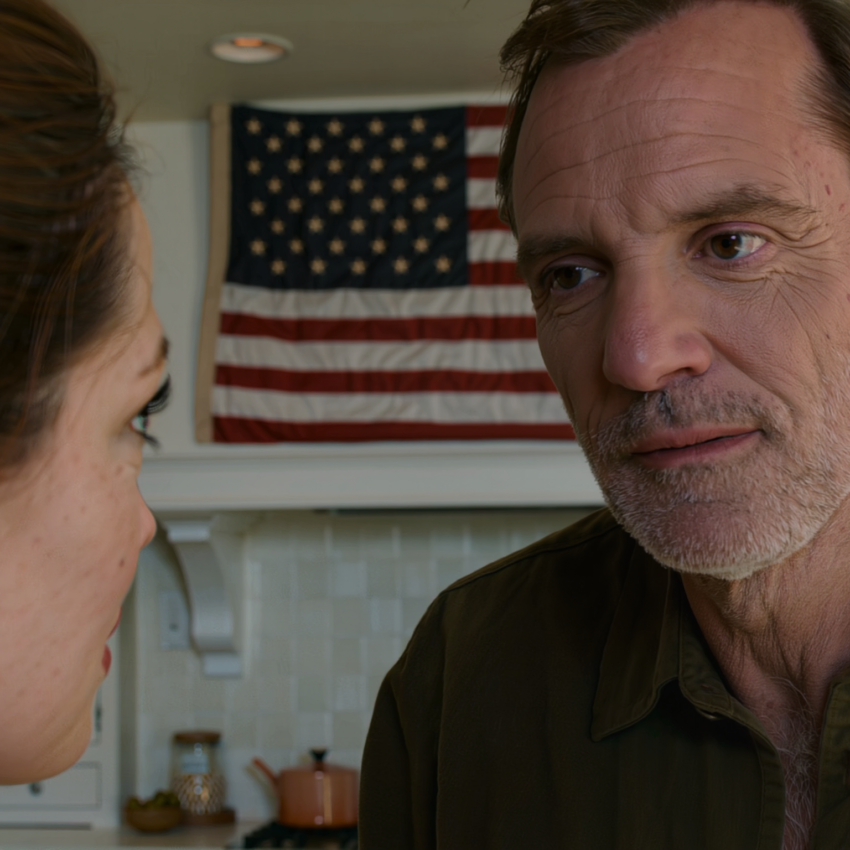
Dale’s Lexus crunched over the gravel like it had every right to be there.
It was nine-fifteen on a Saturday, the kind of quiet Pennsylvania morning where the neighborhood feels held together by dog leashes and lawn mowers and the distant beep of someone backing out of a driveway. I was barefoot on my own kitchen tile, hair still damp, a mug of coffee warming my palms, when I saw the silver hood come into view through the front window.
He didn’t come alone.
A woman stepped out of the passenger side with a leather portfolio hugged to her chest and a camera already swinging from her wrist. Behind them, Janine’s minivan slid in like a second thought, and Greg climbed out stretching his arms—wearing Nolan’s grandfather’s Omega on his wrist as if it had been gift-wrapped for him.
My stomach went cold so fast it felt like my body had made a decision without asking me.
Dale knocked once, then turned the knob like he expected it to open.
It didn’t.
I watched his hand pause, a flicker of irritation, and then his smile snapped into place—bright, practiced, the same smile he’d worn at the funeral luncheon when he’d hugged me too tight and whispered, “We’ll take care of you.”
When I opened the door, the woman smiled first.
“Marissa? I’m Christine,” she said, like we were meeting at a baby shower. “Dale asked me to take a quick look.”
Dale didn’t bother with hello.
He looked past me into the foyer, into the living room, into the hall that led to Nolan’s office. His eyes moved like he was counting square footage.
“We’re selling your house,” he said.
Not suggesting. Not asking. Declaring.
And to my own surprise, I smiled.
Because I’d already moved the things that mattered.
That wasn’t the part that made my hands shake.
It was Greg’s wrist.
It was the weight of that watch sitting where it didn’t belong.
It was the brass key in my pocket, pressing against my thigh like a secret with teeth.
And it was the moment I finally understood: grief hadn’t brought them here.
Greed had.
That was the first time I didn’t feel like a widow.
I felt like a target.
—
The brass key had lived on my nightstand for fourteen days.
It sat inside a ceramic bowl I’d bought at the Quakertown farmers market two summers ago—hand-thrown clay, pale glaze, a tiny uneven lip that caught the light from my lamp. Nolan had loved the bowl because it wasn’t perfect. He’d said it looked “real.” He always chose real over polished.
The key itself was plain. Not fancy, not modern. Brass dulled by fingerprints. Teeth cut deep. A key that looked like it belonged to an older lock on a small door in a quiet place.
Every morning after Nolan died, I woke up and saw it first.
Not the empty space on his side of the bed.
Not the folded hoodie on the chair.
Not the mug in the sink with the coffee ring he’d left like a signature.
The key.
It had been there long enough to feel like it was waiting.
I didn’t touch it.
I didn’t move it.
I didn’t even let myself wonder what it opened.
Because if I wondered, I’d have to accept that Nolan had planned something I didn’t know about.
And if he’d planned something, it meant he’d thought about leaving.
That idea—my husband imagining the world without him—hurt worse than the funeral.
So I let the key sit.
Like if I pretended it was just a piece of metal, the rest of it wouldn’t become true.
Nolan was thirty-seven when he died.
He wasn’t sick.
He wasn’t reckless.
He didn’t take risks with his body the way some men did when they hit their thirties and started believing they were unbreakable. He didn’t ride motorcycles. He didn’t run marathons. He didn’t jump off cliffs into lakes for Instagram.
He coordinated fleets for a regional trucking company based out of Bethlehem—routes, schedules, driver assignments, maintenance windows. He lived inside spreadsheets and checklists and color-coded tabs. The kind of man who used a label maker to tag the circuit breakers in the basement and then alphabetized the labels for fun.
Nobody plans for a blood clot at thirty-seven.
But Nolan planned for me.
That was the part I didn’t understand until I found the lockbox.
—
Two days after the funeral, I went into Nolan’s office because I couldn’t stand how untouched it looked.
The desk was still the way he’d left it: pen cup on the right, notepad on the left, mouse lined up perfectly with the edge of the keyboard. A stack of printed route sheets sat at an angle that felt intentional, even though I knew he’d just tossed them there between calls.
I wasn’t searching for anything.
I was doing what grief makes you do when you’re not ready to accept that someone is gone.
I was touching his life.
I pulled open the bottom drawer—one he always kept half-stuck because it was too full—and found a fireproof lockbox wedged behind a folder labeled “2023 Taxes.”
It startled me, like something alive had blinked.
Nolan wasn’t a secrets person. He was a “tell you exactly what I paid for the lamp” person. He’d bought the lamp on my nightstand at a yard sale in Quakertown because the shade had a dent and the guy knocked three dollars off. Nolan had told that story at least a dozen times like it was a triumph.
So a lockbox didn’t fit.
My hands shook when I set it on the desk.
The key to it was taped to the underside of the drawer in plain view.
Of course it was.
Nolan didn’t hide things. He stored them.
Inside the lockbox was a deed and a stack of Vanguard statements and a note written on yellow legal paper in Nolan’s blocky, no-nonsense handwriting.
The deed was for a small cabin near Holly, Pennsylvania. Two bedrooms. One bathroom. A quarter-acre lot off Tinkwig Road. Close enough to Lake Wallenpaupack that the map showed blue like a promise.
Purchase price: $167,500.
Owner: Marissa Croft.
Only.
The Vanguard statements were worse.
They showed an account balance that made my vision blur.
$315,700.
Not in a joint account.
Not in a trust.
In my name.
And the note—God, that note.
“If something happens to me, everything in this box is yours,” Nolan had written. “Don’t let anyone take it.”
I read that last sentence four times, like maybe the meaning would change if I stared long enough.
Then I shut the lid.
Not because I didn’t believe him.
Because I did.
And believing him meant I had to ask myself why he’d written it.
That question was too sharp to hold.
So I slid the lockbox back into the drawer, closed it, and sat in his chair until the sun moved across the carpet.
Outside, the neighborhood kept doing what it always did.
Mail trucks. Dog walkers. The hum of Route 309 in the distance.
Inside, my whole life had been rearranged by a brass key I hadn’t picked up.
That was the day my marriage started speaking to me from beyond the grave.
—
I should probably tell you what kind of life Nolan and I had before all of this.
Not the Instagram version.
The version made of grocery lists and gas receipts and little arguments about whether the dishwasher was loaded “efficiently.”
We bought our house on Birch Hollow Lane in 2017, when the market still felt possible. It wasn’t a mansion. It was a modest, two-story place in a quiet development outside Coopersburg, where people put wreaths on their doors in December and argued politely about the best local pizza.
Nolan loved the house because it had a basement he could organize.
I loved it because it had an upstairs window that caught the morning light in a way that made the kitchen feel warm even in February.
I worked billing for a gastroenterology practice. Insurance codes, claim disputes, angry calls from people convinced their deductible was my fault. It was numbers all day—clean, predictable, unemotional.
And after Nolan died, that was exactly why I went back to work three days later.
Numbers didn’t tilt their head and ask me how I was holding up.
Numbers didn’t say “I can’t imagine.”
Numbers didn’t stare at my face like they were searching for the crack where the grief would leak.
My coworker Tammy worked across the parking lot at a dental office. We’d met the first time I’d tried to wrestle a too-large box of paper towels out of my trunk during a downpour and she’d jogged over without asking.
She had that kind of energy—helpful in a way that didn’t feel like pity.
The Thursday after I returned to work, my phone rang at lunchtime.
Tammy’s name flashed on the screen.
“Marissa,” she said, before I could say hello, “you’ve got to eat something.”
“I ate,” I lied.
“Coffee doesn’t count.”
“I had a granola bar.”
“Fine. I’m bringing soup. Don’t argue with me.”
That was Tammy. She didn’t request permission to care.
I laughed because if I didn’t laugh, I was going to cry in the middle of the office while my computer screen showed a denial code.
When she arrived, she handed me a plastic container of chicken noodle soup and a roll still warm from the bakery.
“You look like someone unplugged you,” she said gently.
I held the soup like it was a lifeline.
That was the first time I said Nolan’s cause of death out loud without choking.
“Pulmonary embolism,” I whispered.
Tammy swore under her breath. “Thirty-seven,” she said, like it was an accusation.
“Thirty-seven,” I agreed.
And then I didn’t tell her about the lockbox.
Not because I didn’t trust her.
Because I didn’t trust my own reality yet.
I needed the secret to stay quiet while I learned what it meant.
That was my second mistake.
—
Dale called the Friday after the funeral.
Nolan’s older brother, forty-three, licensed commercial real estate agent out of Allentown. He was the kind of man who wore a Bluetooth earpiece to a funeral reception and looked like he could close a deal in the receiving line.
His voice on the phone sounded warm enough to pass for grief.
“Hey, Riss,” he said, using the nickname Nolan had used when he was teasing me. “I’ve been thinking. I want to stop by, help you sort paperwork. Estate stuff. Family stuff. Just… practical things.”
Practical.
That word should have raised every hair on my arms.
But I was thirty-four years old, my husband had been in the ground for two weeks, and I couldn’t imagine having the energy to say no to anything.
“Sure,” I said.
He came on Saturday with a tray of coffee from Dunkin’ and a folder tucked under his arm like he was walking into a meeting.
We sat at my kitchen table.
He drank two cups of coffee.
He asked questions.
Not about Nolan.
About numbers.
“Did he have life insurance through work?” Dale asked.
“Standard policy,” I said. “Forty-five thousand.”
He nodded like he was checking a box.
“What’s the mortgage balance?”
“It’s current,” I said.
He leaned forward slightly. “Any other accounts? Investments? Property? Anything he might’ve had tucked away?”
The way he asked it didn’t sound like curiosity.
It sounded like hunger.
I hesitated. Not long enough for him to call it hesitation. Just long enough for my body to register discomfort.
“No,” I said, even though I hadn’t truly decided to lie. “Not that I know of.”
Dale’s eyes stayed on mine for a beat too long, like he was reading my face.
Then he smiled again.
“Okay,” he said softly. “We’ll figure it out.”
When he left, he hugged me and patted my back like I was a child.
In the doorway, he glanced toward Nolan’s office.
Just a flick.
Like he knew where secrets might sit.
I shut the door and locked it.
Then I stood with my forehead pressed to the wood until my breathing slowed.
I told myself I was being paranoid.
Grief makes you suspicious, I thought.
Grief makes you see threats where there aren’t any.
But my stomach didn’t relax.
It stayed tight, as if my body was refusing to be fooled.
That was the first time I understood that intuition isn’t dramatic.
It’s quiet.
And it doesn’t stop just because you’re exhausted.
—
Three weeks after the funeral, Nolan’s family started coming by in shifts.
It was subtle at first.
Phyllis arrived on a Monday with baked ziti in a foil-covered dish and a Ziploc bag stuffed with sympathy cards.
“I thought you’d want to read these, sweetheart,” she said, pressing the bag into my hands like she was gifting me a hobby.
Phyllis was sixty-eight, widowed for eight years, the kind of woman who could smile while invading your boundaries so smoothly you didn’t realize you were bleeding until later.
I thanked her.
She sat down.
Three hours later, she was still there.
She didn’t ask to do anything.
She just started.
She opened my spice cabinet, pulled jars out one by one, and began lining them up alphabetically like she was inventorying a store.
Paprika ended up between oregano and pepper.
I watched it happen and felt a strange urge to laugh and scream at the same time.
“She means well,” Nolan used to say when his mother did things like this.
He’d said it with the resignation of a man who’d been trained since childhood to accept “help” as control.
Phyllis moved through the house opening drawers, pausing, closing them gently.
Like she was making mental notes.
Like she was counting.
At one point she opened the cabinet above the refrigerator—the one Nolan kept his grandfather’s things in.
She didn’t take anything then.
She just looked.
And my pulse sped up for no reason I could name.
Later that week, Janine called.
Nolan’s sister was thirty-nine, married to Greg, who installed flooring and always smelled faintly of sawdust and cologne. Janine’s voice came through the phone sweet and bright.
“I want to help,” she said. “I can organize Nolan’s closet, the garage. Just… take some of the load off you.”
I wanted to say no.
I wanted to say I needed my husband’s things to stay where they were because moving them would make his absence real.
But grief had made me polite.
So I said yes.
Janine arrived Wednesday afternoon with empty boxes and trash bags and a cheerful determination that didn’t match the situation.
She spent hours folding shirts, sorting tools, stacking old coats.
“Do you want to check the donation bags before I load them?” she asked, breathless like she’d done a workout.
I glanced at one.
Old work shirts.
A broken flashlight.
Boots with the soles peeling.
“Fine,” I said, waving her off.
She smiled. “Good. I’ll take them to Goodwill.”
The next morning, I went to Nolan’s dresser because I needed something of his that still felt like him.
The top drawer was empty.
The Omega—his grandfather’s watch, brushed steel case, original crown, the weight of history on your wrist—was gone.
My hand stayed inside the drawer, fingers searching as if the watch might be hidden beneath fabric.
Nothing.
I stared at the empty space until my eyes burned.
Then I called Janine.
“Hey,” I said, trying to keep my voice steady, “did you happen to see an older watch? An Omega? Silver, leather band?”
There was a pause.
A small pause.
Not a shocked pause.
Not a confused pause.
A pause like someone flipping through a mental list.
“I don’t remember seeing it,” Janine said finally. “Maybe Nolan moved it. You know how he was.”
“It was in the top drawer,” I said. “I saw it last week.”
“I really didn’t touch the dresser, Marissa,” she said, the sweetness sharpening. “Maybe check the garage?”
After we hung up, I checked everything.
Every shelf.
Every box.
Every place Janine’s hands had been.
The watch was gone.
I told myself grief was messing with my memory.
Grief, I learned, is the perfect cover story.
It makes your reality feel unstable.
It makes you doubt your own eyes.
And it gives other people room to move.
That was the day I stopped feeling safe in my own house.
—
A week later, Dale sent a group text to me, his mother, and Janine.
We should sit down and talk about Nolan’s estate.
Just practical stuff.
The same word again.
Practical.
It lodged in my chest like a pebble you can’t swallow.
That Friday, I came home from work and found three pieces of mail on my kitchen counter.
A phone bill.
A credit card statement.
A letter from the county assessor’s office—property tax valuation.
They hadn’t been there when I left that morning.
My mailbox wasn’t inside the house.
I stared at the mail like it was evidence.
Phyllis had a spare key. Nolan had given it to her years ago for “emergencies.”
Dale didn’t.
So if Dale had been inside, he’d used his mother’s access like it belonged to him.
I texted him.
Hey. Were you at the house today? Some of my mail was moved.
He replied within a minute.
Oh yeah. Sorry. Stopped by to check the furnace filter. Mom asked. Must’ve grabbed the mail without thinking.
Without thinking.
Three specific pieces of mail pulled out of a mailbox and placed neatly on a counter.
That was an organized accident.
I sat at my kitchen table staring at his message until my coffee went cold.
I wanted to believe him.
I wanted to believe this was all just how his family loved—too much, too close, too controlling.
I wanted to believe that losing Nolan had made them cling.
But my body didn’t buy it.
My body had known the moment the watch drawer was empty.
And now it knew something else.
They weren’t just visiting.
They were searching.
That was the moment I realized grief could wear rubber gloves.
—
Five weeks after the funeral, the trees along Birch Hollow Lane were mostly bare.
The air had that sharp, metallic cold that shows up before Thanksgiving and makes you crave soup and old movies.
I came home on a Tuesday and saw a white pickup truck in my driveway.
A man I didn’t recognize stood on my porch holding a clipboard.
Dale was with him.
“Hey, Riss,” Dale said like this was normal. “This is Kevin. Buddy of mine. He’s going to take a look at the roof.”
Kevin didn’t look like a roofer.
He wore clean khakis.
He had a laser measurer clipped to his belt.
Roofers don’t show up to roofs with clean khakis and laser measurers.
I should’ve told them no.
I should’ve said, Get off my porch.
But there’s a special kind of social trap that comes with grief.
If you refuse someone’s “help,” you become the villain.
So I let them in.
Kevin walked through my living room.
He measured the walls.
He opened the furnace closet.
He checked the electrical panel and wrote down the amperage.
He asked me how old the water heater was.
He spent exactly zero minutes on my roof.
I followed him silently, my heart pounding, my mind trying to make sense of what my eyes were seeing.
When they left, Dale patted my shoulder.
“Just making sure you’re not going to get surprised this winter,” he said.
For your sake.
Everything was for my sake.
Two days later, my neighbor Mrs. Kasperczak waved me over while I was checking the mail.
She was seventy-four and had the kind of sharp eyes you get from decades of watching a neighborhood like it’s a living organism.
“Marissa, honey,” she said, lowering her voice, “I saw your brother-in-law out by your property line on Tuesday. He had a tape measure. He was walking it like he was figuring something.”
I blinked at her.
“He said he was checking the roof,” I said.
Mrs. Kasperczak gave me a look my grandmother used to give me when I said something naive.
She didn’t argue.
She didn’t need to.
The silence between us said everything.
That was the day I stopped calling it help.
I started calling it a plan.
—
Phyllis called that week.
Her voice sounded fragile in a way that always made you want to soften.
“Sweetheart,” she said, “I don’t know if Nolan ever told you, but when you two bought the house… Dale and I helped with the down payment.”
I closed my eyes.
Here it was.
“We gave Nolan forty-two thousand,” she continued. “We never asked for it back. He was my son. But now that he’s gone… Dale and I have been talking… and we think it’s only fair to discuss how to handle it.”
She said it like she was reading off a grocery list.
Not angry.
Not even sad.
Just… prepared.
I remembered Nolan once mentioning he’d “paid his mom back for something” years ago. I remembered it like you remember a conversation while brushing your teeth—half-heard, not urgent.
Now it felt urgent.
“Okay,” I said carefully. “We can talk about it.”
Three days later, Dale emailed me a spreadsheet.
Not a signed agreement.
Not a promissory note.
Not bank transfer proof.
A spreadsheet.
Neat columns. Dates. Amounts. Fonts consistent. It looked official the way a forged document looks official—clean enough to make you doubt yourself.
I forwarded it to Tammy.
She called me four minutes later.
“Marissa,” she said, voice flat, “you need a lawyer.”
“I don’t want to make it a war,” I whispered.
“Honey,” Tammy said, “it’s already a war. You’re just the only one not armed.”
I stared at Dale’s spreadsheet on my phone screen.
Forty-two thousand.
A number that suddenly had power.
A number that could be used like a crowbar.
And in the drawer upstairs, there was a lockbox that said $315,700.
The difference between those numbers made my mouth go dry.
Because I knew what would happen if Dale ever learned what Nolan had left me.
He wasn’t going to ask for forty-two thousand.
He was going to ask for everything.
That was the day I understood why Nolan had written, Don’t let anyone take it.
—
That night, I went into Nolan’s office and opened the lockbox again.
The deed.
The Vanguard statements.
The note.
The brass key.
I held the key in my palm and finally allowed myself to picture the door it opened.
A cabin.
A quiet place.
A place that belonged to me alone.
It wasn’t just a property.
It was an exit.
I started going through Nolan’s file cabinet.
Third drawer. Behind tax returns. A folder labeled FAMILY in Nolan’s handwriting.
Inside were canceled checks made out to Phyllis Croft.
Three of them.
Eight thousand in March 2018.
Ten thousand in September 2018.
Eight thousand in April 2019.
Twenty-six thousand.
Not forty-two.
But enough to prove Nolan had been paying.
I photographed each check front and back.
Then I slid them back into the folder and locked the cabinet.
I didn’t sleep much.
In the dark, I kept hearing Dale’s voice at my kitchen table: Any other accounts? Any investments? Any property?
At the time, it had felt like questions.
Now it felt like scouting.
I lay there staring at the ceiling, feeling the weight of the brass key on the nightstand like it was a heartbeat.
That was the night I decided my grief wasn’t going to make me stupid.
—
The first time I drove to the cabin, it took an hour and forty minutes.
Route 33 to the Turnpike extension, then north, the roads thinning out as the landscape turned to trees and low hills. The Poconos always felt like a different Pennsylvania—less warehouses, more fog.
I went on a Saturday morning so I wouldn’t have to explain why I was taking a day off.
I told no one.
Not Tammy.
Not my boss.
Not even Mrs. Kasperczak, who would’ve nodded like she understood.
I packed my car with two suitcases, the lockbox, and the photo albums from the hall closet—the ones that held Nolan’s childhood pictures, our wedding photos, the Polaroids from the summer we painted the living room and ended up covered in white specks like snow.
I took the things I couldn’t afford to lose if someone decided my house was their storage unit.
The cabin sat back from the road, tucked behind pines that made the world feel muffled.
Two bedrooms.
One bathroom.
A small porch that faced east.
The air smelled like sap and cold water.
When I unlocked the door, the key turned with a soft click that felt like permission.
Inside, everything was simple.
A small kitchen.
A living room with a stone fireplace.
A dusty sofa covered in a sheet.
Nolan had stocked the pantry with basics—canned soup, pasta, coffee filters—like he’d been preparing for me to arrive in a storm.
I sat on the floor in the living room and pressed my hand flat against the wood planks, letting myself feel the reality of it.
This place was mine.
He’d put it in my name.
He’d built me a door.
And his family didn’t even know it existed.
That thought made my shoulders drop for the first time in weeks.
Not relief.
A kind of safety.
A small square of peace.
I didn’t stay the night.
I wasn’t ready to sleep somewhere Nolan had never slept.
But I left the lockbox in the bedroom closet.
I left the albums stacked neatly on a shelf.
And when I drove back home, the brass key felt heavier in my pocket.
Because now it wasn’t an idea.
It was a plan.
That was the first move I made without asking permission.
—
The next week, Dale shifted from friendly to organized.
It started with another email.
Subject line: House Discussion Moving Forward.
The body was written like a proposal.
He used bullet points.
He wrote the phrase the family’s financial interest twice.
He referred to my home as “the property.”
Janine called that afternoon.
“How are you sleeping?” she asked, voice soft.
“Fine,” I lied.
“Are you eating?”
“Trying.”
She made the right noises, the sympathetic hums people learn from watching daytime television.
Then her tone shifted, almost imperceptibly.
“You know,” she said, “Greg and I have been talking… things are tight. Nolan would’ve wanted us taken care of. Not just you, Marissa. The family.”
Family.
She said it like it was a password.
“We’re all grieving,” she added quickly.
I didn’t argue.
I let her talk.
I counted how many times she said the word family.
Nine.
When we hung up, I sat in my car in the parking lot at work and stared at the steering wheel.
Nine times.
Like she’d practiced.
The next day, Phyllis showed up unannounced with a brochure in her purse.
She slid it across my kitchen table like she was presenting evidence.
It was a real estate flyer for a two-bedroom condo in an over-fifty-five community near Emmaus.
“Just in case you’re thinking about downsizing, sweetheart,” she said. “It’s safe. Close to shopping.”
I was thirty-four.
She was suggesting a retirement community.
That wasn’t help.
That was a hint.
I smiled and thanked her.
As soon as her Buick turned out of the driveway, I dropped the flyer into the recycling bin.
Then I went upstairs and pulled the lockbox out again.
I looked at Nolan’s handwriting.
Don’t let anyone take it.
The sentence didn’t feel dramatic anymore.
It felt like instruction.
That was the day I stopped waiting for them to show their hand.
I started building mine.
—
The morning Dale and Janine and Greg arrived like they were coming to a barbecue, I was standing at the kitchen counter making coffee.
I heard car doors.
One. Two. Three.
I turned and saw them walking up my front path, smiling, casual, like the last six weeks hadn’t been an escalating pressure campaign.
Greg stepped up onto the porch first.
That’s when I saw the watch.
Nolan’s grandfather’s Omega sat on Greg’s wrist, the brushed steel catching the morning light.
He wasn’t hiding it.
He wasn’t even trying.
He wore it like it belonged to him.
My vision narrowed, sharp in the center and soft at the edges.
The watch was the only thing I could see.
The room seemed to tilt.
I didn’t say a word.
I poured three extra mugs of coffee.
I sat at the table.
Dale started talking about the “loan,” about how Nolan had “always meant to handle it,” about how it would be easiest to “sort things out now.”
Janine nodded along.
Phyllis wasn’t there, which felt intentional.
This was the brother and sister attempt.
The softer version.
Greg sat back, arms crossed, his wrist in plain view like a trophy.
I stared at the watch and let my silence do the work.
Finally, I said, “That’s Nolan’s.”
Greg glanced down at his wrist like he’d forgotten he was wearing it.
“Oh,” he said, too casual. “Janine found it. Thought it might be… you know… better kept in the family.”
“The family,” I repeated.
Dale’s smile tightened. “Marissa, don’t make this weird.”
Weird.
Like I was the one crossing lines.
I stood up slowly.
“I’m going to need that back,” I said, voice calm enough to scare even me.
Janine’s eyes flashed.
“Are you accusing me?” she asked.
I looked at Greg’s wrist.
I looked at Dale’s face.
I didn’t answer.
Because the answer was already sitting between us, ticking.
That was the moment I stopped doubting my own reality.
—
An hour later, Dale returned with Christine.
No warning.
No call.
Just his Lexus in my driveway and a woman stepping onto my porch with a portfolio and a camera like she’d been invited.
Christine smiled wide when I opened the door, her eyes already scanning past me.
She stepped inside without waiting.
Dale walked through my house like it was his listing.
“Granite counters updated in 2019,” he said, pointing at the kitchen like he’d paid for it.
He gestured at the back slider. “Double pane. New hardware.”
He opened the basement door and told Christine the foundation was poured concrete.
He knew things about my house that I didn’t know.
Christine took pictures.
She asked about square footage.
She asked about the age of the roof.
She asked about the water heater.
She didn’t ask if I wanted to sell.
She didn’t ask if I’d signed anything.
Dale was doing all the asking for her.
Then he leaned a hand on the granite countertop Nolan and I had picked out after four Saturdays of comparing samples in a warehouse in Nazareth.
“We’re selling your house,” he said.
The words landed on my kitchen tile like something heavy.
I felt the brass key in my pocket.
I thought about the cabin.
I thought about the lockbox sitting in a closet behind pine trees.
And I smiled.
Not because it was funny.
Because half of my heart had already left.
Christine glanced between us, her smile flickering.
Dale didn’t notice.
He pulled out a listing agreement and set it on the counter like he was putting down a menu.
“Two signatures,” he said lightly. “But it’s a formality. Market’s good. We list at three-oh-five, maybe more.”
Christine’s voice carried as she tucked her camera away.
“The comps are closer to two-ninety,” she murmured to Dale, thinking I couldn’t hear.
I was six feet away.
“And I have excellent hearing,” I said, sweet as sugar.
Christine’s cheeks pinked.
Dale’s jaw flexed.
I picked up the pen.
Not to sign.
To remind myself what it felt like to hold power.
“I need time to think,” I said.
Dale’s smile dropped.
Underneath it was something colder.
“Don’t wait too long,” he said. “The market shifts.”
They left.
I locked the front door.
I locked the back.
Then I slid down the kitchen cabinets and sat on the floor with my back against the wood.
I didn’t cry.
I didn’t scream.
I just felt something click behind my eyes.
This wasn’t grief.
This was a takeover.
That was the moment I became someone they didn’t recognize.
—
Tammy drove me to see the attorney on Monday.
She didn’t ask if I wanted company.
She just showed up outside my house at eight-thirty with her coffee in a travel mug and her hair twisted into a clip.
“Get in,” she said. “We’re doing this.”
Mr. Kersner’s office was on the second floor of a converted rowhouse on Broad Street in Bethlehem. Brown carpet. Padded waiting room chairs with wooden armrests that looked like they’d been purchased from the same catalog every law office in Pennsylvania used.
He didn’t waste time.
He read everything I brought—death certificate, deed, Dale’s spreadsheet, the three canceled checks—without making small talk.
When he finished, he set the papers down and looked at me over his glasses.
“The house is yours,” he said. “Joint tenancy with right of survivorship. Your husband died. Title passed to you automatically. Full stop.”
My breath caught.
“But the loan—” I started.
“Even if there was a loan,” he interrupted calmly, “it would be an unsecured personal debt. They can’t attach it to your property without a judgment. They can’t force a sale. They’re either confused or betting you are.”
I stared at him.
I knew which one it was.
Dale wasn’t confused.
He was counting on me being too broken to fight back.
Mr. Kersner tapped Dale’s spreadsheet with his pen.
“This,” he said, “is pressure. Not proof.”
When we left the office, Tammy squeezed my hand.
“See?” she said. “You’re not crazy.”
I laughed once, sharp.
“Not crazy,” I repeated.
But I didn’t feel calm.
I felt awake.
That was the day I realized I wasn’t just protecting a house.
I was protecting the truth.
—
That night, I went back into Nolan’s office like a woman on a mission.
I pulled every file.
Every envelope.
Every scrap of paper.
Behind the 2019 tax return folder, wedged like Nolan had hidden it on purpose, I found two more canceled checks made out to Phyllis.
Eight thousand, June 2019.
Eight thousand, November 2020.
I held them with shaking hands.
Three checks plus two checks.
Eight. Ten. Eight. Eight. Eight.
Forty-two thousand.
Paid.
Every penny.
I photographed them front and back.
Then I slid the originals into the lockbox.
This time, I didn’t close the drawer and pretend.
I picked up the brass key.
The metal teeth pressed into my palm.
It hurt, just slightly.
A reminder.
I went to the closet and started making piles.
Things I would take.
Things I could replace.
Things that would hurt too much to leave.
Every day after work, I loaded my car with something small.
Photo albums.
My grandmother’s crystal.
Nolan’s favorite flannel shirt.
The framed wedding photo.
I didn’t take the furniture.
Not yet.
I took what couldn’t be refunded by a credit card.
I took what made me me.
And I drove it to the cabin.
I kept the key in my pocket the whole time.
Because I didn’t trust the house anymore.
And I didn’t trust Dale.
That was the week I stopped living on Birch Hollow Lane.
I just hadn’t left officially.
—
Phyllis called Thursday evening.
Her voice had that quiver she used when she wanted to sound fragile.
She talked about Nolan.
About missing him.
About how the family was “falling apart.”
I listened, exhausted.
And then—because I was tired, because my defenses had been scraped raw—I made a mistake.
“I talked to someone about the house,” I said.
I meant an attorney.
Phyllis heard something else.
Within two hours, Dale called.
His voice was tight.
“I hear you’ve been talking to lawyers,” he said.
I didn’t confirm.
I didn’t deny.
“I’m handling things,” I said.
“Handling things?” he repeated, like it was profanity. “Marissa, we’re trying to do this the family way. You bring lawyers into it and it gets ugly.”
It was already ugly.
He just didn’t like that I’d seen the teeth.
The next day, I came home from work and my garage had a new lock.
A shiny brass deadbolt.
Not mine.
Not installed by anyone I’d hired.
I stood in my driveway staring at it, keys in my hand, heart thudding.
I called Dale.
“Did you change my garage lock?”
“Yeah,” he said casually. “For security. Mom was worried. You’re not home much.”
Not home much.
The man had just told me, out loud, that he’d altered my property because he felt entitled.
I stared at that lock and felt something inside me go very still.
“You know what, Dale?” I said quietly. “That’s going to cost you.”
He laughed like I was joking.
I wasn’t.
That was the moment he crossed a line he couldn’t uncross.
—
Tammy came over that weekend with a drill and a deadbolt kit from the hardware store.
We changed the front door lock in forty minutes.
We changed the back.
We changed the side.
I didn’t tell her about the cabin yet.
Not because I didn’t trust her.
Because part of me believed that if I said it out loud, it would become real—and then it would become vulnerable.
Instead, I showed her the photos of the canceled checks.
I showed her Dale’s spreadsheet.
I showed her the text messages.
Tammy’s mouth tightened.
“Oh, he’s bold,” she said.
“He thinks I’m going to fold,” I said.
“Are you?”
I looked at Nolan’s note.
Don’t let anyone take it.
“No,” I said.
Monday morning, Mr. Kersner sent a cease-and-desist letter.
Certified mail.
Return receipt.
Addressed to Dale Croft at his office on Hamilton Street in Allentown.
Stop entering the property.
Stop representing authority.
Stop interfering with the rights of the sole owner.
And then, one sentence Mr. Kersner added because I asked:
Any further unauthorized entry will be reported as trespassing.
Dale called fourteen minutes after the tracking number showed delivered.
“What are you doing?” he demanded.
“I’m protecting my property,” I said.
“This is insane,” he snapped. “You’re tearing this family apart.”
“Dale,” I said, voice steady, “you brought a real estate agent into my home and told me you were selling it. You changed my locks. You showed the house while I was at work. I think we’re past family.”
He went quiet.
Then he played the card I’d been expecting.
“Nolan would be ashamed of you.”
For a second, that sentence hit me like a slap.
Then I remembered Greg wearing Nolan’s grandfather’s watch.
I remembered Phyllis reorganizing my spice cabinet like she was preparing for someone else to live there.
I remembered Dale’s hand on my granite counter.
And I felt something in me harden.
“Nolan,” I said softly, “is the reason you’re not winning.”
I hung up.
That was the first time I chose the dead over the living.
—
I sent Dale a text with five attached photos.
The canceled checks.
The dates.
The endorsements.
Forty-two thousand repaid in full by November 2020.
Please stop contacting me about the house.
Two days passed.
Silence.
I told Tammy, “Maybe that’s it.”
Tammy didn’t even smile.
“Don’t celebrate yet,” she said.
She was right.
Dale filed a fraudulent lien against my property with the Lehigh County Recorder of Deeds.
He claimed the forty-two thousand as an unpaid debt attached to the house.
He filed it on a Monday.
I found out on a Wednesday when Mr. Kersner called me at work.
“We have a problem,” he said.
My stomach dropped.
“A lien clouds the title,” he explained. “You can’t sell. You can’t refinance. You can’t do anything until it’s resolved.”
I sat at my desk staring at the computer screen while the office hummed around me.
I couldn’t hear the fluorescent lights.
I couldn’t hear the phones.
All I could hear was my own blood.
I didn’t sleep for four nights.
At one in the morning, I ate cereal standing at the kitchen counter, staring at the wall like it might give me answers.
I sat in my car in the parking lot before work and couldn’t make myself open the door.
On the fourth day, I called Tammy and said the words I’d been trying not to say.
“Maybe I should just pay it,” I whispered. “Maybe it’s not worth this.”
Tammy’s voice sharpened.
“Marissa Croft,” she said, “you are not giving forty-two thousand dollars to people who stole your husband’s watch and tried to sell your house.”
I swallowed.
“But the lien—”
“Call your lawyer,” Tammy said. “And breathe.”
I hung up and pressed my forehead against the steering wheel.
In my mind, I saw the Vanguard statements.
$315,700.
Enough money that I could make the problem go away.
Enough money that I could buy peace.
And that’s why I couldn’t use it.
Because if I paid them, I’d be teaching them that pressure worked.
And then they’d come back for more.
That was the darkest week of my life.
Not because Nolan was gone.
Because the living were trying to erase what he’d left me.
—
Mr. Kersner filed an emergency petition to dissolve the lien.
He attached the canceled checks.
He attached the deed.
He attached Dale’s spreadsheet, pointing out it had no signatures, no supporting documentation, no proof.
The spreadsheet that had been meant to intimidate me became evidence of Dale’s bad faith.
It took nine days.
Nine days of waiting.
Nine days of refreshing my email.
Nine days of brushing my teeth at night and staring into the mirror wondering if I’d ruined my life by fighting instead of folding.
On the tenth day, the county recorder’s office dissolved the lien.
Just like that.
A notice.
A stamp.
A piece of paper that said Dale’s attempt to own my house had been rejected.
I cried then.
Not big sobs.
Just silent tears slipping down my face while I stood in the cabin kitchen staring at the window.
The morning light off the lake came in flat and white, filling the room like forgiveness.
I whispered Nolan’s name.
Then I wiped my face and checked my phone.
Because I knew Dale wasn’t done.
That was the day I learned something else.
When people fail at taking, they try punishment.
—
On day eleven, I learned what Dale hadn’t told anyone.
He’d taken out a personal loan.
Thirty-eight thousand dollars from Lehigh Valley Federal Credit Union.
Secured against his “expected share” from the sale of my house.
A house he had no legal claim to.
A sale that wasn’t going to happen.
Tammy heard it from an ex-girlfriend of Dale’s—someone she recognized from her gym.
We met in Tammy’s car after work like we were doing something illegal.
“Listen to this,” Tammy said, holding up her phone.
She played a voice message.
A woman’s voice, breathless with anger.
“He told me he was about to get paid,” the woman said. “He put a down payment on a boat. A boat. Then he started freaking out because the title got cleared and now the bank’s asking questions.”
I stared at Tammy.
“A boat,” I repeated.
Tammy shook her head. “Men are unbelievable.”
Dale sold strip mall units in Allentown.
He thought he could flip his dead brother’s widow out of her home, take a cut, and buy a boat.
The absurdity of it made my laugh burst out like a cough.
But it wasn’t funny.
Because Dale had put his own debt on my life.
And now he was going to do whatever it took to make it real.
That was the moment I realized Dale wasn’t fighting for family.
He was fighting for cash.
—
The county referred the fraudulent lien filing for review.
That part mattered.
Because filing a false lien wasn’t just rude.
It wasn’t just pressure.
It was a legal problem.
And Dale’s real estate license—the thing that paid his mortgage, funded his Lexus, kept his Bluetooth earpiece charged—was now under scrutiny.
When I got the notice, my hands trembled.
Not from fear.
From a strange, quiet satisfaction.
Nolan had always said consequences were the only language some people understood.
I hadn’t realized he was talking about his own brother.
Mr. Kersner suggested we meet with Dale and Phyllis one last time.
Not to negotiate.
To document.
To make it clear.
I agreed.
We chose a Tuesday afternoon.
I went back to Birch Hollow Lane with Tammy following behind me like backup.
The house looked the same from the outside.
Wreath still on Mrs. Kasperczak’s door across the street.
American flag hanging from her porch pole, fluttering slightly in the cold.
Inside, everything felt haunted.
Not by Nolan.
By what his family had tried to do.
Dale arrived in his suit.
Phyllis came behind him, lips pressed tight.
I set a folder on the kitchen table—the same table where Dale had first asked me about Nolan’s finances.
Inside were the deed.
The five canceled checks.
The cease-and-desist.
The county’s notice of referral regarding the fraudulent lien investigation.
Dale opened it.
His eyes moved fast.
First page.
Second.
Then he stopped.
His mouth opened slightly.
Nothing came out.
I looked at Phyllis.
She sat very still, hands folded in her lap like she was praying.
“You lost a son,” I said quietly. “I lost my husband. But you didn’t lose this house, because it was never yours.”
Phyllis didn’t answer.
Dale closed the folder carefully, like it might bite.
He stood up, buttoned his jacket, and walked out without looking at me.
Phyllis followed.
At the doorway, she paused.
For a second, I thought she might say something.
An apology.
An excuse.
Anything.
She just closed the door.
I listened to the Lexus start.
I listened to the tires crunch on gravel.
Then I listened to the silence that followed.
It felt like a room finally emptied.
That was the last time I let them sit at my table.
—
I moved into the cabin for good in December.
Not on a dramatic day.
Not with a goodbye speech.
Just one more carload after work.
One more trip up Route 33.
One more set of keys sliding into my palm.
The cabin smelled like pine sap and cold lake water, not because I bought a candle, but because that’s what the world smelled like there.
The windows faced east.
In the mornings, light slid across the water in a flat white sheet that filled the kitchen before I even finished making coffee.
The first week, I slept in the guest room.
I don’t know why.
Maybe it felt safer not to claim the main bedroom alone.
Maybe I wasn’t ready to be the only body in a space meant for two.
The brass key didn’t sit in a bowl anymore.
I hammered a small hook into the wall by the front door and hung it there.
Visible.
Ready.
Where it belonged.
Nolan’s note—yellow legal paper, block handwriting—went into a simple frame above the mantle.
I didn’t decorate it.
I didn’t add flowers.
I just let his words be what they were: a promise and a warning.
The Vanguard account still read $315,700.
The number used to feel unreal.
Now it felt like responsibility.
A cushion Nolan had built with his careful hands.
A shield.
And a reminder that someone had loved me enough to plan for my survival.
Back in Coopersburg, my house went on the market on my terms.
My agent.
My listing.
My timing.
Not Dale’s.
I didn’t go to the open houses.
I didn’t need to.
I’d already said goodbye in a different way.
Tammy came up to the cabin one weekend with soup again—like time had folded in on itself.
She stood in my kitchen, looking around.
“This feels like you,” she said.
I swallowed.
“It feels like Nolan,” I said.
Tammy nodded slowly.
“Maybe that’s the same thing,” she said.
On the last box I unpacked, I found Nolan’s silicone spatula—the blue-handled one he used for French toast.
He made the best French toast I’ve ever tasted.
Real vanilla.
A little cinnamon.
A pinch of cardamom he swore was “the secret.”
I put the spatula in the second drawer, left of the stove, like he would have.
Then I stood there with my hand on the drawer handle and let the quiet settle.
Dale’s loan was still outstanding.
Thirty-eight thousand dollars borrowed against a fantasy.
His license review was still pending.
I didn’t know how that would end.
I didn’t need to.
Because the ending I cared about wasn’t his.
It was mine.
And mine sounded like a key turning in a lock nobody else knew existed.
So if you’re reading this from your own kitchen, in your own quiet life, and you’ve got someone circling your grief like it’s an opportunity—hear me.
Lock your doors.
Trust your instincts.
And don’t let anyone convince you that love means surrender.
Because sometimes the last gift a good man leaves you isn’t money.
It’s a way out.
And the strength to take it.
That was the truest inheritance Nolan ever gave me.